

Why Platform Price Is the Wrong Starting Point
Enterprise technology buying decisions that focus on platform licensing costs consistently underestimate the true cost of deployment, and the magnitude of that underestimation tends to grow with the complexity of the platform being deployed.
This is not a new observation. It is the lived experience of every enterprise technology leader who has closed a software contract, started an implementation, and watched the projected timeline and budget expand as the organizational realities of deployment asserted themselves. The phenomenon is so consistent that it has a standard accounting treatment: the total cost of ownership framework that attempts to capture not just license fees but implementation, infrastructure, staffing, training, ongoing maintenance, and the opportunity cost of delayed value realization.
For enterprise AI specifically, the TCO calculation has taken on new importance because the gap between platform capability and operational value has proven stubbornly wide. Organizations have invested in sophisticated data infrastructure, built ML engineering teams, and deployed AI experimentation environments, only to find that moving from a working pilot to production outcomes at scale requires substantially more organizational investment than the initial business case contemplated.
Understanding where that investment goes, and where it can be avoided, is one of the most practically valuable analyses an enterprise technology leader can conduct before committing to an AI platform strategy.
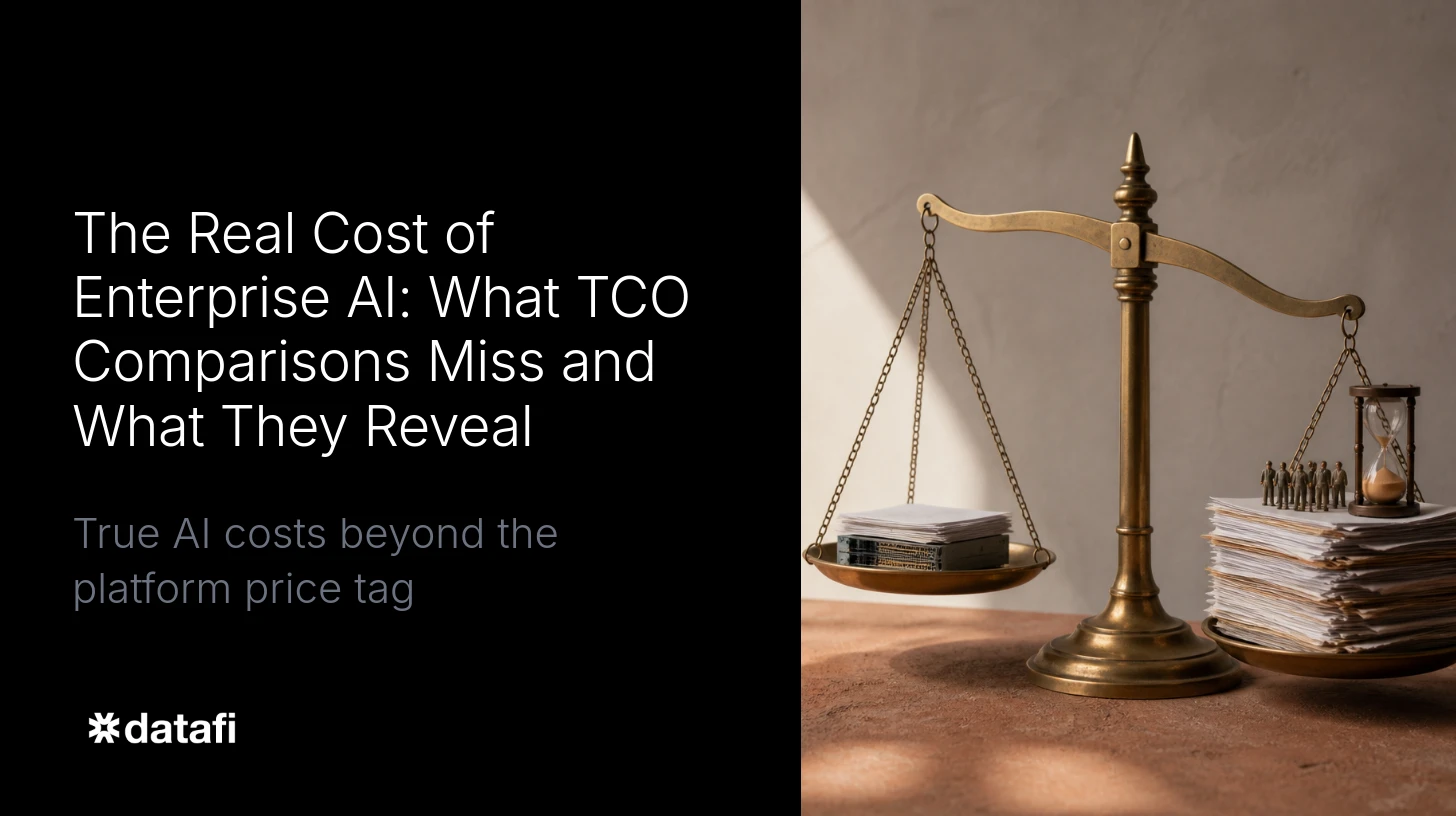
The real cost of enterprise AI is not the platform license. It is the total organizational investment required to move from contract to measurable business outcomes, multiplied by the time that investment takes and divided by the population of employees who ultimately benefit.
The Databricks TCO Architecture
Databricks is a genuinely capable platform with a pricing model that reflects the complexity of what it provides. Understanding the full TCO picture requires looking beyond the per-DBU rates to the complete stack of costs that a real enterprise deployment assembles.
The platform cost itself is consumption-based, combining Databricks Unit charges with underlying cloud infrastructure costs from whichever hyperscaler hosts the deployment. Independent assessments of enterprise deployments consistently note that hidden costs add meaningfully to initial budget estimates, driven by factors including support fees structured as a percentage of total consumption, idle compute that accumulates without active cost governance, and the complexity of reconciling Databricks billing with cloud provider billing across multi-workload environments.
Professional services represent a substantial additional cost category. Implementation, migration, and optimization consulting for Databricks deployments is typically structured at rates commensurate with specialized data engineering expertise. A meaningful enterprise AI deployment on Databricks is not an out-of-the-box configuration exercise. It requires architectural design, pipeline development, Unity Catalog configuration, governance policy design, and ongoing platform engineering work that sustains the environment and extends it as requirements evolve.
The staffing requirement deserves particular attention because it is the cost that most significantly differentiates a Databricks investment from a Datafi investment at the organizational level. A Databricks-based enterprise AI capability requires a sustained team of data engineers, ML engineers, platform administrators, and analytics engineers to build and maintain the pipelines, models, workflows, and governance configurations that produce business value. These are specialized roles in high demand. The market rate for experienced data engineers and ML practitioners reflects that demand. The cost of this team, over the lifetime of the platform investment, typically exceeds the platform license cost itself.
What Time to Value Actually Costs
Beyond the direct cost components, there is a cost that rarely appears in TCO models but that can dwarf every other line item: the cost of delayed value realization.
Enterprise AI platforms do not generate value on the day the contract is signed. They generate value when AI capability is actually operating in production, serving real business users, improving real decisions, and automating real workflows. The time between contract signature and that state is a period of pure investment with no return, and every month of that period carries an opportunity cost that compounds.
For Databricks-based AI deployments, the path from contract to production value runs through data infrastructure design, pipeline development, governance configuration, model development or fine-tuning, interface development, and organizational change management. For organizations without a mature data engineering foundation already in place, this path is measured in months that can stretch to over a year before the business outcomes the original investment case assumed begin to materialize.
This is not a criticism unique to Databricks. It is a structural characteristic of building enterprise AI capability on a data infrastructure platform that was designed for specialists to configure and operate. The capability is real. The time required to realize it is also real.
Datafi’s design philosophy inverts this relationship. The Business AI Operating System is designed to connect to existing enterprise data sources, apply the business context layer, and deliver governed AI capability to business users without the intermediate step of rebuilding the data infrastructure from scratch. The deployment model is measured in weeks, not months, because the platform is designed to work with the data environment that already exists rather than requiring that environment to be reconstructed to a new specification before AI capability can be delivered.
For organizations where a competitive environment makes the timing of AI capability deployment strategically significant, this difference is not a minor convenience. It is a material factor in the expected return on the technology investment.
The Staffing Equation
The staffing cost differential between a Databricks-based AI capability and Datafi deserves its own treatment because it has both direct cost implications and indirect organizational implications that are often underweighted in platform evaluations.
A production-grade enterprise AI deployment built on Databricks requires ongoing investment in roles with specialized skills: data engineers who maintain and extend the pipeline infrastructure, ML engineers who manage model performance and retraining cycles, platform administrators who govern the Unity Catalog configuration and manage cluster economics, and analytics engineers who translate evolving business requirements into data models and workflow configurations.
Recruiting, compensating, and retaining these specialists in the current market represents a significant and ongoing organizational investment. More importantly, the work these specialists do is largely infrastructure work, the maintenance of the technical substrate that AI capability requires, rather than the direct generation of business outcomes. The ratio of infrastructure investment to outcome generation is high, and it does not decrease significantly as the platform matures, because the infrastructure requirements grow with the scale and scope of AI deployment.
Datafi’s no-code architecture changes this ratio fundamentally. The business context layer, workflow configuration, and governance policy management can be handled by business and technical teams without deep data engineering expertise. The platform eliminates the requirement for specialized pipeline development as the bottleneck between AI capability and business value. Technical staff play an important role in configuring integrations, managing governance policies, and extending platform capability, but the team size required is substantially smaller than the equivalent Databricks deployment, and the work is oriented toward value generation rather than infrastructure maintenance.
A Framework for Honest TCO Comparison
Organizations conducting a genuine TCO comparison between a Databricks-based AI strategy and Datafi should account for the following cost dimensions:
Direct platform costs include license or consumption fees, cloud infrastructure costs, and support fees. For Databricks, hidden costs in these categories consistently add significantly beyond initial estimates.
Implementation and professional services include the cost of initial deployment, data architecture design, pipeline development, and governance configuration. For Databricks, this typically involves substantial professional services engagement. For Datafi, the no-code deployment model reduces this cost category materially.
Ongoing staffing is the cost category most frequently underrepresented in initial business cases and most significant in realized TCO. A Databricks-based AI capability requires sustained specialist investment. Datafi’s architecture reduces this requirement substantially.
Time to value is the cost category most difficult to quantify and most consequential strategically. Every month of deployment time is a month of foregone value from the AI capability the investment was intended to deliver.
Organizational reach is the inverse of a cost consideration but belongs in any honest TCO analysis. A platform that delivers AI capability to fifty specialists and a platform that delivers it to two thousand employees do not have comparable denominators in the value-per-dollar calculation, even if their license costs are similar.
When these dimensions are accounted for together, the total organizational cost of a Databricks-based enterprise AI strategy, measured from investment to operational outcome, consistently differs from the Datafi alternative by a margin that the license comparison alone would not predict.
The Investment Thesis
Enterprise AI investments are ultimately evaluated against one criterion: did the business outcomes justify the total organizational cost? That calculation requires honest accounting of what was actually spent, when the value actually arrived, and how many people in the organization actually benefited.
A data infrastructure platform that requires specialist teams, extended implementation timelines, and sustained engineering investment to deliver AI capability to a fraction of the employee population is not necessarily a bad investment. For organizations with mature data engineering practices and the time horizon to build toward long-term capability, it may be the right choice.
For organizations that need AI operating at the speed of their business, serving the full population of employees who make decisions, and delivering measurable outcomes on a timeline that is measured in weeks rather than months, the architecture matters as much as the platform capabilities. The Datafi Business AI Operating System was designed precisely for that requirement, and the TCO reflects it.
Key Takeaway
The real cost of enterprise AI is not the platform license. It is the total organizational investment required to move from contract to measurable business outcomes, multiplied by the time that investment takes and divided by the population of employees who ultimately benefit. When that calculation is done honestly, it reveals a different comparison than the one that appears in most platform evaluations. The question is not what the platform costs. The question is what it costs to deliver value, to whom, and by when.
Datafi is the Business AI Operating System for the modern enterprise. To understand how the transformation ROI model applies to your industry and your operations, visit datafi.co
Next in the Series: Governance by Policy vs. Governance by Architecture: The Coming Compliance Reckoning