


The Demonstration That Impresses. The Deployment That Disappoints.
There is a pattern that enterprise technology leaders have encountered so consistently in AI deployments that it has acquired its own vocabulary. The proof of concept works. The pilot is compelling. Leadership approves the investment. And then, somewhere between the demo environment and production operations, the value quietly disappears.
The AI answers questions accurately in controlled conditions. In the full complexity of real business operations, it produces outputs that are technically correct, contextually inadequate, and organizationally disconnected from the workflows where decisions get made and actions get taken.
This is not a model quality problem. The models are remarkable. It is not primarily a data quality problem, though that matters. It is an architectural problem rooted in a design philosophy that treats enterprise AI as a sophisticated search and retrieval system rather than an operational capability.
The gap between answering questions and solving problems is the gap between those two design philosophies. And closing it requires being honest about which one your current or prospective AI infrastructure was actually built to do.
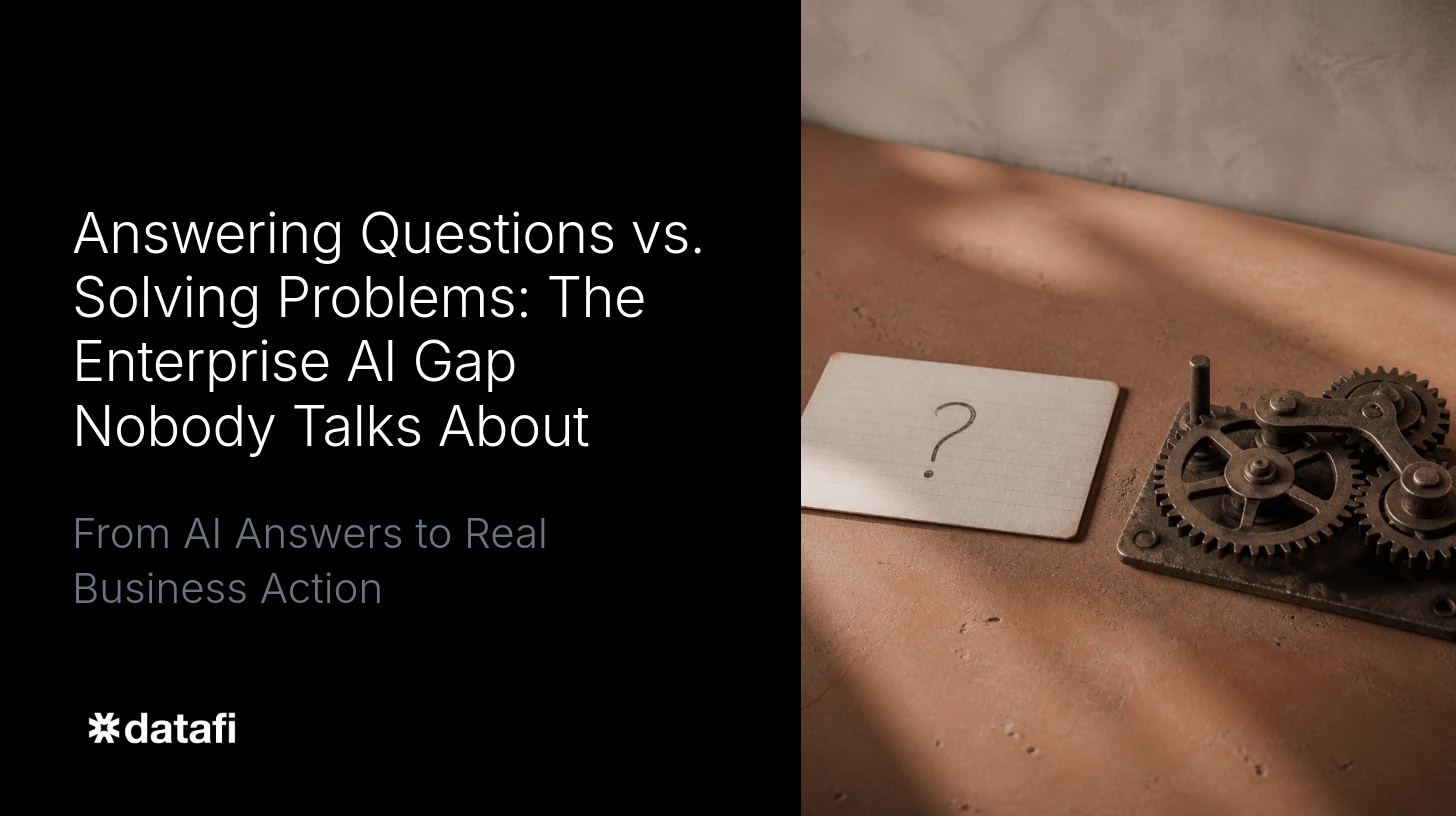
The enterprise AI gap nobody talks about is not about model quality or data quality. It is an architectural gap between platforms designed to produce outputs and platforms designed to drive outcomes. Closing that gap requires AI infrastructure built from first principles around operational action, not information retrieval.
What It Means to Answer a Question
Databricks has invested significantly in natural language capabilities for enterprise data access. Its Genie feature enables users to ask questions in plain language and receive SQL-generated responses from their data assets. Its AI and ML infrastructure supports RAG pipelines, conversational interfaces, and agent frameworks that can retrieve and synthesize information from across a lakehouse.
These are meaningful capabilities. When a data analyst asks “what were our top ten customers by revenue last quarter,” a well-configured system in this category can retrieve that answer quickly and accurately. When an executive wants a summary of performance against plan across business units, the retrieval layer can produce it. When a data scientist needs to understand the distribution of a feature set before training a model, the infrastructure is excellent.
But consider what happens next. The executive receives the performance summary. The answer is accurate. What happens with it? In most organizations, the answer flows into an email thread, a meeting agenda, a slide deck, a conversation. The human who received the answer now needs to do something with it: escalate an issue, redirect a resource, approve a decision, initiate a process. The AI that answered the question is no longer involved. The loop between intelligence and action is broken by design, because the platform was designed to answer, not to act.
This is the fundamental constraint of a question-answering architecture. It optimizes for the production of accurate outputs. It does not optimize for the connection between those outputs and the operational systems where business outcomes are actually determined.
What It Means to Solve a Problem
Solving a problem requires more than a correct answer. It requires the ability to take the knowledge produced by analysis and connect it to action in the systems where that action matters.
Consider a concrete scenario. A logistics operation is running a daily exception management process. Shipments that miss their delivery windows need to be rerouted, customers need to be notified, carrier performance records need to be updated, and the root cause of each exception needs to be logged for trend analysis. In an organization with a question-answering AI, this process looks like: query the TMS for exceptions, receive a list, manually work through each item, update multiple systems, and send notifications. The AI made the query faster. The work is still largely manual.
In an organization running Datafi, an AI agent monitors the exception queue against real-time shipment data and customer service level agreements. When an exception occurs, the agent evaluates the available rerouting options against carrier capacity, cost constraints, and delivery commitment windows. It executes the preferred rerouting in the TMS, triggers the customer notification through the CRM, flags the carrier event in the performance tracking system, and logs the exception with its root cause classification for trend analysis. The human exception manager reviews a summary of what the agent did and confirms or adjusts the handful of cases where the confidence threshold required human input.
The AI did not answer a question about exceptions. It solved the exception management problem. The difference in organizational impact between those two outcomes is not marginal. It is transformational.
The Infrastructure Gap Behind the Outcome Gap
The difference between these two scenarios is not the model. The same frontier language model could power either architecture. The difference is the infrastructure that surrounds the model.
Solving problems requires bidirectional integration with the source systems where business operates. The AI must be able to read live operational data and write back to the systems that record decisions and trigger downstream processes. A read-only lakehouse copy of yesterday’s data is not sufficient infrastructure for an agent that needs to know the current state of a shipment and update a carrier record in real time.
Solving problems requires a business context layer that gives the AI genuine understanding of the operational environment it is acting within. Which exception codes indicate a correctable delay versus an unrecoverable failure. What the customer SLA commitments are for each account tier. Which carrier contracts allow for rerouting without penalty. This knowledge does not live in raw data. It lives in the accumulated operational expertise of the organization, and it must be encoded in the AI infrastructure for the model to reason reliably about it.
Solving problems requires governance that scales with the scope of action. When AI moves from answering questions to executing workflows, the governance requirements change fundamentally. An AI that produces an inaccurate answer creates an inconvenience. An AI agent that takes an incorrect action in an operational system creates a consequence. The governance architecture must be capable of enforcing boundaries on agent behavior at the point of execution, not through after-the-fact auditing.
And solving problems requires an organizational model where every employee, not just technical specialists, can initiate and direct AI capability. The exception manager in the logistics scenario does not write code. They interact with Datafi through a governed natural language interface that understands their role, their permissions, and the operational context of their requests.
The Comparison That Matters
| Capability | Question-Answering Architecture | Datafi Business AI OS |
|---|---|---|
| Data access | Read-only, warehouse layer | Bidirectional, direct to source systems |
| Response to user input | Accurate information retrieval | Governed action on live systems |
| Context | Schema-level metadata | Business context layer encoding domain knowledge |
| Workflow completion | Produces outputs for human action | Executes end-to-end workflows autonomously |
| Governance | Access control on data queries | Policy enforcement on agent actions |
| User base | Data teams and analysts | Every employee, governed by role |
| Value capture point | Analytical insight | Operational outcome |
The left column is not a description of a bad platform. It is a description of a platform built to do something different from what enterprise organizations increasingly need AI to do. The distinction matters because organizations make infrastructure investments that are expensive and slow to reverse. Choosing a platform designed to answer questions and then expecting it to deliver the operational outcomes of a problem-solving architecture is a category error, and one with significant costs.
Where Enterprise AI Goes From Here
The organizations that will extract transformational value from AI over the next five years are not the ones with the most sophisticated data pipelines or the most powerful model infrastructure. They are the ones that close the loop between intelligence and action in the operational systems where business outcomes are determined.
This requires a platform designed from first principles to do exactly that. Not a data platform with AI features. Not a model serving infrastructure with some workflow tooling attached. A Business AI Operating System in which every component, from data integration to context management, from agent orchestration to governance enforcement, is designed around the premise that the purpose of enterprise AI is to solve problems, not to answer questions.
The question every enterprise technology leader should be asking about their current AI platform investment is not “can this system answer questions accurately?” They probably already know the answer to that question. The question is: what happens after the answer?
If the answer is “a human takes that output and goes to work,” the system is answering questions. If the answer is “the system takes action and the human reviews the outcome,” the system is solving problems. The gap between those two answers is the gap between AI as a capability and AI as a competitive advantage.
Key Takeaway
The enterprise AI gap nobody talks about is not the gap between good models and bad models, or between well-governed data and ungoverned data. It is the gap between AI that produces outputs and AI that drives outcomes. Answering questions well is necessary but not sufficient. The organizations that win the AI era will be the ones whose platforms close the loop between intelligence and action, for every employee, across every business function, at the speed of the business itself.
Datafi is the Business AI Operating System for the modern enterprise. To understand how the transformation ROI model applies to your industry and your operations, visit datafi.co
Next in the Series: Built for the Few vs. Built for the Many: Who Actually Owns AI in Your Organization?