


The Question Nobody Is Asking at the Right Level
When enterprise technology leaders evaluate AI platforms today, the conversation tends to center on models, pipelines, and data architecture. These are legitimate technical considerations. They are not, however, the question that determines whether AI delivers business value.
The question that determines business value is this: who is the real end-user of your AI, and what does intelligence look like when it reaches them?
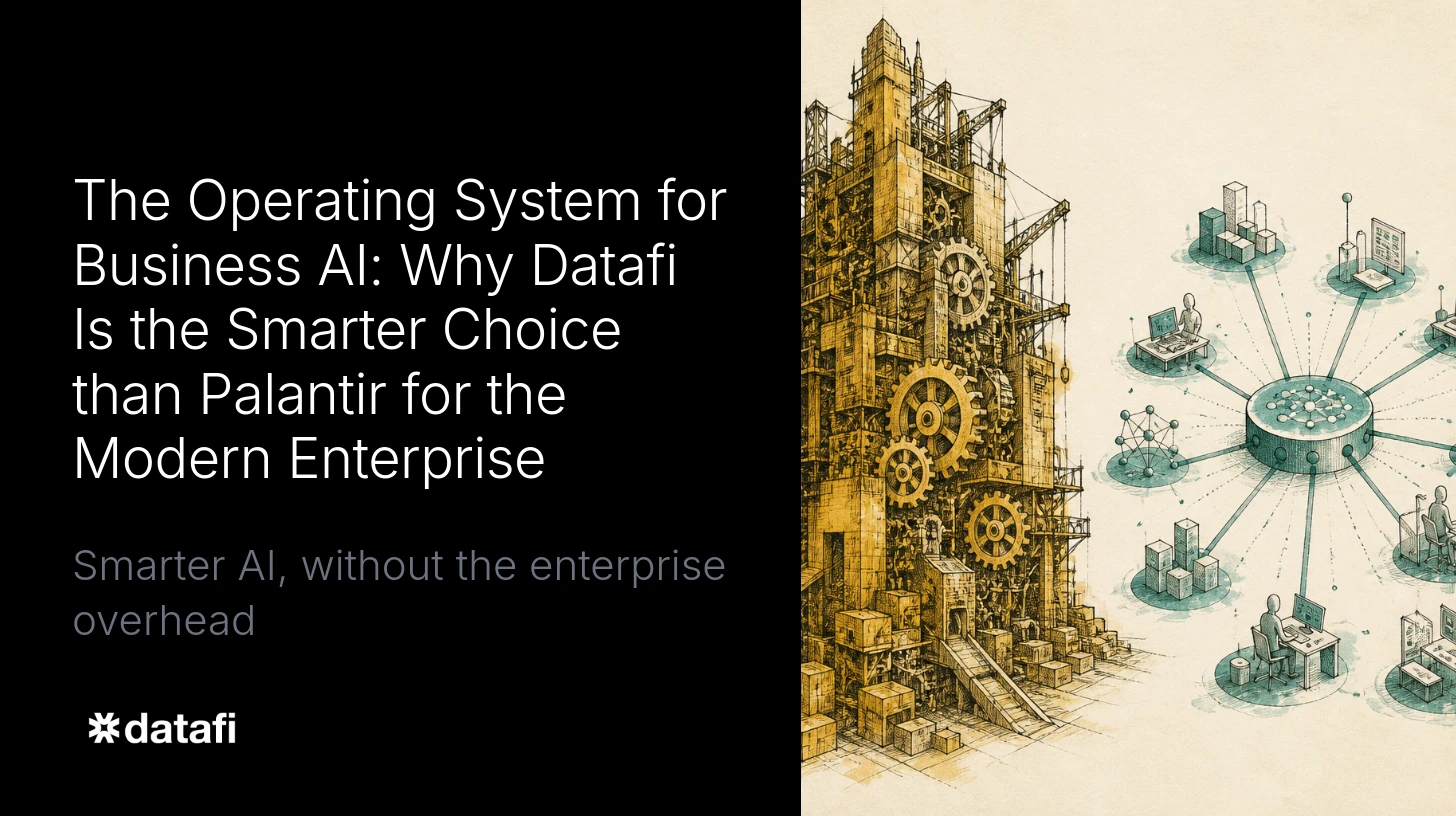
The gap between a data intelligence platform and a business intelligence operating system is not a feature gap. It is a design philosophy gap. Databricks optimizes for the capabilities of data specialists; Datafi optimizes for the decisions of the entire enterprise. In an era where AI must deliver operational outcomes, not just analytical insights, the design philosophy is the product.
For most organizations, the answer is not a data scientist or ML engineer. It is an operations manager trying to reroute a delayed shipment. A claims director deciding which files require escalation. A procurement lead assessing whether to accelerate a purchase order. A plant superintendent determining whether a line shutdown can wait until the next maintenance window.
These people do not live in notebooks. They do not write queries. They make decisions, often fast, often with incomplete information, often under pressure. The platform that wins the enterprise AI era is the one that puts genuine intelligence in their hands, not the one that builds the most sophisticated analytical environment for a team of specialists.
Databricks and Datafi are both serious enterprise platforms. But they were designed to answer very different questions, and understanding that difference is the starting point for any honest technology evaluation.
What Databricks Was Designed to Do
Databricks is a genuinely powerful data and AI platform. Its lakehouse architecture unifies data engineering, analytics, and machine learning workloads under a single infrastructure layer. Unity Catalog provides governance, lineage, and metadata management across structured and unstructured data assets. Its AI capabilities support model training, fine-tuning, retrieval-augmented generation, and agentic application development.
The platform is designed around the assumption that the primary actors are data engineers, data scientists, and ML practitioners. The product surface reflects this: notebooks, pipelines, SQL warehouses, model registries, and feature stores. These are tools for people who think in schemas, transformations, and model evaluation metrics.
This is not a criticism. These tools are excellent for what they do. The organizations that have built mature data practices on Databricks have created real analytical capability. But analytical capability and operational AI capability are not the same thing, and the distinction matters as enterprise AI moves from the analytics layer into the decision layer.
What Datafi Was Designed to Do
Datafi was built from a different premise: that the purpose of enterprise AI is not to make data more accessible to specialists, but to make intelligence operational for everyone in the organization.
This distinction shapes every architectural decision in the platform. The Business AI Operating System is not a data platform with AI features added on top. It is an AI operating system that treats data as one of several inputs into a continuous cycle of context, reasoning, and action.
The real end-users of Datafi are not data teams. They are the frontline employees, operational managers, and executives who make decisions every day. Datafi Chat gives every employee a natural language interface to the full intelligence of the enterprise, governed by the same role-specific permissions that govern every other system access. No technical training required. No pipeline to wait on. No analyst as an intermediary.
Behind that interface, Datafi Studio enables business and technical teams to build AI-powered workflows and agents without writing code. Datafi Runtime executes those agents against live business systems in real time, not against warehouse copies of data that are hours or days old. And Datafi Cyber enforces governance continuously at the architecture level, ensuring that every interaction, regardless of who initiates it or which system it touches, operates within the boundaries the organization has defined.
The Population That Changes Everything
The organizational population that Databricks primarily serves is, in most enterprises, measured in dozens. The population that Datafi serves is measured in thousands.
This is not a market sizing argument. It is an architectural argument. When intelligence is available only to the people who can build models and write pipelines, the rest of the organization continues operating on instinct, experience, and incomplete information. The investment in AI infrastructure produces sophisticated analytical artifacts that circulate among specialists but rarely close the loop between insight and action at the point where decisions are made.
When intelligence is available to everyone, the calculus changes. A customer service representative can resolve a complex account issue by drawing on the full history of that customer’s interactions, contracts, and billing records in real time, without escalation. A warehouse supervisor can identify a fulfillment risk three shifts ahead of when it becomes visible in the reporting layer. A regional sales manager can walk into a renewal conversation with a complete picture of product adoption, support history, and contract terms, synthesized and surfaced without any preparation time.
These are not marginal productivity improvements. They are the difference between an organization that uses AI as an analytical tool and one that operates with AI as a structural capability.
Intelligence at the Point of Decision
The architectural gap between data intelligence and business intelligence is, at its core, a question of proximity. How close does intelligence get to the moment of decision?
Databricks puts powerful tools in the hands of specialists who produce intelligence that flows toward decision-makers through reports, dashboards, and analytical outputs. This model has worked for a generation of data-driven organizations. It will not be sufficient for the generation of AI-native organizations that are forming now.
Datafi puts intelligence directly at the point of decision, in the hands of the person making it, in the context of the live business situation they are navigating. The data team still plays a role: configuring the contextual layer, building governed workflows, and ensuring data quality and integrity. But they are no longer the bottleneck between analytical capability and operational impact.
The question organizations should be asking is not which platform has the most impressive data architecture. It is which platform closes the distance between intelligence and action for the full population of people whose decisions determine business outcomes.
Key Takeaway
The gap between a data intelligence platform and a business intelligence operating system is not a feature gap. It is a design philosophy gap. Databricks optimizes for the capabilities of data specialists. Datafi optimizes for the decisions of the entire enterprise. In an era where AI must deliver operational outcomes, not just analytical insights, the design philosophy is the product.
Datafi is the Business AI Operating System for the modern enterprise. To understand how the transformation ROI model applies to your industry and your operations, visit datafi.co
Next in the Series: The Lakehouse vs. the Business Context Layer: Where Does AI Actually Get Its Smarts?