


The Specialist Trap
Enterprise technology has a long history of producing powerful platforms that deliver their value through specialists. ERP systems required dedicated administrators and finance analysts. Business intelligence platforms required report developers and data analysts. Data warehouses required data engineers and SQL practitioners. In each case, the technology was genuinely powerful, and the value it generated was real. But that value flowed through a bottleneck: the population of trained specialists who could actually use it.
Artificial intelligence has the potential to break that pattern entirely. For the first time in the history of enterprise software, the interface layer, natural language, is one that every employee already knows. There is no training required to speak your own language. The bottleneck is not the interface. The bottleneck is whether the AI infrastructure behind that interface is capable of serving everyone, or whether it was designed to serve specialists and has simply added a conversational wrapper on top.
This distinction is not academic. It determines whether your AI investment produces marginal productivity improvements for a team measured in dozens, or transformational capability for an organization measured in thousands. And the answer to that question is embedded in the architectural decisions that were made when the platform was designed, not in the features that were added later.
Enterprise AI value is not determined by what the platform can do for data specialists. It is determined by what it can do for everyone else. Population is the variable that matters most, and it is the one most often overlooked in platform evaluations.
Who Databricks Was Designed to Serve
Databricks’ customer persona is clearly defined in its product surface. The platform is built for data engineers who design and maintain data pipelines, data scientists who build and evaluate models, ML engineers who deploy and monitor model performance, and analytics engineers who translate business requirements into data assets.
These are highly skilled roles. Databricks serves them with excellent tools: collaborative notebooks, managed Spark clusters, MLflow for experiment tracking, Unity Catalog for governance and lineage, Delta Live Tables for pipeline management, and an increasingly capable set of agent development frameworks. Organizations that have invested in building strong data teams get substantial value from these capabilities.
But consider the organizational math. In a company with two thousand employees, how many are in these specialist roles? In most mid-market and enterprise organizations, the answer is somewhere between fifteen and fifty. The remaining nineteen hundred and fifty employees make decisions every day that are constrained by incomplete information, delayed reporting, manual processes, and the perpetual backlog of the data team that sits between them and the answers they need.
Databricks has recognized this gap and invested in natural language interfaces, most notably Genie, that allow non-technical users to ask questions of enterprise data in plain language. This is a meaningful capability. It is also, fundamentally, a query interface. It gives employees a better way to ask questions of a system that was designed for specialists. It does not give them the ability to initiate governed AI workflows, direct autonomous agents, or take action through the business systems where their decisions actually have consequences.
Who Datafi Was Designed to Serve
Datafi was designed from first principles around the premise that enterprise AI must serve every employee, not as a simplified version of specialist capabilities, but as a full-capability interface calibrated to each person’s role, permissions, and operational context.
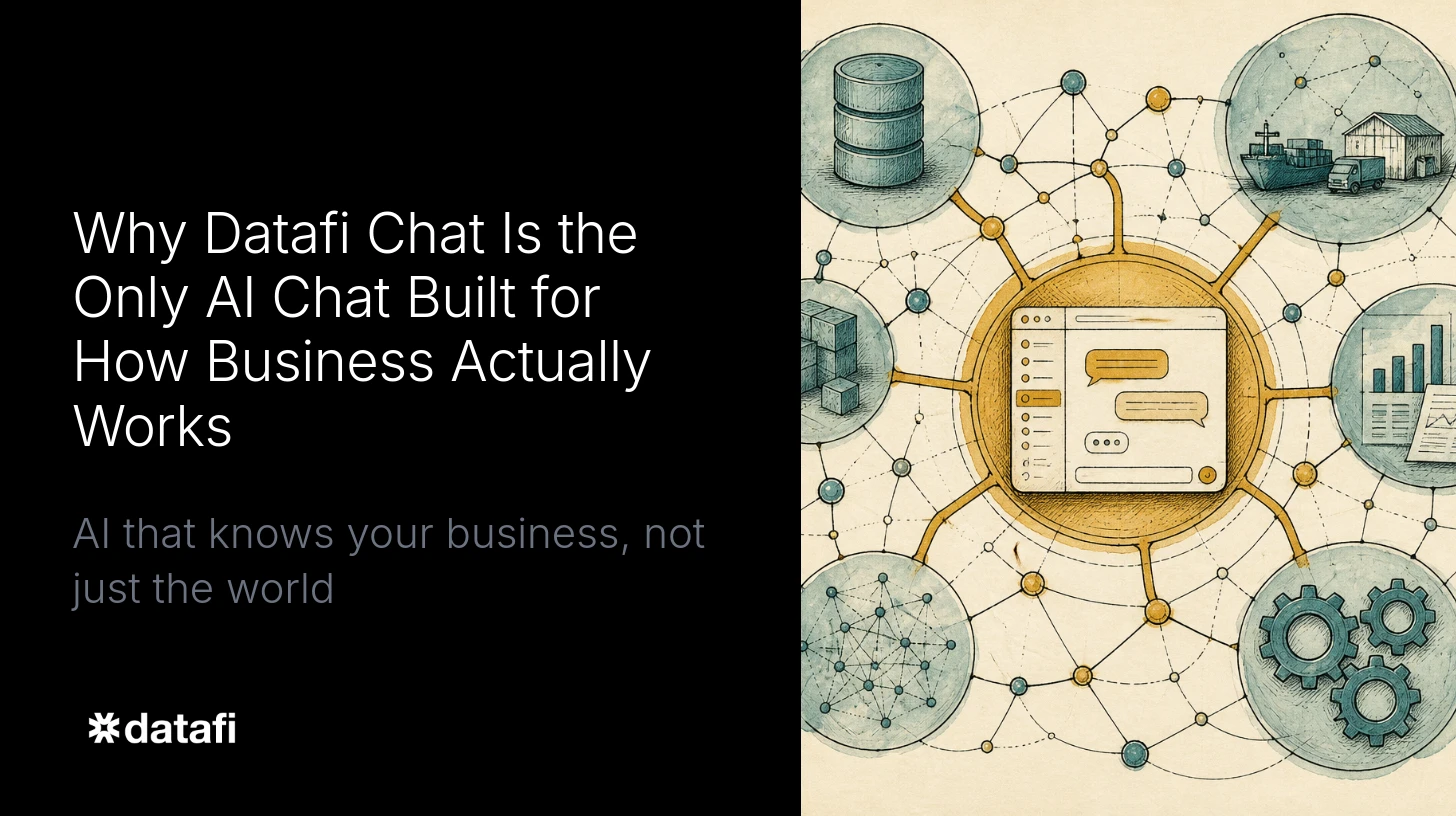
Datafi Chat is not a natural language query layer on top of a data infrastructure. It is a governed AI interface that gives every employee access to the full intelligence of the enterprise, filtered and contextualized by their role, and capable of not just answering questions but initiating workflows and directing agents that take action on their behalf.
The experience is different for every person, by design. A demand planning analyst interacts with Datafi differently from a regional sales manager, who interacts with it differently from a CFO reviewing margin performance by business unit. Each sees the data they are authorized to see, in the context relevant to their work, with the AI capabilities that are appropriate to their role. The governance layer enforces these boundaries continuously, not through manual permission audits, but through the architecture itself.
Datafi Studio extends this capability to builders who are not traditional developers. Business analysts, operations managers, and functional leaders can build AI-powered workflows using visual tools and natural language, without writing code. The workflows they build run on the same governed infrastructure that powers Chat, ensuring that the AI capability they deploy for their teams operates within the same policy boundaries as every other part of the platform.
The practical implication is that Datafi’s active user base in a given organization is not measured by how many people are in the data team. It is measured by how many people show up for work.
The Organizational Topology of AI Value
There is a useful mental model for thinking about where AI value is generated in an enterprise: the topology of decision-making.
At the top of the organization, a relatively small number of executives make strategic decisions that have large individual consequences. These decisions are already supported by substantial analytical capability, management reporting, and dedicated analyst resources. AI helps here, but the incremental value per decision is bounded by the fact that these decisions were already relatively well-supported.
At the middle of the organization, thousands of operational managers and functional leaders make tactical decisions on shorter cycles: resource allocation, customer escalations, inventory adjustments, pricing exceptions, hiring decisions. These decisions are typically less well-supported by analytics, more dependent on individual experience and informal information-sharing, and more numerous than the strategic decisions above them. AI capability at this level has compounding impact because each improvement in decision quality multiplies across a high volume of decisions.
At the base of the organization, tens of thousands of frontline employees make daily operational judgments: customer interactions, fulfillment decisions, quality assessments, service resolutions. Individual decisions here have smaller consequences, but the aggregate effect of improving decision quality at this level can be larger than any strategic initiative because of sheer volume and velocity.
A platform designed to serve specialists reaches the top of this topology well and the middle and base barely at all. A platform designed to serve every employee reaches all three levels. The organizations that will achieve transformational AI outcomes are the ones that understand which topology their current infrastructure is actually built to serve.
The Governance Requirement That Changes With Scale
There is a governance implication to serving the full employee population that is worth addressing directly, because it is often cited as the reason for limiting AI access to specialists: the concern that broader access means broader risk.
This concern is legitimate. AI capability in the hands of employees who lack the context to use it appropriately, or who can access information they should not have, or who can trigger workflows they do not understand, creates real organizational risk. The conventional response is to restrict access to specialists who can be trained and trusted.
Datafi’s response is different: build governance into the architecture so that broader access does not mean broader risk. Datafi Cyber enforces role-specific data permissions at the point of every query, every workflow, and every agent action. An employee in customer service cannot access financial records they are not authorized to see, regardless of how they phrase the request. An operations manager cannot trigger a procurement workflow that requires CFO approval, even if the AI agent would otherwise have the capability to execute it.
This is the difference between governance as a gate, which restricts who can access AI capability, and governance as a fabric, which ensures that AI capability operates safely regardless of who is using it. The gate model preserves security at the cost of value. The fabric model preserves both.
The Question of Organizational Ambition
Every enterprise that invests in AI infrastructure is, implicitly, making a decision about organizational ambition: how much of the organization do we intend to transform with this capability?
A platform designed for specialists answers that question with a number in the tens. A platform designed for every employee answers it with the full headcount of the organization.
That difference in ambition is not just a question of near-term value capture. It is a question of competitive positioning. In industries where the speed of operational decisions determines market outcomes, the organizations that put AI capability in the hands of every decision-maker have a structural advantage over the ones that concentrate it in a data team. That advantage compounds over time as the AI learns from the decisions being made, the workflows being executed, and the operational context being generated by the full employee population, not just the specialists.
The question to ask about your current AI platform investment is not how capable it is for the people who can use it. The question is how large that population actually is.
Key Takeaway
Enterprise AI value is not determined by what the platform can do for data specialists. It is determined by what it can do for everyone else. The organizations that build AI infrastructure designed to serve the full population of employees who make decisions will generate fundamentally different outcomes than the ones that build infrastructure designed to serve specialists and add a conversational interface later. Population is the variable that matters most, and it is the one most often overlooked in platform evaluations.
Datafi is the Business AI Operating System for the modern enterprise. To understand how the transformation ROI model applies to your industry and your operations, visit datafi.co
Next in the Series: The Real Cost of Enterprise AI: What TCO Comparisons Miss and What They Reveal