


A Deceptively Simple Question
When an AI agent in your enterprise receives a question, what does it actually know?
This is not a question about model capability. Today’s frontier language models are extraordinary general reasoners. They can synthesize, summarize, analyze, and generate with a sophistication that was unimaginable five years ago. But general reasoning applied without specific context is, in a business environment, a liability as much as an asset.
A model that does not know what “coverage ratio” means in your industry will guess. A model that does not understand the relationship between your ERP system’s product codes and your CRM’s account hierarchy will hallucinate a connection or miss one entirely. A model that does not know which data sources are authoritative for a given question and which are stale, duplicated, or qualified by a known exception will produce answers that are fluent and wrong.
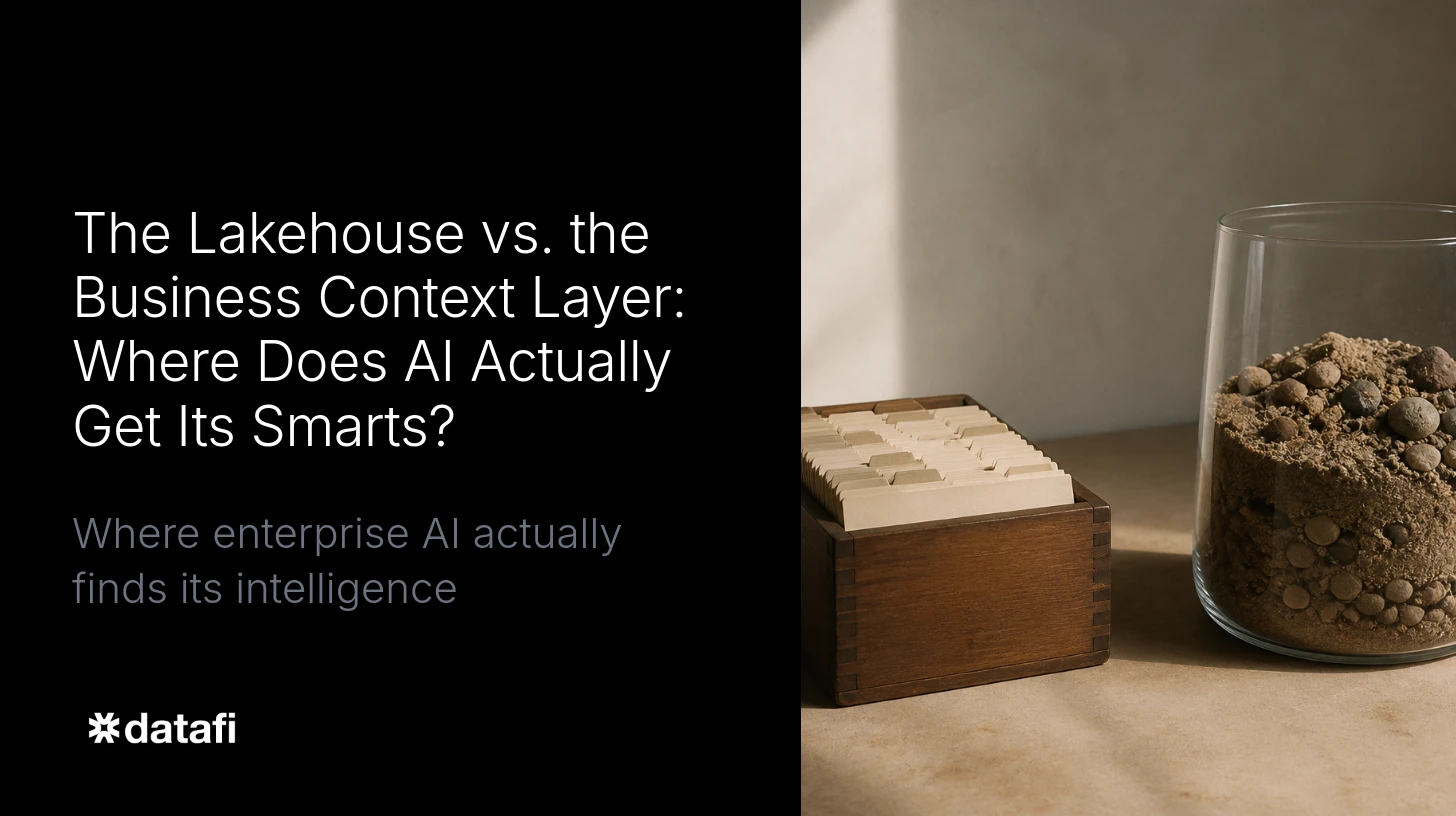
The question of where AI gets its smarts is, therefore, the central architectural question in enterprise AI. And the difference between a lakehouse architecture and a business context layer is the difference between giving a model access to your data and giving a model genuine understanding of your business.
A lakehouse gives AI access to your data. A business context layer gives AI understanding of your business. In enterprise AI, the difference between access and understanding is the difference between a system that impresses in a demo and one that delivers reliable outcomes in production.
What the Lakehouse Provides
Databricks has built one of the most capable data infrastructure platforms in the industry. Its lakehouse architecture consolidates data lakes and data warehouses into a single storage and compute layer, enabling organizations to run analytics, machine learning, and AI workloads against unified data assets without replicating data across multiple systems.
The Unity Catalog governance layer provides metadata management, access control, data lineage, and discovery capabilities that make it possible to understand what data exists, where it came from, and who can access it. These are meaningful capabilities. For data engineering and ML teams, they represent a significant improvement over the fragmented, siloed architectures that preceded the lakehouse model.
But the lakehouse answers a specific question: what data do you have, where is it, and how do you process it at scale? It does not answer the question that enterprise AI actually needs answered before it can operate reliably: what does this data mean in the context of how this business operates?
A metadata catalog is not business context. Data lineage is not business understanding. The ability to run distributed compute across petabytes of lake data is not the same as knowing that your “active customer” definition excludes accounts in a 90-day grace period, or that the margin figure in System A uses a different cost allocation method than the margin figure in System B, or that the demand signal from your largest distribution partner is typically 15% above realized orders due to a hedging behavior your planning team accounts for manually.
These are the things that make enterprise AI trustworthy. None of them live in a lakehouse. They live in the business context layer.
What the Business Context Layer Provides
Datafi’s business context layer is a persistent, structured representation of what your organization knows about itself. It is the mechanism by which general AI capability becomes specific business expertise.
The context layer encodes the semantic meaning of your data: what terms mean, how metrics are defined, which data sources are authoritative for which questions, what relationships exist between entities, and what rules govern how information should be interpreted, qualified, and acted upon. It is continuously enriched through agent interactions, user feedback, and workflow outcomes, becoming more accurate and more specific over time.
When a Datafi agent receives a question about inventory coverage for a regional distribution center, it is not guessing at what “coverage” means or which systems contain the relevant data. The context layer has already encoded that definition, mapped it to the appropriate data sources, embedded the business rules that govern how the metric is calculated, and identified the exceptions and qualifications that determine when the number is reliable and when it requires human review. The model reasons over meaning, not just tokens.
This distinction has compounding consequences across every use case. It is the difference between an AI that gives an analyst a starting point for their own investigation and an AI that gives an operations manager a trustworthy answer they can act on immediately.
The Hallucination Problem Is an Architecture Problem
Enterprise leaders consistently cite hallucination as their primary concern with deploying AI in operational contexts. This is a reasonable concern. But hallucination is rarely a model problem in isolation. It is almost always a context problem.
Models hallucinate when they are asked questions they do not have sufficient specific context to answer accurately. In a consumer context, hallucination is an inconvenience. In an enterprise context, where AI outputs influence procurement decisions, customer commitments, operational schedules, and financial forecasts, hallucination is a risk that cannot be tolerated.
The conventional response to this problem is retrieval-augmented generation: giving the model access to a corpus of documents or database records and instructing it to answer only from those sources. This helps. It does not solve the problem. RAG gives the model access to information without giving it understanding. A model that can retrieve the right document still needs to know what the document means in context, which parts of it are authoritative, and how it relates to the other information the model is drawing on.
The business context layer is the infrastructure that makes RAG and agentic AI actually reliable. It does not replace retrieval. It gives retrieval meaning, so that what the model finds is understood in the same way the organization understands it, with the same qualifications, the same exceptions, and the same institutional knowledge that an experienced employee would apply.
Context as Competitive Moat
There is a strategic dimension to this distinction that deserves attention. The data assets in a lakehouse are often replicable. If a competitor invests in the same cloud infrastructure, the same data sources, and the same data engineering capability, they can build a similar lakehouse. The structural advantage of well-engineered data infrastructure diminishes as the tools become commoditized.
Business context does not commoditize the same way. The organizational knowledge encoded in a business context layer reflects years of operational experience, domain expertise, institutional decisions about how to define and measure performance, and the hard-won understanding of how data from different systems relates to each other. This is not knowledge that a competitor can replicate by deploying a new infrastructure platform. It is knowledge that accumulates over time and compounds in value as AI agents use it, refine it, and extend it.
Organizations that invest in building a business context layer are building a structural AI advantage that grows with use. Organizations that invest only in data infrastructure are building a foundation that is necessary but not sufficient.
The Architecture Decision That Determines AI Outcomes
The comparison between a lakehouse and a business context layer is not a comparison of competing storage architectures. It is a comparison of competing theories about what enterprise AI fundamentally requires to work.
Databricks’ theory is that better data infrastructure produces better AI outcomes. This is partially true. Data quality, data freshness, and data accessibility all affect AI reliability. But they are inputs into the AI system, not the source of its intelligence.
Datafi’s theory is that grounded business context produces better AI outcomes. That a model operating within a rich, continuously maintained representation of the business will produce more reliable, more actionable, and more trustworthy outputs than a model operating against raw data in a lakehouse, regardless of how well-engineered that lakehouse is.
The evidence for this position is visible in every enterprise AI deployment that has moved from proof of concept to production. The organizations that get there are not the ones with the largest data lakes. They are the ones whose AI systems understand the business well enough to reason about it reliably.
Key Takeaway
A lakehouse gives AI access to your data. A business context layer gives AI understanding of your business. In enterprise AI, the difference between access and understanding is the difference between a system that impresses in a demo and one that delivers reliable outcomes in production. Context is not a feature. It is the foundation.
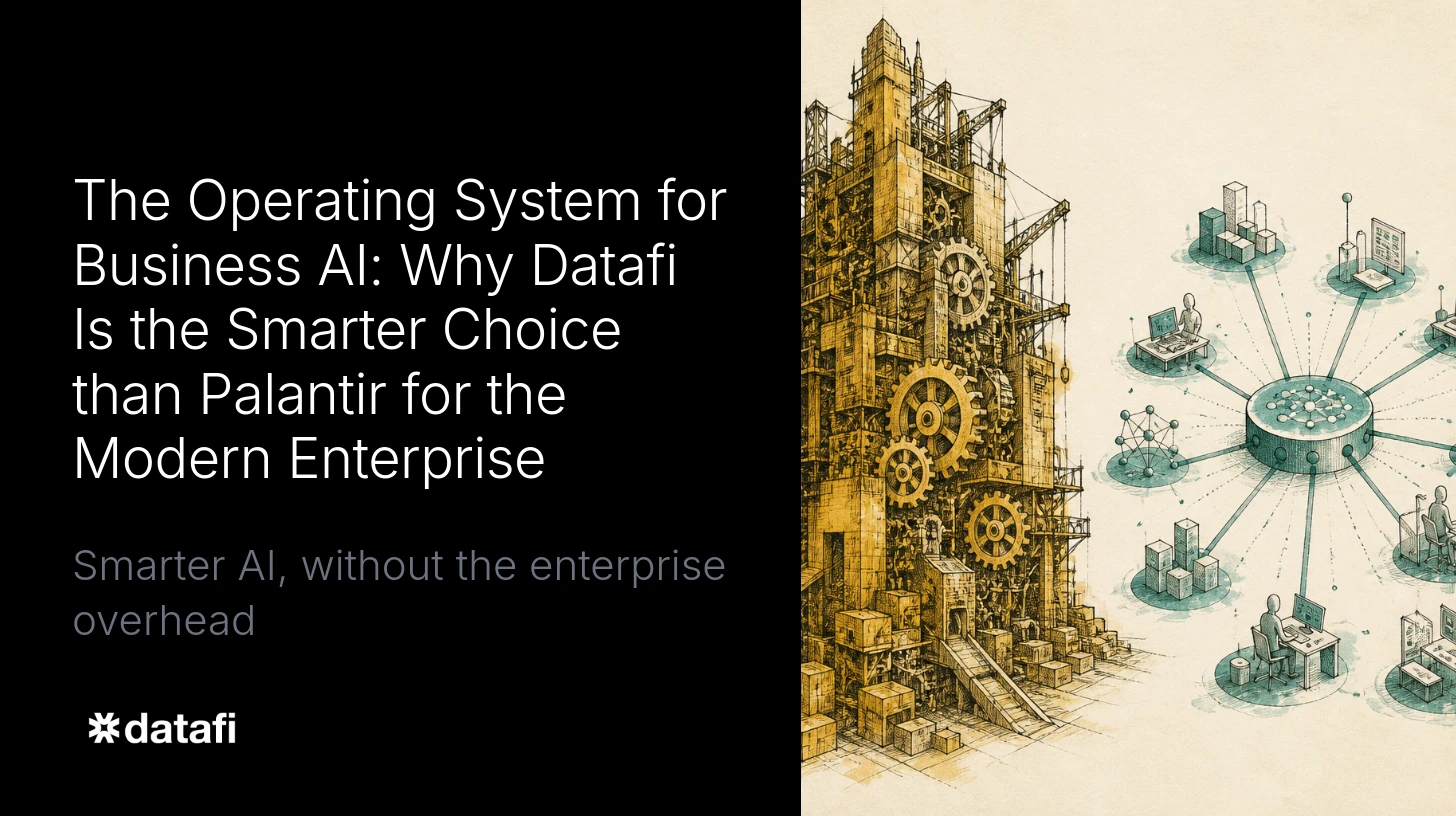
Datafi is the Business AI Operating System for the modern enterprise. To understand how the transformation ROI model applies to your industry and your operations, visit datafi.co
Next in the Series: Answering Questions vs. Solving Problems: The Enterprise AI Gap Nobody Talks About