


There is a moment every enterprise AI project eventually reaches. The proof of concept impressed the right people, budget was approved, and the technology was deployed. Then the questions started arriving that the system could not answer. Not because the model was inadequate, but because the AI had never been given what it truly needed: the full operational reality of the business.
This is the divide that separates AI systems that answer questions from AI that solves problems. It is also the divide that separates Datafi from point solutions like Contextual.ai.
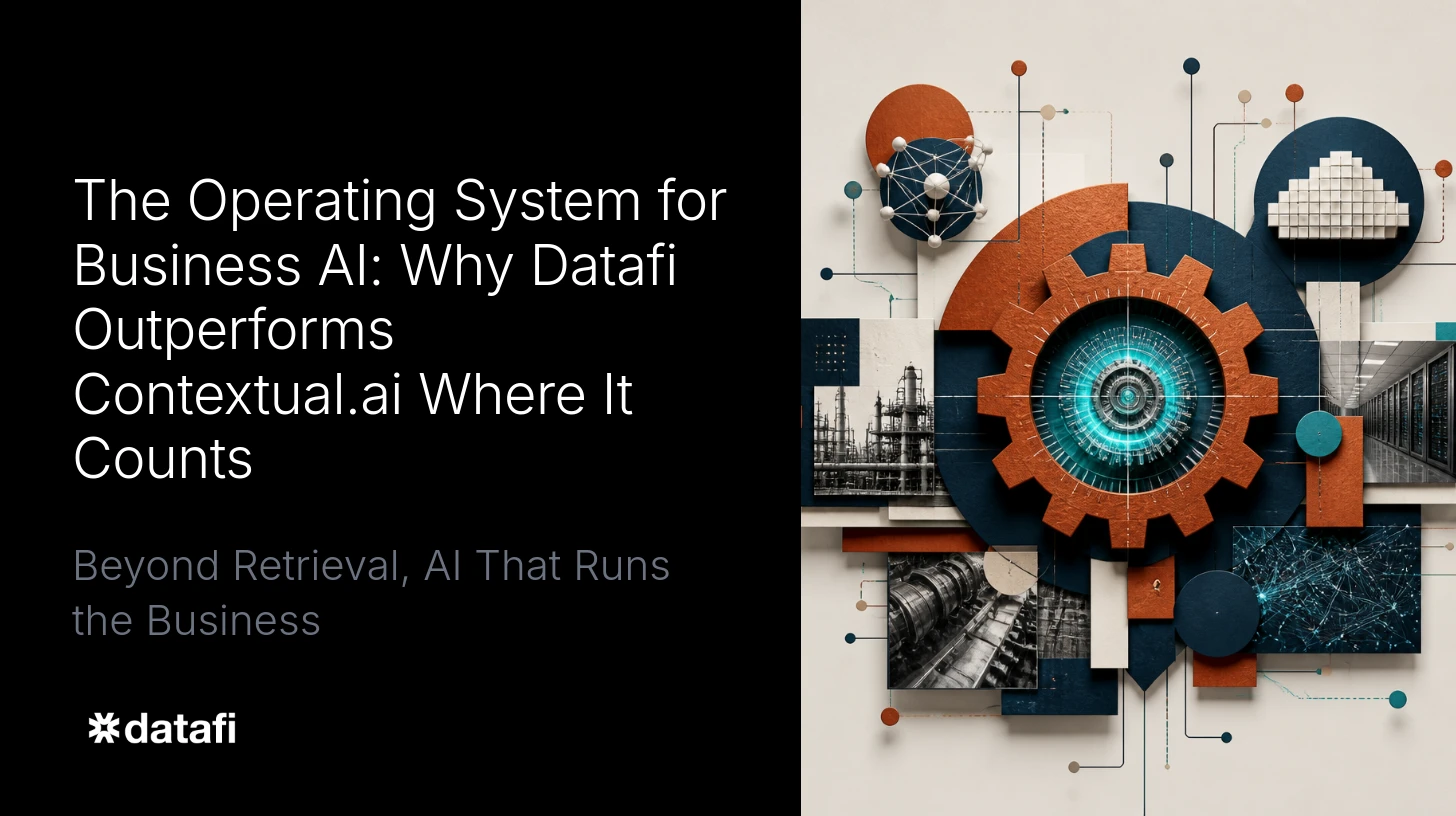
Retrieval platforms like Contextual.ai answer questions from bounded document stores. Datafi functions as a full business operating system, connecting every data source, enforcing dynamic governance, and enabling AI agents to act, not just respond.
Two Philosophies, Two Futures
Contextual.ai has built a capable RAG platform. For organizations that need to make a defined corpus of documents searchable and conversational, it delivers measurable value. Engineers can ingest content, tune retrieval, and surface answers from that bounded dataset with notable accuracy. As a specialist tool for knowledge retrieval, it earns its place.
But a retrieval system is not a business operating system. And as enterprise ambitions for AI expand from question-answering into workflow automation, predictive analysis, cost reduction, and autonomous decision support, the limitations of the retrieval-first architecture become consequential.
Datafi was built from a different premise entirely. The operating thesis is that LLMs require the full context of a business to deliver transformative outcomes. That means access to the complete data ecosystem, not a curated document store. It means governed, policy-aware AI that earns the trust of compliance and legal teams. It means agentic capacity, so AI can act on what it learns rather than merely report it. And it means a Chat UI designed for non-technical employees, so the benefits of enterprise AI are not confined to the teams that built it.
This is what an operating system for business AI looks like.
The Context Problem Is Larger Than Retrieval
When practitioners talk about RAG, they are usually describing a mechanism for injecting relevant text into an LLM prompt. The assumption is that the primary challenge of enterprise AI is making the right documents findable. Contextual.ai has optimized this mechanism impressively.
The problem is that the assumption is wrong, or at least radically incomplete.
Consider a transportation operator trying to use AI to support predictive maintenance decisions. The relevant information is not sitting in a document. It is distributed across sensor telemetry, maintenance logs, parts inventory systems, work order histories, crew schedules, and contractual service level agreements. Retrieval from a document store can surface a maintenance manual. It cannot synthesize the operational state of a fleet in real time, correlate that state with historical failure patterns, cross-reference parts availability, and recommend a prioritized maintenance schedule that accounts for operational constraints.
That outcome requires what Datafi delivers: a vertically integrated data and AI stack with live connections to the complete data ecosystem.
The distinction matters enormously for the use cases enterprises now care most about. Operations optimization, passenger experience personalization, strategic planning, asset lifecycle management, and workforce efficiency programs all depend on AI that understands the business as a living system, not as a collection of indexed documents. Contextual.ai gives organizations a very good library. Datafi gives them a thinking partner that knows how the business actually runs.

Vertical Integration Changes What Is Possible
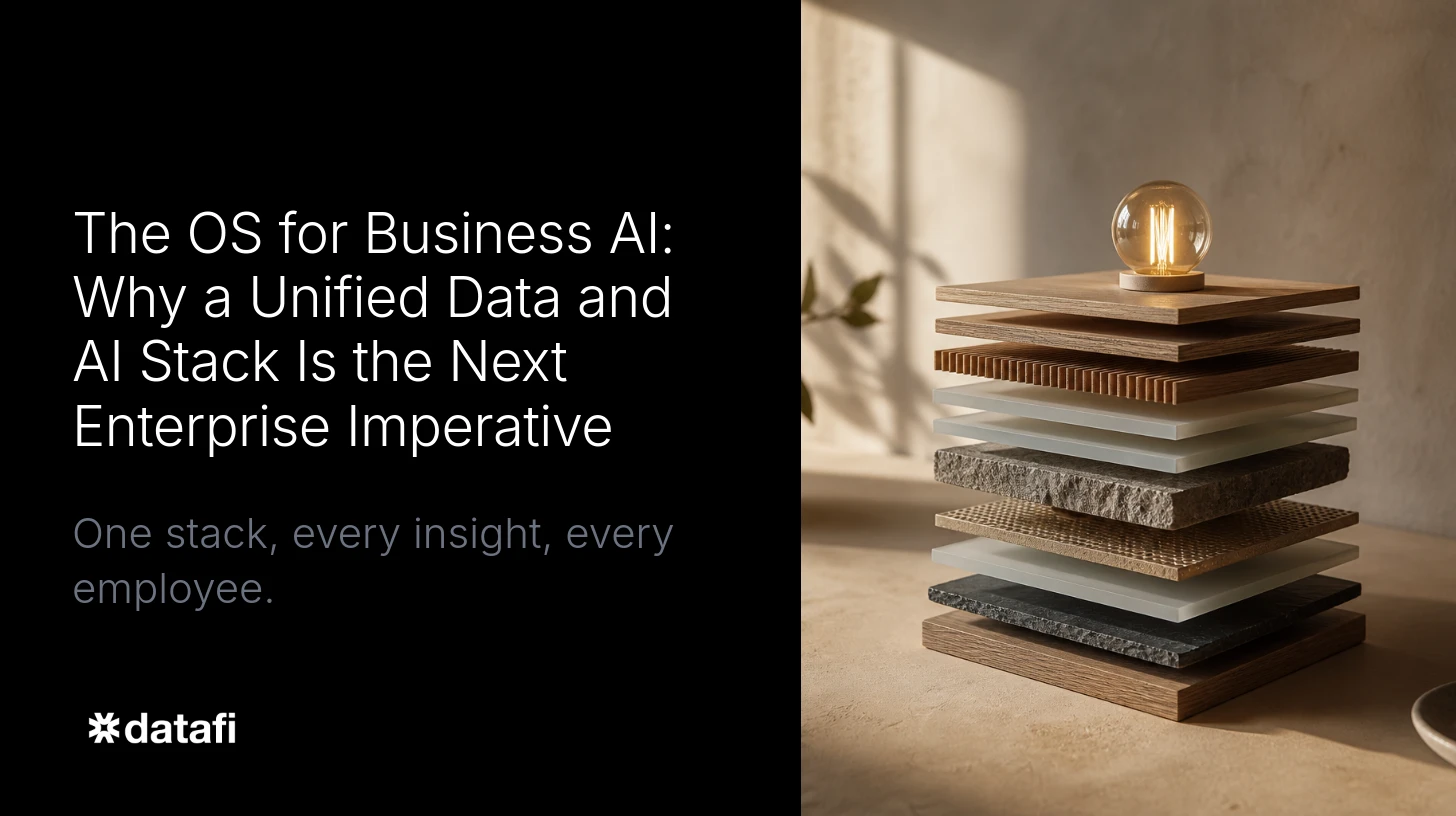
The term “vertically integrated” gets applied loosely in enterprise software, but in the context of AI infrastructure it has a precise meaning. It means that the components required to deliver an outcome, data connectivity, access governance, AI reasoning, and user experience, are designed together rather than assembled from separate products.
Contextual.ai sits in one layer of a larger stack. Organizations that adopt it still need to build or buy data pipeline infrastructure, establish governance controls, integrate outputs into workflows, and figure out how to make those outputs accessible to non-technical staff. Each of those additional layers is a project, a contract, a point of failure, and a source of latency between AI insight and business action.
Datafi eliminates that fragmentation. The data connectors, the policy engine, the AI reasoning layer, and the Chat UI are a single system. That integration is not merely an operational convenience. It is what enables AI to operate with genuine business context.
When an employee in strategic planning asks Datafi a question about competitive positioning relative to a new market entrant, the system does not search a document library. It draws on financial performance data, customer concentration patterns, product utilization metrics, and external signals, all within the governance boundaries the organization has defined. The answer is not retrieved. It is reasoned.
This is a fundamentally different capability, and it is only possible when the stack is integrated from data source to conversational interface.
Governance Is Not an Add-On
One of the underappreciated differences between Datafi and retrieval-focused platforms is how each treats data governance.
For Contextual.ai, governance is largely a pre-ingestion problem. Organizations determine what goes into the system, and the system retrieves from that approved corpus. This model works when the boundary of permissible information is static and well-understood. In practice, enterprise data environments are neither.
Datafi treats governance as a first-class capability woven through the entire stack. Policies are not applied at ingestion and then forgotten. They are enforced dynamically, at query time, based on the identity of the user, the sensitivity of the data, the jurisdiction of the question, and the context of the workflow. An AI agent operating in Datafi’s environment cannot access data it has not been authorized to access, regardless of how the question is framed or which workflow triggered the request.
This matters for AI adoption in ways that go beyond compliance. Organizations do not expand AI access to sensitive operational data, financial records, customer information, or strategic planning inputs unless they have genuine confidence in the control layer. Datafi’s governance architecture is what allows organizations to extend AI into critical thinking roles without exposing themselves to the risks that make legal and compliance teams say no.
For enterprises in regulated industries, for public sector organizations, for any company where data sovereignty is a real concern, this is not a differentiator. It is a prerequisite.
Agentic AI: From Answering to Acting
The most significant strategic difference between Datafi and Contextual.ai is what each platform enables AI to do with what it knows.
Contextual.ai produces answers. The workflow is: user asks question, system retrieves relevant content, LLM synthesizes a response, user reads response. The human remains in the loop for every step that follows.
Datafi is designed for agents and workflows. AI in the Datafi environment does not just synthesize answers. It can initiate actions, monitor conditions, trigger downstream processes, and operate autonomously within defined boundaries. This is the architecture that allows AI to function in genuinely consequential roles.
A Datafi agent does not wait to be asked. It monitors, correlates, evaluates, and acts within governed boundaries, turning AI from a reference tool into an operational force multiplier.
Predictive maintenance is a useful illustration. A retrieval system can answer the question “what does the maintenance manual say about this component?” A Datafi agent can monitor sensor data continuously, detect anomalous patterns before they manifest as failures, cross-reference the maintenance history of similar assets, check parts availability, evaluate the operational schedule for optimal intervention windows, and generate a prioritized work order, without waiting to be asked.
The same architecture applies across the operational priorities that enterprises are investing in. In passenger experience, agents can personalize service delivery in real time based on historical preferences, current conditions, and operational constraints. In operations optimization, agents can identify inefficiency patterns, model interventions, and execute adjustments within authorized parameters. In strategic planning, agents can synthesize internal performance data with external signals to surface emerging risks and opportunities faster than any manual analytical process.
These outcomes are not achievable with a retrieval system. They require AI that has been given the data access, the contextual grounding, and the operational authority to act.

Unified Data Experience for Every Employee
There is a persistent assumption in enterprise AI deployment that AI tools are for technical users. Data scientists query the models. Analysts interpret the outputs. Everyone else receives a summary.
This assumption is one of the most expensive constraints in modern enterprise operations. The employees closest to operational problems, the field technician noticing an unusual equipment behavior, the customer service agent managing an escalating complaint, the regional manager evaluating a quarterly shortfall, are rarely the employees with access to sophisticated AI tools.
Datafi’s Chat UI was designed to change this. The interface is built for non-technical users, which means it is built for the majority of an organization’s workforce. It does not require SQL knowledge, data literacy, or familiarity with AI prompting conventions. It requires the ability to describe a problem in the user’s own business language.
This design choice has compounding effects on organizational value. When AI is accessible to every employee, the surface area for AI-enabled insight and efficiency expands dramatically. Problems get identified earlier. Decisions get made with better information. Workflows get automated at the points where they actually reduce friction. Organizations do not have to route every analytical question through a data team that is already at capacity.
Contextual.ai can serve technical users well. Datafi serves everyone. The organizational implications of that difference are substantial.
Size Is Not a Barrier
One of the more consequential commitments in Datafi’s design philosophy is that the benefits of unified data experience and AI-enabled efficiency should not be reserved for organizations with the resources of a global enterprise.
The infrastructure required to build a Contextual.ai deployment, including the data pipelines, governance layer, workflow integrations, and user experience development, can be formidable. Organizations without large engineering teams or significant technology budgets may find the total cost of capability prohibitive.
Datafi’s vertically integrated architecture changes this calculus. Because the stack is unified, the implementation burden is lower. Because governance is built in rather than bolted on, compliance readiness does not require separate engineering investment. Because the Chat UI is designed for non-technical users, adoption does not require training programs or change management at scale.
A regional transit authority can deploy the same architecture as a global logistics company. A mid-sized manufacturer can access the same agentic capacity as a Fortune 500 industrial conglomerate. The technology scales to the problem, not to the size of the organization’s IT budget.
This is not a feature. It is a strategic position. The organizations that are most constrained by the cost of inefficiency are often those that have historically had the least access to the tools to address it.
What the Next Horizon Requires
The enterprise AI landscape is maturing rapidly. The organizations that invested early in point solutions for document retrieval are discovering that those solutions, however capable, do not scale to the ambitions that now define AI strategy. They answer questions. They do not run operations.
The next horizon requires AI that knows the full context of the business. It requires agents that can operate autonomously within governed boundaries. It requires a user experience that extends AI capability to every employee, not just those comfortable with technical interfaces. It requires a stack where data connectivity, policy control, reasoning, and action are integrated rather than assembled.
Contextual.ai built a strong retrieval platform. It serves a real need within a defined scope.
Datafi built the operating system for business AI. It serves the full scope of what AI must become to deliver transformative outcomes: not systems that answer questions when asked, but systems that understand the business deeply enough to solve its hardest problems before they are asked at all.
For organizations ready to move from AI experimentation to AI operations, the architecture matters. The choice is not between two comparable platforms. It is between two fundamentally different theories of what enterprise AI is for.
Datafi is an applied AI software company building the vertically integrated data and AI operating system for enterprise. To learn how Datafi enables governed, agentic AI across your complete data ecosystem, contact us.