


There is a quiet frustration building inside enterprises that adopted AI early. The tools arrived with enormous promise. Copilots, intelligent search, summarization assistants, and chat interfaces were deployed across departments. Budgets were committed. Change management programs were launched. And yet, when boards ask what has fundamentally changed in how the business operates, the honest answer is: not much.
The reason is architectural. Most enterprise AI deployments are bolted onto existing data infrastructure rather than built through it. The AI sits on the surface, answering questions from a narrow slice of business context, disconnected from the systems of record that actually run the organization. It can describe a problem. It cannot solve one.
At Datafi, we believe the gap between AI that answers questions and AI that solves problems is not a model problem. It is a stack problem. And closing that gap requires a fundamentally different approach to how AI, data, and enterprise workflows are assembled together.
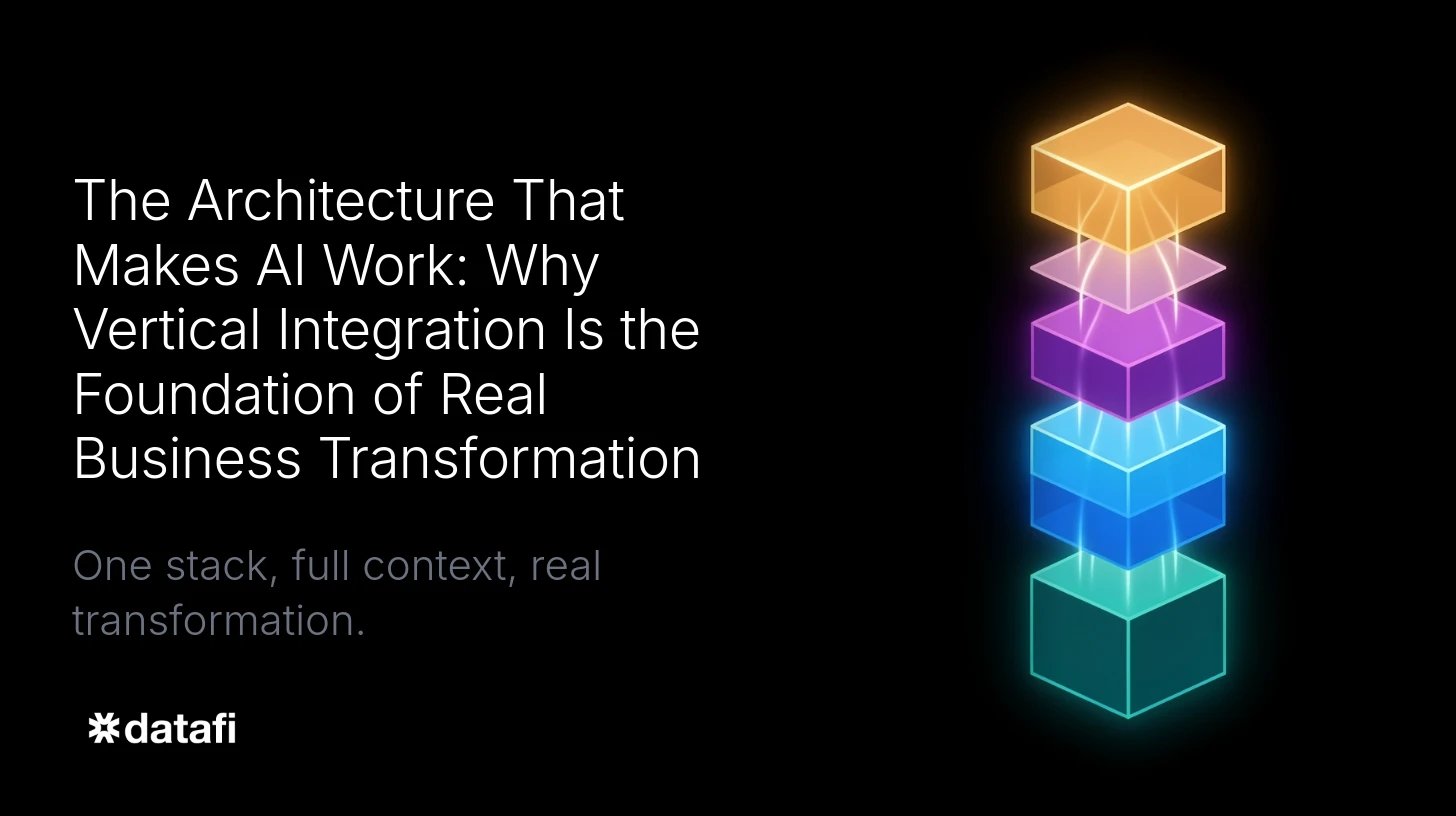
The gap between AI that answers questions and AI that transforms operations is not a model problem, it is a stack problem. Vertical integration, where data, governance, agents, and user experience are designed as a unified system, is the architectural foundation that makes genuine business transformation possible.
The Limits of the Layered Approach
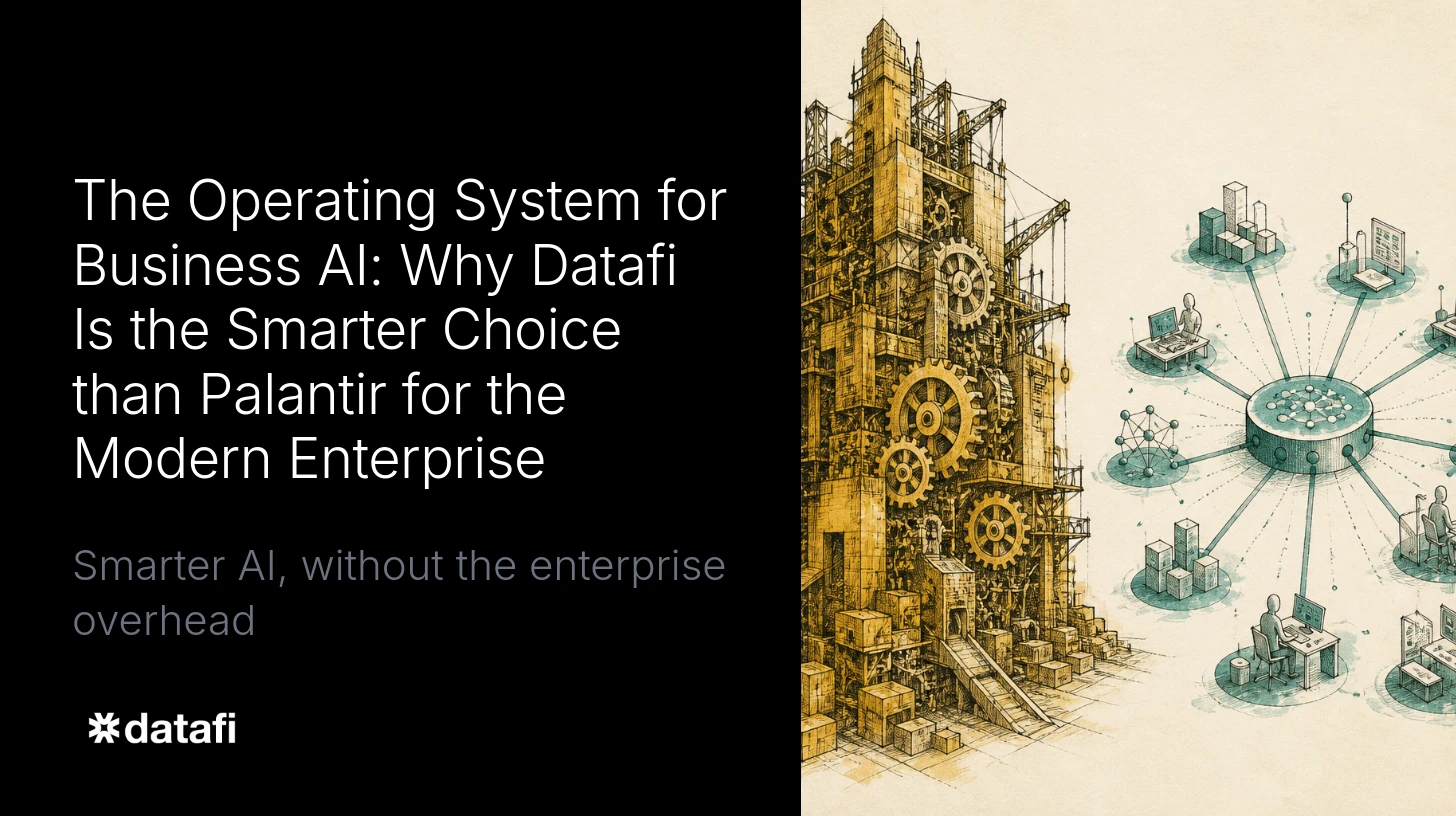
The dominant model for enterprise AI over the past few years has been additive. Organizations already had a data stack, a set of operational systems, and a collection of analytics tools. AI was added on top, connected through APIs and integrations, and handed a window into whatever data could be reasonably surfaced.
This approach produces capable tools for point tasks. A well-prompted model with access to a curated knowledge base can answer policy questions, draft communications, and summarize meeting notes. These are real productivity gains, and they are worth having.
But they are not transformational.
Transformation happens when the intelligence embedded in AI is connected to the full operational context of the business, empowered to take action within governed workflows, and capable of learning from outcomes over time. None of that is possible when AI is a layer floating above a fragmented data ecosystem.
The fragmentation problem runs deeper than most organizations realize. Data lives across operational databases, data warehouses, cloud storage, SaaS platforms, streaming feeds, and legacy systems. Each of those sources has its own access controls, schemas, latency characteristics, and quality profiles. Connecting an AI agent to a handful of those sources through bespoke integrations does not give it business context. It gives it fragments of business context, which is a different thing entirely.
What Vertical Integration Actually Means

A vertically integrated data and AI stack is one in which the layers of the architecture, from data ingestion and governance through to AI reasoning and user experience, are designed to work together as a unified system rather than assembled from independent components.
This is not about proprietary lock-in or rejecting best-of-breed components. It is about coherence. When the governance layer understands the data layer, and the AI layer understands both, and the user experience layer is designed around how non-technical employees actually think and work, the result is a system that can do something no collection of loosely integrated tools can: it can act on behalf of the business with full awareness of what the business actually is.
The Datafi AI Operating System is built on this principle. Every element of the stack, data access, policy enforcement, agent orchestration, and the conversational interface that employees interact with daily, is designed as part of a single coherent architecture. That coherence is what makes genuine autonomy possible.
Full Business Context as a Foundation
LLMs are extraordinarily capable reasoning engines. But their effectiveness in any given deployment is bounded by what they know about the specific organization they are serving. A general-purpose model knows a great deal about the world. It knows very little about your asset maintenance schedules, your operational cost structure, your customer segments, your supplier relationships, or the institutional knowledge embedded in years of internal data.
Closing that gap requires giving AI systems persistent, structured access to the complete data ecosystem of the organization, not a curated subset prepared for a specific use case, but the full scope of operational, transactional, analytical, and unstructured data that defines how the business actually functions.
This is where vertical integration pays its most significant dividend. When the data layer is designed to serve the AI layer, and the AI layer is designed with awareness of how the data is structured and governed, the resulting system develops something that isolated deployments cannot: contextual depth.
Contextual depth is what allows an AI agent to understand that a maintenance anomaly in one asset class has historically correlated with failures in adjacent systems. It is what allows a planning agent to weight strategic options against real operational constraints rather than idealized assumptions. It is what allows a customer experience agent to resolve a complex service issue by drawing on account history, operational status, and policy context simultaneously.
Without the full data ecosystem, AI operates on projections of business reality. With it, AI operates on business reality itself.
Governance and Policy as Enablers, Not Constraints
One of the persistent anxieties about deploying AI in autonomous roles across the enterprise is the question of control. If an AI agent can take action, how do you ensure that it takes the right actions? How do you enforce data access policies across thousands of interactions? How do you maintain auditability as agents operate across complex, multi-step workflows?
In architectures where AI is layered on top of existing infrastructure, these questions are answered through a patchwork of controls applied at different points in the stack. The result is governance that is difficult to maintain, harder to audit, and frequently circumvented when it creates friction.
In a vertically integrated stack, governance is structural. Policies are embedded in the architecture, not applied after the fact. When the AI layer and the data layer share a common governance model, access controls, data classification, usage policies, and audit logging are enforced consistently and automatically across every agent interaction. Governance becomes a foundation that enables autonomous operation rather than a set of constraints that limit it.
This matters enormously as organizations move AI into critical thinking and analytical roles. The confidence to let an AI agent operate autonomously in predictive maintenance decisions, procurement analysis, or customer-facing workflows comes from knowing that the governance layer is comprehensive, consistent, and visible. Vertical integration makes that confidence structurally warranted rather than aspirationally hoped for.
Agents and Workflows That Solve Hard Problems

The most compelling applications of enterprise AI are not productivity enhancements to existing workflows. They are new capabilities that were not previously feasible because they required a combination of data access, analytical reasoning, and coordinated action that human teams could not reliably deliver at scale.
Predictive maintenance and asset management is a clear example. The data required to predict equipment failure, optimize maintenance scheduling, and extend asset life spans is typically distributed across sensor feeds, maintenance records, procurement systems, and operational logs. Connecting those sources, reasoning across them continuously, and translating insights into maintenance actions requires exactly the kind of vertically integrated architecture that Datafi provides. An agent operating in this domain needs more than a good model. It needs persistent access to the full data ecosystem, the authority to act within governed workflows, and the ability to learn from outcomes over time.
Operations optimization presents a similar picture. The variables that determine operational efficiency, labor allocation, logistics, energy consumption, process throughput, are dynamic, interconnected, and often in tension with each other. Optimizing across them in real time requires an AI system that can hold the full operational context of the business in view simultaneously and reason about trade-offs that span multiple systems and time horizons. That is not a task for a model with a narrow data window. It is a task for an AI operating system with structural access to the complete data ecosystem.
In passenger experience and customer journey management, the requirement is different in character but similar in structure. Delivering an experience that feels genuinely responsive to an individual customer’s history, preferences, and current situation requires the AI to synthesize data from reservation systems, operational status feeds, service history records, and real-time context. Fragmented integrations cannot do this reliably. A vertically integrated stack can.
Strategic planning is perhaps the most demanding application. The quality of strategic decisions is a function of how well the decision-making process is informed by operational reality. AI agents that can synthesize financial performance data, competitive signals, operational constraints, and market dynamics into structured analytical frameworks give leadership teams a qualitatively different kind of input than traditional analytics processes. But only if those agents have the full business context required to reason with appropriate depth and nuance.
A Chat Interface Designed for Everyone
The power of a sophisticated data and AI architecture is only realized if the people who need to use it actually can. This is a failure point that technical architects consistently underestimate. Building a capable AI stack and then requiring employees to interact with it through interfaces designed for data professionals is like building a high-performance aircraft and leaving out the cockpit controls.
Datafi’s approach to the user experience layer is built around a simple but demanding principle: every employee, regardless of technical background, should be able to engage with AI-powered capabilities in a way that feels natural, productive, and trustworthy.
This requires a conversational interface that understands the domain context of the business, that guides users toward effective interactions rather than requiring them to construct precise queries, and that presents outputs in formats appropriate for the decisions being supported. An operations manager asking about maintenance status should receive a response that reflects operational context, not a raw data output that requires interpretation. A finance director exploring cost optimization scenarios should be able to iterate through analytical questions conversationally, without needing to understand the underlying data infrastructure.
When the interface layer is designed as part of the integrated stack rather than added on top of it, this kind of contextually aware interaction becomes possible. The interface knows what data is available, what the user’s role and permissions are, and how to present information in a way that supports effective decision-making. That knowledge comes from the integrated architecture, not from a standalone application trying to approximate it.
The Compounding Advantage
One of the most important properties of a vertically integrated AI operating system is that its value compounds over time in a way that point solutions cannot match.
As AI agents operate across the organization, they generate data about how the business works, where decisions are made, which interventions are effective, and where gaps in the organization’s operational model exist. In a fragmented architecture, this data is dispersed and difficult to aggregate into organizational learning. In an integrated architecture, it flows back into the system, enriching the contextual layer that future agents will operate from.
This is the mechanism by which AI moves from being a tool that assists human decisions to being an organizational capability that learns, adapts, and improves. The Datafi AI Operating System is designed from the ground up to support this progression. The architecture that makes AI useful today is the same architecture that makes AI transformative over time.
Built for Every Organization
The capabilities described here are not reserved for enterprises with the largest data teams and the deepest technology budgets. Datafi’s vertically integrated architecture is designed to scale across organizations of different sizes, industries, and levels of data maturity.
The unified data experience it delivers, the workflow efficiencies it enables, the autonomous agents it supports, and the governance it enforces are available to any organization willing to move beyond the additive model and invest in an architecture that is built for the work AI actually needs to do.
The question organizations need to ask is not whether they can afford to build this kind of architecture. It is whether they can afford not to. The gap between AI that answers questions and AI that transforms operations is wide. A vertically integrated architecture is what closes it.
That is what the Datafi AI Operating System is built to do.