


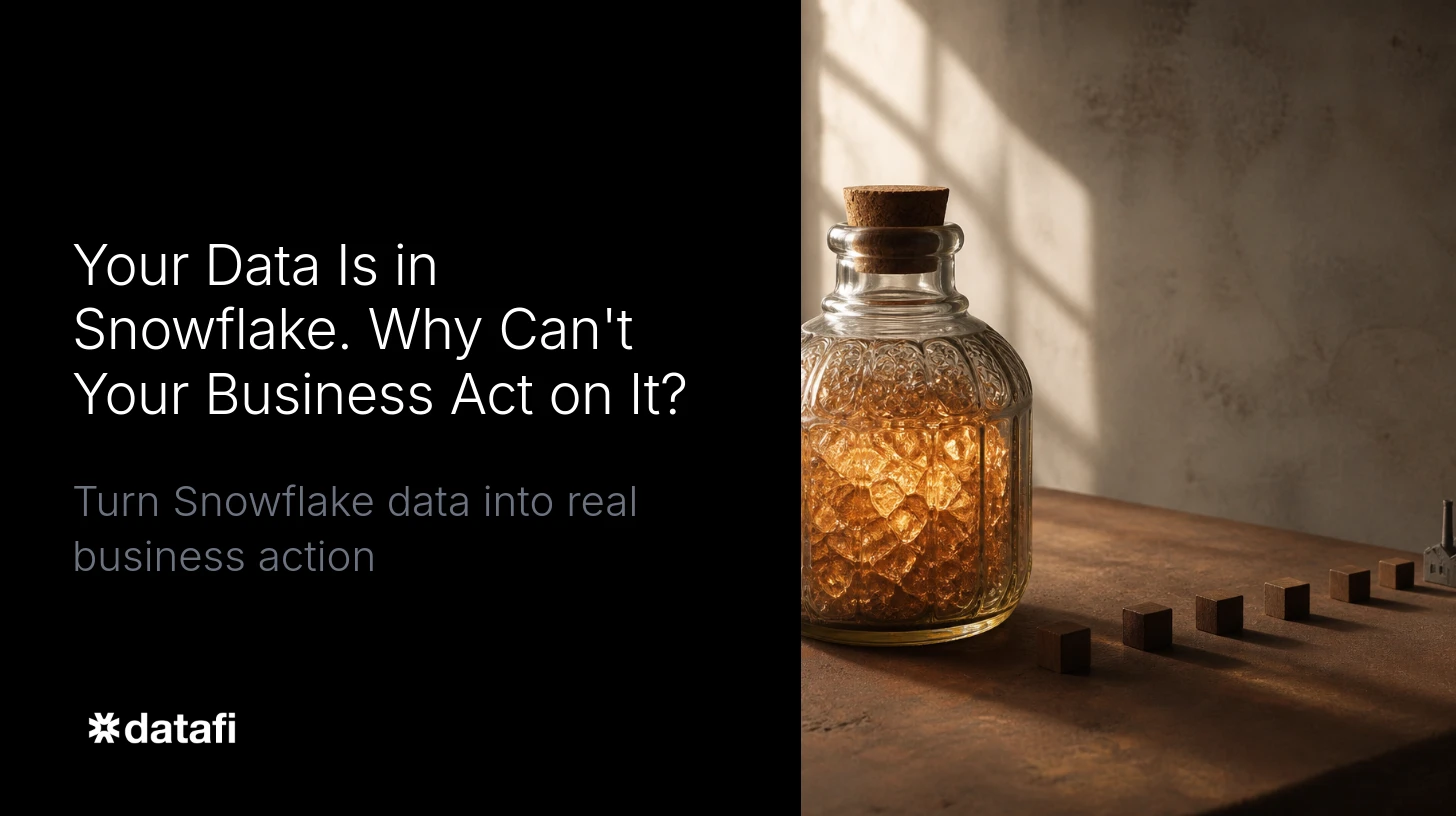
Snowflake is a world-class data platform. If your organization runs on it, you have made a sound infrastructure investment. Your data is consolidated, governed, and queryable at scale. Analysts can run SQL. Cortex can generate answers from natural language. Reports can be built. Dashboards can be refreshed.
And yet, the business still waits.
Operations teams still ask the same questions every Monday morning. Executives still rely on weekly reports that describe last week rather than direct today. Frontline employees still have no direct access to the intelligence locked inside the platform. The gap between data and decision remains.
This is not a Snowflake failure. It is a category limitation. Snowflake was built to be the best place to store, process, and query enterprise data. It was not built to close the distance between data and business action. That gap has a name. It is the gap that the Business AI Operating System was designed to fill.
The gap between enterprise data and business action is not a data quality problem or a Snowflake limitation. It is a missing contextual layer, and closing it requires a purpose-built Business AI Operating System that understands how your organization actually works.
The Infrastructure-Outcome Gap
Enterprise data platforms have always solved the infrastructure problem well. Where do we store data? How do we process it at scale? How do we govern who can access what? Snowflake answers all of these questions with sophistication.
What infrastructure platforms cannot answer is a different class of question entirely: What does this data mean in the context of how our business actually operates? What should a specific employee do, right now, given what the data shows? What workflows need to change because a threshold has been crossed or an anomaly has appeared?
These are not query problems. They are context problems. And they require something that no data warehouse, however capable, was architected to provide.
Context is the understanding of how your business works, your products, your customers, your contracts, your processes, your roles, your exceptions, your history. Without that context embedded into the intelligence layer, AI can only answer generic questions. It cannot solve specific problems.
What “AI-Ready Data” Actually Means
The enterprise software industry has spent years telling organizations to get their data AI-ready. Clean it. Govern it. Centralize it. Put it in the cloud. And to be clear, all of that work matters. Data quality and governance are real prerequisites for any serious AI deployment.
But AI-ready data is not the same as a business-ready AI system.
A well-governed Snowflake environment gives an AI model access to accurate numbers. It does not give that model understanding of what those numbers mean inside your organization. It does not tell the model that a 12% variance in this particular metric is a normal seasonal pattern, not an alert. It does not tell the model that the VP of Operations is the right person to act on this signal, not the analyst who ran the query. It does not tell the model that action in this situation means updating a purchase order, not sending an email.
That knowledge does not live in tables. It lives in the heads of the people who have been running the business. And until that knowledge is codified into a system that AI can operate within, data-ready infrastructure will keep producing insights that nobody acts on.
The Missing Layer
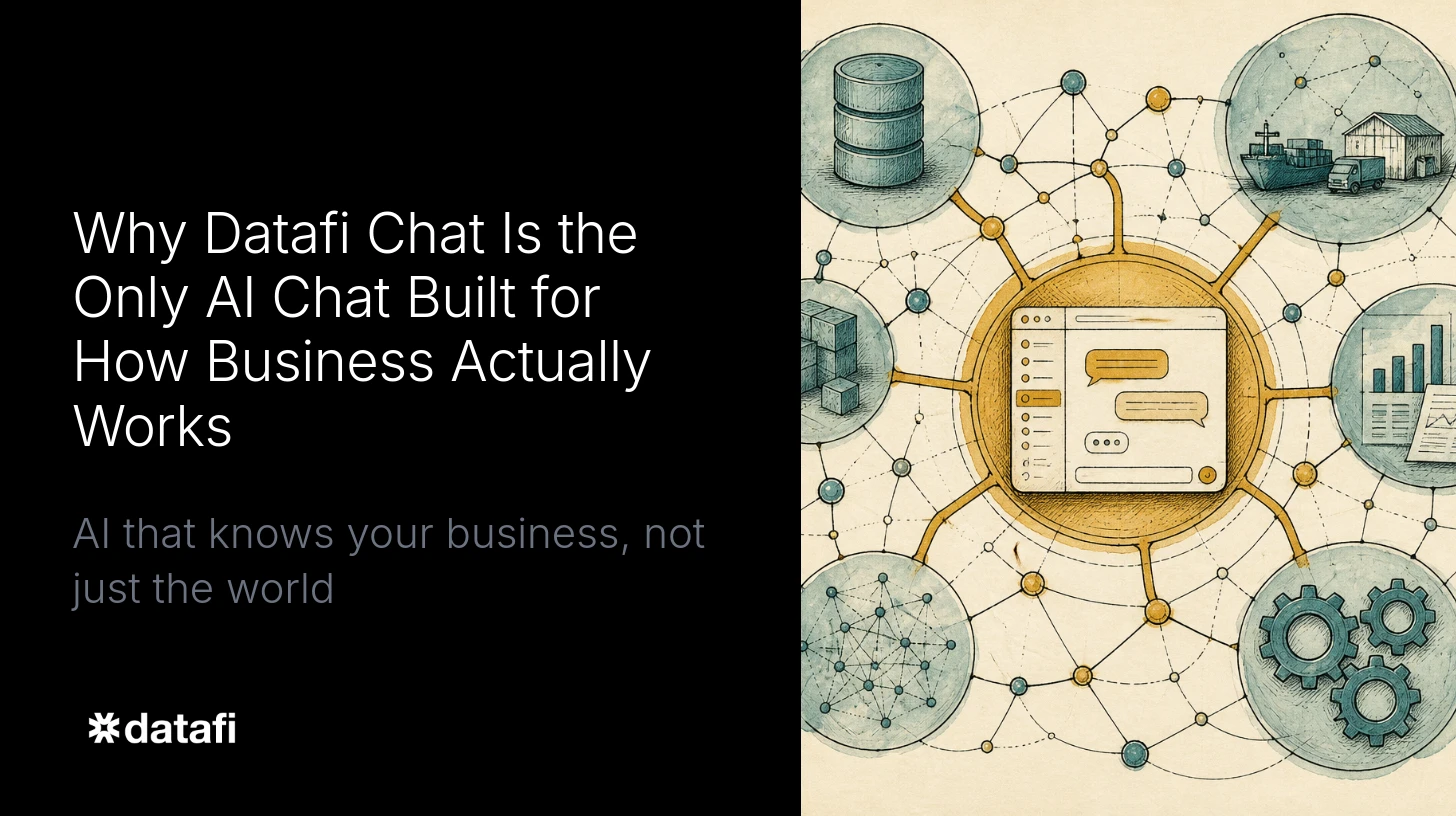
Datafi was built to be the layer that sits above your data infrastructure and below your business users. It connects to your existing data sources, including Snowflake, and builds the global contextual layer that gives AI the business understanding it needs to move from answering questions to solving problems.
This is not a reporting layer or a BI tool. It is an operating system for Business AI. It understands your business model, your operational workflows, your governance rules, and the roles of every employee who needs to interact with intelligence derived from your data.
When a supply chain manager asks a question in Datafi Chat, the response is not a generic answer pulled from a table. It is a contextually grounded insight that understands what that manager is responsible for, what the current state of their operations is, what the relevant thresholds and policies are, and what options exist for taking action.
Organizations that confuse data platforms with Business AI systems end up investing in infrastructure while their competitors invest in outcomes.
That is a different product category from a data platform. And organizations that confuse the two end up investing in infrastructure while their competitors invest in outcomes.
The Right Role for Snowflake
None of this is an argument to replace Snowflake. If you have invested in Snowflake as your data foundation, that investment retains its value inside a Business AI OS architecture. Datafi connects to Snowflake as a data source. The governance, the data quality, the processing power you have already built continues to do its job.
What changes is what you can do with it.
Instead of data sitting available for queries that someone has to know to ask, that data becomes the fuel for AI agents that know what to look for, who needs to know about it, and what to do when they find it. Instead of a reporting cycle that tells leadership what happened, an always-on intelligence layer tells the people closest to the work what is happening now and what their next best action is.
That is not a feature of a data platform. It is the product of a Business AI Operating System.
A Question Worth Asking
If your organization has spent years building a data estate in Snowflake, ask yourself honestly: how much of that data is currently being acted on by the people who could most benefit from it? Not queried by analysts. Not surfaced in dashboards. Actually used, in the flow of daily work, by the operations managers, sales teams, clinical staff, or logistics coordinators who make decisions every hour.
For most organizations, the honest answer is: a small fraction.
The data is there. The intelligence is possible. What is missing is the layer that makes it operational.
That is what Datafi is built to be.
This is Part 1 of the Snowflake vs. Datafi series. Part 2 examines why Snowflake’s emerging agentic AI vision still stops at the data layer, and what a purpose-built Business AI OS can do that a retrofitted data platform cannot.
Learn more about how Datafi works alongside your existing data infrastructure at datafi.co.
Next in the Series: The Control Plane Problem: Why Snowflake’s Agentic Vision Still Stops at the Data Layer