


There is a question every enterprise leadership team eventually faces, usually after the AI pilots have run, the proof of concept results have been presented, and the board has approved expansion investment. The question is not technical. It is strategic.
Are we building AI that automates what we already do, or AI that transforms what becomes possible?
The answer to that question determines which technology belongs at the center of your AI strategy. And it is the question that most clearly separates ServiceNow from Datafi.
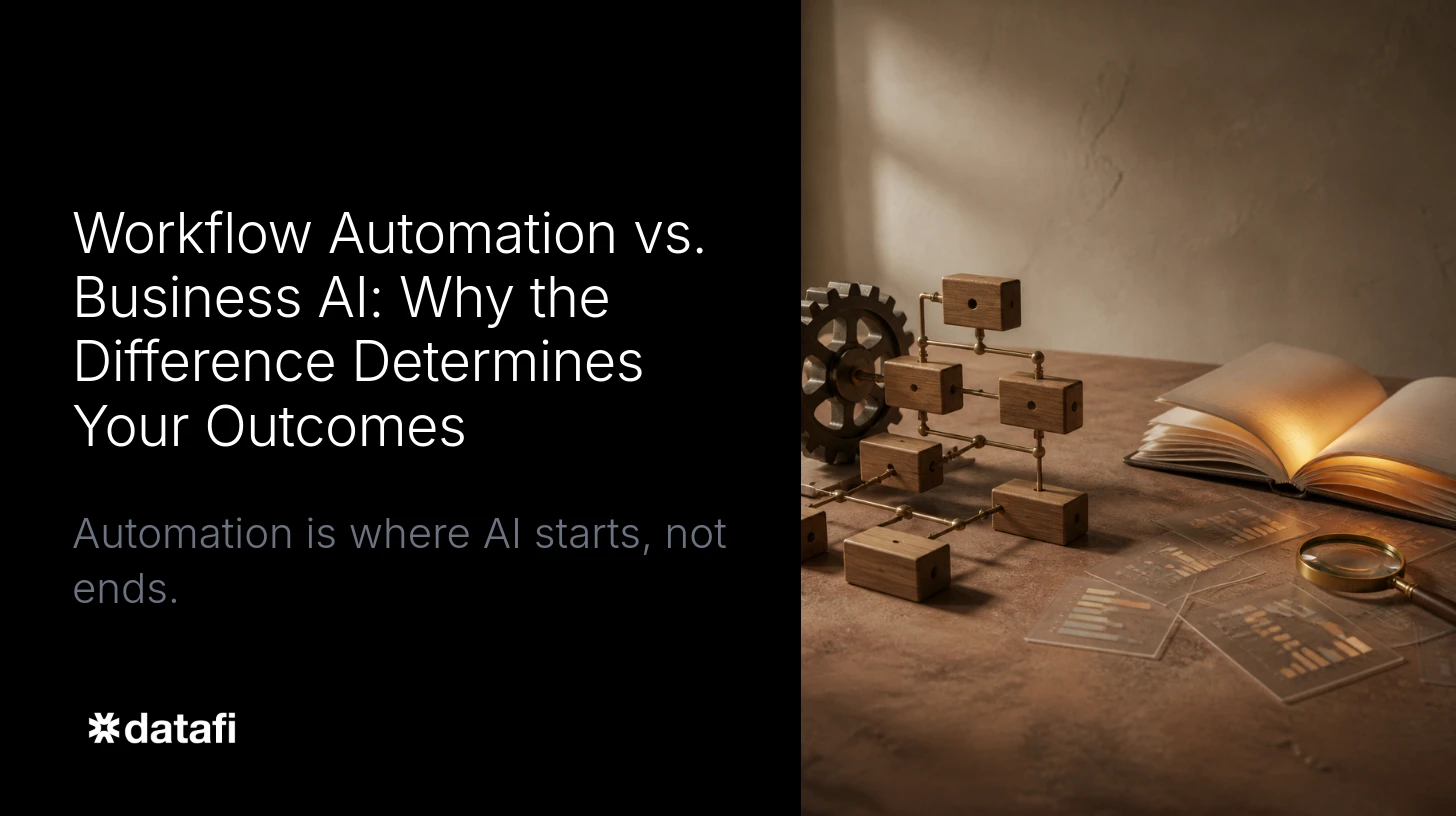
AI built on workflow logic will always be bounded by the workflows that exist. AI built on full business data context can identify problems, surface correlations, and act on conditions that no workflow was ever designed to handle. That architectural difference determines your strategic ceiling.
ServiceNow Was Built to Automate What Humans Designed
ServiceNow is a genuinely impressive platform. It has built one of the most sophisticated enterprise workflow engines in existence, with roots in IT service management that have expanded across HR, customer service, finance operations, and beyond. Its recent investments in AI through Now Assist, its agent orchestration capabilities, and its growing ecosystem of preconfigured AI agents represent serious product development.
But ServiceNow’s architecture reflects its origin. It was built to automate processes that humans had already defined. A ticket gets created, routed, escalated, resolved, and closed according to workflows that an administrator configured. AI in this environment is fundamentally an enhancement to known processes. It can classify tickets faster, summarize interactions more efficiently, and suggest next actions within the workflow. What it cannot do is see beyond the workflow.
This is not a criticism of ServiceNow. For organizations whose AI ambitions center on making existing processes faster, cheaper, and more consistent, it is well suited to the task. The limitation only becomes consequential when the ambition is larger.
Datafi Was Built Around a Different Premise
Datafi begins with data, not with process. The operating thesis is that AI delivers transformative outcomes when it has access to the full operational reality of the business: every data source, every system of record, every unstructured document, every real-time signal, unified into a single context layer that AI can reason over.
This distinction sounds architectural. Its consequences are strategic.
When an AI system is grounded in the full data context of the business, it can identify problems that no workflow was designed to handle. It can surface correlations across systems that no human analyst would have thought to connect. It can monitor conditions continuously and act within governed boundaries before a problem becomes visible. It can answer questions that were not anticipated when the system was built.
ServiceNow’s AI answers questions about the state of your workflows. Datafi’s AI answers questions about the state of your business.
That is a different capability, operating at a different level of the enterprise.
The Workflow Ceiling in Practice
Consider a distribution company managing a complex supply chain. ServiceNow can automate the procurement request process: a request is submitted, routed for approval, tracked through fulfillment, and closed when the purchase order is complete. AI can accelerate that sequence, reduce manual touches, and flag exceptions that fall outside normal parameters.
What it cannot do is look across supplier performance data, inventory turnover patterns, freight cost trends, demand forecasting models, and customer contract commitments simultaneously, and proactively identify that a specific category of components is trending toward a shortage that will breach SLA obligations in approximately eleven weeks.
That outcome requires AI that has full access to the business, not AI that is embedded in the procurement workflow. It requires a Business AI Operating System, not a smarter ticketing system.
Why This Distinction Is Accelerating in Importance
The enterprise AI landscape is moving fast. Organizations that deployed AI for productivity enhancement are now being asked to demonstrate strategic impact. Boards and executive teams want AI that moves the metrics that matter, revenue, margin, risk, operational resilience, not just AI that reduces the number of tickets a human has to touch.
ServiceNow is a strong answer to the first generation of enterprise AI ambitions. For the next phase, the architecture has to be different.
Datafi was designed for that next phase from the beginning. The vertically integrated stack connects data where it lives, enforces governance as a foundational layer rather than an afterthought, and enables AI agents that do not just respond to requests but monitor, reason, and act. The Chat UI makes this capability accessible to every employee, not just the technical teams that built the system.
The question is not whether ServiceNow or Datafi can automate a process. Both can. The question is whether your AI strategy ends at automation or begins there.
For enterprises that want AI to deliver transformative outcomes, the foundation has to be built on data. The workflows will follow.
Datafi is the Business AI Operating System for the modern enterprise. To understand how the transformation ROI model applies to your industry and your operations, visit datafi.co
Next in the Series: The Data Access Gap: Why ServiceNow’s Workflow Fabric Is Not the Same as Full Business Context