


Enterprise software buying decisions are rarely made on total cost of ownership. They are made on capability demonstrations, vendor relationships, analyst reports, and the understandable human preference for choosing a known quantity over an unfamiliar one. TCO enters the conversation later, usually when a renewal comes due and the number on the invoice has grown in ways that were not anticipated when the original contract was signed.
AI platforms that monetize through consumption create a cost trajectory that accelerates with success: the more your AI deployment grows, the faster your bill grows, and the harder it becomes to leave.
For AI platform decisions, the TCO conversation is arriving faster and at greater scale than most organizations expected. The reason is structural. AI platforms that monetize through consumption, where every agent interaction, every workflow execution, and every data query generates incremental cost, create a fundamentally different financial relationship than traditional enterprise software. The more successful the AI deployment, the faster the cost grows.
ServiceNow has made this model explicit. Its transition toward consumption-based pricing for Now Assist reflects a deliberate strategic choice to capture value proportional to AI adoption. For ServiceNow, this is sound business logic. For its enterprise customers, it creates a cost trajectory that deserves careful analysis before the commitment is made.
How Platform Dependency Compounds Over Time
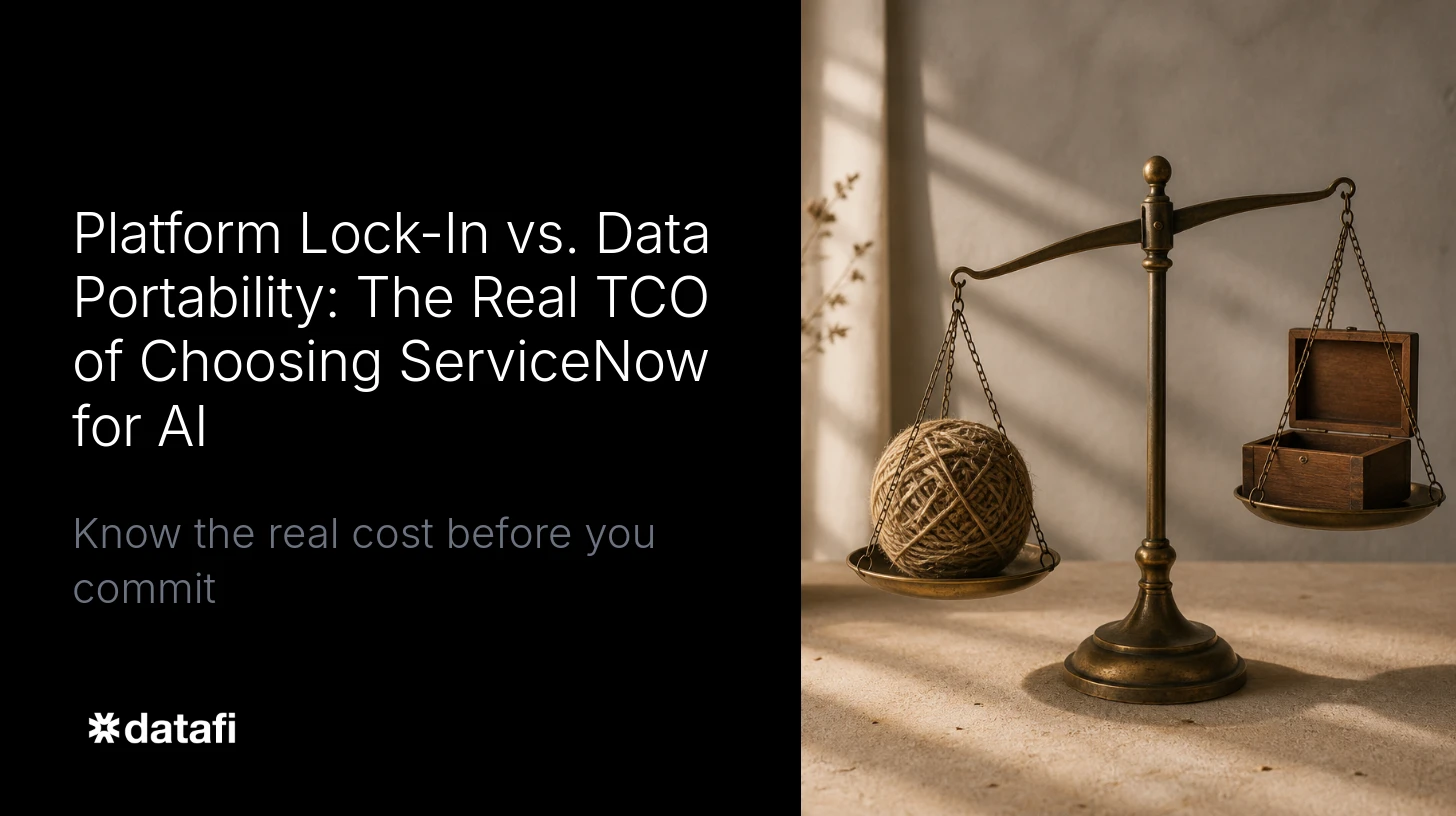
The lock-in dynamic in enterprise AI platforms operates differently from traditional software lock-in. It is not primarily about switching costs, although those are real. It is about the compounding dependency that develops as AI capabilities are built on top of a proprietary foundation.
When an organization deploys Now Assist across IT, HR, and operations, it is not just buying workflow automation. It is building institutional knowledge, process design, and employee habits around a specific platform architecture. The agents that get configured, the workflows that get optimized, and the integrations that get built all represent investment that is only recoverable inside the ServiceNow ecosystem.
ServiceNow’s AI Control Tower deal volume nearly tripled in Q4 2025, and Now Assist exceeded six hundred million dollars in annual contract value, doubling year over year. These are impressive growth metrics for ServiceNow. They also represent the scale at which enterprise commitments to the platform are accumulating. Organizations that are part of that growth curve are building dependencies that will shape their AI strategy for years.
What Data Portability Actually Means
Datafi’s architecture is built around a principle that is easy to state and consequential in practice: data stays where it lives. Datafi connects to source systems through native connectors rather than ingesting data into a proprietary store. This means that the enterprise’s data estate remains under the enterprise’s control, in the systems the enterprise already owns, governed by the policies the enterprise has already established.
The practical consequence is that a decision to change AI platforms does not require a data migration. The financial data in the ERP, the customer records in the CRM, the operational data in the data warehouse, and the unstructured content in the document repositories all remain in place. What changes is the AI layer on top of them, not the data underneath.
When the cost of switching is an integration project rather than a data migration, the renewal conversation is fundamentally different.
This is a fundamentally different leverage position for the enterprise in any commercial negotiation. When the cost of switching is an integration project rather than a data migration, the renewal conversation is different.
The Hidden Costs Inside the ServiceNow Model
The consumption-based pricing model is the most visible component of the TCO equation, but it is not the only one. Organizations that choose ServiceNow as their primary AI platform face several additional cost categories that are easy to underestimate at the point of purchase.
The first is the scope boundary cost. ServiceNow’s AI operates most naturally within the ServiceNow workflow ecosystem. Extending AI reasoning to data sources outside that ecosystem, the ERP data that ServiceNow does not own, the operational telemetry that lives in specialist platforms, the unstructured intelligence in document repositories, requires integration investment that sits outside the platform contract.
The second is the upgrade dependency cost. ServiceNow’s AI capabilities, including its language models, agent frameworks, and governance tools, are delivered through platform releases. Organizations that want access to the latest capabilities must maintain currency with the platform upgrade cycle. For large, complex ServiceNow deployments, that upgrade cycle is a significant ongoing engineering commitment.
The third is the talent concentration cost. Building AI capability on a proprietary platform requires investment in platform-specific skills. ServiceNow-certified administrators and developers command premium salaries, and the supply of qualified practitioners grows no faster than ServiceNow’s certification programs allow.
How Datafi’s Architecture Changes the TCO Equation
Datafi’s vertically integrated architecture eliminates several of the cost categories that accumulate in the ServiceNow model. Because data remains in source systems, there is no scope boundary cost for extending AI to data that lives outside a proprietary store. Because the platform is LLM-agnostic, organizations are not locked into a single model provider’s pricing trajectory. Because governance is architectural rather than a licensed add-on, compliance capability does not scale in cost with AI adoption.
The deployment model also changes the time-to-value calculation. Datafi’s thirty-day deployment approach, compared with the eighteen-month implementation timelines that characterize complex ServiceNow AI buildouts, means that the period between investment and return is measured in weeks rather than quarters. That difference in payback period is meaningful for any capital allocation decision.
The honest TCO comparison between Datafi and ServiceNow is not a single number. It is a trajectory. In the first year, the differences may appear modest. By year three, the divergence in consumption costs, integration investment, upgrade overhead, and renewal leverage tells a significantly different story.
For organizations making AI platform decisions today, the question is not only what the platform costs now. It is what the platform will cost when AI is central to operations, running across dozens of use cases, touching every department, and generating the consumption volume that the vendor’s business model was designed to capture.
The architecture that keeps your data portable and your cost structure predictable is the architecture that keeps the AI strategy in your hands.
Datafi is the Business AI Operating System for the modern enterprise. To understand how the transformation ROI model applies to your industry and your operations, visit datafi.co
Next in the Series: Who Gets to Use the AI? Democratizing Intelligent Access Across the Enterprise