


ServiceNow makes a compelling claim about its AI advantage. The argument, made prominently in its investor communications and product positioning, is that the business context embedded in decades of enterprise workflow data gives its AI a unique foundation. Billions of production workflows and trillions of transactions represent, in its framing, an unmatched source of enterprise intelligence.
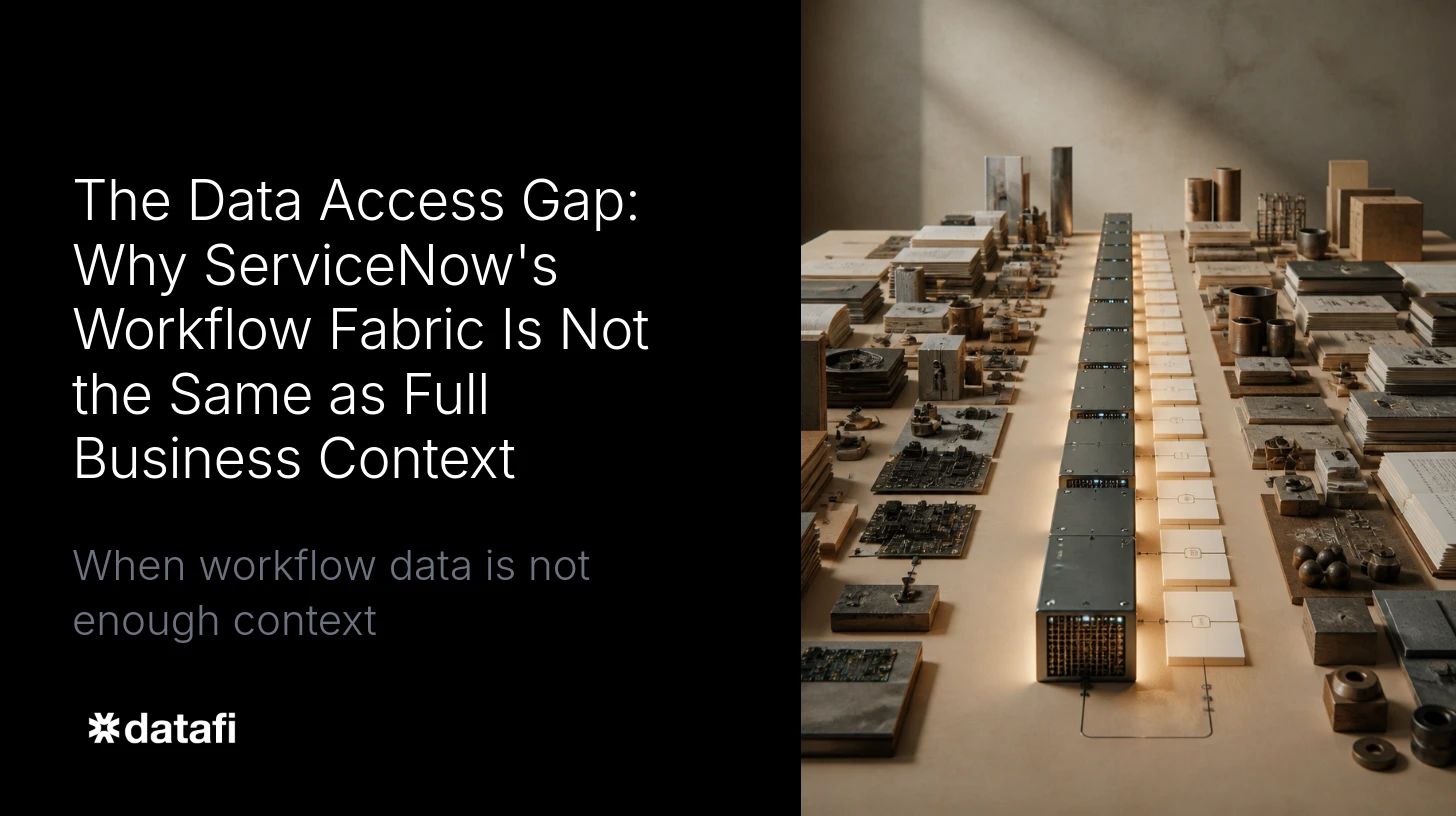
The claim is not wrong. It is incomplete. And the gap between what ServiceNow means by business context and what business context actually requires for transformative AI is where the strategic decision between ServiceNow and Datafi is really made.
Workflow telemetry is a shadow of business reality. AI that can only see what a workflow captured cannot reason about the full operational state of the enterprise, and that gap is what separates process optimization from genuinely transformative AI outcomes.
What Workflow Context Can and Cannot Tell You
ServiceNow’s workflow fabric is a record of how processes have been executed. It knows which tickets were raised, how long they took to resolve, which approvals were sought, which exceptions were escalated, and which teams were involved. This is genuinely useful data, and AI trained on it can identify patterns, predict bottlenecks, and optimize process throughput in meaningful ways.
But workflow telemetry is a shadow of business reality. It captures what happened inside a defined process. It does not capture the full operational state of the enterprise that caused the process to be triggered in the first place, or the downstream consequences that followed after the workflow closed.
Consider a manufacturer running ServiceNow for IT and facilities operations. The workflow data is rich with incident history, change requests, and asset management records. What it does not contain is the production telemetry from the factory floor, the quality control data from the inspection systems, the supplier delivery schedules from the procurement platform, or the customer order commitments from the ERP. Those systems exist. They produce data continuously. But they are outside the ServiceNow workflow boundary.
AI that has access only to the workflow fabric cannot reason about the relationship between a degrading sensor reading and a downstream delivery commitment. It cannot correlate a pattern of minor incidents in one facility with a supplier quality issue that is about to surface in three others. It cannot see the business as a living system. It can only see what the workflow captured.
Datafi’s Direct Connect Architecture
Datafi connects to data where it lives, across more than 150 source systems including ERP platforms, CRM systems, data warehouses, cloud storage, unstructured document repositories, operational databases, and real-time data streams. The architecture is not a replication or ingestion model. It is direct connection, which means AI operates on current data, not on a stale copy of what the business looked like when the last sync ran.
This matters for the quality of AI reasoning in ways that are easy to underestimate. Business conditions change faster than batch pipelines move data. A supply constraint that emerged this morning is not in yesterday’s warehouse snapshot. A customer escalation that arrived at 8am is not in the reporting database until tonight. AI that reasons on real-time data and AI that reasons on scheduled replications are not the same system.
More significantly, direct connection enables bidirectional operation. Datafi’s AI agents do not just read data from source systems. They can write back, updating records, triggering workflows, closing exceptions, and completing actions across the systems where the business actually runs. This is what transforms AI from a reporting layer into an operational capability.
The Governance Consequence of Broader Data Access
Expanding AI access to a broader range of enterprise data systems creates a governance challenge that ServiceNow’s architecture does not face in the same way. When AI can access financial records, customer data, regulated information, and strategic planning inputs in addition to workflow data, the policy requirements become more demanding.
Datafi was designed with this challenge as a first-order architectural constraint, not as a compliance feature added after the fact. Datafi Cyber, the security and governance layer, enforces granular access policies at query time, based on user identity, data sensitivity classification, jurisdictional requirements, and workflow context. An AI agent cannot access data that the governing policy does not authorize, regardless of how the question is framed.
For organizations in regulated industries, this distinction is not academic. Healthcare organizations managing HIPAA obligations, financial services firms under SEC and FINRA oversight, manufacturers with export control requirements, and public sector organizations with data sovereignty constraints all face governance demands that extend well beyond the workflow layer. Datafi’s governance architecture was built for that scope.
The Integration Tax of Point Solutions
One of the less visible costs of ServiceNow’s AI approach is what happens to the data that exists outside the platform. Organizations that want AI to reason across their full data estate while using ServiceNow as their workflow backbone are not choosing between two capabilities. They are choosing to build and maintain an integration layer between them.
That integration layer is expensive in ways that appear in multiple budget lines simultaneously. There is the direct cost of the integration infrastructure. There is the engineering time required to build and maintain connectors. There is the latency introduced by data movement pipelines. There is the governance overhead of managing data that now exists in multiple places. And there is the compounding fragility of a system where a change in any source creates reconciliation work across the stack.
Datafi eliminates that tax. The platform connects directly to source systems, enforces governance at the point of access rather than at the boundary of an ingestion pipeline, and presents a unified data environment to AI agents and users without requiring a separate integration project to maintain.
The business context that AI requires to deliver transformative outcomes is not sitting in workflow telemetry. It is distributed across every system your organization runs. The architecture that gets AI access to that context, safely and in real time, is the architecture that determines what AI can ultimately do for the business.
Datafi is the Business AI Operating System for the modern enterprise. To understand how the transformation ROI model applies to your industry and your operations, visit datafi.co
Next in the Series: Governance-by-Architecture vs. Governance-by-Addition: A Security and Compliance Comparison