


Every enterprise AI conversation eventually arrives at the same moment. The business case is compelling, the use cases are well defined, and the executive sponsor is ready to move. Then the CISO and the General Counsel join the meeting.
Their questions are not about capability. They are about control. Who can see what data? How is access enforced when the AI is acting autonomously? What is the audit trail when something goes wrong? How does the system behave when a regulated data element is included in a query that was not designed to touch regulated data?
The answers to those questions are not just policy decisions. They are architectural ones. And the difference between how Datafi and ServiceNow approach AI governance reveals a strategic divide that matters enormously for organizations with serious compliance obligations.
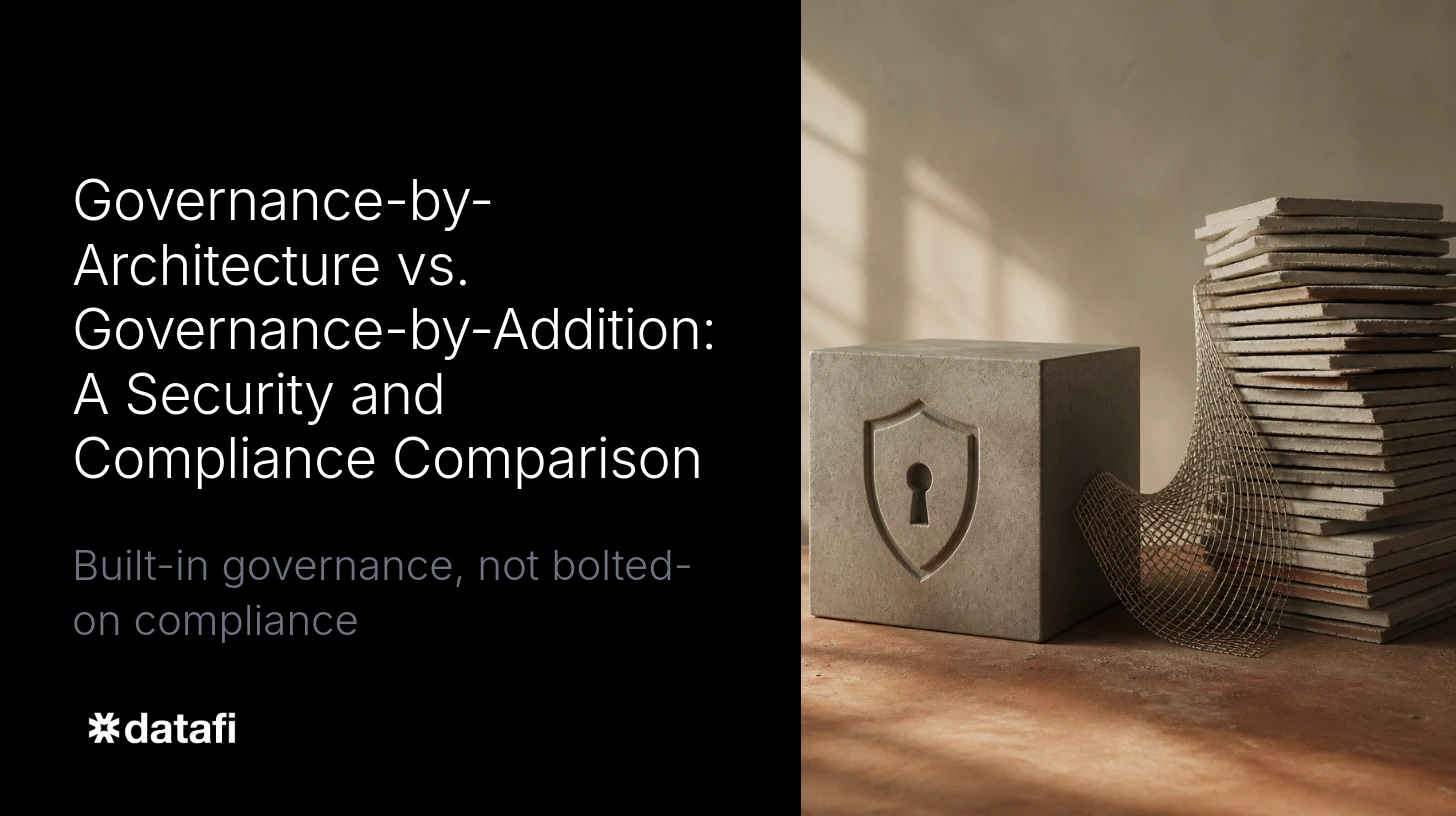
Governance built into the architecture means every new use case, every new agent, and every new data connection inherits the compliance foundation automatically. That is the difference between AI that scales and AI that stalls.
How ServiceNow’s AI Control Tower Was Built
ServiceNow’s primary AI governance product is its AI Control Tower, which the company describes as a centralized capability for monitoring AI assets, managing adoption, and enforcing governance policies across agents and workflows. The product has grown significantly, particularly through 2025, and represents genuine investment in making enterprise AI observable and manageable.
The architectural history matters, however. ServiceNow built one of the world’s most widely deployed workflow platforms long before AI agents existed as a product category. Its governance capabilities for AI are being built on top of a platform designed for a different era of enterprise software. The AI Control Tower is, by necessity, a layer added to enable governance of AI capabilities that the original platform architecture did not anticipate.
This is not unusual. Most enterprise software vendors are in exactly the same position. The question is whether governance as an added layer is sufficient for the use cases enterprises now need to support.
How Datafi’s Governance Was Designed
Datafi’s governance layer, Cyber, was designed as a foundational architectural component, not as a product extension. This distinction has practical consequences at every level of the platform.
In Datafi’s architecture, there is no path for data to reach an AI agent, a user query, or a workflow execution that does not pass through the governance layer first. Access policies are not enforced at the boundary of the system, where data enters or exits. They are enforced at the point of access, dynamically, for every operation, every time.
What this means in practice is that governance in Datafi is not a configuration task that administrators perform before going live. It is a continuous property of the system. When a new data source is connected, governance applies immediately. When a new agent is deployed, governance applies from its first execution. When a user’s role changes, the access change is reflected in real time, without requiring a manual update to a separate policy store.
Zero-Trust Architecture in an AI Context
Zero-trust architecture is well understood in the context of network security: never assume that a request is legitimate because of where it originates. Every access request is authenticated and authorized on its own merits, every time.
Applying this principle to AI agents creates requirements that most governance frameworks were not designed to address. An AI agent is not a human user with a defined role and a static set of permissions. It is a dynamic process that can generate requests based on reasoning that its administrators did not explicitly anticipate. It can combine data from multiple sources in ways that individually are permissible but in combination may not be. It can act on behalf of users in ways that blur the boundary between the agent’s permissions and the user’s permissions.
Datafi’s Cyber was designed with AI agents as a first-class security principal. This means that the authorization model is not inherited from human user permissions. Every agent, every workflow, and every automated process operates within its own explicitly defined permission boundary. Those boundaries are enforced at the data layer, which means an agent cannot use its reasoning capabilities to work around access controls that were intended to apply to it.
For organizations deploying AI in high-stakes operational roles, this distinction is not theoretical. An AI agent managing financial reconciliation should not be able to access customer PII because a reasoning chain connected the two. An AI agent supporting clinical decision-making should not be able to surface research data that the requesting clinician is not authorized to see. These are not edge cases. They are the everyday reality of enterprise AI in regulated environments.
Tenant Isolation and Data Residency
ServiceNow operates as a shared-infrastructure platform, with tenant isolation managed at the application layer. For most enterprise software use cases, this model is entirely appropriate. For AI workloads that involve sensitive data, regulated information, or cross-jurisdictional compliance requirements, the application-layer isolation model warrants closer scrutiny.
Datafi was built with tenant isolation as a foundational infrastructure requirement, not an application-layer property. Data and workloads do not share infrastructure across tenants. This architecture supports the data residency requirements that are increasingly central to enterprise AI compliance, particularly for organizations operating across multiple jurisdictions with different data sovereignty regimes.
For a European financial services firm concerned about GDPR data residency, for a healthcare organization managing HIPAA obligations across multiple states, or for a defense contractor with strict data handling requirements, this is not a feature comparison. It is a prerequisite.
The Compliance Audit Question
One of the most operationally demanding aspects of enterprise AI governance is the audit requirement. When an AI agent takes an action, or when an AI system surfaces a recommendation that influences a consequential decision, organizations need to be able to reconstruct exactly what happened: which data was accessed, what reasoning was applied, which policies were in effect, and which actions followed.
Datafi maintains immutable audit trails at the platform level, covering every data access event, every agent execution, every policy evaluation, and every user interaction. These trails are not optional logging that administrators must configure. They are a built-in property of the system, generated continuously and stored in a tamper-evident format.
For organizations that have faced a regulatory inquiry, a litigation hold, or an internal investigation involving AI-generated outputs, the difference between an audit trail that was designed in and one that was bolted on is the difference between a one-hour response and a multi-week forensic reconstruction.
Organizations that treat governance as a capability to be added once the AI is working will spend more time managing compliance risk than delivering business value.
The Strategic Consequence
The governance conversation is often framed as a constraint on AI ambition. Organizations want to move fast, and governance is seen as the force that slows them down.
This framing gets the causality backwards. Organizations that deploy AI without adequate governance do not move faster. They move faster until they hit a compliance event, a security incident, or a regulatory inquiry, at which point they stop entirely while the investigation runs and the remediation is built.
Datafi’s governance-by-architecture approach does not slow down AI deployment. It removes the governance ceiling from AI ambition. When the compliance and security teams can see everything the AI is doing, can verify that policies are being enforced correctly, and can produce audit evidence on demand, the conversation with the CISO and the General Counsel changes.
It changes from a question about whether AI can be trusted with sensitive data to a question about which sensitive data to unlock next.
That is the governance advantage that architecture provides. And it is the one that ultimately determines how far enterprise AI can go.
Datafi is the Business AI Operating System for the modern enterprise. To understand how the transformation ROI model applies to your industry and your operations, visit datafi.co
Next in the Series: Platform Lock-In vs. Data Portability: The Real TCO of Choosing ServiceNow for AI