

A new McKinsey report delivers a finding that should be required reading for every enterprise technology leader: fewer than 10 percent of companies that have experimented with agentic AI have successfully scaled it to deliver tangible value. Eight in ten cite data limitations as the primary obstacle. Not model capability. Not budget. Data.
The global enterprise AI market sits at $115 billion in 2026 and is projected to reach $273 billion by 2031. Zoom out further and the numbers become even more striking: independent research firms estimate the broader AI market reaching $4 trillion by 2035. Against these headline numbers, the McKinsey failure rate is almost incomprehensible. An industry mobilizing trillions of dollars in investment is, by its own admission, delivering scaled value in fewer than one in ten organizations.
The reason is architectural, not aspirational. The infrastructure required to transform AI from a conversational assistant into an autonomous, problem-solving operating system has never been about the model sitting at the top of the stack. It has always been about what lies beneath: data quality, context, governance, and architecture. The organizations that get this right will capture disproportionate value. The platforms that enable them to get it right will capture the market.
Eighty percent of enterprises cite data limitations, not model capability or budget, as the primary reason agentic AI fails to scale. The competitive moat in the AI era is a governed, unified data foundation, not the model on top of it.
At Datafi, we built the Business AI Operating System precisely for this moment. And the sectors where the gap between AI ambition and AI reality is widest represent our primary markets: supply chain, insurance, life sciences, cybersecurity, manufacturing, and financial services. Collectively, these industries represent hundreds of billions of dollars in addressable AI spending, enormous operational complexity, and an almost complete absence of a purpose-built platform that delivers the full agentic AI stack without requiring a Fortune 50 data engineering organization to deploy it.
Understanding the Market Palantir Does Not Serve
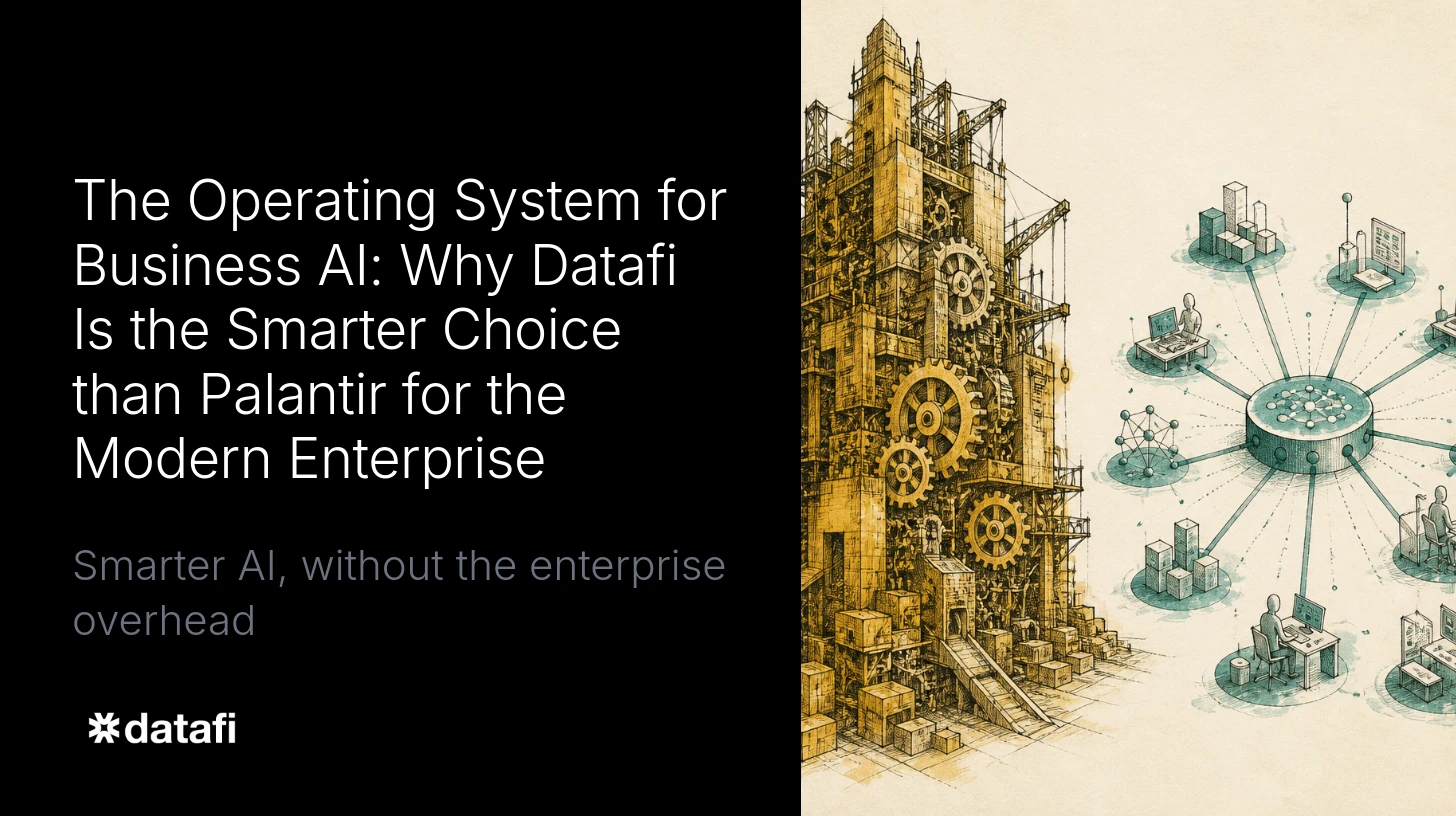
Palantir Technologies is a serious company doing serious work. Its Gotham and Foundry platforms represent genuine technical achievement built primarily for government intelligence work and the largest global enterprises, organizations with dedicated data engineering teams, multi-year implementation budgets, and a tolerance for deeply customized, services-intensive deployments.
That customer profile is real. It is also narrow.
The commercial middle of the global economy does not fit it. Mid-market and growth-stage enterprises across the six sectors described below lack the internal data engineering headcount that Palantir deployments require. They cannot absorb multi-year implementation timelines. They need AI that acts within their existing operational context, not a platform that requires rebuilding that context from scratch at enterprise consulting rates.
These organizations are generating rich, mission-critical data every day. Their pressure to operationalize AI is equal to or greater than that of their larger peers. And the tools available to them fall into two inadequate categories: point solutions that answer questions within a narrow domain but cannot coordinate across the business, or bespoke stacks assembled from disconnected vendors that require specialized talent most of these companies cannot attract.
Neither path leads to transformative outcomes. The result, as McKinsey confirms, is that two-thirds of enterprises have experimented with agents while fewer than one in ten have captured real value.
Two-thirds of enterprises have experimented with AI agents. Fewer than one in ten have captured real value. That gap is a market, and a very large one.
That gap is a market. A very large one.
Six Industries, One Structural Problem, One Platform Advantage
The McKinsey framework identifies seven data architecture principles required for agentic AI to scale: treating data as a product, sharing meaning not just data, unifying the analytics and AI foundation, building governance in by default, exposing stable interfaces, making behavior measurable, and providing a controlled execution environment for agents. These principles manifest differently across industries, but the failure mode is always the same: fragmented data, inconsistent governance, and the absence of a business context layer that provides AI agents with the institutional knowledge required to act rather than merely inform.
Supply Chain and Logistics: A $35 Billion Market Demanding Real Action
The AI in supply chain market reached $7.67 billion in 2025 and is forecast to expand to $35.28 billion by 2030, a 35.67% compound annual growth rate that ranks among the fastest in enterprise technology. The demand signal is clear: enterprises deploying AI for predictive disruption management, dynamic routing, and intelligent inventory allocation report 15 to 20 percent cost savings and near-perfect order accuracy.
But most supply chain organizations are not capturing these results. The data required to power autonomous supply chain agents, operational technology feeds, ERP transactions, third-party logistics data, supplier communications, and demand signals, lives in siloes that were never designed to interoperate. An AI agent that cannot simultaneously read inventory positions, supplier lead times, freight capacity, and customer commitments cannot make reliable autonomous decisions.
Datafi’s vertically integrated stack eliminates these integration gaps by design. When context travels with data through a unified semantic and governance layer, agents do not just surface a risk alert. They recalibrate a purchase order, trigger a supplier escalation, and update downstream production schedules, all within governance boundaries the business controls. The distinction between AI that informs a supply chain manager and AI that actually runs the supply chain response is the distinction between a $50,000 analytics subscription and a platform that generates measurable margin impact at scale.
Insurance: A $154 Billion AI Market Still Running Manual Workflows
The AI in insurance market stood at $10.36 billion in 2025 and is projected to reach $154.39 billion by 2034. Full AI adoption among insurers jumped from 8 to 34 percent year-over-year between 2024 and 2025, and 90 percent of insurance executives identify AI as a top strategic initiative. Yet only 7 percent of insurers have successfully scaled AI initiatives across their organizations.
The operational potential is extraordinary and well-documented. Claims processing time has been reduced by 55 to 75 percent through AI automation in early deployments. One major insurer that deployed AI models across its claims domain cut complex-case liability assessment time by 23 days, improved routing accuracy by 30 percent, and reduced customer complaints by 65 percent. AI is projected to increase productivity in insurance processes and reduce operational costs by up to 40 percent by 2030, and to save the industry $390 billion globally by that same year.
The barrier to realizing these outcomes is not willingness. It is data. Insurance workflows span structured policy records, unstructured claims documents, external market feeds, regulatory databases, and historical loss patterns. The governance requirements are non-negotiable: every agent decision must be auditable, every data access logged, every action traceable. Insurers are moving away from monolithic systems toward modular architectures that allow best-of-breed AI tools to interoperate, but assembling those architectures from disconnected vendors requires integration expertise most mid-tier insurers do not have in-house.
Datafi delivers the modular, governed, interoperable architecture that insurers need without requiring them to build it themselves. Embedded lineage tracking, attribute-based agent permissions, and a contextual layer that ensures consistent business definitions across all workflows means that when an AI agent touches a claim, a policy record, or a fraud flag, it does so within boundaries that satisfy compliance requirements and generate the audit trail regulators demand.
Life Sciences: A Race Against Time Worth Hundreds of Billions
PwC projects that AI could enable pharmaceutical companies to capture a $868 billion opportunity by 2030 through AI-driven trial management, precision medicine, and optimized commercial operations. The AI in life sciences market itself is valued at $3.61 billion in 2025 and is forecast to reach $11.11 billion by 2030, while AI in pharma and biotech is expanding at an even faster 43.55% compound annual growth rate toward $154 billion by 2034.
The value creation potential in life sciences is among the highest of any industry because the cost of inefficiency is measured in years and lives, not just dollars. Drug development timelines of ten years and costs exceeding $2 billion per approved compound are driven substantially by data fragmentation: clinical trial data, real-world evidence, safety monitoring signals, regulatory submissions, and commercial performance data that lives across systems acquired through M&A and never designed to interoperate.
AI agents that can monitor pharmacovigilance signals continuously across clinical and real-world data, flag anomalies with complete data provenance, and coordinate regulatory documentation workflows represent a genuine compression of timelines that currently require months of expert manual effort. Clinical trial optimization algorithms that mine real-world data to refine inclusion criteria are cutting screen-fail rates, while adaptive trial designs are reported to reduce protocol amendments by up to 70 percent in cost savings.
None of this is achievable without the governance architecture that Datafi embeds by default. In life sciences, every AI-informed decision must be traceable to the data that informed it. The contextual layer that codifies business meaning, the lineage tracking that records every transformation, and the access controls that enforce what agents can see and act on are not features. They are prerequisites for regulatory acceptance.
Cybersecurity: Where Agentic AI Is an Operational Requirement, Not a Roadmap Item
The AI in cybersecurity market reached an estimated $31.48 billion in 2025 and is projected to grow to $93.75 billion by 2030 at a 24.4% compound annual growth rate. But unlike other sectors where AI is primarily an efficiency story, cybersecurity is a response time story, and the math is unforgiving.
Security operations centers are already drowning in telemetry. The correlation of threat indicators across network traffic logs, endpoint data, identity records, and threat intelligence feeds is still largely manual at most organizations. Mean time to respond to a material breach is measured in hours to days. The business consequences of that latency are growing more severe as attacks become faster and more targeted.
Agentic AI that can correlate indicators of compromise across federated data sources and trigger containment actions within pre-approved response playbooks reduces mean time to respond from hours to minutes. This is not a productivity improvement. It is a qualitative change in security posture.
The prerequisite is a data foundation that federates security telemetry from SIEM platforms, endpoint detection tools, identity providers, and cloud logging services into a coherent, queryable, governable architecture. Datafi’s unified stack handles the data federation, semantic normalization, and governance layer that makes autonomous security response trustworthy. Because response actions have irreversible consequences, the governance controls that define what agents can act on, and the audit trail that records what they did, are the foundation on which any responsible agentic security deployment must be built.
Manufacturing and Industrial Operations: Closing the OT/IT Gap
The manufacturing AI market is part of a broader industrial AI opportunity that analysts project reaching tens of billions annually by 2030. The use cases are among the most quantifiable in enterprise technology: predictive maintenance that prevents unplanned downtime can generate 10 to 25 percent reductions in maintenance costs. Computer vision-based quality control in automotive manufacturing has cut defect rates by up to 30 percent. Energy optimization and dynamic production scheduling create compounding operational improvements that scale with facility count.
The barrier is the OT/IT divide. Every modern production facility generates operational technology data from sensors and control systems alongside information technology data from ERP and MES platforms. These environments are architecturally incompatible by default: OT data is frequently unstructured, inconsistently timestamped, and generated by legacy systems that were never designed to interface with cloud-native AI platforms.
Bridging this divide into a unified data foundation that AI agents can act on in real time requires a platform that handles structured and unstructured data with equal rigor, enforces consistent governance across both environments, and maintains the quality standards that autonomous production decisions demand. This is the architecture Datafi delivers, and it is the architecture that the manufacturing sector cannot assemble from point solutions without sustained data engineering investment that most manufacturers outside the Fortune 100 do not have.
Financial Services: Governance as the Entry Ticket
Banking, financial services, and insurance collectively held 23.67 percent of the enterprise AI market in 2025, and that share reflects the depth of the opportunity. Commercial banking, wealth management, and specialty finance outside the top-tier institutions face the same structural challenge as every other sector in this analysis: data distributed across core banking systems, CRM platforms, market data feeds, regulatory reporting tools, and client communication archives, none of which were designed to interoperate at the level required for autonomous agent operation.
The governance requirements in financial services make the Datafi architecture particularly compelling. Any AI agent operating on financial data must operate within documented, auditable boundaries. Every decision must be traceable to the data that informed it. This is not a compliance checkbox; it is a fundamental design requirement that most AI platforms treat as an afterthought. Datafi treats it as a core architectural principle, which means that what other platforms require months of governance engineering to achieve, Datafi delivers from day one.
The Datafi Market Opportunity and Value Creation Model
The combined AI spending across supply chain, insurance, life sciences, cybersecurity, manufacturing, and financial services represents well over $500 billion in projected market opportunity by 2030. But market opportunity is not the same as addressable market. The addressable market for Datafi is the portion of that spending that falls outside the Palantir customer profile: organizations with real operational complexity, multi-system data environments, and governance requirements, but without the data engineering depth to build and maintain a bespoke agentic stack.
That segment is large and growing faster than the overall market. The small and medium enterprise segment of the enterprise AI market is projected to expand at a 19.34% compound annual growth rate through 2031, faster than the large enterprise segment, as cloud-native platforms lower the deployment barrier and mid-market organizations accelerate their AI transformation timelines.
Datafi’s value creation model operates on three levels. First, operational value: the workflows that Datafi’s Business AI Operating System automates, from supply chain intervention to claims processing to pharmacovigilance monitoring, generate measurable cost and cycle-time reductions that are well-documented across early deployments in each sector. These outcomes create clear return on investment and drive platform expansion within customer accounts.
Second, strategic value: organizations that successfully deploy agentic AI at scale develop a compounding data advantage. Every agent interaction generates labeled, structured business data that improves model performance, sharpens semantic definitions, and strengthens the governance architecture. Datafi’s vertically integrated stack captures this feedback loop in a way that point-solution competitors cannot, because they do not own the full stack through which the data flows.
Third, competitive moat value: the McKinsey research is explicit that data foundations increasingly define competitive positioning in the agentic age. Enterprises that successfully deploy Datafi are not just implementing software. They are building a proprietary AI capability layer that becomes harder to displace with each passing quarter. This dynamic creates high retention economics and strong net revenue retention characteristics, both of which are central to Datafi’s value creation thesis as a platform business.
The Moment We Are In
The commercial middle of the global economy is not a niche. It is the majority of business activity, employment, and value creation outside the largest enterprise tier. It spans the six industries analyzed above and dozens more: healthcare operations, media and publishing, logistics and freight, professional services at scale, specialty retail, and energy services.
What these organizations share is not a sector. It is a structural position: generating the data that agentic AI requires, facing the operational complexity that agentic AI can resolve, and lacking access to a platform purpose-built to serve them. Palantir owns its market. The intelligence community, the defense sector, the Fortune 50 with armies of data engineers. That market is real and defensible.
The market Datafi is building for is larger, faster-growing, and structurally unaddressed by any incumbent. The data foundation that makes agentic AI work at scale is not just a technical requirement. It is the competitive moat. And for the enterprises across these six industries and beyond, Datafi is that foundation: purpose-built, vertically integrated, and ready for the moment we are in.
Datafi is the Business AI Operating System for commercial enterprises. Our vertically integrated data and AI platform enables organizations across supply chain, insurance, life sciences, cybersecurity, manufacturing, financial services, and beyond to deploy agentic AI that solves business problems autonomously, with full governance, context, and control. Learn more at datafi.co