



How a vertically integrated AI operating system is redefining what’s possible in logistics
The freight and logistics industry has always been a pressure test for operational intelligence. Routes shift. Capacity tightens. Customer expectations accelerate. And somewhere in the middle of all of it, brokers, forwarders, and carriers are trying to make thousands of decisions a day with incomplete information, aging systems, and the relentless friction of disconnected data.
A May 2026 report from McKinsey & Company puts a sharper point on something many in the industry have felt but struggled to articulate: AI is not coming to logistics. It is already here, and incumbents who treat it as a bolt-on tool rather than a foundational shift will find themselves on the wrong side of a decisive competitive realignment.
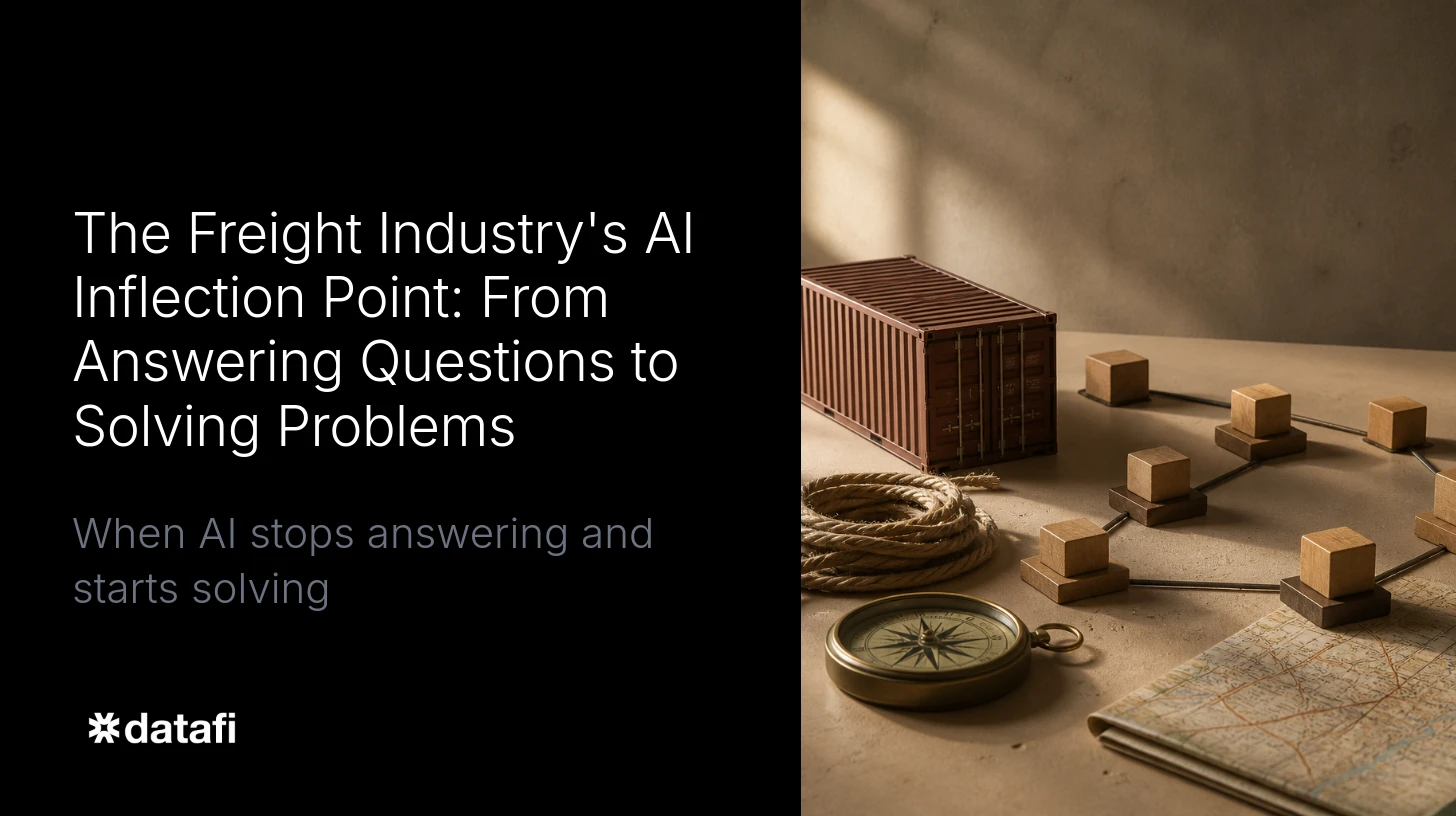
At Datafi, we have been building toward this moment for years. Not because we predicted McKinsey’s conclusions, but because our work with freight and logistics customers, including a four-year partnership with a regional LTL carrier in the Pacific Northwest, taught us something foundational about what AI actually needs to deliver real operational value. The difference between AI that answers questions and AI that solves problems is not a better model. It is a better system.
The difference between AI that answers questions and AI that solves problems is not a better model. It is a better system, one built on unified data, embedded governance, and the context to act autonomously across the full complexity of a freight operation.
Why the Freight Industry Is an AI Proving Ground
Freight logistics is, at its core, an information orchestration problem. Every shipment represents a chain of decisions, pricing, routing, carrier selection, documentation, exception handling, customer communication, each one dependent on data that lives in different systems, owned by different teams, governed by different rules.
For decades, incumbent brokers and forwarders built competitive moats around their software platforms, their carrier relationships, and the proprietary data those interactions generated. McKinsey identifies these moats clearly: scale, personal connections, operational experience, and years of transaction data that newer entrants simply cannot replicate.
But the report also identifies the threat clearly. AI could allow new entrants to rapidly replicate logistics software interfaces that previously required years and significant capital investment to build. More disruptively, AI agents could stitch together functionality from open data sources and bypass the need for specialized logistics platforms entirely. The question McKinsey poses, will incumbents’ carefully designed platforms still provide sustainable competitive advantage, is not rhetorical. It is urgent.
The incumbents who answer it well will not be the ones who simply add AI features to existing workflows. They will be the ones who use AI to fundamentally rewire how their organizations access, interpret, and act on information.
The Problem With AI That Only Answers Questions
Most enterprise AI deployments today operate in a fundamentally limited mode. A user asks a question, the AI retrieves relevant information, and the user receives a response. This is useful. It is not transformative.
The freight industry generates an extraordinary volume of operational data: shipment status, carrier performance, customer pricing history, capacity availability, route exceptions, claims, compliance records. In a traditional analytics or chat-based AI model, that data can be queried. A dispatcher can ask about current load status. A pricing analyst can request a market comparison. A customer service representative can pull shipment history.
But none of those interactions solve the problem. They surface information that a human still has to interpret, prioritize, and act on, often under time pressure, with incomplete context, and without the benefit of seeing how similar situations resolved in the past.
This is the distinction that defines the next era of freight logistics AI: the difference between a system that informs decisions and a system that makes them.
What a Four-Year Partnership Taught Us About Context
Datafi’s four-year partnership with a regional LTL carrier in the Pacific Northwest has been a master class in what it actually takes to operationalize AI across a freight organization.
This carrier has deep roots in the communities it serves and a reputation built on reliability and relationships. When we began working together, the question was not whether AI could help, it was whether AI could be deployed in a way that matched the complexity of their operational environment, the diversity of their workforce, and the governance requirements of a regulated industry.
What we learned is that the foundational requirement for AI to work in this context is not a better algorithm. It is a complete, governed, integrated data environment. This carrier’s operational data does not live in one place. It spans transportation management systems, customer portals, driver communication tools, billing platforms, and compliance records. For an AI agent to make a meaningful decision, not just surface a piece of information, but actually take an action or recommend a course of action that changes an operational outcome, it needs access to all of that data, in context, with the appropriate policies and controls in place.
This is what we mean by the contextual layer. It is the foundation that allows AI to move from retrieval to reasoning, and from reasoning to action.
The Datafi Operating System: Built for the Problem, Not the Demo
The Datafi Business AI Operating System was designed around a thesis that our experience with customers like this one confirmed: LLMs need the full context of the business, access to the complete data ecosystem, and the ability to function in fully autonomous roles to learn and solve hard business problems.
This is not a dashboard. It is not a copilot bolted onto an existing system. It is a vertically integrated stack that combines three elements that freight logistics organizations need to make AI operationally real.
Unified data ecosystem access. Datafi connects to the full breadth of an organization’s operational data, structured and unstructured, real-time and historical, internal and third-party. In a freight context, that means TMS data, carrier capacity feeds, customer contract terms, claims history, route performance, and compliance records are all available to AI agents as a single, coherent operational picture. This is the difference between an AI that knows a shipment is late and an AI that knows why it is late, which customer it affects, what the contractual implications are, and what the available remediation options cost.
Embedded governance and compliance-ready AI. Freight logistics operates under significant regulatory and contractual constraints. Any AI that makes autonomous operational decisions must do so within a framework of policies, access controls, and audit trails. Datafi’s embedded governance layer ensures that AI agents operate within defined boundaries, that actions are logged, and that human oversight is preserved where it is required. This is not a constraint on AI capability, it is what makes AI trustworthy enough to deploy in critical workflows.
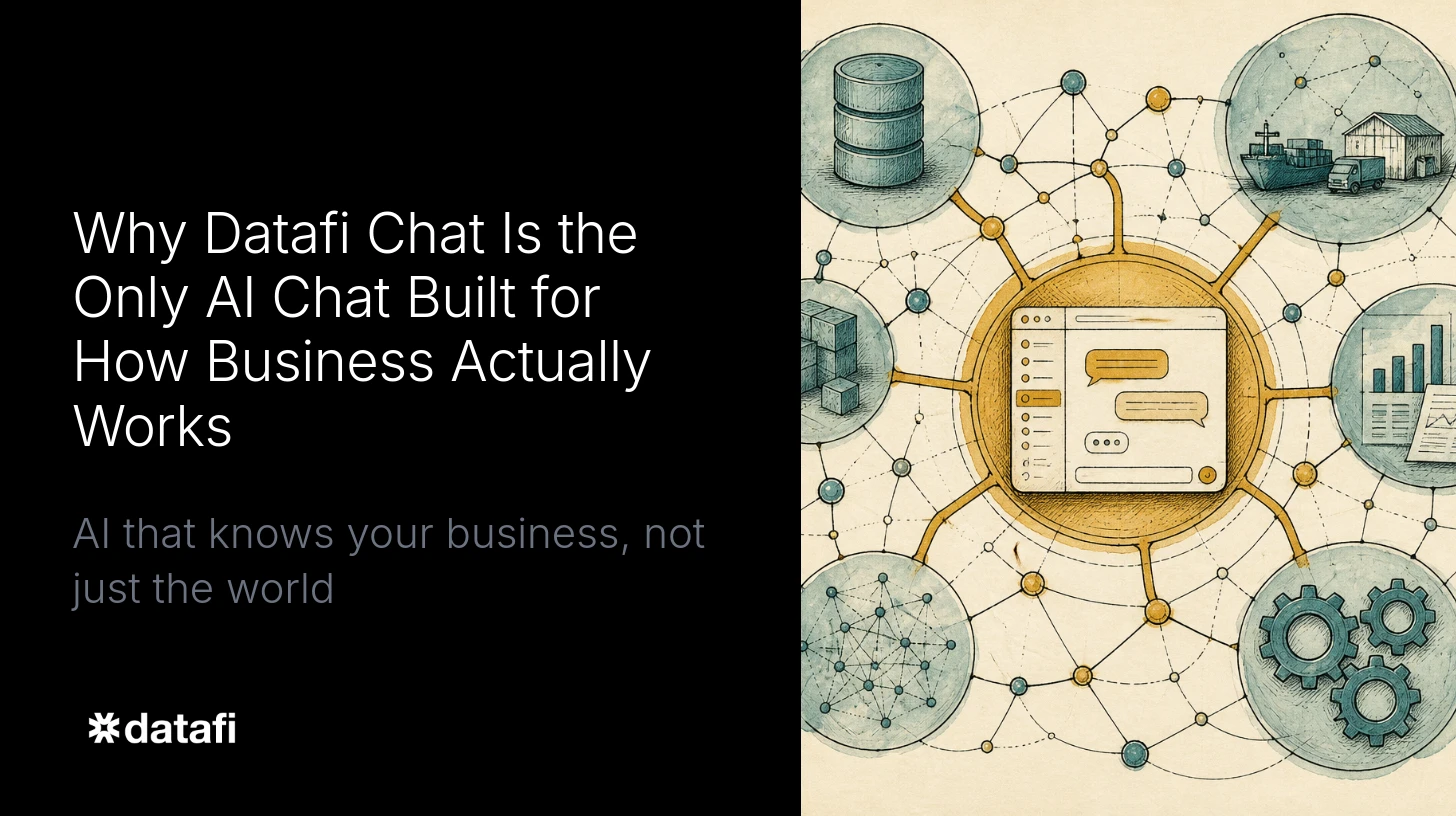
A Chat UI designed for non-technical users. The operational workforce in freight logistics is not a technical audience. Dispatchers, customer service representatives, pricing analysts, and operations managers need to interact with AI in natural language, through interfaces that surface the right information and actions without requiring them to understand what is happening behind the scenes. Datafi’s Chat UI is designed for this reality, making the full power of the AI operating system accessible to every employee, regardless of technical background.
Where AI Agents Are Already Changing Freight Operations
The McKinsey report describes AI’s impact on logistics across several operational domains. Each of these maps directly to where we see Datafi customers achieving measurable outcomes.
Pricing and capacity sourcing. AI agents that can access real-time market data, customer pricing history, carrier cost structures, and capacity availability can generate quotes faster, more accurately, and with less human intervention than traditional processes. One transportation company cited in the McKinsey report processed two million quotes through AI automation. The competitive implication is significant: organizations that price faster and more accurately capture more volume at better margins.
Freight tracking and exception management. The check-call, a labor-intensive process of manually confirming cargo status, is a natural target for AI automation. But the more valuable opportunity is exception management: identifying shipments that are at risk before they become problems, and triggering the right response automatically. This requires AI that has access to real-time tracking data, historical on-time performance, customer sensitivity profiles, and carrier communication channels simultaneously.
Document handling and billing. Bills of lading, proof of delivery, freight invoices, and claims documentation represent a significant administrative burden in freight operations. AI agents that can read, classify, validate, and route documents, and identify discrepancies before they become disputes, compress the cycle time between delivery and revenue recognition while reducing the error rates that generate costly claims.
Training and workforce development. McKinsey identifies AI as a potential training agent for workers. In freight, where operational complexity is high and workforce turnover is a persistent challenge, AI agents that can guide new employees through exception scenarios, surface relevant historical context, and reinforce best practices in real time represent a meaningful capability investment.
The Rewiring Imperative
McKinsey is clear that AI cannot simply be layered on top of existing processes. It must be woven into the core of a company’s strategy and execution. The report outlines four capability buckets: talent, operating model, technology, and data.
This is exactly right, and it is why the Datafi approach begins with the data and technology architecture, not the use case. Organizations that start with a point solution, an AI tool that solves one problem in one workflow, find themselves unable to scale. The AI lacks the context to generalize. The governance is inconsistent. The user experience varies by department. And the organization ends up managing a portfolio of disconnected AI experiments rather than an integrated operational capability.
The freight and logistics companies that will define the next decade of the industry are the ones investing now in the foundational layer: a unified data environment, embedded governance, and an AI operating system that gives every employee access to the same operational intelligence, regardless of their technical sophistication.
This is not a small undertaking. But the incumbents McKinsey describes, the ones with scale, relationships, experience, and proprietary data, have every structural advantage to build it. Their data is the training ground. Their relationships are the trust infrastructure. Their operational experience is the domain knowledge that makes AI agents genuinely useful rather than generically capable.
From Question-Answering to Problem-Solving: The Datafi Thesis
At Datafi, we believe the freight logistics industry is at the beginning of a transformation that will ultimately be defined not by which companies adopted AI first, but by which companies built the right foundation for AI to operate autonomously, at scale, across the full complexity of their business.
The McKinsey report frames this as a choice between incumbents who treat AI as an accelerant and those who treat it as a bolt-on tool. We would frame it slightly differently. The real choice is between organizations that give AI the context it needs to solve problems and organizations that limit AI to surfacing information for humans to act on.
Context is everything. A freight AI that knows a shipment is delayed is marginally useful. A freight AI that knows the shipment is delayed, understands the customer’s service level agreement, sees that the carrier has a pattern of late performance on this lane, identifies an alternative carrier with available capacity, calculates the cost differential, checks the customer’s authorization threshold, and triggers the re-tender automatically, that AI is solving a business problem.
In freight logistics, where the margin for error is measured in hours and the cost of getting it wrong is measured in lost customers, the organizations that build the right AI foundation first will not just survive the transition. They will define it.
That is the future we are building toward. And in freight logistics, where the margin for error is measured in hours and the cost of getting it wrong is measured in lost customers, the organizations that build it first will not just survive the AI transition. They will define it.
Datafi is the Business AI Operating System for enterprises that need AI to do more than answer questions. Learn more at datafi.co.