


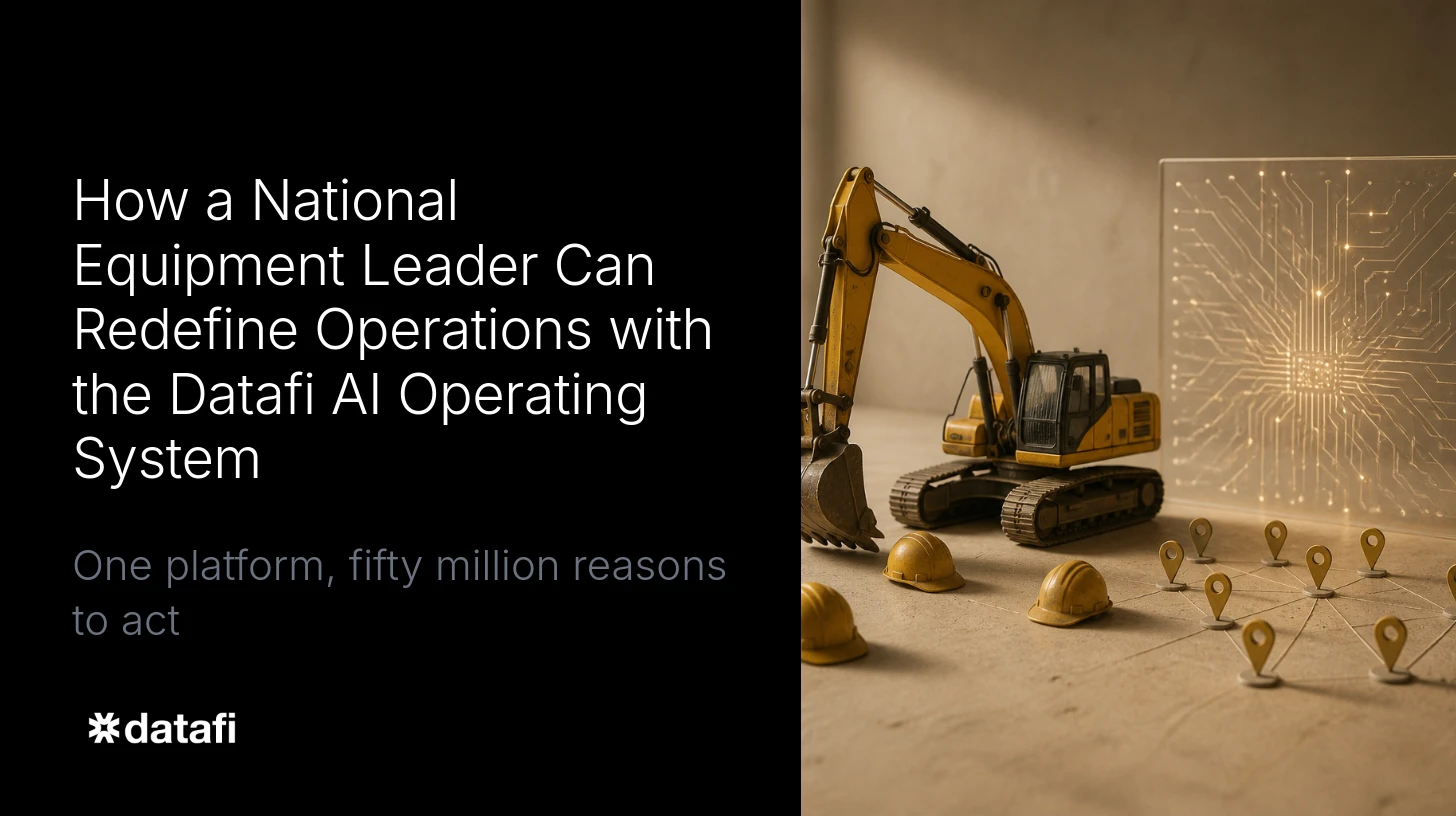
A leading construction equipment rental and technology company sits at the intersection of physical operations and data-rich technology. This story explores what becomes possible when that data is fully activated through a vertically integrated AI operating system.
The gap between useful AI and transformative AI is not model quality. It is architecture: whether the system has access to the full data ecosystem, operates within embedded governance, and is designed to solve hard business problems autonomously, not just answer questions.
AT A GLANCE
| Industry | Construction Equipment Rental & Technology |
| Scale | 385+ locations, national footprint |
| Employees | Large enterprise, multi-function workforce |
| Platform | Datafi AI Operating System |
| Opportunity | Projected economic outcomes based on Datafi deployment |
| Total Value | $50.2M projected annual impact (conservative baseline) |
THE OPPORTUNITY
A Data-Rich Company That Has Not Yet Unlocked the Full Power of Its Own Intelligence
This national equipment rental and technology company operates at a remarkable scale, managing thousands of machines across hundreds of locations while simultaneously building a proprietary telematics and fleet intelligence platform for its customers. The company generates enormous volumes of operational, financial, and sensor data every single day.
And yet, like virtually every enterprise today, the vast majority of that data sits in disconnected silos. Rental management systems do not speak to field service platforms. Telematics data is accessible to customers but not yet deeply wired into internal decision-making workflows. Finance, operations, and logistics teams each navigate their own reporting stacks. Analysts spend more time preparing data than acting on it.
This is not a data shortage problem. It is a contextual intelligence problem. The question is not whether the company has the data to solve its hardest operational challenges. It does. The question is whether there is an operating system capable of unifying that data, embedding it into autonomous workflows, and enabling every employee, from field technicians to the executive team, to act on it in real time.
“LLMs will only deliver transformative outcomes when they have full business context, access to the complete data ecosystem, and the ability to function in truly autonomous roles. Answering questions is table stakes. Solving hard business problems is the standard we hold ourselves to.” — Datafi Co-Founder & Chief Product Officer
WHY DATAFI
The Problem with Point Solutions and Disconnected AI
Over the past three years, this company has invested meaningfully in data infrastructure and begun exploring AI tools across various business functions. Those investments have produced real value. But they have also surfaced a structural limitation that is common across enterprises of this scale: when AI tools operate in isolation, without shared context, integrated data access, and embedded governance, they create islands of intelligence rather than a unified operating capability.
A chatbot that can answer questions about a single rental contract is useful. An AI agent that autonomously monitors the health of every machine in the fleet, cross-references historical failure patterns, coordinates with dispatch, adjusts maintenance scheduling, and surfaces an exception report to the right field supervisor before a breakdown occurs, that is transformative.
The difference between those two outcomes is not model quality. It is architecture. Specifically, it is whether the AI has access to the full data ecosystem, operates within an embedded governance layer that ensures compliance and data integrity, and is designed to solve problems rather than merely respond to prompts.
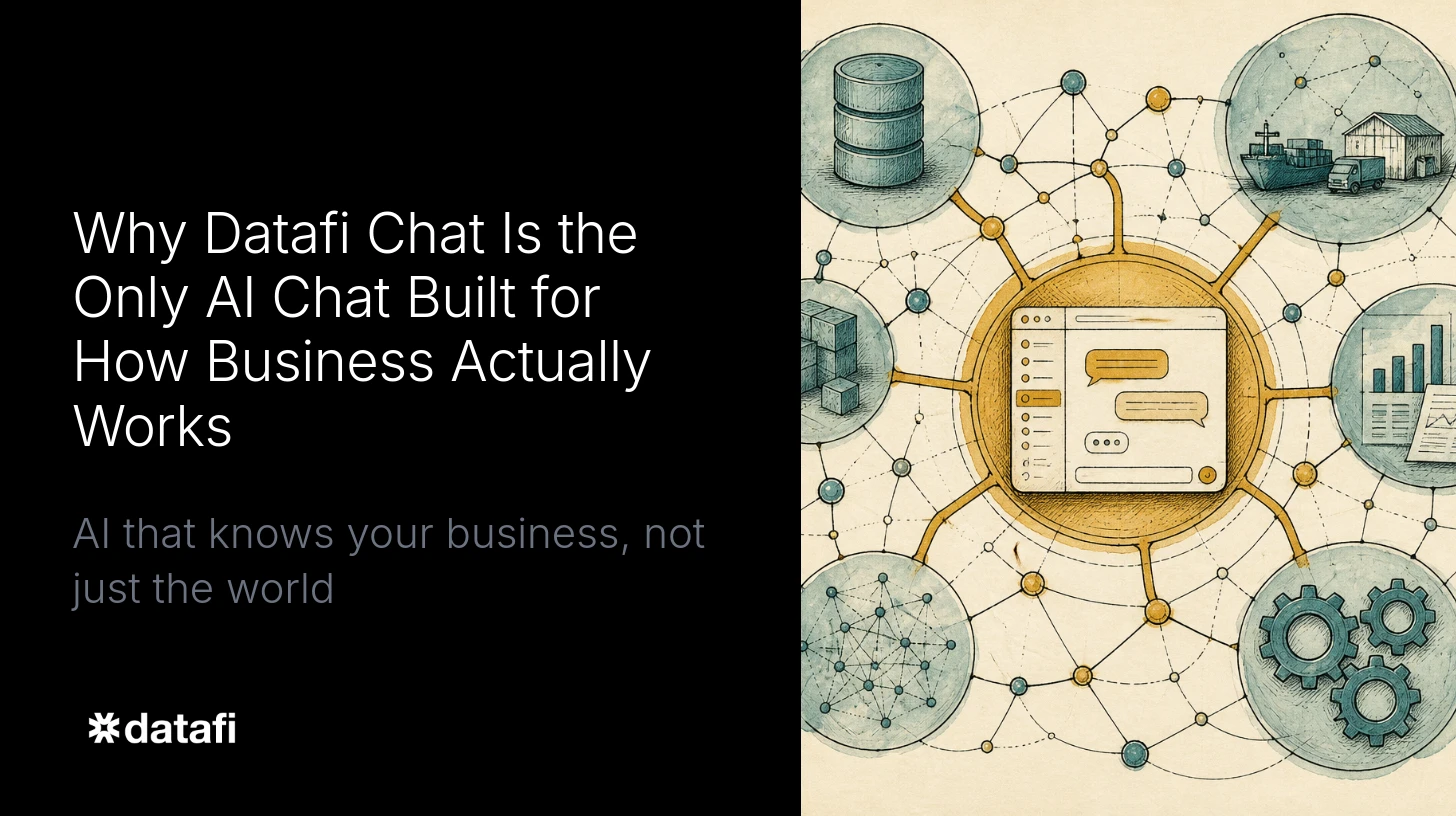
Datafi is purpose-built for this architectural requirement. As a vertically integrated AI operating system, Datafi unifies data access, governance, agent workflows, and a natural-language Chat UI into a single platform. Non-technical employees, field managers, dispatchers, and executives all interact with the same intelligence layer, calibrated for their role, without requiring data science expertise or custom tooling for every use case.
The Datafi Stack: How It Maps to This Business
| Component | Description |
|---|---|
| Chat UI | Natural language access for every employee: fleet managers, dispatchers, service technicians, finance teams, and executives. No SQL, BI tools, or data science expertise required. |
| AI Agents | Autonomous agents operate across predictive maintenance, utilization optimization, contract management, and customer intelligence workflows continuously and without human prompting. |
| Governance | Embedded data policies ensure that telematics data, customer contracts, and financial records are accessed appropriately by role and in compliance, at enterprise scale. |
| Data Ecosystem | Full connectivity across rental management, telematics, ERP, CRM, field service, and logistics systems, creating a single unified data foundation for all AI workflows. |
| Contextual Layer | The business context model: machine history, customer relationships, pricing logic, service SLAs, and operational rules all encoded as AI-accessible context, deepening over time. |
USE CASES & ECONOMIC OUTCOMES
Six Areas Where the Datafi AI Operating System Drives Measurable Value
The following table summarizes the primary use case domains, the mechanism through which Datafi creates value in each, and the estimated annual economic impact based on industry benchmarks for companies of comparable fleet size, location density, and operational complexity.
| Use Case | Description | Est. Annual Value |
|---|---|---|
| Predictive Maintenance & Asset Health | AI agents continuously monitor telematics signals, correlating engine diagnostics, usage hours, and historical failure patterns to predict component failures before they occur. | $14.2M |
| Fleet Utilization Optimization | Autonomous agents track real-time location, availability, and demand signals to dynamically rebalance fleet distribution, reducing idle time and improving rental yield per asset. | $11.8M |
| Contract & Customer Intelligence | AI agents analyze contract utilization, renewal signals, upsell opportunities, and at-risk accounts, enabling account managers to act on intelligence rather than hunt for it. | $9.1M |
| Dispatch & Logistics Intelligence | Datafi agents optimize delivery and pickup routing in real time, integrating traffic, technician availability, customer SLAs, and equipment readiness into a unified decision engine. | $7.4M |
| Strategic Planning & Executive Intelligence | Executive teams access cross-functional performance intelligence through natural language queries, enabling faster decisions on expansion, pricing, and capital allocation. | $4.9M |
| Workforce Productivity & Knowledge Access | Field technicians, service advisors, and branch staff access operational knowledge and process guidance through a natural language interface calibrated for non-technical users. | $2.8M |
ECONOMIC SUMMARY
Projected Annual Value: A Conservative Baseline
The estimates below represent a conservative baseline, not a ceiling. As Datafi’s contextual layer deepens over time, incorporating more business history, customer behavior, and operational patterns, the economic returns compound. The total reflects 60-70% adoption across relevant employee populations, a deliberately modest assumption for an initial deployment scenario.
| Value Driver | Mechanism | Annual Impact |
|---|---|---|
| Predictive Maintenance | Reduction in unplanned downtime, emergency repair costs, and fleet replacement cycles through early failure detection | $14.2M |
| Fleet Utilization | Improved asset yield through AI-driven rebalancing across locations, reducing idle inventory while meeting demand where it exists | $11.8M |
| Contract & Customer Intel | Accelerated renewals, reduced churn, and improved upsell conversion through autonomous monitoring of customer engagement and contract health signals | $9.1M |
| Dispatch & Logistics | Route and schedule optimization across delivery, pickup, and field service, reducing fuel, labor, and SLA breach costs | $7.4M |
| Strategic Planning | Faster, higher-confidence executive decisions on capital allocation, pricing, and expansion through unified cross-functional data access | $4.9M |
| Workforce Productivity | Reduction in time-to-answer for field and branch staff, faster onboarding, and elimination of redundant reporting workflows | $2.8M |
| Total Projected Annual Value | Conservative baseline across six primary use case domains, assuming 60-70% adoption across relevant employee populations | $50.2M |
THE DATAFI DIFFERENCE
Why a Vertically Integrated Stack Changes Everything
The distinction that matters most in enterprise AI is not which language model powers the system. It is whether the system has been architected to solve problems, not just answer questions. This requires three things working together simultaneously.
First, the AI must have access to the full data ecosystem, not a curated subset of it. Predictive maintenance agents that can only see telematics data but not maintenance history, parts inventory, or technician availability cannot make autonomous decisions. They can only surface alerts. Datafi’s data connectivity layer eliminates these boundaries.
Second, the AI must operate within embedded governance. At enterprise scale, ungoverned AI access to sensitive customer, financial, and operational data is not acceptable. Datafi’s governance layer enforces data policies at the point of access, ensuring that every agent and every employee query operates within appropriate compliance boundaries, without requiring separate governance tooling or manual oversight.
Third, the AI must have deep business context: the rules, relationships, history, and logic that make this particular company’s operations distinct from every other company running similar equipment. This contextual layer is what separates an AI that gives generic answers from one that gives the right answer for this customer, this machine, this contract, this market condition. Datafi builds that contextual layer as a core infrastructure component, not as a one-time prompt engineering exercise.
“Transformative outcomes from AI require systems that have the full context of the business, access to the complete data ecosystem, and the capacity to operate autonomously. That is not a future state. That is the standard Datafi is built to deliver today.” — Datafi, datafi.co
The Path Forward: From Pilot to Platform
Datafi’s deployment approach is designed to generate value within the first 90 days while building toward the full-platform outcome. The typical engagement begins with two to three high-impact use cases, predictive maintenance and fleet utilization being the most common entry points for equipment-intensive businesses, and uses those workflows to establish the data connectivity and governance foundation that all subsequent agents will rely on.
By month six, the contextual layer has accumulated enough operational history to begin surfacing compound insights that no single-domain tool can produce: the relationship between specific operator behaviors and maintenance intervals, the correlation between seasonal demand patterns at the regional level and optimal fleet rebalancing timing, the early signals that predict customer churn twelve weeks before contract expiration.
This is the compounding nature of an AI operating system versus a collection of AI tools. Each workflow generates data that enriches the contextual layer. Each enrichment makes every other agent more effective. The return on the platform investment grows over time rather than plateauing after initial deployment.
Datafi is building the Business AI Operating System for the enterprise: a vertically integrated data and AI platform with embedded governance, autonomous AI agents, and a Chat UI designed for every employee. Learn more at datafi.co.