


Series: How Life Sciences Leaders Are Putting AI to Work Across the Enterprise | Article 1 of 3
The data was always there. Petabytes of it, accumulated across decades of research, manufacturing, clinical operations, and commercial activity. For one of the world’s most complex life sciences organizations, a company operating across pharmaceuticals, medical devices, and consumer health in more than 60 countries, the data was never the problem. The problem was that the data could not see itself.
Research compounds lived in discovery platforms disconnected from clinical outcomes databases. Regulatory submission histories sat in document repositories that quality teams could only access through manual searches. Manufacturing batch records generated in one system had no automated pathway to adverse event monitoring in another. Commercial intelligence about market performance was assembled by hand, in spreadsheets, by analysts who spent most of their week gathering rather than thinking.
This is not an unusual story in life sciences. It is the story of almost every large organization in the sector. The difference is that this organization decided to stop accepting it.
The gap between insight and action in life sciences does not close because you deploy better models. It closes because you build an operating environment that allows AI to reason across the full landscape of your business, with governed access to every data domain.
The Context Problem at Enterprise Scale
When AI first arrived in enterprise life sciences, it arrived as a search tool. Natural language interfaces that let scientists query document repositories. Summarization engines that condensed clinical trial reports. Chatbots trained on internal knowledge bases that could answer questions about regulatory guidance. These tools were genuinely useful. They were also genuinely limited.
The limitation was not the underlying model. It was the context the model was allowed to see.
Ask an AI to summarize a clinical trial report and it will summarize it with precision. Ask it whether the safety signals in that trial are consistent with adverse event data from the post-market surveillance system, the batch records from the manufacturing facility that produced the compound, and the protocol amendment history from the last three sites to join the trial, and a summarization tool has nothing to offer. It has never seen those systems. It has no pathway to them. It cannot reason across them because it has no access to them.
This is the context problem. And for a life sciences enterprise managing the full arc from early research through commercial launch, the context problem is not a minor inconvenience. It is the primary constraint on what AI can actually accomplish.
What Full Business Context Changes
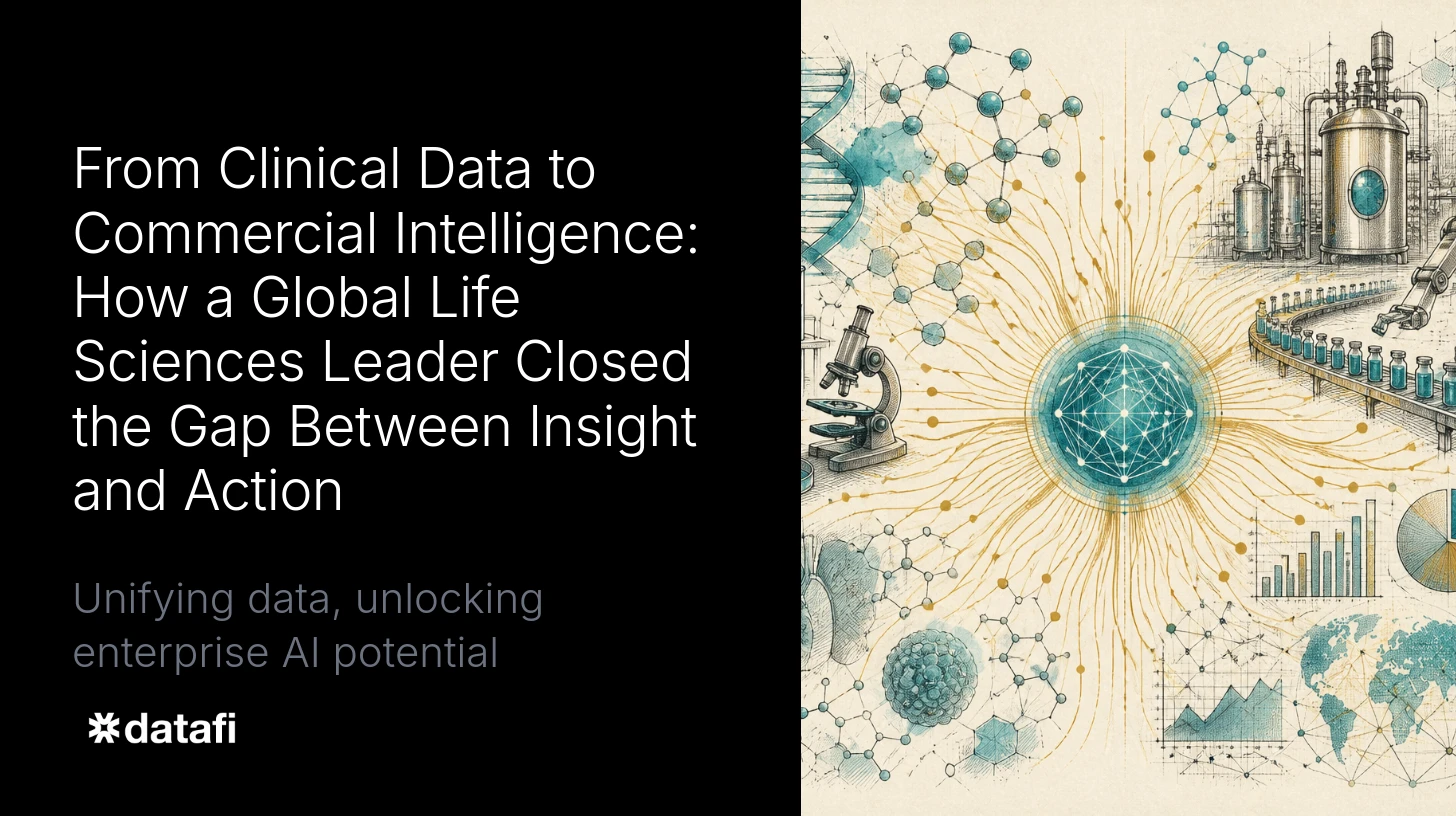
When this organization deployed Datafi’s Business AI Operating System, the architectural shift was not about switching models or upgrading compute. It was about building a governed, unified data layer that gave AI agents access to the complete operational picture for the first time.
R&D data. Clinical operations data. Regulatory submission history. Manufacturing quality records. Pharmacovigilance databases. Commercial performance signals. All of it connected, governed by role-based access controls, and made available to AI agents that could reason across the full landscape rather than answer questions from a slice of it.
The first impact was speed. Context assembly that previously required days of manual effort across disconnected systems collapsed into minutes. Research scientists preparing for portfolio review meetings stopped waiting for analysts to pull compound histories together. Clinical operations leaders stopped receiving trial status reports that were already forty-eight hours out of date by the time they landed in an inbox. Quality directors stopped building CAPA summaries by hand from eight different data sources.
But speed was only the surface of it. The deeper impact was the quality of reasoning that became possible when AI had the full picture.
When AI Can See Across the Enterprise
A safety monitoring team using Datafi identified a pattern that would not have been visible inside any individual system. Adverse event signals from the post-market surveillance database, cross-referenced against batch-specific manufacturing records and a cluster of protocol deviation reports from two clinical sites, pointed toward a process variable that warranted immediate investigation. No single system contained the pattern. The pattern only existed in the relationship between three systems that had never been connected before.
This is the difference between an AI that answers questions and an AI that solves problems. Answering a question requires access to the answer. Solving a problem requires access to the full operational context in which the problem lives, including the parts of that context that no one thought to ask about.
On the commercial side, Datafi enabled the organization’s market intelligence function to operate with a level of synthesis that manual processes could not approach. Real-world evidence, prescription trend data, payer policy shifts, competitive pipeline signals, and internal sales performance data were brought together into a governed analytical environment where AI agents could identify emerging market dynamics before they became visible in lagging indicators. Strategic planning teams stopped reacting to quarterly data and started operating with forward visibility that changed the nature of the decisions they were making.
The Governance Requirement That Cannot Be Compromised
It would be easy to describe this kind of data connectivity as simply a technical achievement. It is also a governance achievement, and in life sciences the governance dimension is not secondary to the technical one. It is equal to it.
GxP compliance, IP protection, audit trail requirements, and the regulatory framework governing clinical and manufacturing data all impose constraints that generic AI tools are not built to respect. A system that connects clinical trial data with manufacturing records and commercial intelligence is only valuable if it can do so in a way that maintains the integrity of each data domain, enforces role-based access at every layer, and produces a complete audit trail of every AI interaction with regulated data.
Datafi’s embedded governance architecture was not added to the platform as a compliance feature. It was built into the operating model from the ground up. Every AI interaction with regulated data in this organization is governed, logged, and auditable. The scientists, clinicians, quality professionals, and commercial leaders using the system are not navigating governance as a burden. They are operating within it as a designed condition of the environment.
Quantitative Benefits: What the Research Shows
The outcomes described here are consistent with a growing body of industry evidence on what unified, governed AI environments deliver in life sciences. The following ranges represent documented results from enterprise AI deployments across the sector, and reflect the scope of impact organizations can expect when AI operates with full business context rather than in isolated point solutions.
| BENEFIT AREA | IMPACT RANGE | WHAT CHANGES |
|---|---|---|
| Clinical Data Context Assembly | 70-85% faster | Days of manual reconciliation across 6-8 systems reduced to under 30 minutes |
| Trial Monitoring & Safety Signal Detection | 50-60% reduction in manual processing time | Cross-system adverse event patterns identified in real time vs. periodic manual review |
| Commercial Intelligence Cycle Time | 40-60% reduction | Market dynamics surfaced before they appear in lagging quarterly indicators |
| R&D Portfolio Decision Speed | 30-50% faster prioritization cycles | Compound and indication decisions grounded in synthesized internal and external data |
| Manufacturing Quality Cost | Up to 14x lower quality costs vs. peers | AI-enabled factories with connected data environments vs. siloed operations (McKinsey) |
What This Means for the Sector
The lesson from this organization’s experience is not that AI is finally ready for life sciences. It is that the preconditions for transformative AI have finally been met at scale. When AI operates with full business context, with access to the complete data ecosystem, within a governance architecture built for regulated environments, the outcomes are not incremental improvements on existing processes. They are capabilities that did not exist before.
The gap between insight and action, the chronic failure mode of data-rich but insight-poor life sciences organizations, does not close because you deploy better models. It closes because you build the operating environment that allows AI to reason across the full landscape of your business.
This organization closed that gap. The question for every life sciences leader reading this is whether they are building toward the same capability, or whether they are still waiting for the data to see itself.
Datafi is the Business AI Operating System for enterprise life sciences organizations. Learn more at datafi.co
Next in the series: The Regulatory Submission Problem Is Actually a Data Intelligence Problem