


Series: How Life Sciences Leaders Are Putting AI to Work Across the Enterprise | Article 3 of 3
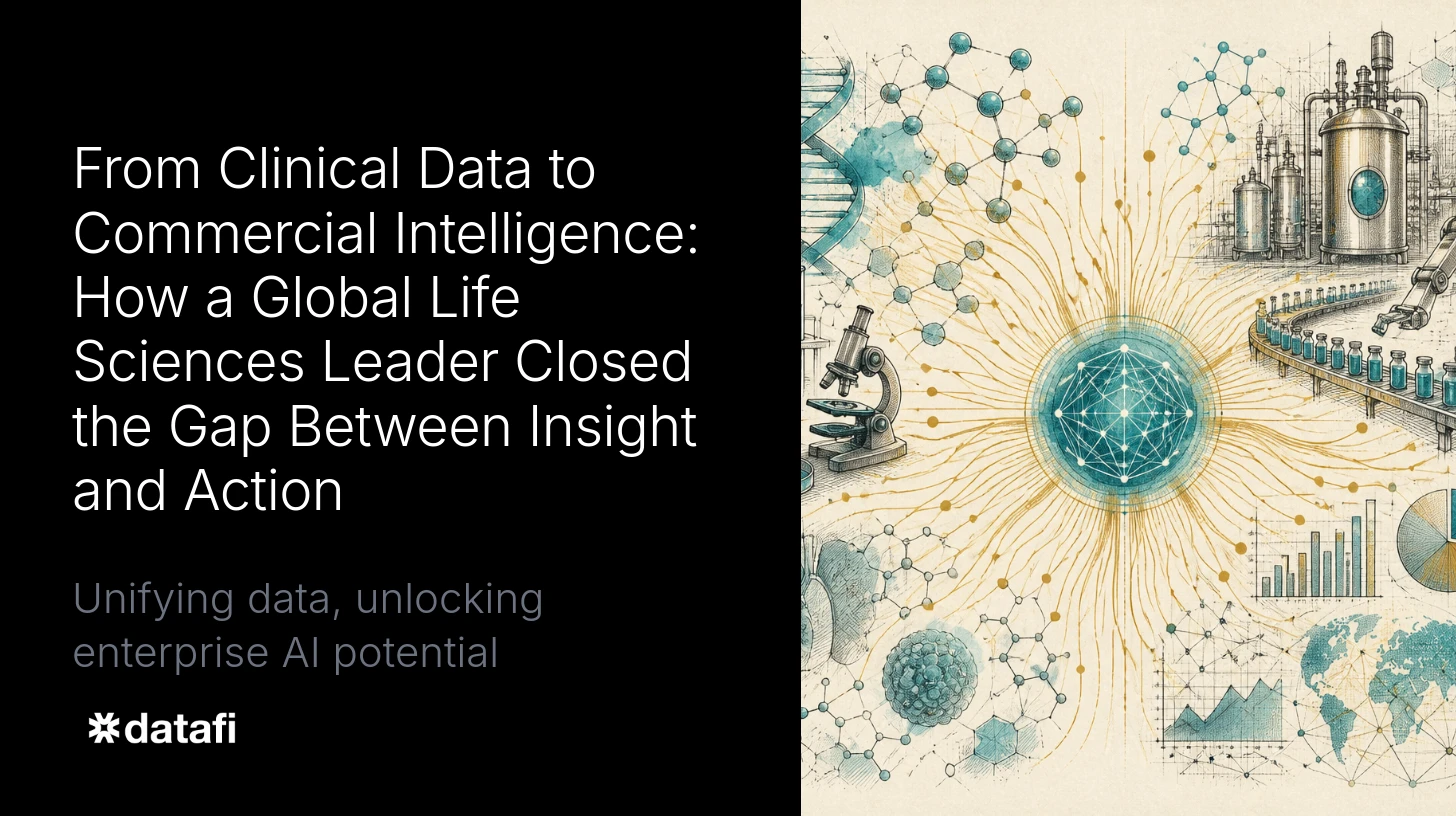
Every major life sciences organization is sitting on an insight that could change its trajectory. A compound that was deprioritized five years ago for reasons that no longer apply. A real-world evidence signal pointing toward a high-value indication that the clinical development team has not explored. A supply chain vulnerability whose leading indicators have been accumulating in operational data for months, waiting for someone to notice. A competitive intelligence pattern that, read correctly, would reshape how the commercial team is positioning in a key market.
The insight exists. The data that contains it exists. The organizations that would benefit from it exist. The missing element is not information. It is synthesis.
This is the challenge that defines the current moment for life sciences leaders who are serious about AI. Not whether AI can answer questions, because it clearly can. Not whether AI can summarize documents or extract structured data from unstructured text, because the evidence of that capability is everywhere. The defining challenge is whether AI can operate across the full landscape of an organization’s data, reason across the connections between domains that have never been connected before, and surface the insights that no individual, no team, and no siloed tool could find on its own.
For one global life sciences organization, that challenge became the central design question for their AI deployment. The answer they arrived at is instructive for every organization in the sector.
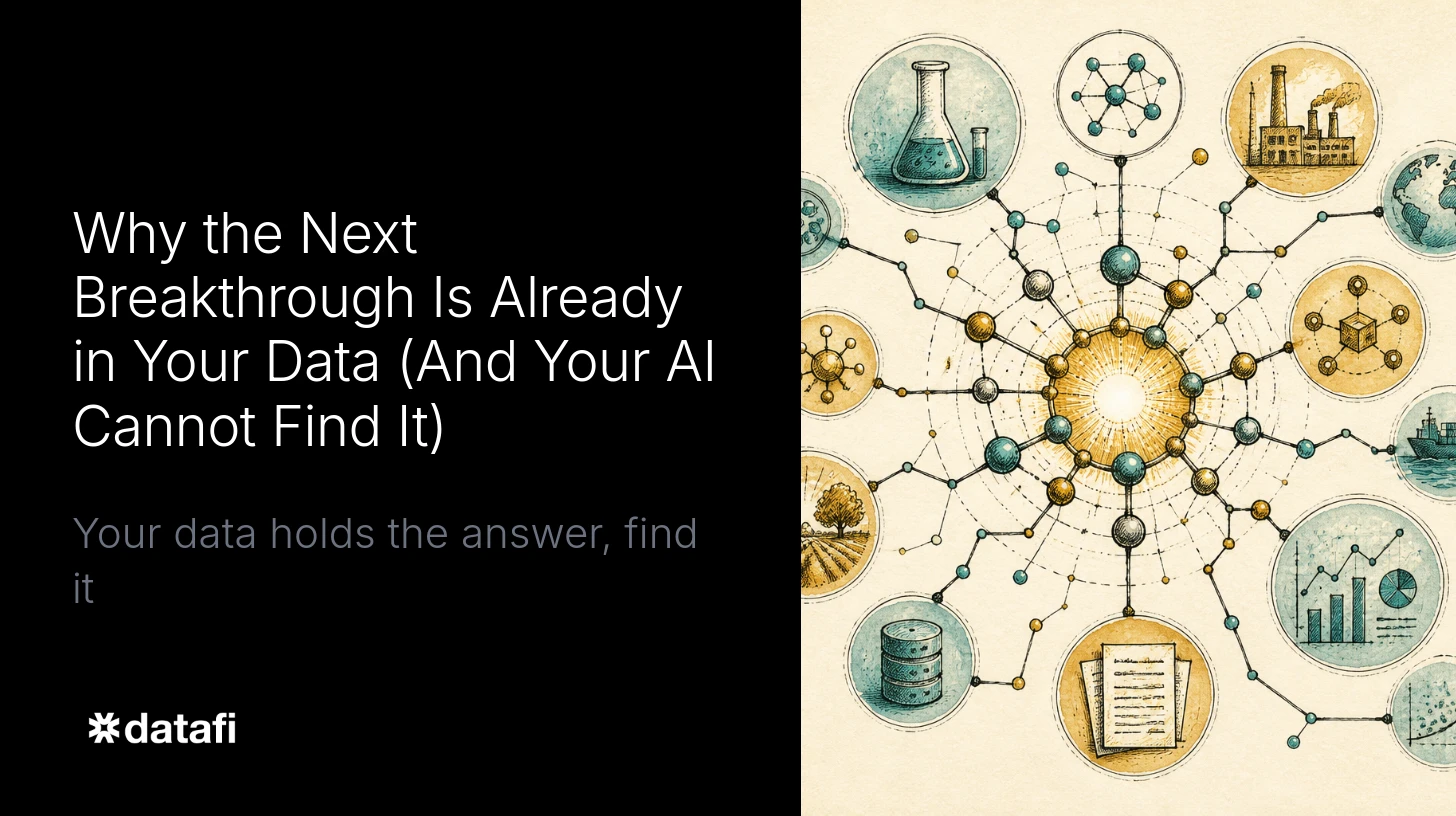
The next breakthrough in life sciences is not blocked by a lack of data. It is blocked by the inability to synthesize across data domains. Organizations that build a unified AI operating environment gain access to insights that no single function, team, or siloed tool could find on its own.
The Synthesis Gap
Life sciences organizations have more data than any human team can process. The average large pharmaceutical company operates across hundreds of internal data systems. External data streams, including real-world evidence, competitive intelligence, published literature, regulatory precedent databases, and market access signals, add layers of context that internal systems alone cannot provide.
The conventional response to this data abundance has been specialization. R&D teams develop deep fluency with research and clinical data systems. Regulatory teams become experts in submission and compliance data. Commercial teams build capability around market and sales intelligence. Each function develops the data competency it needs to perform its own work.
Specialization is an entirely rational response to information overload. It is also the structural mechanism through which the most valuable insights in a life sciences organization become invisible.
The insight that connects a real-world evidence pattern with an early-stage compound with a manufacturing capability with a market access opportunity does not live inside any single function’s data domain. It lives in the relationship between all of them. Specialization, almost by definition, produces organizations that are well-equipped to see the pieces and structurally incapable of seeing the whole.
This is the synthesis gap. And it is where the next breakthrough is hiding.
What Happened When the Walls Came Down
When this organization built a unified, governed data operating environment with Datafi, the first thing that changed was not what the AI could analyze. It was what the AI could see.
Research and development data that had never been in the same analytical environment as commercial performance data was now connected. Real-world evidence feeds that previously required manual integration projects lasting months were brought into the governed data layer and made available to AI agents alongside internal clinical and manufacturing data. Competitive intelligence signals that lived in external databases were connected to internal portfolio planning data in a way that allowed the AI to reason about market dynamics in the context of organizational capability rather than in isolation from it.
The results challenged assumptions the organization had held for years.
A portfolio review process that had been anchored to a standard prioritization model surfaced a compound that had been deprioritized based on an early-stage efficacy read. When the AI was given access to the current real-world evidence landscape, the competitive pipeline database, and the updated market access environment, the compound’s risk-adjusted opportunity looked materially different from how it had appeared in the original review. The insight was not hidden. It was simply unassemblable by a process that could only reason across the data it had been given. AI-driven approaches to portfolio prioritization, when applied across the full evidence landscape, have been shown to reduce time to preclinical candidate selection by up to 40 percent and lower early-stage development costs by 30 percent.
A supply chain risk team identified a vulnerability in a critical active pharmaceutical ingredient supply pathway that had no visible signal in the primary supply chain monitoring system. The signal existed in a combination of geopolitical news feeds, a supplier financial health database, and a manufacturing capacity utilization pattern that had been trending in a direction that, read in isolation, looked normal. Read together, it pointed toward a disruption risk that the team was able to address twelve weeks before the disruption would have occurred. Industry deployments of AI-driven supplier risk monitoring have reported a 15 percent reduction in API procurement costs and a 20 percent acceleration in contract cycle time in comparable environments.
A medical affairs team, working on a market access strategy for a recently launched product, can use AI synthesis across real-world outcomes data, payer policy history, and competitive reimbursement data to identify an evidentiary gap that, if closed, would materially strengthen the product’s formulary position in a high-value market segment. The analysis took hours. The same work, assembled manually from the same data sources, would have taken months and might not have surfaced the specific combination of signals that created the strategic opportunity.
The Democratization of Strategic Intelligence
One dimension of this story that deserves specific attention is who was doing the analysis.
In each of these cases, the insight was surfaced not by a specialized data science team running custom analytical workflows, but by functional professionals, portfolio planners, supply chain managers, medical affairs leads, who were using a Chat UI designed for non-technical users to interrogate a data landscape they had never been able to access directly before.
This is a structural shift in how strategic intelligence works in a life sciences organization, and its implications are significant. When advanced analysis requires a data science intermediary, the volume of questions that can be asked is constrained by the capacity of the data science team. The questions that get asked are the ones that the people who control the queue believe are worth asking. The insights that get surfaced are the ones that fit the analytical frameworks already in use.
When every functional professional has governed, natural-language access to the full data landscape, the volume of questions that can be asked is constrained only by organizational curiosity. The questions that get asked are the ones that the people closest to the business problems believe are worth asking. The insights that get surfaced include the ones that no one in the data science queue would have known to ask for.
For this organization, the impact of democratizing strategic intelligence was not just a faster analysis process. It was a different quality of organizational attention. Problems that would have remained invisible because no one with the right data access had thought to look for them were being identified by the people who had the context to recognize them and the authority to act on them.
Quantitative Benefits: What the Research Shows
The strategic outcomes described here are supported by a substantial and growing body of evidence from AI deployments across pharmaceutical R&D, supply chain, and commercial functions. The ranges below represent documented results from organizations that have moved beyond point-solution AI to unified, context-aware operating environments.
| BENEFIT AREA | IMPACT RANGE | WHAT CHANGES |
|---|---|---|
| R&D Portfolio Prioritization Speed | 40% faster time to preclinical candidate | AI synthesis across internal and external data; 30% cost reduction at early-stage (Nature Biotech 2025) |
| Drug Discovery Timeline Compression | 40-60% faster vs. conventional methods | AI-assisted projects vs. traditional development timelines across preclinical and early clinical stages |
| API Supply Chain Risk Management | 15% cost reduction; 20% faster contracts | AI-driven supplier screening and risk monitoring vs. manual procurement processes |
| Clinical Trial Cost Reduction | Up to 70% per-trial savings | AI-optimized recruitment, site selection, and real-time monitoring (Scilife 2024) |
| Commercial Intelligence Cycle Time | 20-30% improvement in marketing effectiveness | Early adopters with unified real-world evidence and market data environments vs. siloed analysis |
The Compounding Effect
There is a compounding dynamic at work in life sciences organizations that build this kind of AI capability that is easy to understate.
The first insights surfaced by a unified AI operating environment create organizational confidence that accelerates the use of the capability. As more functions begin operating with access to the full data landscape, the breadth of questions being asked increases. As the breadth increases, the probability of surfacing non-obvious connections, the patterns that live in the relationships between data domains rather than within them, increases. As those connections are surfaced and acted on, the evidence base that justifies further investment in the capability grows.
Organizations that build this capability early do not just develop a faster version of their existing analytical processes. They develop a structural advantage in the quality and speed of the decisions they make, and that advantage compounds over time as the organizational capability for AI-driven synthesis deepens.
McKinsey estimates that generative AI alone could deliver $60 to $110 billion in annual value across the pharmaceutical sector. The organizations positioned to capture that value are not the ones waiting for better models. They are the ones building the operating environment that allows AI to reason across the full landscape of the business.
The next breakthrough was always in the data. Now there is an AI that can find it.
Datafi is the Business AI Operating System for enterprise life sciences organizations. Learn more at datafi.co