



Series: How Life Sciences Leaders Are Putting AI to Work Across the Enterprise | Article 2 of 3
Ask any head of regulatory affairs at a major pharmaceutical or medical device company to describe their biggest operational challenge and the answer will almost never be ‘we don’t understand the requirements.’ Regulatory teams at sophisticated life sciences organizations understand the requirements with precision. They know the submission formats, the evidentiary standards, the agency expectations, and the consequences of getting it wrong.
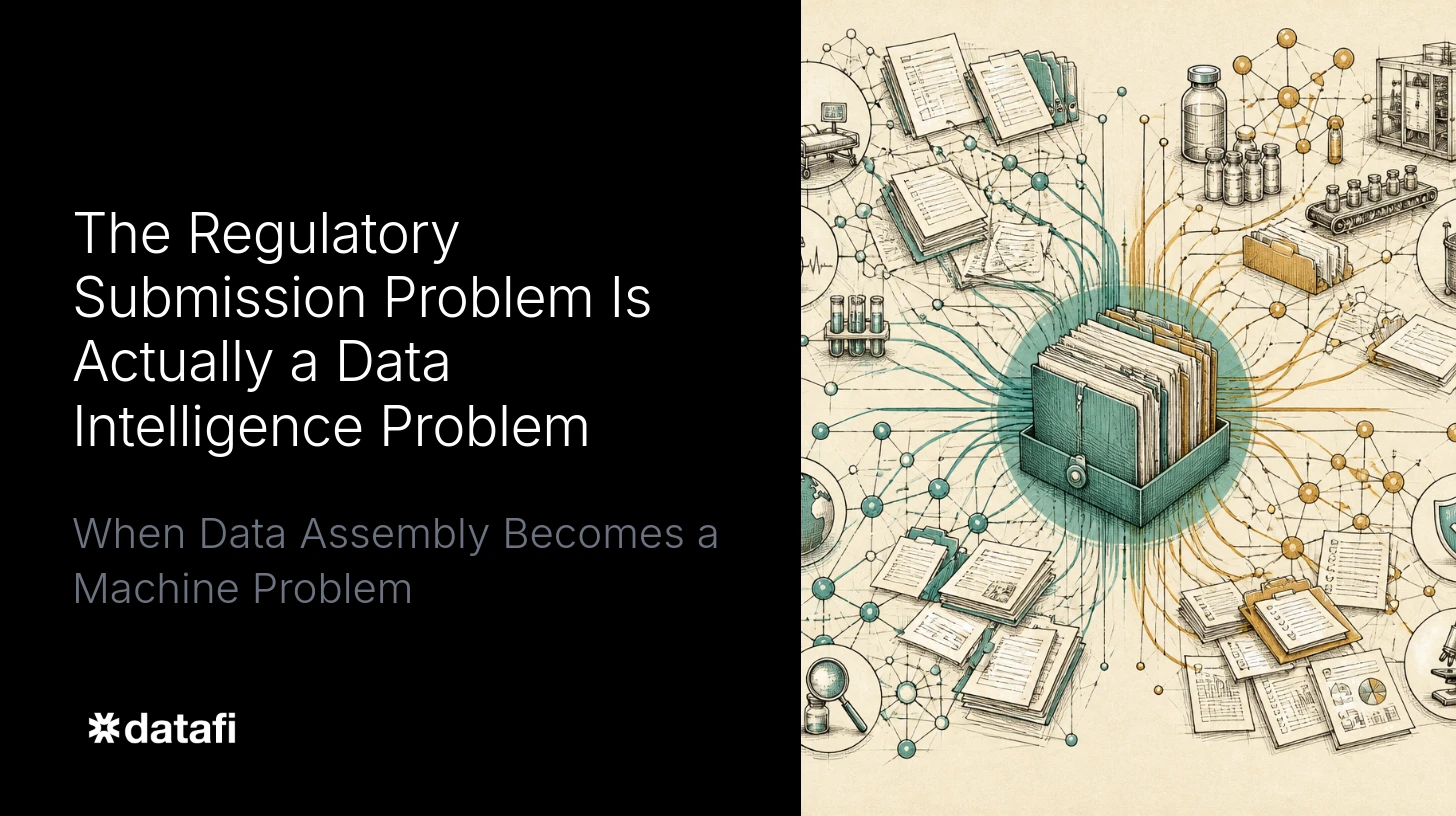
The problem is not knowledge. The problem is assembly.
A single regulatory submission for a new drug application can draw on thousands of documents spanning multiple years of clinical development, manufacturing validation, nonclinical research, and labeling history. Those documents live in a minimum of six or eight distinct systems, maintained by teams across R&D, clinical operations, quality, and manufacturing, each of which has its own data architecture, its own naming conventions, and its own version control practices. The regulatory affairs team responsible for the submission does not own any of those systems. They are dependent on every one of them.
This is the regulatory submission problem. And it is, at its core, a data intelligence problem.
The regulatory submission bottleneck is not a knowledge problem or a complexity problem. It is a data assembly problem, and AI that operates across the full data ecosystem, not just fragments of it, is what finally makes it solvable.
The Assembly Bottleneck
For one global life sciences organization managing a portfolio of pharmaceutical and medical device products across dozens of regulatory jurisdictions, the submission assembly process was the single most resource-intensive and schedule-sensitive activity in the regulatory function. Not review. Not strategy. Not agency interaction. Assembly.
A typical major submission required weeks of pre-submission data gathering across systems that were never designed to communicate with each other. Clinical data from electronic data capture platforms had to be reconciled against protocol amendment histories stored in a clinical trial management system. Adverse event summaries from the pharmacovigilance database had to be cross-referenced against manufacturing deviation records in the quality management system. Reference standards from previous submissions had to be located, validated for current applicability, and formatted for the new submission context.
Every one of these steps was manual. Every one of them created a sequencing dependency that added time to the critical path. And every one of them was a potential source of inconsistency, because the humans performing the assembly were working from their own understanding of what had changed since the last submission, not from a governed, real-time view of the current state of the data.
The submission timelines that resulted were not a reflection of regulatory complexity. They were a reflection of data fragmentation. The cost of that fragmentation is measurable: industry analysis estimates that the pharmaceutical sector loses billions of dollars annually in delayed approvals and extended patent-protected revenue windows, with a significant portion of that delay traceable not to science but to submission preparation.
What AI Gets Wrong Without Full Context
The first wave of AI tools applied to regulatory workflows did not solve the assembly problem. They moved it.
Summarization tools could condense a clinical study report in minutes. But they could not tell you whether the safety language in that report was consistent with the adverse event data in the pharmacovigilance system, because they had never seen the pharmacovigilance system. Document retrieval tools could surface relevant prior submissions when given the right query. But they could not identify which sections of those prior submissions were still current and which had been superseded by manufacturing changes or protocol amendments in systems the tool had no access to.
The result was AI-assisted work that was faster in individual steps and as fragmented as ever in the aggregate. Regulatory professionals were still assembling the context themselves. The AI was helping them process it once assembled, but the assembly, the most time-consuming and error-prone part of the process, remained entirely human.
This is the failure mode of AI that operates on fragments. It optimizes the pieces. It cannot see the whole.
A Different Starting Point
When this organization deployed Datafi’s Business AI Operating System across its regulatory function, the starting point was not which regulatory documents to connect to the AI. The starting point was the complete data ecosystem: every system that held data relevant to the regulatory picture, connected into a single governed operating environment.
Clinical trial management. Electronic data capture. Pharmacovigilance. Quality management. Manufacturing execution. Document management. Prior submission archives. Reference standard libraries. All of it connected, with role-based governance applied at every layer to ensure that access to regulated data remained controlled and auditable regardless of how the AI was used.
From that foundation, the nature of what AI could do in the regulatory function changed completely.
AI agents operating across the full data landscape could identify consistency issues between a clinical summary document and the underlying adverse event database before the document ever reached a reviewer. They could surface all manufacturing deviations from a relevant time window alongside the corresponding regulatory correspondence history, assembled in a governed workspace rather than extracted from eight systems by hand. They could generate a submission gap analysis, identifying what evidence existed, what was still needed, and where the data to close the gap already lived in internal systems that regulatory teams had not known to look in.
The assembly problem did not disappear. It was solved by making it a machine problem rather than a human one. Documented results from comparable deployments in the sector confirm the scale of the shift: AI-assisted clinical study report authoring has reduced first-draft preparation time from 180 hours to 80 hours while cutting document errors by 50 percent. End-to-end submission timeline compression of 30 to 40 percent is now achievable when data assembly is automated across the full evidence chain.
The Compliance Architecture That Makes It Possible
It is worth being explicit about what makes this kind of AI application viable in a regulated environment, because the governance requirements in pharmaceutical and medical device regulatory affairs are not negotiable constraints that must be worked around. They are the operating conditions that the system must be built to satisfy.
GxP requirements govern data integrity across the drug development lifecycle. 21 CFR Part 11 establishes standards for electronic records and signatures. ICH guidelines shape the evidentiary requirements for global submissions. A system that connects clinical, manufacturing, and pharmacovigilance data for AI-driven analysis must do so in a way that maintains the integrity of each data domain, produces a defensible audit trail of every AI interaction with that data, and enforces access controls that reflect the organizational and regulatory boundaries governing who can see what.
Datafi’s governance architecture was designed from the ground up for this operating environment. Audit trails are not a reporting feature added on top of the AI layer. They are a structural property of every AI interaction with governed data. Attribute-based access is not a filter applied after the fact. It is enforced at the data connection level, before any AI agent ever encounters the data.
For regulatory affairs teams, this architecture changes what AI-assisted work looks like in practice. The professionals using the system are not managing a compliance risk created by AI access to regulated data. They are operating within a compliance framework that was built to support exactly that access.
Quantitative Benefits: What the Research Shows
The performance improvements described here draw on documented outcomes from AI deployments in pharmaceutical and medical device regulatory environments. The ranges below reflect what is achievable when data assembly is treated as a machine-solvable problem rather than a human coordination task.
| BENEFIT AREA | IMPACT RANGE | WHAT CHANGES |
|---|---|---|
| Clinical Study Report Authoring | 55% reduction in drafting time | First-draft time from 180 hours to 80 hours; document errors reduced 50% (McKinsey-Merck) |
| End-to-End Submission Timeline | 30-40% compression | From evidence gathering through submission-ready package across all data domains |
| Pharmacovigilance Case Processing | 50-60% reduction in manual processing | AI automation of safety report assembly and consistency checking across systems |
| Regulatory Query Response Time | 40-60% faster | Cross-system evidence assembly for HAQ and agency queries that previously required weeks |
| Submission Error & Rework Rate | 50% reduction in errors | AI-driven consistency checks across clinical, manufacturing, and safety data before review |
Submissions as a Strategic Capability
The downstream impact of solving the assembly problem is not just faster submissions. It is a regulatory function that can operate strategically rather than reactively.
When regulatory teams are no longer spending the majority of their capacity on data assembly, they are available for the work that creates competitive advantage: proactive engagement with agency expectations, early identification of submission risks while there is still time to address them, cross-portfolio analysis of regulatory precedents that can inform development decisions upstream. When AI agents can maintain a continuous, governed view of the evidentiary landscape for every asset in development, regulatory intelligence becomes a real-time organizational capability rather than a periodic deliverable.
For this organization, regulatory affairs moved from being a downstream function that processed the output of development to being an upstream intelligence function that shaped it.
That shift was made possible by AI that could see the full data landscape and reason across it with the rigor that regulated environments demand.
The regulatory submission problem has always been a data intelligence problem. Life sciences organizations that recognize that distinction are the ones building the capability to solve it.
Datafi is the Business AI Operating System for enterprise life sciences organizations. Learn more at datafi.co
Next in the series: Why the Next Breakthrough Is Already in Your Data (And Your AI Cannot Find It)