
Every enterprise wants more from data and AI. Leaders are being asked to reduce costs, improve productivity, move faster, and make better decisions in environments that are only becoming more complex. The opportunity is real, but so is the execution risk. Many organizations assume the logical path is to build an internal platform that combines data access, governance, AI tooling, and workflow automation. On paper, that sounds like control. In practice, it often becomes a costly, multiyear effort with uncertain adoption and a growing long-term maintenance burden.
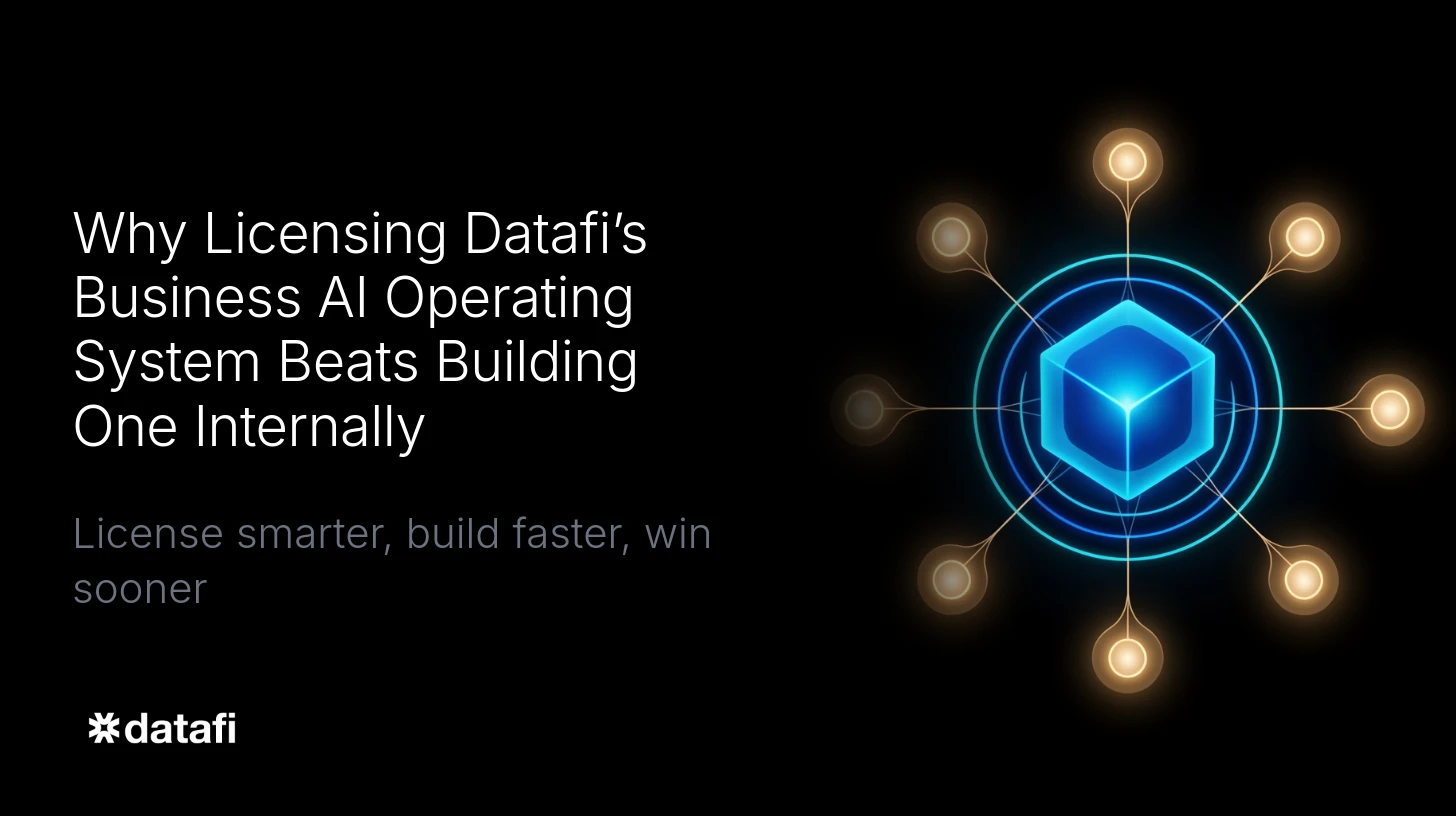
Most internal AI platform efforts underestimate scope, timeline, and total cost of ownership. Licensing a purpose-built Business AI Operating System gives enterprises a faster, lower-risk path to production-grade AI that spans data, governance, and real workforce workflows.
What businesses actually need is not another dashboard, model endpoint, or isolated chatbot. They need an operating system for business AI: one that unifies the full data ecosystem, enforces policies and controls, and gives every employee a simple way to interact with data and intelligent workflows. That includes frontline teams, analysts, operations leaders, planners, and executives. When this foundation is in place, organizations of any size can create a unified data experience and workflow efficiencies for every employee while using AI agents and workflows to improve performance in predictive maintenance, asset management, operations optimization, passenger experience, strategic planning, and more.
This is where the difference between licensing Datafi and building internally becomes clear. A comparable internal effort is rarely just a technology project. It is a platform program that requires deep expertise across data engineering, security, governance, AI orchestration, user experience, product design, and enterprise change management. Teams must connect structured and unstructured data sources, reconcile inconsistent definitions, manage permissions, create lineage and trust, select and govern models, build orchestration and monitoring, and then package all of that inside an experience that nontechnical users can actually adopt.
Most internal build efforts underestimate the scope. An LLM alone does not create enterprise value. To move beyond basic question answering, the system needs access to the complete data ecosystem and the full context of the business. It must understand entities, relationships, business rules, process states, permissions, and operational objectives. It needs a contextual layer that enables complex agents and workflows to reason correctly and act safely. Without that layer, AI produces interesting outputs, but it does not consistently solve hard business problems.
The timeline gap is just as important as the technology gap. Internal teams can often build an impressive pilot in a matter of months, but turning that pilot into a trusted enterprise capability is a different challenge entirely. Production readiness means hardening security, governance, observability, user access, model evaluation, workflow controls, and support processes. It means integrating new systems, managing version changes, and continuously adapting as the model landscape evolves. What begins as a fast proof of concept often turns into a multiyear platform effort before broad business value is realized.
Cost follows the same pattern. The visible cost of an internal build is the initial team and infrastructure. The hidden cost is everything that comes after: integration work, policy enforcement, UI refinement, support, vendor changes, model upgrades, monitoring, regression testing, training, and ongoing platform operations. There is also a major opportunity cost. Highly capable internal teams end up spending time rebuilding commodity platform components rather than focusing on the workflows, analytics, and operating improvements that actually differentiate the business. Over time, that can make the internal option more expensive than it first appeared, even before considering delay in time to value.
Failure risk is another factor that is often underweighted. Many internal AI efforts fail not because the model is weak, but because the operating environment is incomplete. Data remains fragmented. Policies are inconsistent. Users do not trust outputs. The interface is built for technical experts rather than the broader workforce. Workflows stop at insight and never reach action. In that state, adoption stalls. The organization is left with a patchwork of tools, partial integrations, and isolated experiments that are difficult to scale and expensive to maintain.

At Datafi, we see customers increasingly wanting to use AI in more critical thinking, workflow automation, and analytical roles, not just as a conversational helper. That requires more than retrieval and summarization. It requires a vertically integrated data and AI stack with governed access to the enterprise data ecosystem, policy-aware controls, and a Chat UI designed for nontechnical users. It requires a platform that can support broad enterprise adoption while also enabling deeper autonomous workflows. That is the difference between AI that answers questions and AI that participates in the business.
Licensing the Datafi platform gives organizations a faster, lower-risk path to this outcome. Instead of assembling infrastructure from the ground up, customers start with a purpose-built operating system that already connects data, context, governance, and user experience. They can focus on the areas where their expertise matters most: defining business objectives, improving workflows, and deploying AI where it creates measurable operational value. That accelerates time to value while reducing technical uncertainty and organizational friction.
The long-term total cost of ownership also favors licensing in most cases. With Datafi, the platform provider absorbs much of the ongoing burden of maintaining the core operating system, including platform evolution, model compatibility, architecture improvements, and reusable capabilities across use cases. Customers still shape their business logic and workflows, but they do not carry the full cost of owning every foundational layer forever. The result is more predictable economics and a lower-risk path to enterprise scale.
There is also a strategic advantage in standardization. When a company builds internally, use cases often emerge as custom projects that are difficult to extend across teams. When a company licenses a unified platform, the contextual layer, governance framework, and user experience become reusable enterprise assets. That makes it easier to move from one successful workflow to many, from one team to the full organization, and from isolated productivity gains to meaningful operating leverage.
Our perspective on this is grounded in real experience with data and AI implementation. Transformative outcomes do not come from giving a model access to a single dataset or wrapping a chatbot around a warehouse. They come from enabling AI to action data in context, with the right controls, and inside the real workflows of the business. LLMs will need to know the full context of the enterprise, access the complete data ecosystem, and function in increasingly autonomous roles if they are going to solve hard business problems at scale.
For most organizations, building that foundation internally is not the best use of capital, time, or talent. Licensing Datafi offers a more practical path: lower upfront complexity, faster deployment, lower failure risk, and a stronger long-term cost profile. Most importantly, it gives businesses what they actually need from AI: a system that helps people and intelligent agents work together to solve problems, improve operations, and create lasting advantages.