


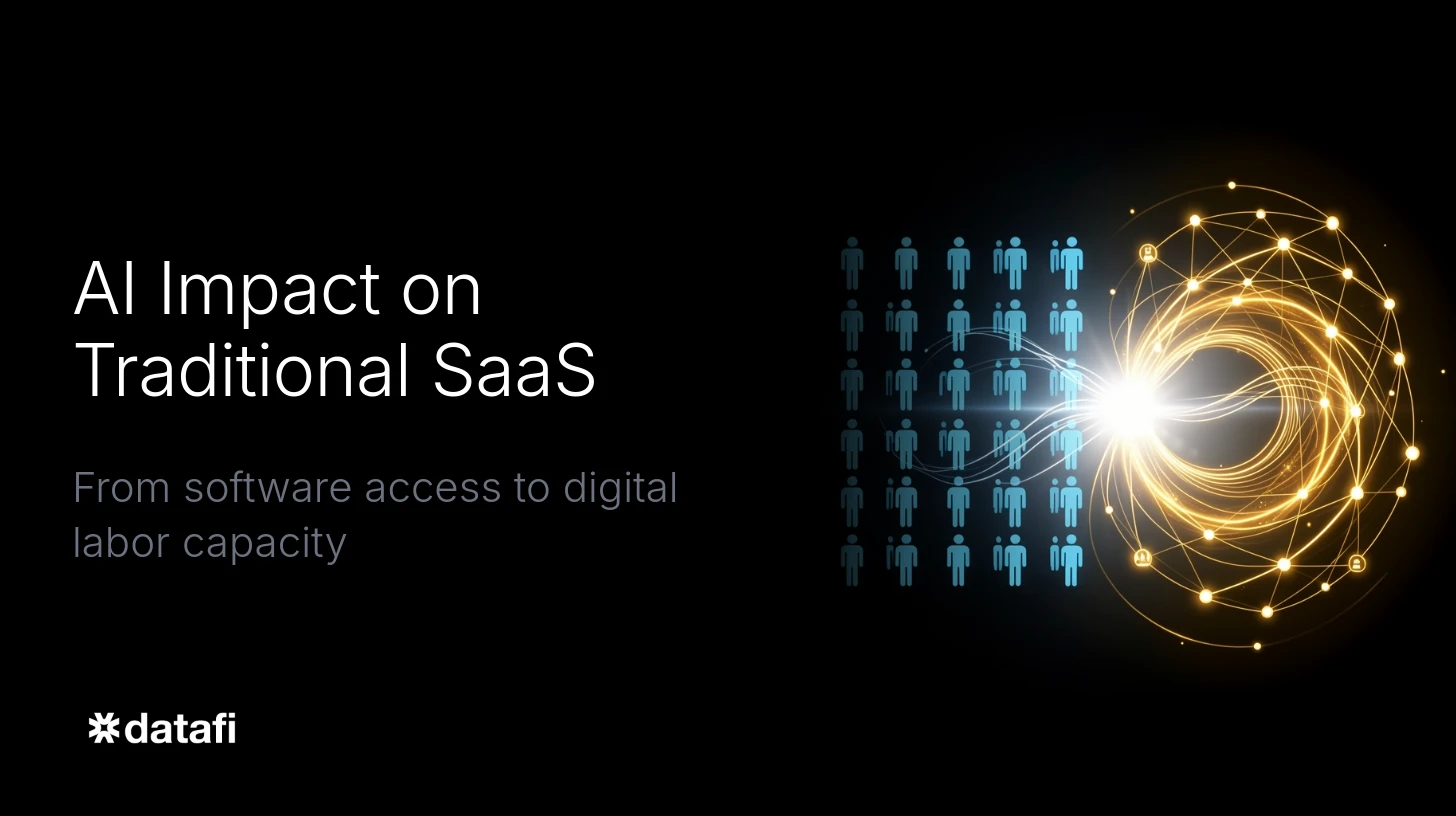
AI pushes enterprise software away from “a tool a human uses” toward “digital labor that does work.” That single shift rewires both the unit economics and the unit of value, which is why you are already seeing major vendors introduce hybrid pricing (seats plus consumption) and new “wallets,” credits, and metering constructs.
The fundamental shift in enterprise software is from monetizing access (seats, modules, tiers) to monetizing execution (actions, workflows completed, outcomes delivered), and every major vendor’s pricing strategy is already reflecting this transition.
For enterprise SaaS providers

The unit of value shifts from seats to work performed. Traditional enterprise SaaS monetized access: users, modules, tiers, and feature gates. AI monetizes execution: actions, conversations, documents processed, workflows completed, and eventually outcomes. You can see the market moving in this direction in the way leading platforms are pricing agentic capability. Salesforce explicitly positions Agentforce as “digital labor” and offers consumption models like Flex Credits (metered by “Actions” an agent executes) or per-conversation pricing, alongside an agent user license. Their pricing page even defines how an “Action” draws from a credit pool and lists action costs in credits.
A hybrid model becomes the default: base AI included, premium AI metered. SaaS vendors are learning that if they gate all AI behind a high add-on, adoption slows, and their competitor’s “good enough AI” becomes a retention wedge. So the packaging pattern is: include baseline AI broadly to protect the core subscription, then meter the expensive or high-value workloads. SAP is very explicit about this split: it describes “Base AI” as included in standard cloud subscriptions without additional cost, while “Premium AI” services are powered by “AI Units” for more advanced use cases. SAP’s Joule base entitlement is even shown with a USD 0.00 monthly price, reinforcing the “baseline is free, premium is monetized” logic.
Seat pricing does not disappear, but it gets demoted. Copilots that augment humans still map cleanly to per-user pricing, especially when the primary benefit is productivity in a user’s daily tools. Microsoft’s commercial positioning still anchors heavily on per-user Copilot licensing, for example “Supercharge your plan with Microsoft 365 Copilot for $30.00 user/month” on enterprise plan pages. At the same time, Microsoft’s own Copilot pricing page distinguishes between “Copilot Chat” included for eligible customers and “agents” that are explicitly metered, and it notes that using agents requires an Azure subscription. That is the hybrid model in plain language: access plus metered execution.
Gross margin stops being “mostly fixed” and becomes an operational discipline you productize. Classic SaaS has high gross margins because serving one more user is cheap. AI flips that: inference and retrieval add real variable cost. That changes how vendors build, sell, and operate product.
-
Metering becomes a core platform capability, not a billing back-office detail. Salesforce’s “Digital Wallet” concept is a good example of turning consumption visibility into a first-class product surface for customers.
-
Vendors need levers to protect margin (routing to cheaper models, caching, response shaping, policy controls), which drives investment in an “AI control plane” that is itself monetizable. Microsoft’s Copilot pricing page highlights a “Copilot Control System” with enterprise data protection, IT controls, agent management, and analytics to measure usage and ROI.
-
Customers demand predictability. When usage drives cost, finance teams want guardrails, alerts, and forecasting. That pushes SaaS toward credit pools, precommit tiers, and contract constructs that look more like cloud consumption than like pure software licensing.
Bundling and repackaging accelerates because AI features are hard to evaluate line-by-line. In the old world, a feature checklist could justify a tier. In the AI world, a lot of value is emergent and workflow-specific, so vendors simplify the offer and shift differentiation to outcomes and ecosystem. Microsoft’s move to bundle specialized Copilots for Sales, Service, and Finance into Microsoft 365 Copilot (starting October 2025) is a concrete example of “bundle the capability, then expand through agents and usage.”
The moat moves up the stack: from UI and CRUD features to proprietary context and executable workflow. AI rapidly commoditizes “nice UX,” reporting, and a lot of horizontal features. What becomes defensible is:
-
Trusted enterprise context: permissions, data lineage, high-quality grounding, and strong connectors.
-
Workflow authority: the right to take action in the system of record, not just answer questions. Vendors that can safely let agents create, read, update, and delete business objects win more budget because they are selling throughput, not interface.
-
Governance and safety: audit trails, approval flows, policy enforcement, and reproducible evaluation.
AI also changes distribution: the assistant becomes the new UI layer. As more work starts in chat or agent surfaces, the underlying SaaS risks being “headless” infrastructure. That threatens vendors who rely on UI lock-in, and it rewards vendors who expose robust APIs, tool schemas, and governance for agent actions. Practically, every enterprise SaaS provider will need an “agent-ready surface area” and a partner ecosystem for agent skills, because customers will demand cross-system automation.
For enterprise systems integrators

The billable-hour implementation core gets compressed. SIs historically monetized complexity: requirements gathering, configuration, customization, integration, test, documentation, training, and cutover. AI can accelerate many of those labor-heavy steps (drafting requirements, generating mappings, producing test cases, creating documentation, and even generating code and flows). That does not eliminate integration work, but it reduces the duration and staffing mix of projects, pressuring time-and-materials revenue.
A new recurring revenue center emerges: operating and improving agentic systems. As enterprise customers deploy agents that can take actions, they inherit a new operational problem: agents degrade, policies change, data shifts, and failures have real business impact. This creates SI opportunities that look like managed services, not projects:
-
“AI operations” for the enterprise: monitoring, evaluation, prompt and tool changes, regression testing, incident response, and governance.
-
Consumption and value management: forecasting and optimizing usage units, which matters because many vendors are introducing burn-down and no-rollover constructs. ServiceNow’s guidance around Now Assist consumption forecasting is a good illustration: it describes a burn-down model tied to contract anniversary dates and explicitly notes that unused assists are forfeited at reset. An SI that helps a customer forecast, instrument, and steer consumption is protecting both ROI and budget predictability.
-
Data readiness and semantic alignment: AI performance is gated by knowledge quality, taxonomy, permissions, and process definitions. That is SI terrain, but it needs to be sold as an ongoing capability, not a one-time data migration.
SIs must productize their expertise or they get squeezed. If implementation timelines shrink, the only way to sustain margins is to shift from “labor resale” to “IP plus services.” Expect more of the following:
-
Vertical accelerators: reusable agent templates, process blueprints, evaluation suites, compliance packs, and connectors, sold as subscription add-ons to the SI relationship.
-
Industry-specific “agent catalogs”: libraries of vetted skills (for example, claims triage, procurement exceptions, IT incident remediation) that can be deployed across multiple clients with less reinvention.
-
Governance frameworks as a deliverable: model risk management, auditability, and policy enforcement.
Pricing models move toward outcome-based and shared-risk constructs. As AI makes delivery faster, customers will resist paying for headcount. SIs will respond with fixed-fee, milestone, or KPI-linked pricing, sometimes paired with ongoing managed services. A plausible future pattern is: fixed fee to deploy an agent portfolio, then a monthly run fee tied to adoption and reliability metrics, and possibly a gainshare component tied to measurable throughput or cost reduction.
Talent models change in a very specific way: fewer juniors, more high-leverage experts. If AI tools handle more of the drafting and repetitive build steps, utilization-based pyramids break. Competitive SIs will rebalance toward architects, domain SMEs, security and governance specialists, and engineers who can build robust tool surfaces and evaluation harnesses. They will also invest aggressively in internal AI to increase consultant throughput, because internal productivity becomes the only way to defend margins when clients expect faster delivery at lower cost.
SaaS vendors will encroach on SI territory, and SIs will counter by owning cross-platform outcomes. Vendors are already baking in guided setup, prebuilt copilots, and partner enablement. ServiceNow’s Now Assist positioning emphasizes it is built into the platform and supports both ServiceNow’s own models and third-party models, signaling a push to make AI adoption more native and less dependent on heavy external build. As vendors automate more of the “implementation middle,” SIs will differentiate in the hard parts vendors cannot own across the enterprise: multi-vendor integration, end-to-end process redesign, organizational change management, and operating the agent fleet across systems.
A useful way to summarize the business model shift
Enterprise SaaS providers move from selling software access to selling work capacity plus control. Enterprise systems integrators move from implementing systems to operating digital labor.
Enterprise SaaS providers move from selling software access to selling work capacity plus control. You can already see this in public pricing language: per-user copilots (access) combined with metered agent actions, credits, and usage wallets (capacity), and increasingly explicit governance and analytics (control).
Enterprise systems integrators move from implementing systems to operating digital labor. Their defensible value becomes: making agents safe, reliable, and measurably valuable in the messy reality of enterprise data and process, then continuously improving that system over time. The monetization shifts accordingly: less one-time project labor, more recurring operations, IP subscriptions, and outcome-linked fees.