


There is a question that every executive, operations leader, and technology decision-maker is sitting with right now: Is the AI we are using actually solving our problems, or is it just answering our questions?
It is a deceptively important distinction. Answering questions is useful. Solving problems is transformative. And the gap between those two outcomes is not a matter of which large language model you choose. It is a matter of architecture, context, data access, and control. It is a matter of whether your AI operates within the full reality of your business or in isolation from it.
ChatGPT is a remarkable achievement in natural language processing. Millions of people use it every day to draft content, brainstorm ideas, and summarize information. But when organizations attempt to deploy it as a serious business intelligence and workflow automation platform, they quickly encounter a fundamental ceiling. That ceiling is not the model’s intelligence. It is everything the model does not know about your business, your data, your operations, and your people.
Datafi was built to break through that ceiling.
The difference between AI that answers questions and AI that solves problems is not the model, it is the architecture. Enterprise AI only becomes transformational when it operates with full access to your data ecosystem, enforced governance, and the contextual layer that reflects your actual business reality.
The Problem With General-Purpose AI in the Enterprise

ChatGPT and tools like it are designed for breadth. They are trained on vast repositories of general knowledge and optimized to respond conversationally to a wide range of prompts. That generality is their strength in consumer and productivity contexts. It is also their fundamental limitation in enterprise environments.
When a maintenance engineer at a manufacturing facility asks a general-purpose AI whether a pump is at risk of failing, the AI can only tell them what it knows about pump failure in general. It cannot tell them whether their pump, running on their line, under their operating conditions, with their historical maintenance record, is exhibiting the early signatures of a failure event. That answer lives in the organization’s data ecosystem. And general-purpose AI does not live there.
The same limitation applies across every high-value enterprise use case. Optimizing logistics routes requires access to real-time operational data. Improving passenger experience requires a 360-degree view of customer interactions across channels. Strategic planning requires the ability to synthesize structured financial data, unstructured market intelligence, operational metrics, and forward-looking projections simultaneously. None of these problems yield to a chat interface that is disconnected from the organization’s actual information environment.
This is the core challenge Datafi was designed to solve.
What an Operating System for Business AI Actually Means
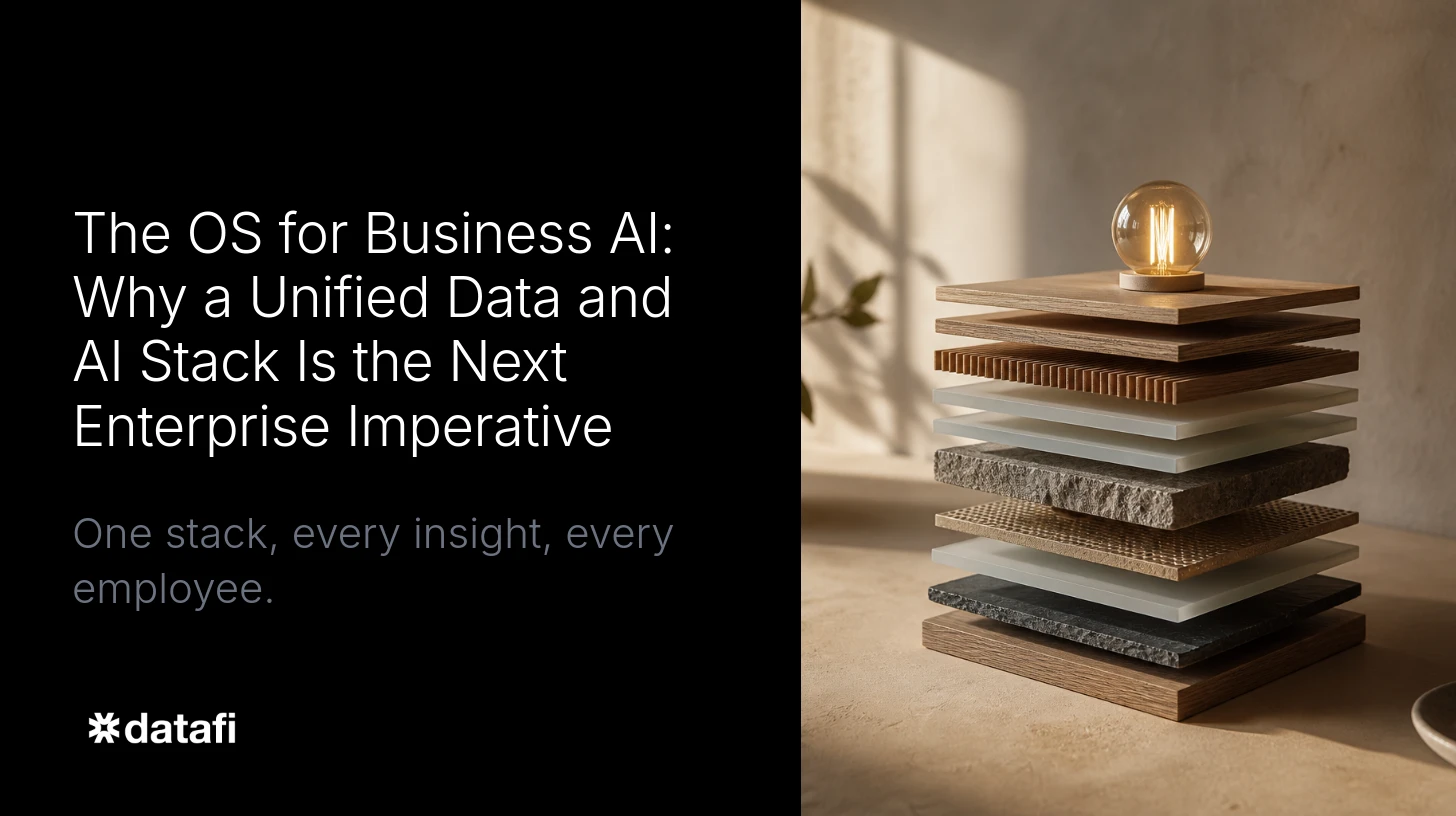
Datafi is not a chat interface layered over a generic AI model. It is a vertically integrated data and AI technology stack, purpose-built to give AI the full context of your business so it can function not as a search engine but as a genuine participant in your operations.
The operating system metaphor is deliberate and precise. Just as an operating system manages the relationship between hardware, software, and the user, Datafi manages the relationship between your data ecosystem, your AI models, your policies and governance controls, and the people across your organization who need to act on information every day. It is the connective tissue that transforms AI from a novelty into an operational capability.
There are three elements that define this architecture and differentiate it categorically from general-purpose AI tools.
Full data ecosystem access. Datafi connects to the complete landscape of an organization’s data sources, whether structured databases, unstructured documents, real-time operational feeds, third-party data integrations, or proprietary internal systems. When an AI model operates through Datafi, it is not drawing on generic training data. It is drawing on your data, current and contextualized, at the moment of need.
Governance, policies, and control. Enterprise AI without governance is not enterprise AI. It is a liability. Datafi applies policy and access control at every layer of the stack, ensuring that data is surfaced appropriately, that AI outputs are traceable, and that the organization retains full oversight of how its information is being used. This is not an afterthought. It is foundational architecture.
A Chat UI designed for non-technical users. The power of AI should not be reserved for data scientists and engineers. Datafi’s interface is designed so that any employee, regardless of technical background, can access the intelligence embedded in the organization’s data ecosystem through natural language. The result is a unified data experience that extends AI capability to every function, every team, and every level of the organization.
From Question-Answering to Problem-Solving: The Contextual Layer
The most significant difference between Datafi and ChatGPT is not any individual feature. It is the presence of what we call the contextual layer: the accumulated, structured understanding of a business that allows AI to function in genuinely intelligent, autonomous roles.
Large language models are extraordinarily capable. But their capability is only realized when they have access to the right context. A model that knows everything about logistics optimization in the abstract, but nothing about your fleet, your routes, your contracts, or your customer commitments, cannot optimize your operations. The intelligence is present. The context is not.
Datafi is designed to build and sustain that contextual layer continuously. As the platform ingests data, tracks workflows, and learns from user interactions, the AI’s understanding of the organization deepens. Over time, it develops the kind of institutional knowledge that was previously trapped in the minds of experienced employees and siloed across disconnected systems.
An AI with full business context does not need to be told what the problem is. It can identify anomalies, surface risks, recommend actions, and initiate workflows autonomously, because it understands not just what is happening but why it matters and what should happen next.
Agentic AI: The Next Frontier for Enterprise Operations

ChatGPT operates primarily in a reactive mode. A user provides a prompt, the model generates a response, and the interaction ends. Even with plugins and tool integrations, the fundamental model is one of request and response. The human remains the agent. The AI remains the assistant.
Datafi is built for a fundamentally different model of AI deployment, one where AI agents and workflows operate autonomously to complete complex, multi-step tasks across the organization’s data and systems.
This agentic capacity is not a feature toggle. It is a consequence of the underlying architecture. Because Datafi connects AI to the full data ecosystem and provides the contextual layer required for real-world reasoning, it can support agents that execute, not just advise. Agents that take action, not just surface information.
Consider what this means in practice across some of the highest-value enterprise use cases.
Predictive maintenance and asset management. An AI agent with access to sensor data, maintenance logs, equipment specifications, and failure history can continuously monitor asset health, detect early warning indicators, generate maintenance work orders, schedule service personnel, and update asset records, all without a human initiating each step. The reduction in unplanned downtime and the extension of asset lifecycle translate directly to measurable financial outcomes.
Operations optimization. Whether the application is supply chain logistics, production scheduling, workforce deployment, or inventory management, agentic AI can analyze real-time operational data, identify inefficiencies, model alternative scenarios, and recommend or execute adjustments at a speed and scale no human team can match. The compounding effect of continuous optimization across an organization’s operations is a strategic advantage that grows over time.
Passenger and customer experience. For transportation operators, hospitality providers, and any organization managing the human experience at scale, Datafi enables agents that synthesize real-time operational data with customer history, preferences, and feedback to deliver personalized, proactive service. When a flight is delayed, an AI agent that understands the full passenger context can anticipate rebooking needs, communicate proactively, and surface options before a customer even knows they need them.
Strategic planning and decision support. Senior leadership teams spend enormous amounts of time and resources synthesizing information from across the organization to support high-stakes decisions. Datafi’s platform enables AI to perform this synthesis continuously and at a level of depth and precision that no manual process can approach. Scenario modeling, competitive intelligence synthesis, risk analysis, and performance attribution become dynamic, always-current capabilities rather than periodic, resource-intensive exercises.
Unified Data Experience for Every Employee
One of the most underappreciated dimensions of Datafi’s value proposition is its democratizing effect on organizational intelligence.
In most organizations, access to data and the ability to act on it is highly uneven. Analytical teams, with the technical skills to query databases and build models, have access to the organization’s intelligence. Everyone else depends on reports, dashboards, and the availability of scarce analytical resources to get the information they need. This creates bottlenecks, delays decisions, and leaves enormous value unrealized.
Datafi eliminates this bottleneck by providing every employee with a natural language interface to the organization’s complete data ecosystem. A store manager who needs to understand why their inventory turnover changed last quarter does not need to submit a request to the analytics team and wait three days. They ask the question in plain language and get an answer grounded in the actual data, immediately.
This is not just an efficiency gain. It is a cultural transformation. When every employee can access the intelligence embedded in the organization’s data, the quality of decisions improves at every level. Problems are identified earlier. Opportunities are acted on faster. The organization becomes more responsive, more adaptive, and more competitive.
Critically, Datafi is designed to deliver this capability to organizations of any size. The unified data experience and the agentic AI capacity that were previously accessible only to large enterprises with substantial technology investments are available through Datafi’s platform regardless of organizational scale. A mid-market logistics company has the same access to transformative AI capability as a global manufacturer.
Why This Moment Demands a Different Kind of AI Platform
We are at an inflection point in enterprise AI adoption. The early experiments with general-purpose AI tools have demonstrated both the potential of the technology and the limitations of deploying it without the right infrastructure. Organizations that moved quickly to adopt AI are now asking harder questions: Where is the ROI? Why is the AI not making a difference where it matters most? What do we need to change?
The answer, in most cases, is not a different model. It is a different architecture.
The organizations that will derive transformational value from AI in the next three to five years are those that invest now in building the contextual layer, the data ecosystem connectivity, the governance infrastructure, and the agentic capacity that allow AI to function as a genuine participant in the business rather than a sophisticated search interface.
Datafi exists precisely to make that investment accessible, accelerate that journey, and ensure that the AI at the center of your operations has what it needs to do more than answer questions.
It is ready to solve problems.
Datafi’s operating system for business AI is designed for organizations that are ready to move from AI as a tool to AI as a capability. To learn more about how Datafi can transform your data experience and unlock agentic AI across your operations, contact our team or explore our platform documentation.