


The board has spoken. The CEO has set the mandate. Now comes the hard part.
Across every industry, technology leaders are navigating one of the most consequential inflection points in the history of enterprise software. Boards are no longer asking whether artificial intelligence will transform the business. They are asking why it has not happened yet, and they are asking with urgency.
The pressure is real. According to nearly every major analyst firm, AI investment has accelerated dramatically since 2023, with enterprise software budgets being reallocated at a pace not seen since the cloud transition. And yet, when technology leaders look honestly at what their organizations have actually achieved, the gap between expectation and outcome is striking. Chatbots answer questions that used to require a search. Summarization tools compress meeting transcripts. Copilot-style assistants help draft emails faster. These are useful capabilities. They are not transformational.
The problem is not that AI lacks potential. The problem is that most organizations have deployed the wrong architecture for the ambition they carry.
Most enterprises are not failing at AI because the technology is immature. They are failing because they have deployed AI as a search and summarization layer rather than as a vertically integrated operating system capable of reasoning, acting, and learning across the full business.
The Summarization Trap

When generative AI became widely accessible, enterprises moved quickly to adopt the most visible and immediately usable surface: the conversational interface. Products built on top of large language models promised to give every employee a brilliant assistant who could find information, summarize documents, and generate content on demand.
Many organizations invested significantly in these tools and discovered, within months, that the ROI narrative was harder to construct than the vendor pitch suggested. Employees used the tools for individual productivity. Teams appreciated the convenience. But the core operational challenges that drive cost, risk, and competitive differentiation remained stubbornly unchanged.
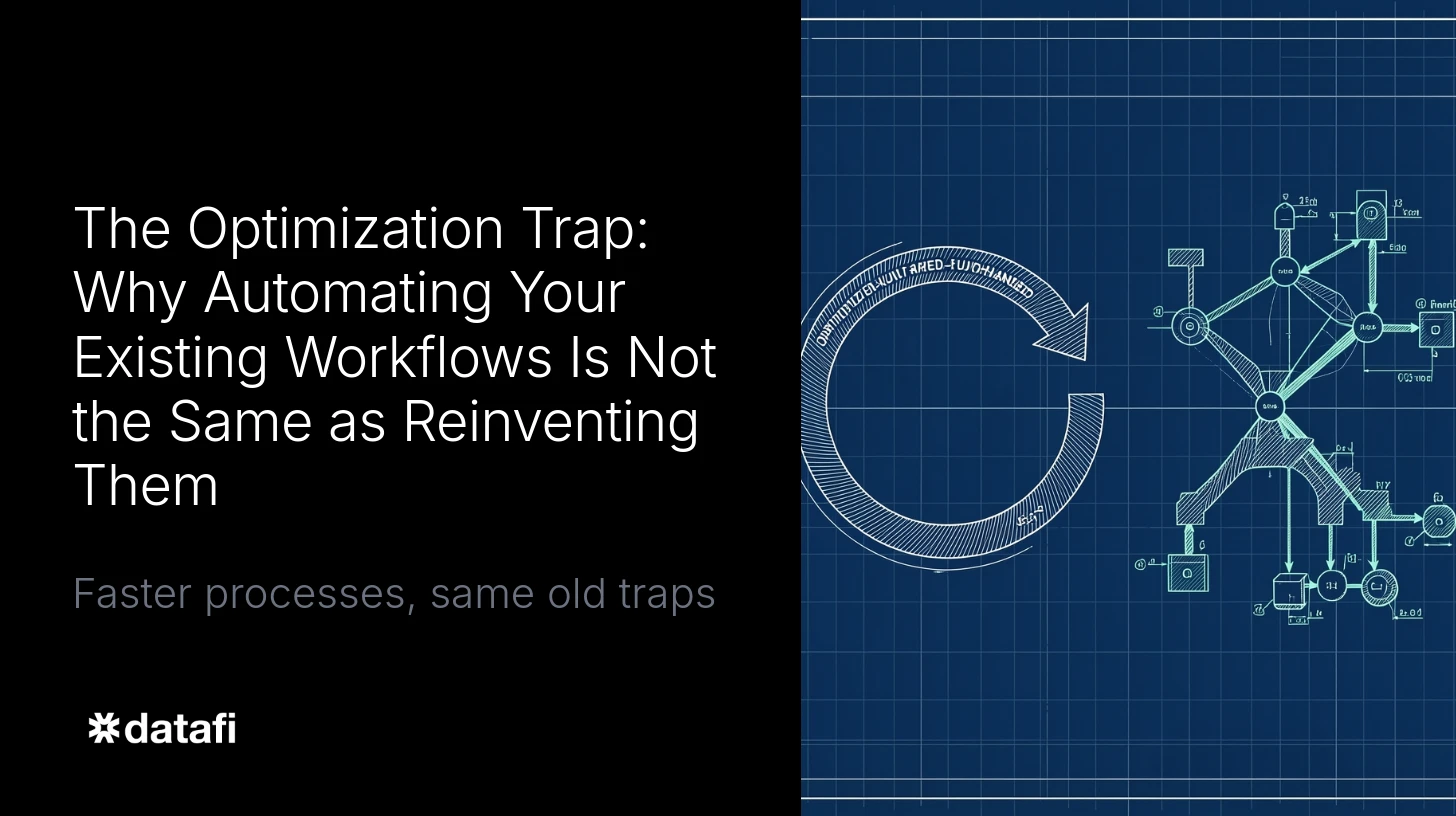
This is the summarization trap: deploying AI as a retrieval and synthesis layer on top of existing information silos, then measuring success by adoption metrics rather than business outcomes. It feels like progress because the technology is impressive and the demos are compelling. But when the board asks what AI has done for margins, cycle times, customer retention, or capital efficiency, technology leaders find themselves reaching for answers that are still largely anecdotal.
The trap has a structural cause. General-purpose AI search and summarization tools are designed to work with content, not with the full operational fabric of an enterprise. They can read a document. They cannot reason across a data ecosystem. They can surface a policy. They cannot monitor compliance in real time and trigger a remediation workflow. They can answer a question. They cannot solve a problem.
Solving problems requires something different. It requires AI that knows the business deeply, has access to every relevant data source, operates within governance and control frameworks, and is capable of taking action autonomously when the evidence demands it.
What Transformative AI Actually Requires
Technology leaders who have moved beyond the summarization trap share a common insight: the architecture that enables genuine AI-driven transformation is fundamentally different from the architecture that enables AI-assisted search.
Four capabilities separate incremental AI tools from transformative AI systems.
Full business context. Large language models are extraordinary reasoners, but they reason on what they know. A model with access to a company’s complete operational data ecosystem, its historical performance, its live transactional systems, its external market signals, and its institutional knowledge can reason about that business with a depth that no general-purpose tool can approximate. Context is not a feature. It is the foundation on which every meaningful AI capability is built.
Complete data ecosystem access. Most enterprise data landscapes are sprawling and heterogeneous. Structured data lives in data warehouses, operational databases, and ERP systems. Unstructured data lives in document repositories, email systems, and collaboration platforms. Real-time data streams from sensors, financial markets, and customer interactions. A business AI system must be capable of working across all of it, not just the portions that have been cleaned and indexed for retrieval. The hard problems are always at the intersection of multiple data sources.
Governance, policy, and control. The promise of autonomous AI raises legitimate concerns about security, compliance, and accountability. Technology leaders cannot deploy agents that operate outside the governance frameworks their organizations depend on. This means AI systems must have native policy and access control layers that enforce data entitlements, track actions taken, maintain audit trails, and ensure that autonomous behavior operates within defined boundaries. Governance is not a constraint on AI capability. It is what makes broad deployment possible.
Agentic capacity. The difference between AI that answers and AI that acts is the difference between a consultant who writes a memo and a team that executes a program. Autonomous agents and orchestrated workflows transform AI from an advisory layer into an operational participant. They can monitor systems, detect anomalies, execute remediation, coordinate cross-functional processes, and learn from outcomes over time. This is the dimension of AI capability that drives measurable cost reduction, efficiency improvement, and risk mitigation at scale.
The Datafi Business AI Operating System
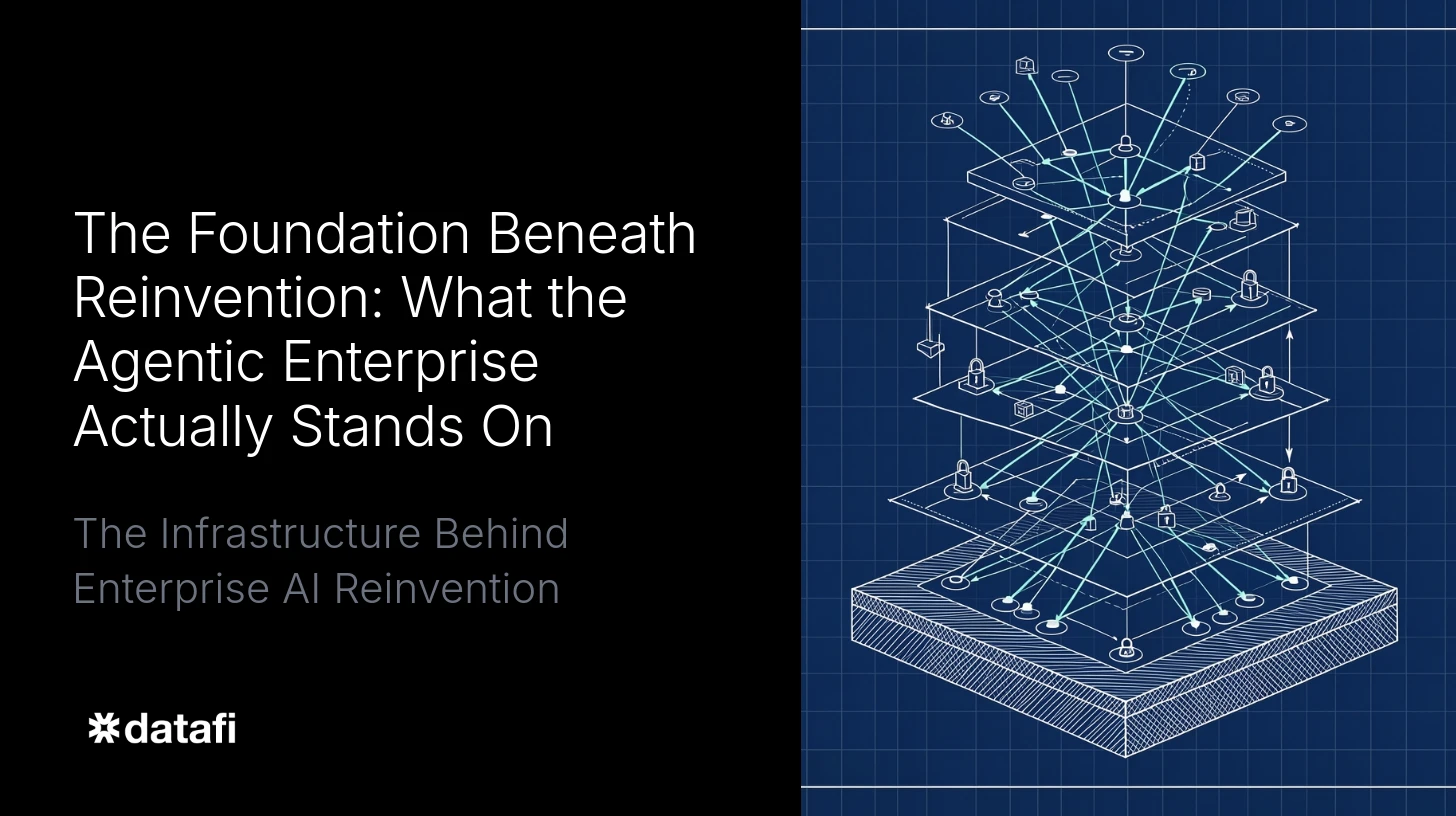
Datafi was built on the conviction that these four capabilities must be delivered as a vertically integrated system, not assembled from disconnected point solutions. The Datafi Business AI Operating System brings together the data connectivity layer, the policy and governance framework, the agentic workflow engine, and a conversational interface designed for non-technical users into a single, cohesive platform.
This integration matters because the hard problems in enterprise AI are not technical problems in isolation. They are systems problems. When a predictive maintenance agent needs to correlate sensor telemetry with maintenance records, parts inventory data, and technician scheduling systems, it cannot do so if those connections live in separate tools governed by separate teams operating on separate release cycles. The vertical integration of the Datafi stack eliminates the friction that turns promising AI initiatives into months-long integration projects that exhaust budgets before they reach production.
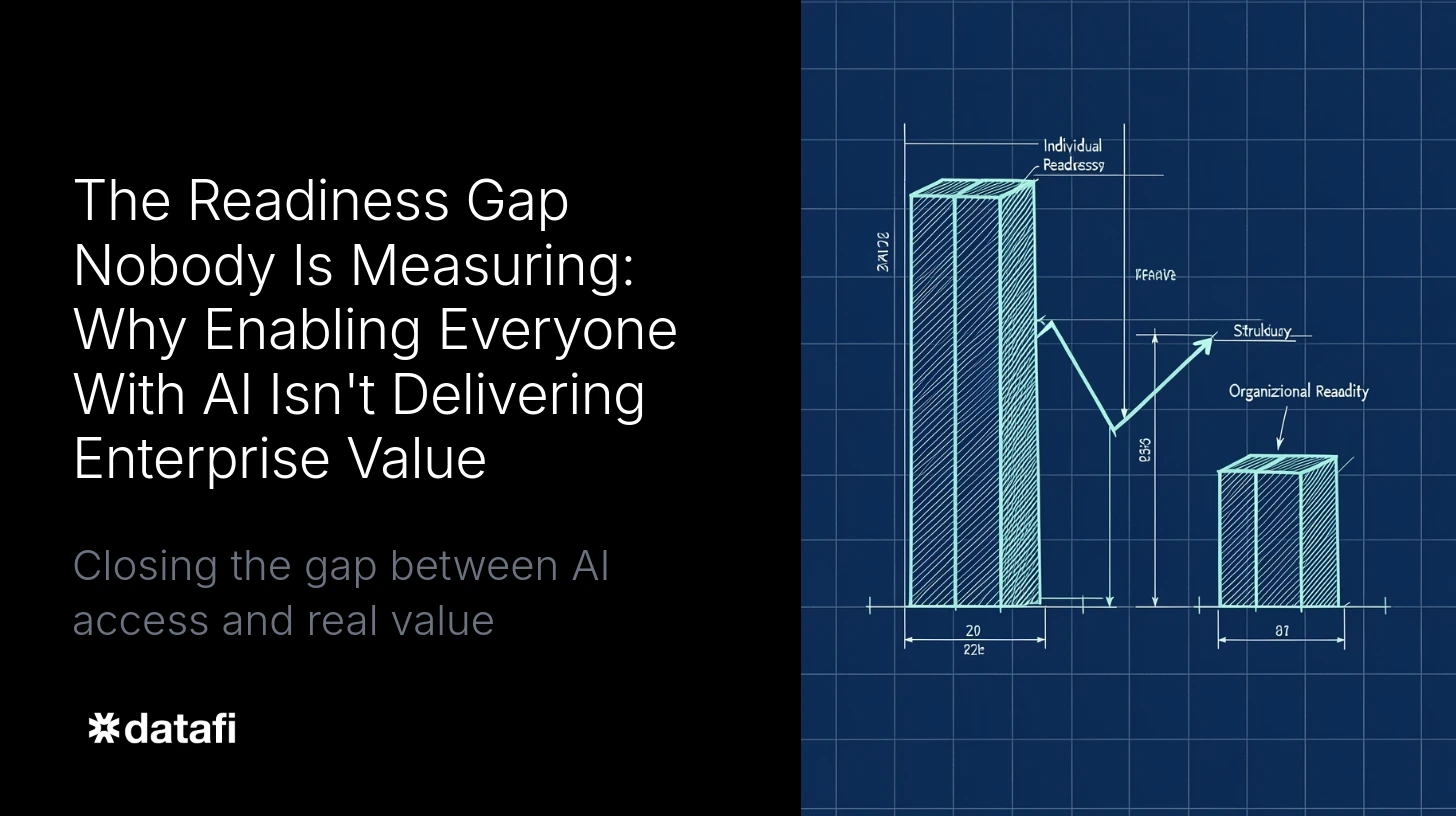
The Chat UI that Datafi provides is designed explicitly for the non-technical majority of the enterprise workforce. This is not a concession to simplicity. It is a recognition that transformative outcomes require broad participation. If AI capability is accessible only to data scientists and analysts, its impact is bounded by the capacity of that small population. When every employee, from the operations floor to the executive suite, can interact with AI systems through a natural language interface that understands the context of their role, their data, and their objectives, the surface area of potential impact expands by orders of magnitude.
If AI capability is accessible only to data scientists and analysts, its impact is bounded by the capacity of that small population. Transformation requires broad participation across every level of the enterprise.
Where the Outcomes Live

The use cases that drive the most compelling ROI for technology leaders are precisely those that require the depth of capability that a business AI operating system delivers. They share a common structure: complex data environments, time-sensitive decisions, and operational consequences that scale with accuracy and speed.
Predictive Maintenance and Asset Management. Industrial and infrastructure-intensive organizations carry enormous capital tied up in physical assets. When equipment fails unexpectedly, the costs compound rapidly across downtime, emergency repair, supply chain disruption, and safety exposure. Datafi’s agentic workflows can continuously monitor sensor data streams, correlate equipment performance patterns with historical failure signatures, anticipate maintenance requirements before failure occurs, and trigger work orders through existing operational systems. The result is a shift from reactive to predictive maintenance that reduces unplanned downtime and extends asset life in ways that show directly on the income statement.
Operations Optimization. The operational layer of most enterprises contains significant latent efficiency that is invisible to human analysts because it requires synthesizing data across too many systems simultaneously. Datafi agents can monitor operational flows in real time, identify bottlenecks and anomalies, model alternative configurations, and recommend or execute adjustments within governed parameters. In logistics, this means dynamic routing and load optimization. In manufacturing, it means yield improvement and waste reduction. In financial services, it means automated exception handling and process acceleration. The intelligence required to find and capture these efficiencies already exists in the data. Datafi makes it actionable.
Passenger and Customer Experience. For transportation, hospitality, and retail organizations, the experience that customers and passengers have in the moments of highest engagement defines brand equity and drives retention. Datafi can synthesize real-time operational data with historical customer profiles, behavioral signals, and preference data to enable hyper-personalized experiences at scale. When a flight delay occurs, an agent can proactively identify affected passengers, understand their connection requirements and loyalty status, evaluate available alternatives, and initiate personalized communications and rebooking offers before the passenger reaches the service desk. This is the difference between reacting to disruption and managing it.
Strategic Planning and Decision Intelligence. At the executive level, the highest-value application of AI is compressing the cycle time between question and decision-quality insight. Strategic planning processes that traditionally require weeks of analyst time to aggregate data, model scenarios, and prepare briefings can be transformed into continuous intelligence capabilities that deliver current, contextually rich analysis on demand. Datafi gives leadership teams the ability to interrogate the full operational and market data environment through a conversational interface, with agents capable of running scenario models, surfacing non-obvious patterns, and synthesizing cross-functional inputs into coherent strategic views.
The Contextual Layer: What Makes Complex Agents Possible
There is a dimension of Datafi’s architecture that deserves specific attention because it represents the capability gap that most enterprise AI deployments have not yet crossed.
Complex agents, the kind capable of operating autonomously in critical thinking and analytical roles, require a comprehensive business contextual layer. This is the accumulated, structured understanding of a specific business that allows an AI system to reason about novel situations with the same judgment that an experienced employee would apply.
Building the contextual layer requires persistent access to the full data ecosystem, the ability to learn from outcomes over time, and a governance framework that ensures the knowledge encoded in the layer reflects current reality rather than stale snapshots. It is not something that can be purchased from a general-purpose AI vendor and deployed in weeks. It is something that develops through sustained operation within a specific business environment.
Datafi’s architecture is designed to build and continuously enrich this contextual layer as the platform operates. Every workflow executed, every data source connected, every agent interaction adds to the system’s understanding of the business. Over time, this creates a compounding advantage: the system becomes progressively more capable of handling novel situations, identifying non-obvious opportunities, and operating with reduced human oversight in areas where its judgment has been validated.
This is the architecture of transformation, not the architecture of convenience.
A Message to Technology Leaders
The mandate you are operating under is not unreasonable. The potential that boards and CEOs sense in AI is real. What is unreasonable is expecting that potential to materialize through tools designed for information retrieval in environments that demand operational intelligence.
The technology leaders who will deliver on their mandates are those who recognize that the transition from AI as a search tool to AI as a business operating system is not an incremental upgrade. It is a rearchitecting of how the enterprise engages with its own data, its own processes, and its own decision-making.
Datafi exists to make that transition achievable for organizations of any size. You do not need a hundred-person data engineering team or a multi-year platform migration to deploy a system capable of delivering genuine transformation. You need a vertically integrated architecture that connects to the data ecosystem you already have, governs AI behavior within the frameworks you already operate, and delivers capability to the employees who are already doing the work.
The board is watching. The CEO is waiting. The transformation they are asking for is possible. But it requires an AI operating system built for the full complexity of enterprise business, not a smarter search bar.
Datafi is the Business AI Operating System for enterprises that need AI to do more than answer questions. To learn how Datafi can help your organization move from AI exploration to AI transformation, connect with our team.