


The Quiet Leak in Fixed Operations
Every dealer principal knows the math. The front end sells the car, but fixed operations keep the lights on. Service, parts, and collision carry the highest gross margins in the group, drive absorption, and build the relationship that brings the customer back to the showroom. Yet most dealerships lose a large share of their service customers within a few years of the sale, and the loss accelerates the moment factory warranty coverage ends.
The defection rarely happens in one dramatic moment. A customer declines a brake job and never hears back. A family moves one state over and the independent shop down the street becomes more convenient. A customer who bought a Jeep at one rooftop takes their second vehicle, a Honda, to a competitor because no one recognized them as an existing customer. One by one, customers drift into the “lost soul” category, and by the time a report surfaces the trend, the revenue has already walked out the door.
For family-owned groups that have spent generations earning community trust across multiple markets, every lost service customer is more than a missed RO. It is a relationship the group worked hard to build.
Service retention loss is not a reporting problem; it is an action problem. By the time a dashboard flags lapsed customers, the revenue has already left. Recovering it requires AI that identifies at-risk customers, understands why they drifted, and acts before they are gone for good.
Why Point Solutions Cannot Solve It
A multi-franchise, multi-state dealer group runs on an especially complex patchwork of platforms. Repair order history lives in the DMS, sometimes in more than one instance across acquired stores. Customer communications live in the CRM and the BDC’s phone system. Declined services sit in the multipoint inspection tool. Recalls, warranty eligibility, and loyalty incentives come from a dozen or more separate OEM portals, each with its own rules. Loyalty and rewards activity lives in the group’s mobile app. Service contract coverage, collision history, and parts sales each live somewhere else again.
Each vendor offers its own retention module, and each sees only its slice of the picture. The CRM knows who was emailed but not whether the vehicle is overdue for its 60,000 mile service. The DMS knows the last RO date but not that the customer redeemed rewards points in the app last month. The inspection tool knows the customer declined front pads at 3mm, but no one connects that to the open recall on the same VIN, or to the extended service contract that would cover part of the repair.
Service retention recovery is fundamentally a multi-system problem, which is why dashboards and point solutions keep failing to fix it. They answer questions about what already happened. Recovering customers requires AI that solves the problem: identifying who is at risk, understanding why, deciding what to do, and acting before the customer is gone.
How Datafi Approaches Service Retention Recovery
Datafi is a Business AI Operating System built on a vertically integrated data and AI technology stack. Rather than adding one more disconnected tool, Datafi connects to the systems already in place and builds a contextual layer across them. DMS instances, CRM, inspection platforms, OEM data, loyalty and app activity, service contracts, and collision systems become one governed, unified view of every customer, vehicle, and interaction across every rooftop and brand.
That contextual layer is what allows AI agents to move beyond answering questions. When an LLM understands the full context of the business, it can reason about each customer the way your best service manager would, at a scale no human team can match, and recognize a household as one relationship even when it spans three brands and two stores.
Datafi agents continuously score every customer for retention risk, weighing time since the last visit against expected intervals based on actual mileage patterns, the value of declined services, warranty and service contract status, open recalls, loyalty engagement, and signs of competitor activity such as a lapsed oil change cadence after years of consistency. Customers are not simply flagged as overdue. They are understood.
From Insight to Action
Consider a customer who bought a pickup from one of your stores four years ago. Bumper to bumper coverage expired last spring, but they purchased the group’s extended service contract. They declined rear brakes eight months ago, have not opened the mobile app since, and missed their usual spring maintenance window. A traditional report lists them among thousands of overdue customers across the group.
A Datafi agent sees more. It recognizes a high value customer at the exact inflection point where dealers typically lose them, notices an open recall, and confirms which covered components apply under their service contract. It drafts personalized outreach that leads with the recall, explains the safety case for the declined brake work, adds a rewards incentive, and offers an appointment in a slot the nearest store’s scheduler shows as underutilized. It routes the recommendation to the BDC with full context or, where the group has approved it, executes the outreach autonomously and logs every step back to the CRM.
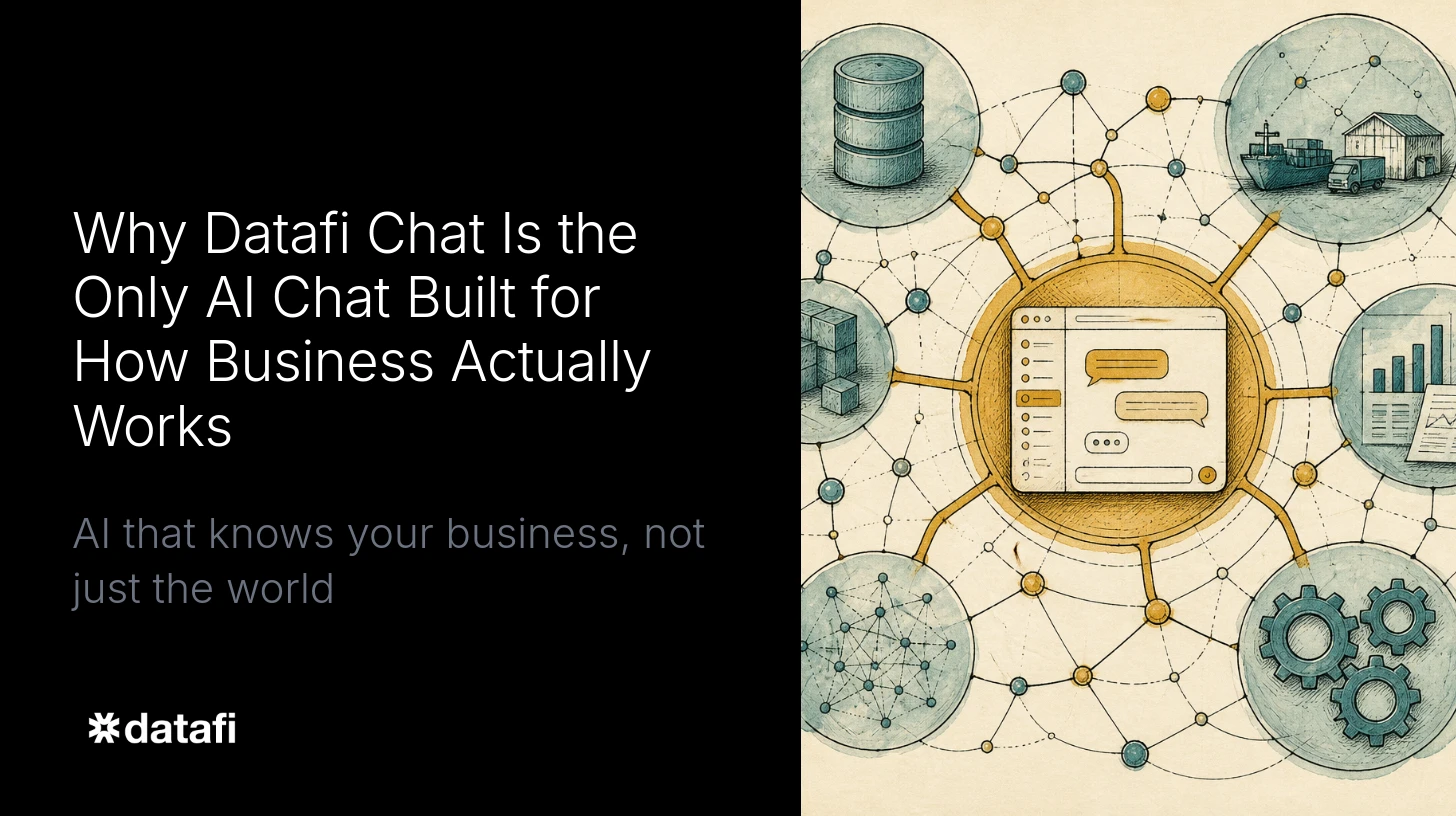
The fixed ops director, meanwhile, can simply ask in plain language: “Which customers across our Midwest stores with expired factory warranties and declined safety items are we most likely to lose this quarter, and what is the gross profit at risk?” Datafi’s Chat UI, designed for non-technical users, returns an answer grounded in live data across every connected system.
Governed, Compliance-Ready by Design
Customer outreach carries real obligations. TCPA consent, opt-out preferences, state privacy laws that vary across markets, and each OEM’s co-op marketing rules all shape what a store can say and to whom. Datafi’s governance is built into the architecture rather than bolted on. Role-based policies control which data each agent and employee can access, communication preferences are enforced before any message is sent, and every recommendation and autonomous action is auditable. Group leadership gets a single governed view across states and brands while each store acts on its own customer base with consistent retention playbooks.
The Outcomes That Matter
Dealer groups using Datafi for service retention recovery focus on the metrics that move fixed operations: customer pay RO counts, recovered declined service revenue, recall completion rates, retention beyond the warranty period, loyalty program engagement, and ultimately service absorption. Because every agent action is tied back to the RO that followed, the group can measure which outreach actually brought customers back, and agents learn which approaches work over time.
Advisors spend less time digging through history and more time with customers in the lane. BDC teams call the right people with the right message. And the loyal service customer, the one most likely to buy their next vehicle from your group, stays yours.
AI That Solves Problems, Not Just Answers Questions
Service retention is not a reporting problem. It is an action problem that spans every system, store, and brand in the group. Datafi gives automotive retailers the unified data foundation, governed AI, and autonomous agents required to recover lapsed customers and keep them coming back.
To see how Datafi can help your stores recover service retention and protect fixed operations revenue, request a demo at datafi.co.