


Supply chains have always been complex. What’s evolved is the speed and volatility of the environment around them: changing customer expectations, tighter margins, shifting freight markets, unpredictable disruptions, and an explosion of operational data spread across systems. The result is familiar to organizations of every size: critical information lives in too many places, workflows depend on tribal knowledge, and decisions often are made with partial context.
Business AI promises to help - yet most AI efforts in supply chain stall after a few pilots. The reasons are rarely about models. They’re about the operating reality: fragmented data access, unclear governance, brittle integrations, and user experiences that don’t meet employees where they work. If AI can’t reliably “see” the end-to-end business context or safely act inside real workflows, it becomes a dashboard feature rather than an operational advantage.
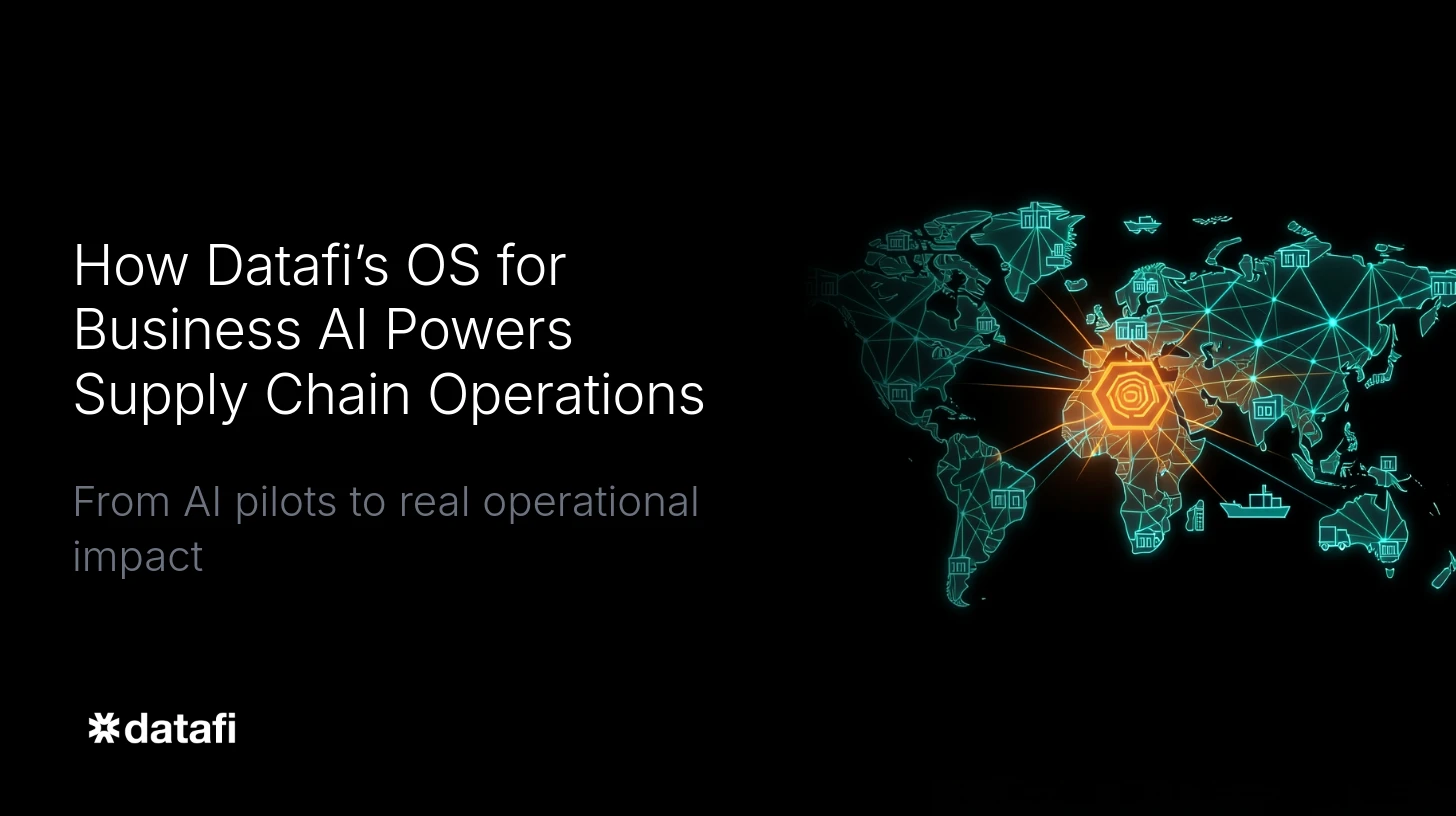
Datafi’s operating system for business AI is designed to change that. It brings together a unified data experience, policy-driven control, and agentic workflows so organizations can move from AI that answers questions to AI that solves problems across supply chain operations.
The gap between AI pilots and real operational impact in supply chain isn’t a model problem. It’s an infrastructure problem: fragmented data access, missing governance, and user experiences that don’t meet employees where they work. A vertically integrated data and AI stack closes that gap.
A Unified Data Experience for Every Employee

Supply chains run on interconnected processes: procurement, transportation, warehousing, customer fulfillment, invoicing, and exception management. Each generates data in different formats, owned by different teams, across different tools. When this ecosystem is fragmented, the first “job” in any workflow becomes hunting, reconciling, and validating information.
The Datafi operating system is built to unify the data experience across the enterprise so employees can interact with the complete operational picture - connecting the data where it lives, and without needing to become data experts. Instead of asking teams to learn yet another analytics tool or navigate complex schemas, the platform enables natural interaction through a Chat UI designed for non-technical users. The goal is straightforward: put trusted, governed, contextual information in front of the right person at the moment of action.
That unified experience has compounding benefits:
-
Faster decisions because employees don’t lose hours searching across systems or waiting on specialized teams.
-
Better decisions because answers are grounded in enterprise context, not just one system’s view.
-
More consistent execution because workflows become repeatable and measurable rather than ad hoc.
When everyone from a transportation analyst to a customer service representative can access the same source of truth - through an intuitive interface - operational alignment improves dramatically.
Workflow Efficiency That Scales Across Roles
Supply chain performance isn’t determined by a single “big” decision. It’s shaped by thousands of daily micro-decisions: how a shipment is routed, how exceptions are resolved, which carriers are used, whether charges align to contract terms, and which customers need proactive communication.
These are the workflows where AI creates real leverage - if it can operate inside the process, not alongside it.
Datafi enables enterprise-grade and policy enforced AI agents and workflows that reduce cost and improve efficiency across high-impact areas, including:
Bill of Lading (BOL) creation and validation
BOL workflows often involve repetitive steps, manual data entry, and compliance checks. AI can streamline document creation, validate required fields, cross-check shipment details, and flag discrepancies before they become delays or chargebacks.
Route optimization and transportation planning
Route and mode decisions require balancing service levels, capacity constraints, cost, and real-time disruption signals. AI workflows can evaluate routing options, incorporate current constraints, and recommend - or execute - changes with auditable reasoning and business rules.
Revenue recovery and freight audit
Freight invoices and accessorial charges frequently contain errors, mismatches, or missed recovery opportunities. AI agents can compare invoice line items against contracts, shipment events, and agreed terms; identify recoverable charges; and trigger dispute workflows with supporting evidence.
Exception management and proactive resolution
Late pickups, missed appointments, inventory mismatches, and allocation issues are unavoidable. What matters is response time and resolution quality. AI workflows can monitor event signals, triage exceptions, recommend next-best actions, notify stakeholders, and keep customers informed - all while logging actions for continuous improvement.
These aren’t “nice to have” automations. They are the operational backbone of cost control, service reliability, and working capital performance.
Why Supply Chain AI Needs a Vertically Integrated Data + AI Stack

Many organizations start their AI journey by layering an LLM on top of existing tools. That approach can help with light summarization or question answering. But supply chain operations demand more than conversational insights. They require AI that can reason over enterprise context and take actions safely.
At Datafi, we see customers increasingly aiming for AI in critical-thinking workflow automation and analytical roles - the work traditionally reserved for experienced operators who understand how decisions ripple across cost, service, and risk.
To enable that, we believe a vertically integrated data & AI stack is essential:
-
Access to the full data ecosystem - Supply chain truth is distributed across TMS, WMS, ERP, EDI feeds, telematics, carrier portals, and spreadsheets that still drive real decisions. Business AI must connect to this entire ecosystem to build accurate situational awareness.
-
Policies and control built into the system - AI must operate under governance: permissioning, data lineage, auditability, and clear boundaries for what it can view and what it can do. Without this, adoption stalls because the risk feels too high.
-
An experience built for non-technical users - The biggest supply chain gains come when AI supports the front lines: planners, analysts, coordinators, warehouse teams, customer ops, and finance. A Chat UI designed for non-technical employees lowers the barrier to adoption and drives broad operational impact, not isolated analytics wins.
A vertically integrated approach reduces the fragility that often limits AI rollouts. Instead of stitching together data access, governance, orchestration, and UI as separate products, the operating system aligns them into one coherent environment where AI can be trusted to work.
The Contextual Layer: What LLMs Need to Solve Hard Business Problems
Supply chain decisions depend on context: business rules, service commitments, carrier performance, contract terms, inventory positions, customer priorities, and the messy reality of what is happening right now.
For AI to move beyond answering questions and into solving problems, LLMs must be able to:
-
Understand the full business context (processes, constraints, KPIs, and rules)
-
Access the complete data ecosystem (structured, semi-structured, and operational event streams)
-
Function in autonomous roles with safe boundaries (execute workflows, learn from outcomes, and improve)
This is how organizations develop the contextual layer required for complex agents and workflows - the layer that connects models to real operations. It’s not just about calling an API or generating a response. It’s about creating an environment where AI can reason, act, and learn inside the guardrails of the business.
With the right contextual layer, supply chain AI becomes capable of handling problems such as:
-
Identifying root causes of service failures across multiple systems
-
Predicting cost overruns before invoices arrive
-
Optimizing trade-offs between expedited shipping and customer value
-
Detecting systematic data issues that create downstream friction
-
Continuously improving decision logic based on observed outcomes
That’s the leap from “insight” to “impact.”
Transformative Outcomes Come From Actionable AI
Across industries, the most valuable AI systems will be those that reduce operational burden and elevate decision quality at scale. In supply chain, this means enabling AI to do more than explain what happened - it must help prevent issues, resolve exceptions, and execute repeatable improvements.
Datafi’s operating system is built for this outcome: an enterprise-ready foundation where AI agents and workflows can be deployed across roles, processes, and systems - without sacrificing governance or usability.
Transformative outcomes come when organizations can action data. That requires more than a model. It requires a complete operating environment where AI has context, access, control, and a user experience that invites adoption.
From my experience working deeply with data & AI, one conclusion stands out: transformative outcomes come when organizations can action data. That requires more than a model. It requires a complete operating environment where AI has context, access, control, and a user experience that invites adoption.
When those pieces come together, organizations of any size can unlock a unified data experience and workflow efficiency for every employee - and move toward a supply chain where AI doesn’t just answer questions, but consistently solves the hard operational problems that define performance.