



Industry Series: AI for Freight and Logistics | Part 2 of 3
For the better part of a decade, freight visibility has been the defining technology investment for carriers and logistics operators trying to modernize their operations. The promise was compelling and the delivery was real: for the first time, operations teams could see where their freight was, where their assets were, and what was moving through their network at any given moment.
That investment was worthwhile. Visibility platforms genuinely changed how the industry operates. But a quiet recognition has been building among operations leaders across the freight sector, one that is starting to reshape how the most forward-thinking carriers think about their next technology investment.
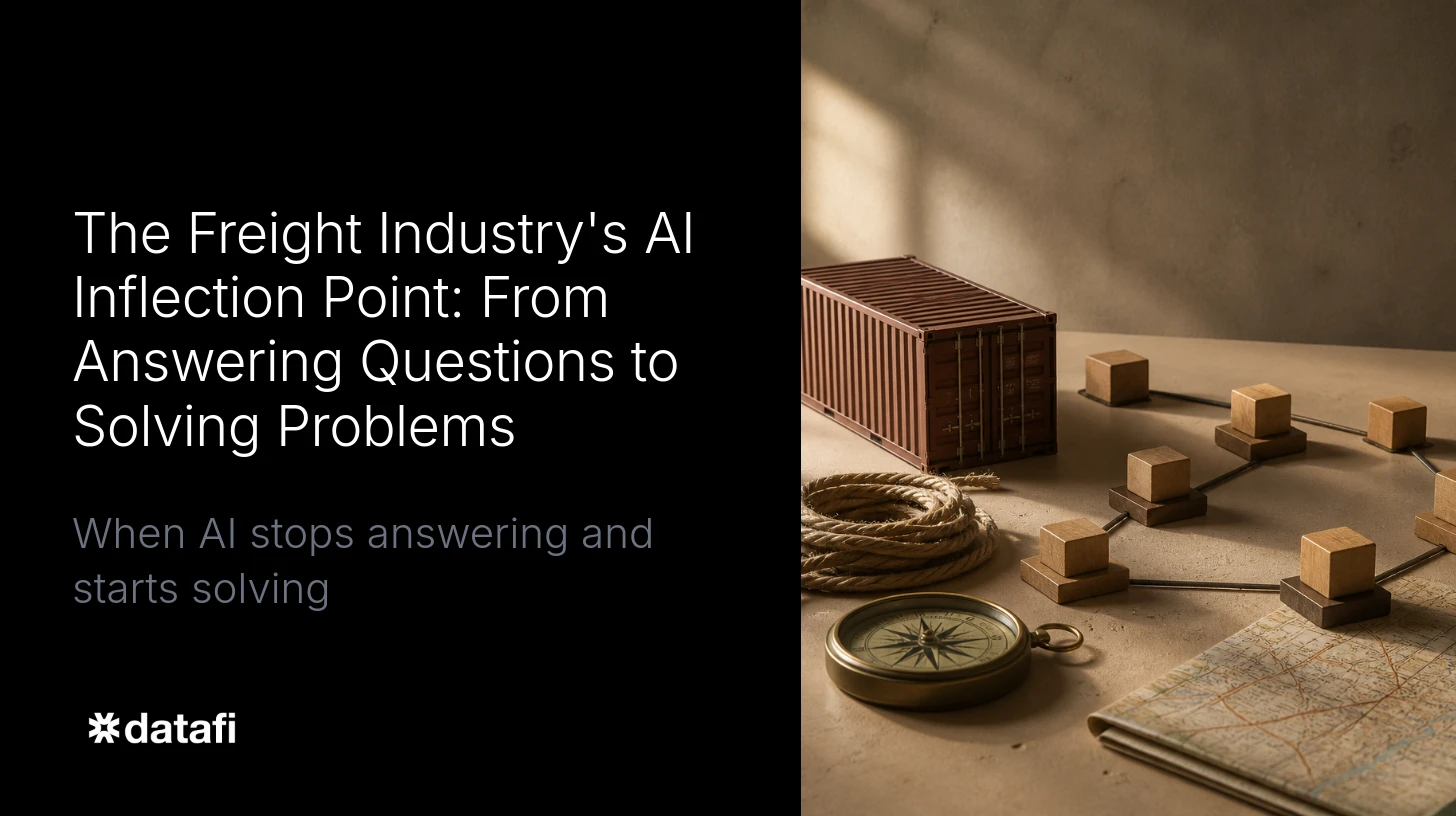
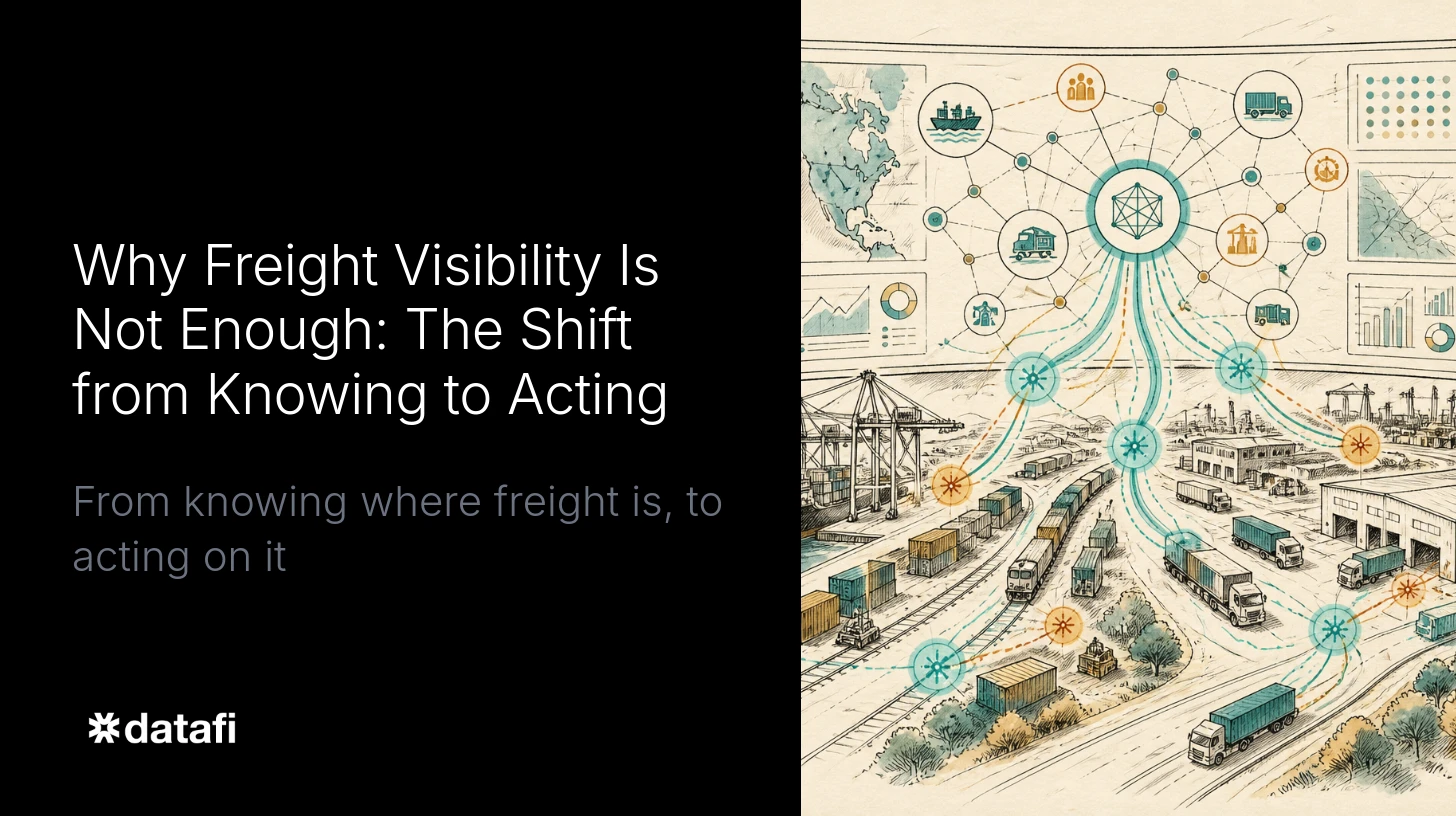
Visibility tells you what is happening. It does not tell you what to do about it. And in an industry where the window to act on a developing problem is often measured in hours or less, the gap between knowing and acting is exactly where service failures, cost overruns, and missed commitments live.
Freight visibility gives operations teams a dashboard, but dashboards require humans to interpret, connect, and act. The competitive edge now belongs to carriers who have built the capacity to act on their data faster and more accurately than their competitors, not just see it.
The Limits of the Visibility Era
The visibility era gave the freight industry a dashboard. Real-time location data on tractors, trailers, and containers. Shipment status updates tied to scan events. Estimated arrival windows refined by traffic and weather data. For operations teams that had previously been working from phone calls, paper manifests, and experience-based guesswork, this was a fundamental improvement.
But a dashboard requires someone to look at it, interpret what they see, connect it to other information that may live in a different system, decide what action is warranted, and execute that action before the window closes. Every step in that chain is a place where time is lost and human capacity is consumed.
The deeper problem is that real operational decisions in freight are never single-variable problems. A shipment running two hours late is not just a visibility event. It is a labor scheduling event at the destination terminal. It is a customer notification event. It may be a dock door reassignment event. It may be a next-day service commitment event if the delay pushes the freight past the delivery window. Each of those downstream effects requires information from multiple systems, and the person looking at the visibility dashboard is rarely the same person who controls all of those levers.
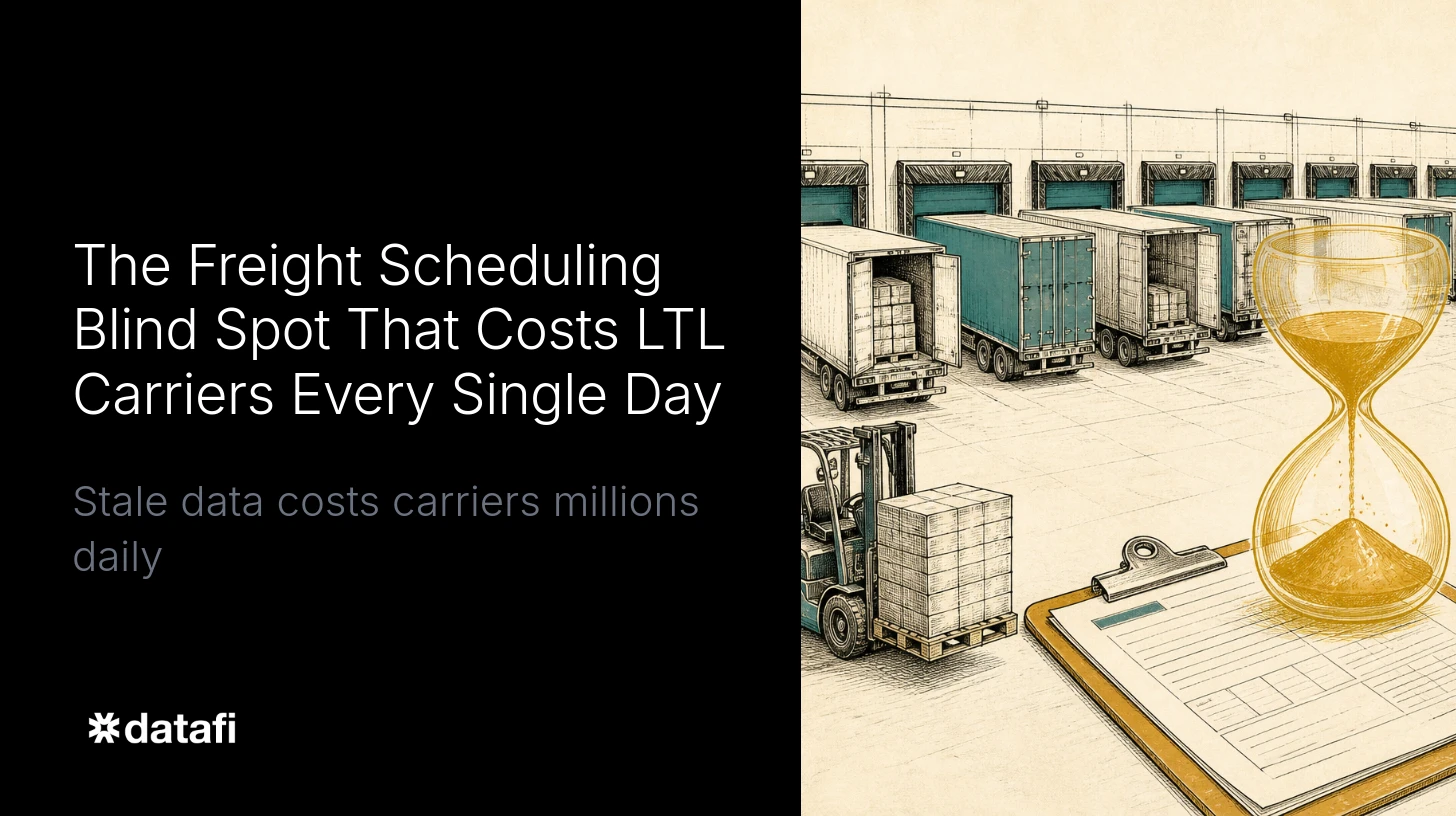
Visibility made the information available. It did not eliminate the work of translating that information into coordinated action across the operation. The average mid-size LTL carrier’s operations team handles 80 to 120 exceptions every single month, with each exception consuming an estimated two to four hours of staff time to resolve. That is a substantial operational cost that visibility alone does nothing to reduce, because visibility only surfaces the exception. Acting on it is still a manual process.
What Intelligence Looks Like
The carriers who are pulling ahead of the field right now are not those who have the best visibility platforms. They are the carriers who have built the capacity to act on their data faster and more accurately than their competitors.
This requires a different kind of AI than the industry has typically deployed. Chatbots and reporting tools that answer questions when asked are useful, but they still require a human to ask the right question at the right time. What operations need is AI that can hold the full context of the business simultaneously, monitor the data ecosystem continuously, and initiate appropriate actions without waiting to be prompted.
A practical illustration makes this concrete. A regional LTL carrier operating dozens of terminals faces hundreds of micro-decisions each day that affect labor efficiency, dock utilization, service performance, and customer satisfaction. Under a visibility model, those decisions flow through the operations team, each one requiring a human to gather the relevant information, weigh the options, and act. Under an intelligence model, AI agents handle the information-gathering and pattern-recognition layer continuously, surfacing only the decisions that genuinely require human judgment and initiating routine actions autonomously.
The difference in operational capacity is not incremental. It is structural. C.H. Robinson, the largest mover of LTL freight among third-party logistics providers in North America, documented this distinction precisely when it deployed AI agents to handle missed pickup resolution in 2026. The result was 95 percent automation of a labor-intensive process and more than 350 hours of manual labor saved every single day. Freight moved up to a full day faster. That is not a visibility outcome. It is an intelligence outcome, and it required AI operating across the full context of the shipment, the carrier, and the customer rather than simply reporting on status.
The difference between visibility and intelligence is not incremental. It is structural. AI agents that operate across the full context of the business do not just report on exceptions; they resolve them.
A Regional Carrier Closes the Gap
A Pacific Northwest LTL carrier with a multi-terminal network and a strong reputation for service reliability had invested meaningfully in visibility technology over the preceding years. Their operations team could see their network clearly. What they could not do was act on what they saw as quickly or as accurately as their growth ambitions required.
The specific pressure point was the connection between inbound freight data and terminal-level labor planning. Freight document processing lagged real-world freight movement by hours, which meant that by the time the visibility picture was complete, the optimal window for labor scheduling decisions had already passed. Operations managers were compensating with scheduling buffers that protected service levels but added costs that did not need to be there.
The carrier deployed the Datafi platform to close this gap. AI agents built on Datafi’s vertically integrated data and AI stack were given access to the full data ecosystem relevant to terminal operations: freight documents, shipment records, labor systems, customer commitments, and historical patterns. The agents did not just read the data. They connected it, reasoned across it, and pushed actionable intelligence into the hands of terminal managers in real time.
The results across three measurable dimensions were significant.
Exception handling speed improved dramatically. Routine exceptions that had previously required 30 to 60 minutes of manual information-gathering were resolved automatically by AI agents that already had full context assembled. For the exceptions that genuinely required human judgment, the agent pre-populated the relevant information, reducing resolution time by an estimated 60 to 70 percent compared to the fully manual baseline. At an industry-average exception cost of $300 to $500 per incident, the compounding savings across hundreds of monthly exceptions represent a meaningful improvement to operational margin.
Labor scheduling accuracy translated directly into cost reduction. With AI-driven freight intelligence replacing estimate-based scheduling, the carrier reduced the overtime premium it had been absorbing as a buffer against volume uncertainty. Across the terminals where Datafi was deployed, the reduction in scheduling variance produced labor cost improvements that the carrier attributed directly to having better data at the right moment, rather than having better people making guesses.
Operations management capacity was redirected to judgment work. The operations managers who had been spending significant portions of their shifts gathering information, reconciling data across systems, and chasing down exception context were now spending that time on the decisions that actually require experience and judgment. The carrier did not reduce headcount. It increased the effective operational capacity of the management team it already had, which translated into better decisions made faster across a growing network.
The Architecture That Makes Intelligence Possible
The reason most carriers have not yet made this transition is not lack of awareness or lack of ambition. It is an architecture problem. Turning freight visibility into freight intelligence requires AI that can access and reason across the full data ecosystem of the business simultaneously. That means freight management systems, labor systems, customer systems, document management, and the real-time data streams from visibility platforms, all unified into a single operating context for the AI agents running on top of it.
This is precisely what most point solutions cannot deliver. An AI agent that can only see the visibility platform cannot connect freight delays to labor scheduling implications. An AI agent that can only see the TMS cannot factor in the labor availability data that determines whether an expedited action is actually feasible. Intelligence requires full context, and full context requires a platform architecture designed to provide it.
Datafi’s vertically integrated approach was built specifically to address this requirement. The platform unifies the data ecosystem, provides LLMs with the full business context they need to reason effectively, and enables AI agents to operate autonomously across the full scope of an operation rather than within the siloed view of a single application.
The Competitive Consequence
The freight industry has historically competed on network, price, and relationships. Those factors have not disappeared, but a new variable is emerging: operational intelligence. The carriers that can act on their data faster, more accurately, and more consistently than their competitors will have a structural advantage that compounds over time.
Service reliability improves when AI catches developing problems before they become failures. Labor efficiency improves when scheduling decisions are based on actuals rather than averages. Customer satisfaction improves when exceptions are resolved proactively rather than reactively. Each improvement reinforces the others, and the gap between carriers who have made this transition and those who have not will widen as the technology matures.
Visibility was the right investment for its era. The carriers who understood that early captured real competitive advantage. Intelligence is the right investment for this era, and the window to capture that advantage before it becomes table stakes is not unlimited.
The question is no longer whether freight visibility is enough. It is not, and the industry knows it. The question is which carriers will build the operational intelligence layer first, and what kind of advantage they will have earned by the time everyone else gets there.
Datafi is the Business AI Operating System for freight, logistics, and other data-intensive industries. Built on a vertically integrated data and AI technology stack, Datafi enables unified data experiences, autonomous AI agents, and embedded governance that transform how organizations use AI across the enterprise. Learn more at datafi.co.
Next in the series: The AI Agent on the Dock: How Regional Carriers Are Competing on Intelligence, Not Just Network