


Every procurement executive has lived some version of the same story. A critical supplier quietly accumulates financial stress for eighteen months. The signals were there: tightening payment terms in one system, a credit downgrade buried in a third-party feed, a logistics partner flagging inconsistent fulfillment windows, a geopolitical shift that should have triggered a category review. Nobody connected those signals. Nobody could. They lived in separate systems, owned by separate teams, surfaced on separate dashboards that nobody had time to reconcile at the pace risk actually moves.
Then the supplier fails. And the post-mortem reveals what everyone already suspects: this was not a sourcing failure. It was a data synthesis failure.
This distinction matters enormously, because organizations have been solving the wrong problem for a decade. They have invested in better supplier scorecards, more rigorous onboarding processes, diversified vendor panels, and sophisticated contract terms. All of that work has value. But none of it addresses the core structural vulnerability: the inability to synthesize fragmented, real-time signals across an entire supplier ecosystem into a coherent, continuously updated picture of exposure.
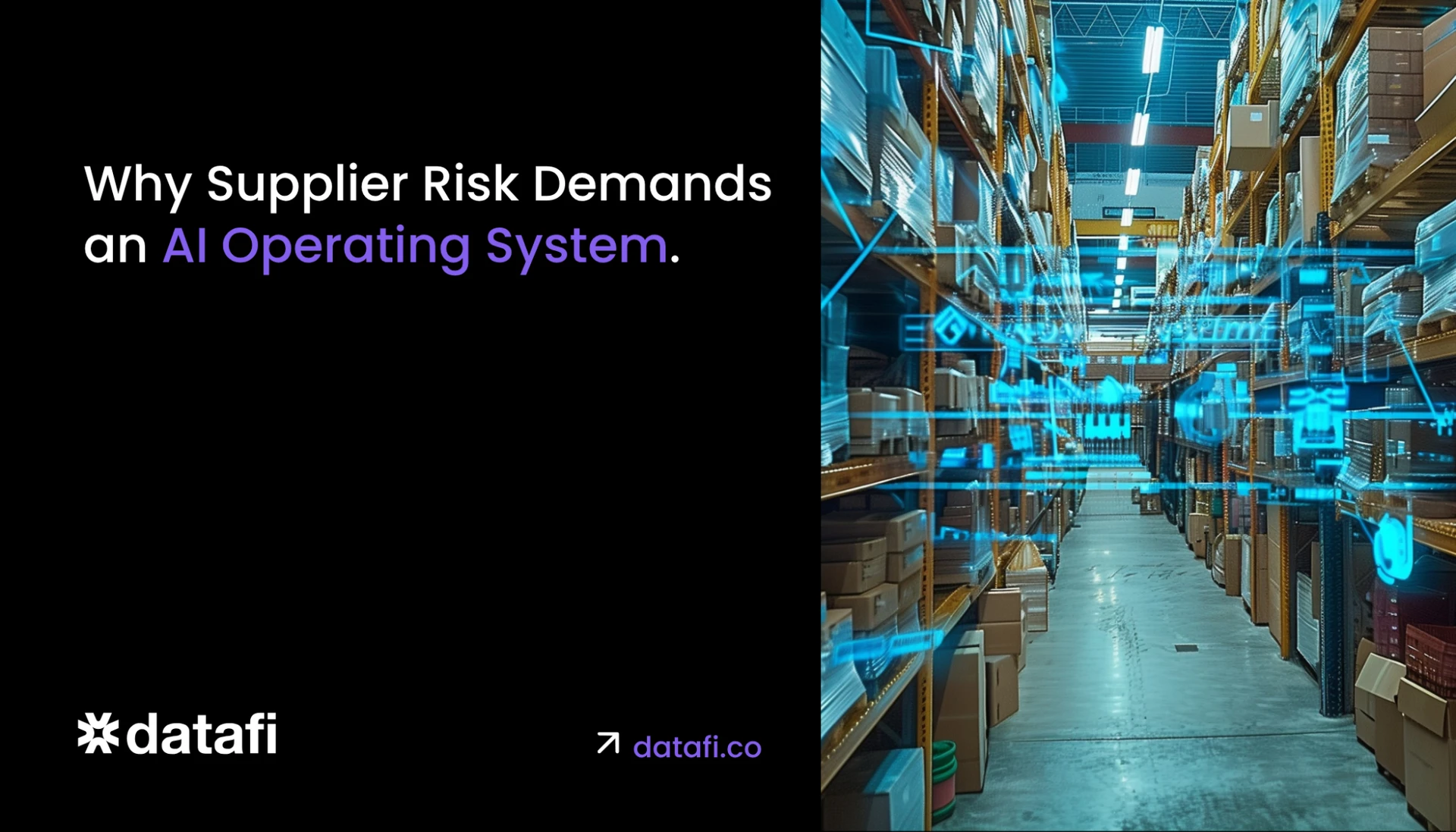
That is an AI data analysis problem. More precisely, it is a problem that only a purpose-built AI operating system, functioning as a true data integration platform across the enterprise, can solve.
Supplier failures are not sourcing failures. They are data synthesis failures. The organizations that win on supply chain resilience will be those that give AI the full context of their supplier ecosystem and build the agentic capacity to act on risk continuously, not periodically.
The Fragmentation That Makes Risk Invisible
Procurement organizations sit at the intersection of more data streams than almost any other function in the enterprise. Vendor master records. Purchase order histories. Contract terms and renewal schedules. Accounts payable aging reports. Third-party credit and financial monitoring services. Logistics performance feeds from carriers and freight platforms. ESG ratings and compliance certifications. News and geopolitical intelligence. Commodity price indexes and raw material cost signals. Customs and trade compliance data.
Each of these data streams has legitimate owners, governance requirements, and system homes. ERP systems hold the transactional backbone. Procurement platforms manage sourcing workflows. Finance owns the AP data. Logistics visibility platforms track shipment performance. Risk intelligence vendors sell subscriptions to external monitoring feeds. In large organizations, these systems number in the dozens. In global enterprises, they number in the hundreds.
The operational consequence is a supplier risk function that is permanently backward-looking. Analysts spend the majority of their time extracting, transforming, and manually reconciling data from systems that were never designed to speak to each other. By the time a risk picture is assembled into a usable report, the underlying signals have moved. The analysis reflects the world as it was, not the world as it is.
This is not a process failure or a talent failure. It is an architecture failure. And it cannot be solved by adding more people to a fundamentally broken data model.
Why Traditional Approaches Fall Short
The standard response to supplier risk fragmentation has followed a predictable pattern. Organizations invest in risk management platforms that promise unified visibility. They implement supplier portals that push questionnaires and request documentation. They license third-party monitoring services that alert on financial distress signals. They build dashboards in business intelligence tools that aggregate key metrics.
Each of these investments has value in isolation. The problem is systemic coherence. A dashboard that shows a supplier’s DUNS score, on-time delivery rate, and open purchase order volume is useful as a snapshot. It is not useful as a risk management system nor is it a complete data analysis tool. It cannot reason across those signals simultaneously. It cannot weight a deteriorating logistics trend against a stable financial rating and a contract renewal approaching in ninety days. It cannot flag that the same supplier is sole-sourced for a component with a fourteen-week lead time, making the exposure asymmetric in ways that a simple risk score completely obscures.
Critically, these systems cannot learn. They surface what they are configured to surface. They miss what they were not designed to look for. And they require armies of analysts to translate raw outputs into the contextual judgments that actually drive decisions.
The missing layer is not more data. It is intelligence that spans all of the data simultaneously, understands the full context of the business, and can reason about risk the way an experienced practitioner would, except continuously, at scale, and without the organizational silos that prevent any single human from holding the complete picture.
What Changes When AI Has the Full Context
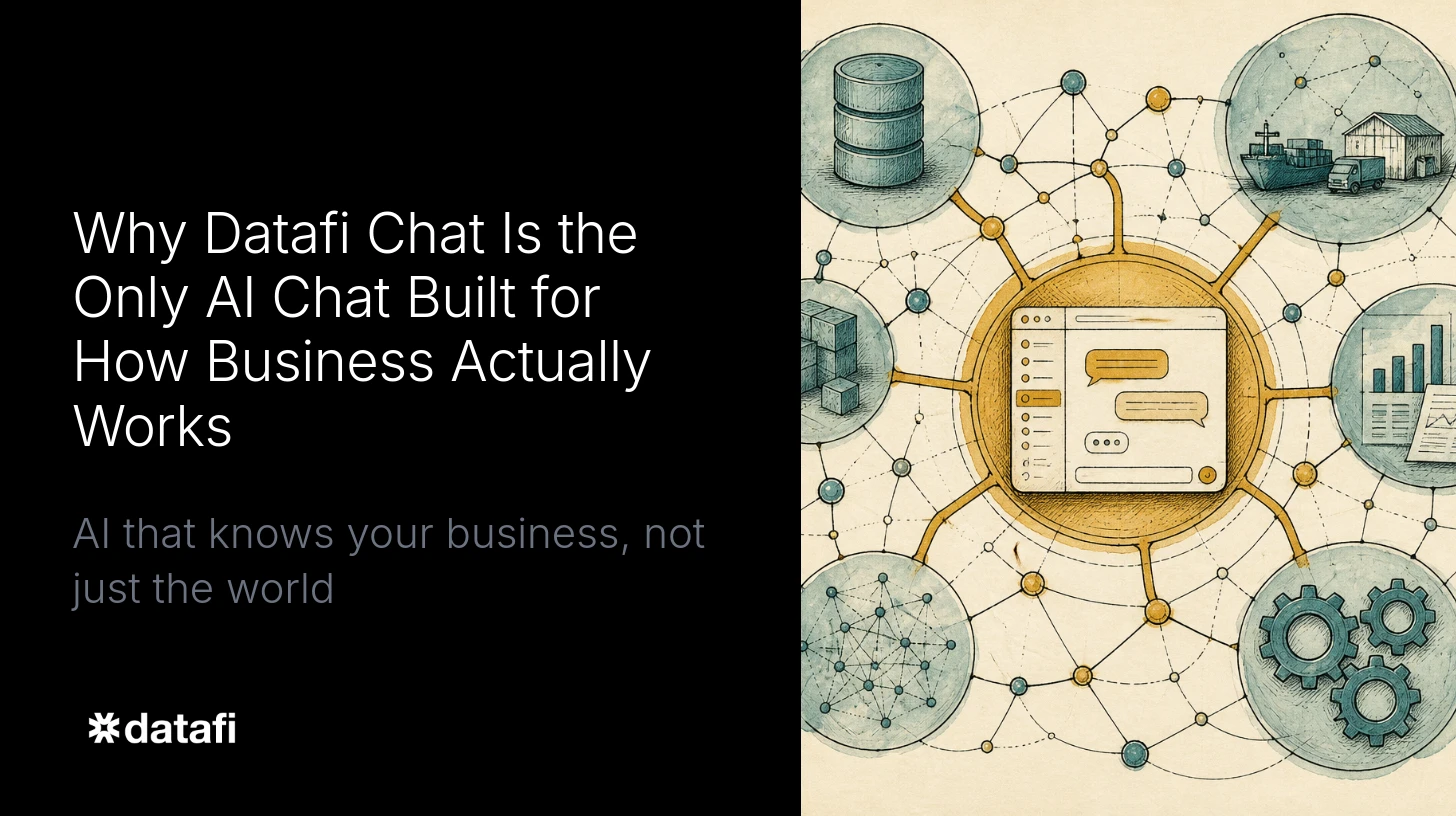
The Datafi operating system is built on a foundational belief that most organizations have encountered as a hard operational truth: AI cannot solve complex business problems without access to the complete data ecosystem. Not a curated subset. Not a pre-aggregated warehouse of approved metrics. The complete ecosystem, governed appropriately, with the full relational context that makes signals meaningful. That is what separates a real data platform from just a reporting tool.
Supplier risk is one of the clearest illustrations of why this matters.
Consider what changes when an AI system can simultaneously access your ERP’s vendor master and purchase order history, your AP platform’s payment aging data, your logistics provider’s shipment performance feeds, your third-party financial monitoring subscriptions, your contract management system’s terms and renewal schedules, your commodity risk feeds, and your geopolitical intelligence sources, all at once, all in context.
The system stops looking at suppliers as rows in a table. It starts reasoning about them as entities embedded in a web of interdependencies that your business depends on. It can identify that a supplier whose financial rating is stable is nonetheless concentrated in a region facing labor disruption that is trending toward escalation in the news data. It can surface that your AP team has been extending payment terms with a specific vendor, a signal that might indicate a quiet negotiation underway or financial accommodation that has not been formalized. It can calculate that three suppliers in your top twenty all source a specific raw material from the same geography, meaning a single geopolitical event creates correlated exposure that no single-supplier risk score would ever reveal.
These are not insights that analysts fail to generate because they are not trying hard enough. They are insights that no human team can generate reliably, at scale, in real time, without AI as the connective tissue between all of those data streams.
Agentic Capacity Changes the Risk Model Entirely
Understanding risk is necessary but not sufficient. The operational advantage of a purpose-built AI operating system like Datafi is that it does not stop at generating insights. It is capable of acting on them.
When AI agents have governed access to the full data ecosystem and can execute workflows autonomously, supplier risk management transforms from a periodic review process into a continuous operational capability. An agent monitoring your supplier ecosystem can detect an emerging concentration risk, cross-reference it against your sourcing strategy and contract terms, identify alternative qualified vendors in your approved supplier list, flag the commercial impact against your current category spend, and draft a recommended remediation plan for procurement leadership to review, all before a human analyst has opened their morning dashboard.
This is not theoretical. It is what becomes possible when the AI has the business context to reason about risk in terms of actual operational consequence, not just abstract scores. An AI that knows your lead times, your sole-source dependencies, your inventory buffers, your customer commitments, and your strategic supplier relationships can triage risk in terms of business impact, which is the only framing that drives executive action.
The shift this enables for procurement and operations leaders is profound. Instead of managing a function that is permanently in reactive mode because the data synthesis work consumes all available capacity, you lead a function where AI handles the synthesis continuously and your team focuses on the judgment calls, the relationship conversations, and the strategic decisions that actually require human expertise.
The Role of Governance in Making This Safe
Access to the complete data ecosystem without appropriate governance is not a solution. It is a new category of risk. Procurement data sits alongside financial data, HR data, customer data, and operational data. Supplier financial intelligence may be commercially sensitive. Contract terms may be under legal privilege. Some risk monitoring data carries compliance obligations around how it can be accessed and used.
The Datafi operating system is built with policies and governance as first-class architectural components, not features bolted on after the fact. Every data access is governed by the policies that apply to the person or agent making the request. A procurement analyst using the Datafi Chat UI gets a synthesized view of supplier risk that draws on all of the relevant data they are authorized to access. A supply chain director with broader access gets a fuller picture. An AI agent executing a workflow operates within the scope defined for that workflow.
This governance architecture is what makes it safe to give AI the full data ecosystem access it needs to be genuinely useful. You are not choosing between capability and control. As a true data integration platform, the Datafi model provides both simultaneously, because the policy layer is embedded in every data interaction, not applied as a filter at the end.
For procurement and operations executives, this resolves the tension that has historically made enterprise AI adoption complicated. The organization wants AI to have enough context to be useful. The organization also needs to know that sensitive supplier intelligence, financial signals, and contract data are not being exposed inappropriately. Datafi’s vertically integrated stack makes both requirements satisfiable at once.
The Practitioner Experience
One of the persistent failure modes in enterprise AI adoption has been the gap between what AI systems can do in theory and who in the organization can actually use them. If realizing the value of AI-powered supplier risk intelligence requires a team of data engineers to build and maintain integration pipelines, and a team of data scientists to interpret outputs, and a team of analysts to translate outputs into business language, the ROI calculus starts to look very different.
Datafi’s Chat UI is designed specifically to close this gap. Non-technical users across procurement, operations, finance, and executive leadership can query the full context of the supplier risk environment in plain language. A category manager can ask which of their top ten suppliers have experienced logistics performance degradation in the past ninety days, cross-referenced against contract renewal dates in the next six months, and receive a synthesized answer drawn from the live data ecosystem without writing a query or opening a BI tool.
This is not a simplified interface layered over a limited dataset. It is a natural language access layer over the complete governed data ecosystem, with the AI reasoning across all of the relevant context to produce an answer that is operationally meaningful, not just technically accurate.
For organizations of any size, this means that supplier risk intelligence stops being a function of how many analysts you can afford to staff. It becomes a capability that extends to every employee who needs it, calibrated to their role, their data access, and their operational context.
Reframing the Investment Case
Procurement and operations leaders evaluating AI investments in supplier risk often frame the decision around risk avoidance: what is the cost of a supplier failure versus the cost of better monitoring? That is a legitimate frame. But it understates the return.
The more powerful case is operational leverage. When AI handles the continuous synthesis work that currently consumes the majority of your risk management capacity, your team’s bandwidth redirects entirely toward higher-value activities. Supplier development. Strategic sourcing. Negotiation. Relationship management. Category innovation. These are the activities that procurement leaders know drive long-term competitive advantage, and they are consistently crowded out by the data management burden that AI can eliminate.
Organizations that have deployed Datafi as their data platform and operating system across procurement and supply chain functions consistently discover that the initial use case, whether risk monitoring, spend analytics, or supplier performance tracking, rapidly expands. Once the full data ecosystem is accessible through a governed AI layer, the scope of problems the organization can address with AI expands in direct proportion to the business context available to it. Supplier risk becomes the entry point to a broader transformation of how procurement and operations intelligence is generated, distributed, and acted on across the enterprise.
The Synthesis Imperative
The organizations that will lead their industries in supply chain resilience over the next decade will not be those with the most sophisticated sourcing processes or the most diversified supplier panels. They will be the ones that solved the synthesis problem first, that gave AI the full context of their supplier ecosystem, and that built the agentic capacity to act on risk intelligence continuously rather than periodically.
Supplier risk is not a sourcing problem. It never was. It is a data synthesis problem, and for the first time, there is an operating system for AI that is purpose-built to solve it.
The question for procurement and operations executives is not whether to make this investment. It is whether to make it before or after the next supplier failure teaches the lesson that data fragmentation has been teaching organizations for years.
Datafi exists to make that lesson unnecessary. Get in touch with us today.