


For COOs, VPs of Supply Chain, and Chief Procurement Officers who are tired of being surprised by problems their data already knew about.
There is a moment every supply chain leader recognizes. The call comes in. A critical supplier has gone dark. A port is backing up. A single-source component is suddenly unavailable. The post-mortem always reveals the same uncomfortable truth: the signals were there. They were buried in procurement data, sitting in logistics feeds, visible in quality reports, or hiding in a supplier’s own financial disclosures. But no one synthesized them in time. No one connected the dots before the disruption connected itself.
This is not a data problem. It is a synthesis problem. And for most organizations, it has remained unsolved not because the data is insufficient, but because the systems designed to interpret it were never built to think.
That is changing. And the organizations that understand what is actually required to close this gap, not just surface dashboards but genuinely reason across the full context of an enterprise, will build a durable competitive advantage that compounds over time.
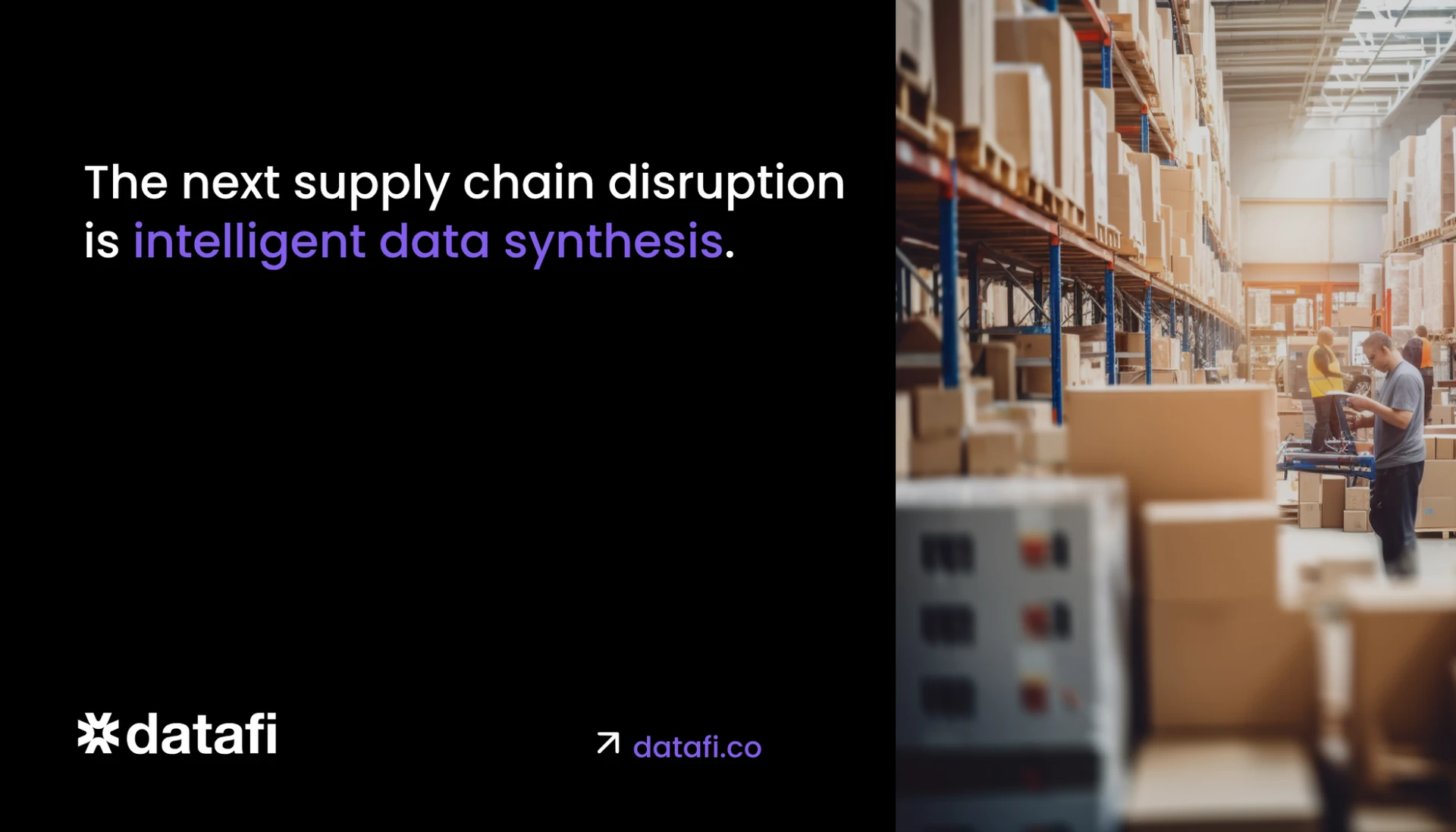
The disruptions that defined the last several years of supply chain history were not unforeseeable. They were unsynthesized. The data existed, the signals were present, and the capacity to connect them at speed simply was not deployed.
The Illusion of Visibility
Most large organizations today have more supply chain data than they have ever had. They have ERP systems tracking purchase orders and inventory. They have supplier portals collecting performance metrics. They have logistics platforms generating real-time shipment data. They have financial systems monitoring spend. They have sustainability databases tracking ESG commitments. They even have external feeds for commodity prices, weather events, geopolitical risk, and port congestion.
What they do not have is a system that reads all of it together.
Instead, each data source becomes its own silo, managed by its own team, reviewed on its own schedule, analyzed through its own lens. The procurement team is watching spend. The logistics team is watching transit times. The finance team is watching payables. The risk team is running quarterly supplier assessments. Each group is doing exactly what they were hired to do. And no one is watching what happens when you overlay all four at once.
This is the core failure of legacy analytics. Tools built to answer questions cannot tell you what questions to ask. A dashboard that shows on-time delivery rates is only as useful as the person who thinks to check it, knows what to compare it against, and has the time and authority to act. When the signals are distributed across a dozen systems and interpreted by a dozen teams with no shared context, the surprise that follows is not a matter of bad luck. It is a structural outcome.
What Synthesis Actually Requires
The conversation about AI in supply chain often defaults to a narrow frame: automation of repetitive tasks, chatbots for internal queries, predictive models for demand forecasting. These are real use cases. But they are not the same as synthesis, and they do not solve the fundamental problem of connecting fragmented signals into coherent intelligence.
True synthesis requires three things that most AI deployments lack.
First, it requires access to the complete data ecosystem, not a curated subset. The insight that a tier-two supplier is under financial stress does not live in a single table. It lives in the intersection of payment terms, invoice aging, quality deviation trends, order volume changes, and external signals like credit ratings or news sentiment. A system that can only see one or two of these sources will always miss the full picture. A system with access to all of them can begin to reason.
Second, it requires business context that spans the full organization. The relationship between a supplier’s performance and a customer’s experience, filtered through the lens of your cost structure and contractual commitments, is not a calculation any single team can run. It requires a model that understands the business at depth, not just its data fields, but the intent behind the workflows, the priorities embedded in the policies, and the trade-offs that have been made over years of operations. This is what separates an AI that answers questions from one that is a true data analysis AI that solves problems.
Third, it requires the capacity to act, not just observe. The value of identifying a supply risk three weeks before it becomes a disruption depends entirely on whether something happens next. If the identification surfaces in a report that gets reviewed in a weekly meeting, the lead time advantage is consumed before anyone picks up a phone. The organizations that will win are the ones where the intelligence triggers the action autonomously, within governed parameters, at a speed that a human team and a traditional process automation tool operating in sequence simply cannot match.
The Datafi Operating System: Built for This Problem
Datafi was designed around a foundational belief: that the reason AI has not delivered on its promise in the enterprise is not a model quality problem. It is an infrastructure and context problem. Large language models are extraordinarily capable. But capability without context is guesswork. And context without action is theater.
The Datafi AI operating system addresses this by providing a vertically integrated stack that gives AI agents what they actually need to reason and act effectively inside a real enterprise environment.
At the foundation is access to the full data ecosystem. Datafi connects to the complete range of enterprise data sources without forcing data movement or replication. It operates across structured and unstructured data, internal systems and external feeds, historical records and real-time streams. This is not a data warehouse replacement. It is a connective layer and data platform that makes the entire ecosystem available as context for the AI working inside it.
Above that foundation sits the governance and policy layer. For supply chain and procurement leaders, this is not a nice-to-have. It is the prerequisite. AI that can access supplier financials, contractual obligations, sourcing strategies, and cost models must operate within clearly defined boundaries. Datafi’s policy and control architecture ensures that agents operate within the permissions, data classifications, and workflow boundaries that the organization has established. The intelligence is expansive. The governance is rigorous.
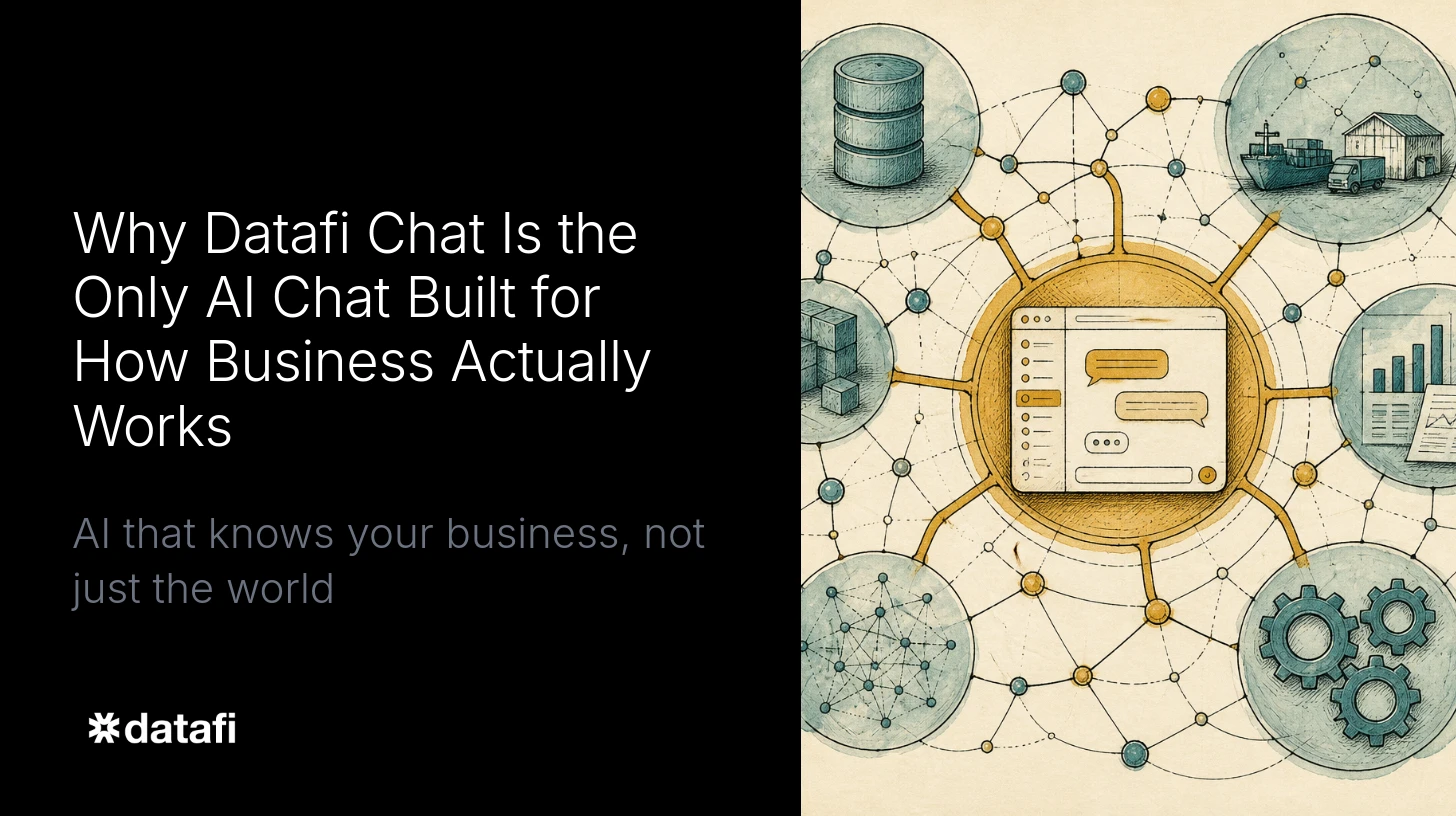
The interface layer is built for the entire enterprise, not just the data team. Datafi’s Chat UI is designed for non-technical users, which means that a category manager, a logistics coordinator, or a plant operations lead can access AI-driven intelligence through natural conversation. They do not need to know how to write a query, configure a report, or interpret a model output. They ask the question that matters to their work, in the language of their work, and the system reasons across the full context of the business to answer it.
This is the unified data experience that organizations of any size can achieve. Not a single dashboard. Not a centralized analytics team. A distributed capacity for intelligent inquiry that reaches every employee who makes decisions.
What This Looks Like in Practice
Consider predictive maintenance across a distributed manufacturing or logistics network. Traditional approaches rely on scheduled maintenance intervals, reactive repair records, and periodic inspections. The signals that precede equipment failure, patterns in sensor data, subtle shifts in operating parameters, correlations between environmental conditions and component wear, are collected but rarely synthesized before something breaks.
With the Datafi operating system, an AI agent with access to IoT sensor feeds, maintenance histories, parts procurement records, and supplier lead times can identify degradation patterns well before failure probability reaches threshold. It can calculate the cost of an unplanned stoppage against the cost of proactive intervention. It can initiate a parts order, schedule maintenance, and notify the relevant operations team, all within the policy boundaries the organization has defined. The insight and the action arrive together.
The same principle applies to supplier risk. A procurement team managing hundreds of active suppliers cannot manually monitor every financial signal, every geopolitical development, every quality trend, and every contractual milestone for every relationship simultaneously. An AI operating system with full data ecosystem access and deep business context can. Continuous AI data analysis reads across payment aging, performance metrics, external risk indicators, and internal demand forecasts simultaneously. When the pattern warrants attention, it surfaces it proactively, not in response to a query, but as autonomous intelligence that treats supplier health as an ongoing concern rather than a periodic report.
For operations optimization, the value of full-context reasoning becomes even clearer. Decisions about network configuration, carrier allocation, inventory positioning, and sourcing strategy all involve trade-offs that are invisible when each variable is examined in isolation. When an AI system understands the full cost model, the service commitments, the capacity constraints, and the market dynamics simultaneously, it can recommend and execute optimization decisions at a speed and granularity that human teams working with fragmented tools simply cannot reach.
The Case for Autonomous Agents in Critical Workflows
The most significant shift in enterprise AI is not smarter dashboards. It is the emergence of agents capable of operating autonomously in complex, multi-step workflows where the stakes are real and the decisions require genuine contextual reasoning.
COOs and supply chain leaders are beginning to see this shift clearly. The question is no longer whether AI can assist in supply chain operations. The question is what architecture is required to deploy AI in genuinely critical roles, where it is not just surfacing information but making decisions and executing actions within defined parameters.
Datafi’s view is that this requires a vertically integrated stack for a specific reason: the contextual layer that makes an agent trustworthy in a critical role cannot be assembled from point solutions or a generic process automation tool. It emerges from the depth of integration between the data ecosystem, the governance layer, and the model itself. When the model knows the business, not just the data, it can reason about exceptions, not just patterns. It can distinguish between a supplier performance anomaly that warrants investigation and one that reflects an approved operational change. It can apply judgment, within scope, in a way that narrows the gap between intelligence and action.
This is the architecture that enables LLMs to operate in fully autonomous roles where learning and problem-solving compound over time. The agent that resolves a supplier risk this month builds context that makes it more effective next month. The workflow that optimizes carrier allocation today generates data that improves the model’s understanding of the cost landscape tomorrow. The intelligence is not static. It grows with the business.
The Competitive Divide Is Opening Now
There is a window closing. The organizations that build genuine AI operating capacity in their supply chains now, not proof-of-concept deployments, not analytics projects, but production-grade, autonomous, contextually aware systems, will establish advantages that are genuinely difficult to close later.
The disruptions that defined the last several years of supply chain history were not unforeseeable. They were unsynthesized. The data existed. The signals were present. The capacity to connect them at the speed and depth required, and the kind of data analysis AI that unifies everything together, was simply not deployed.
That capacity now exists. The question for every COO, VP of Supply Chain, and Chief Procurement Officer reading this is not whether to pursue it. It is whether to pursue it before or after the next disruption reveals that the signals were there all along, waiting in the data, for someone or something capable of reading them together.
The disruption you did not see coming was already in your data. The intelligence to have seen it is now available. What comes next is a choice about architecture.
Datafi is an applied AI software company building the operating system for enterprise AI. The Datafi platform provides vertically integrated data ecosystem access, policy and governance controls, and a Chat UI designed for non-technical users, enabling organizations to deploy AI agents and workflows across the full breadth of the enterprise.