


Industry Series: AI for Freight and Logistics | Part 3 of 3
For most of the history of the freight industry, scale won. The carrier with the bigger network, the more terminals, the broader geographic reach, and the larger fleet had structural advantages that smaller regional operators simply could not overcome. Network density determined pickup and delivery windows. Asset scale determined cost structure. Relationship depth determined shipper loyalty. Size was not everything, but it was most things.
That calculus is shifting.
Not because network and scale have stopped mattering, but because a new variable has entered the competitive equation with enough force to change the math. The carriers who are outperforming their size right now are doing it with intelligence, specifically with AI that operates across their data ecosystem, reasons with the full context of their business, and acts autonomously in ways that are creating operational advantages their larger competitors have not yet matched.
This is not a technology prediction. It is a pattern that is already playing out on the ground, and the carriers who understand what is driving it have a clear view of where the industry is heading.
Regional carriers are outcompeting larger networks not by expanding their footprint, but by deploying AI that operates across their full data ecosystem, reasons with complete operational context, and acts autonomously, turning intelligence itself into a structural competitive advantage.
Why Network Used to Be the Moat
The logic of network advantage in LTL is straightforward. A carrier with more terminals can offer pickup and delivery service across a wider geography. More terminal density means shorter linehaul distances, which means faster transit times and lower costs. More volume across the network means better asset utilization. Better asset utilization means better margins, which fund continued network investment. The advantage compounds.
Regional carriers have always competed against this logic by excelling within their geography. A carrier focused on a specific region can develop terminal density, local market knowledge, and shipper relationships that a national carrier stretching across forty-eight states cannot match on a local basis. Service quality and reliability have been the traditional differentiation tools for regional players, and they have worked well enough to sustain a healthy regional carrier ecosystem alongside the national operators.
But service quality and reliability are increasingly becoming table stakes rather than differentiators. The best-performing national LTL carriers now routinely report on-time service performance at or above 99 percent, cargo claims ratios below 0.1 percent, and operating ratios in the low-to-mid seventies. When the performance bar is that high, the question for shippers is no longer whether a carrier can deliver reliably. It is which carrier can deliver most efficiently, most responsively, and at the best total cost. That question is increasingly being answered by data and AI, not just by network footprint.
The Intelligence Layer as Competitive Infrastructure
Consider what an AI operating system actually does for a regional LTL carrier when it is deployed correctly. It does not replace the humans who run the operation. It transforms what those humans are able to accomplish.
Terminal managers make better labor scheduling decisions because they have accurate, real-time freight volume data instead of lagged estimates. Dock supervisors allocate resources more effectively because AI agents have already connected inbound freight volumes to available capacity and surfaced the optimal configuration. Customer service teams resolve exceptions faster because the AI has already gathered the relevant context and escalated with a complete picture rather than requiring the representative to chase down information across multiple systems. Operations leadership has a cleaner, more accurate view of network performance because the AI is continuously synthesizing data that previously lived in silos.
Each of these improvements is individually meaningful. Together, they create something more significant: a carrier that operates with consistently better information than its competitors, acts on that information faster, and compounds those advantages across every shift, every terminal, and every customer interaction.
The quantitative case for this kind of operational transformation is now well-documented across the industry. Research on freight operations consistently shows that manual or rule-based freight management leaks 15 to 30 percent of addressable logistics spend across fuel, labor, carrier penalties, and failed delivery costs. For a regional carrier with $300 million in revenue, capturing even half of that addressable efficiency represents tens of millions of dollars in annual cost and margin improvement. The network carrier with three hundred terminals faces the same leakage problem at larger scale; the regional carrier with thirty-five terminals and better AI can move faster to close it.
A Regional Carrier Builds Its Intelligence Advantage
A well-established LTL carrier serving the western United States recognized this dynamic before most of its competitors. The carrier had built a strong regional reputation over decades of operation, with a dense terminal network, reliable service, and deep shipper relationships. It understood its competitive strengths and it understood the pressures building in the market. What it needed was a way to translate its operational strengths into consistent execution at scale as volumes grew and shipper expectations evolved.
The decision to deploy the Datafi platform was grounded in a specific operational challenge: the lag between freight entering the physical network and that freight becoming visible in operational systems was creating unnecessary friction in labor planning, dock management, and exception handling. The carrier was compensating with scheduling buffers and management oversight that worked but consumed capacity and added cost that did not need to be there.
Datafi’s AI agents were deployed to close this loop. Built on a vertically integrated data and AI architecture that unified the carrier’s freight management systems, labor systems, document workflows, and operational data streams, the agents processed incoming freight documents in real time, connected freight volume data to scheduling systems, and delivered accurate operational intelligence to terminal managers hours earlier than had previously been possible.
Three categories of quantifiable benefit emerged from the deployment.
Overtime costs fell at the terminals where AI-driven scheduling replaced estimate-based planning. The carrier estimated a 15 to 20 percent reduction in overtime hours at fully deployed locations, driven by the elimination of the scheduling buffer that had previously been necessary to compensate for data lag. In a labor-intensive business where direct labor represents a substantial portion of the cost base, this improvement flowed directly through to operating ratio improvement.
Management time was redistributed from information-gathering to decision-making. The operations managers who had been spending 30 to 60 minutes per shift aggregating data from multiple systems before they could make scheduling decisions were now making those decisions in minutes. Across a multi-terminal network, the cumulative recovery of management capacity was equivalent to adding significant operational bandwidth without adding headcount, freeing experienced managers to focus on the service and safety decisions that their expertise was actually needed for.
Service consistency improved as a downstream effect of better planning. When freight volume data is accurate and timely, the dock configuration is right, the labor is appropriately matched to the volume, and the first-pass execution of the operational plan improves. The carrier saw measurable reductions in the exception rate tied to scheduling mismatches, which compounded through customer satisfaction metrics that had become increasingly important in shipper retention conversations.
What the Intelligence Advantage Requires
The carriers watching this dynamic from the outside often ask the same question: what does it actually take to build this kind of intelligence advantage? The answer is more straightforward than the technology landscape would suggest.
It requires an AI platform that can access the full data ecosystem of the operation. Not just the TMS, not just the visibility platform, not just the labor system, but all of them together, unified into a single operating context that AI agents can reason across simultaneously. This is the foundation, and it is the requirement that most point solutions and departmental AI tools cannot satisfy. An AI agent that can only see one system is an AI agent that can only optimize within the boundaries of that system. Real operational intelligence requires the full picture.
It requires AI that is built to act, not just to answer. The distinction matters enormously in an operational environment where the value of information degrades rapidly with time. An AI system that surfaces insights for human review is better than no AI. An AI system that initiates appropriate actions autonomously, escalating only the decisions that genuinely require human judgment, is the difference between incremental improvement and structural transformation.
And it requires a platform partner that understands the freight and logistics business well enough to configure the AI to work the way operations actually work, not the way a generic AI product assumes they work. Context specificity is not a nice-to-have. It is the mechanism by which AI becomes genuinely useful rather than theoretically interesting.
The Window Is Open, But Not Indefinitely
The carriers who move early on the intelligence layer will capture advantages that compound over time. Service consistency improves. Cost efficiency improves. The carrier’s understanding of its own operation deepens as AI agents learn from more data across more operational cycles. These advantages are not easily replicated quickly, because the value of an AI operating system grows with time and context.
The carriers who wait will face a different competitive environment when they finally move. By then, the early movers will have built operational habits, institutional knowledge, and AI-driven capabilities that have had time to mature. Catching up to a competitor that has been running AI agents across its full data ecosystem for two or three years is a different challenge than building the capability in parallel.
The freight industry has always rewarded the carriers who understood the next source of competitive advantage before their competitors did. Network investment. Safety technology. Driver retention practices. Visibility platforms. Each wave of investment created advantage for the early movers and eventually became the cost of entry for everyone else.
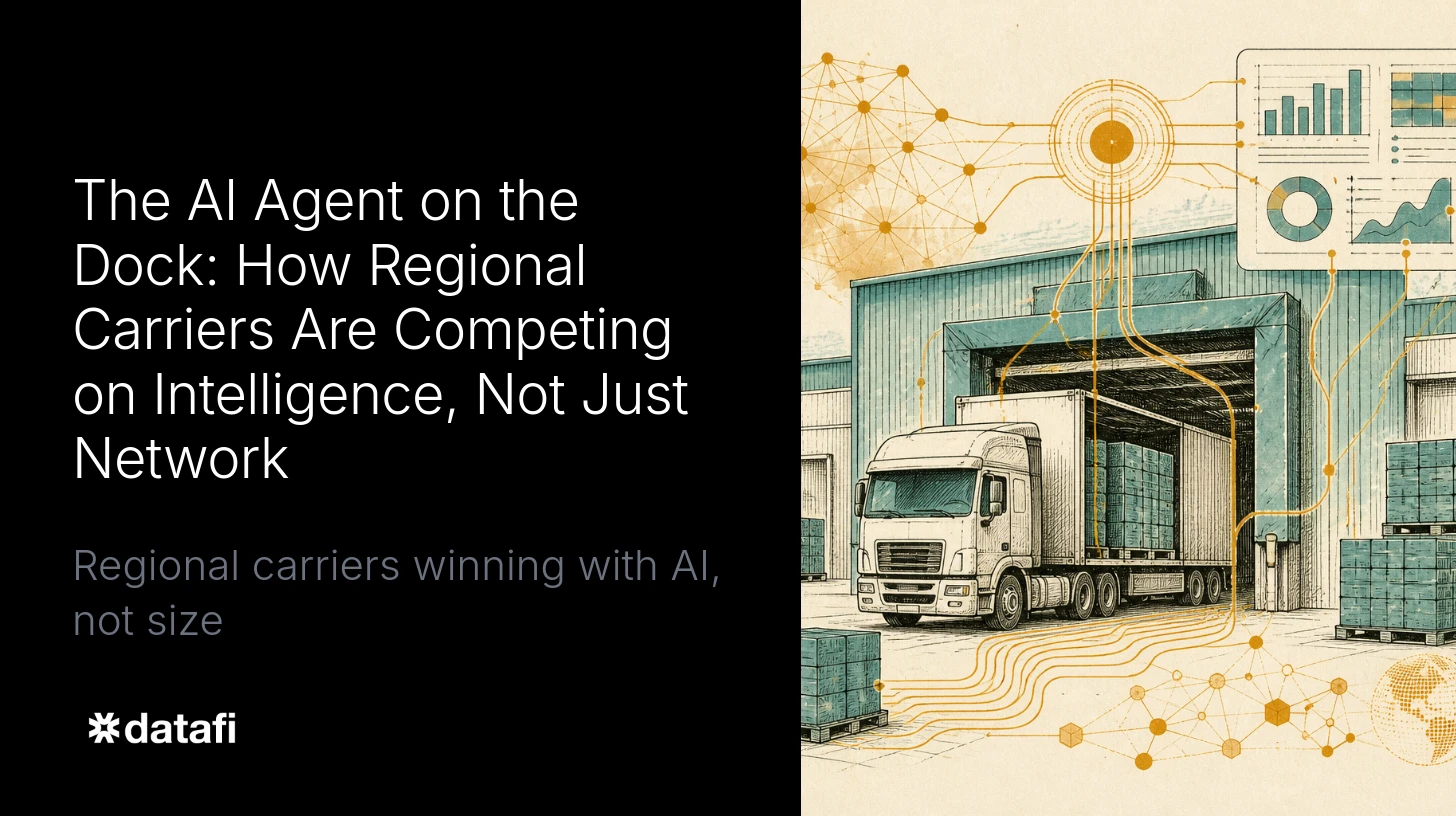
Operational intelligence is the current wave. The AI agent on the dock is not a future concept. It is running today at the carriers that will define the competitive standard for the rest of the decade.
The question every regional carrier leadership team should be asking is not whether to build this capability. It is how much time they can afford to let the early movers build their advantage before catching up becomes the only option.
Datafi is the Business AI Operating System for freight, logistics, and other data-intensive industries. Built on a vertically integrated data and AI technology stack, Datafi enables unified data experiences, autonomous AI agents, and embedded governance that transform how organizations use AI across the enterprise. Learn more at datafi.co.