



AI-Era Design Principles, Part 1 of 4
This is the first article in a four-part series exploring the AI-era design principles that separate transformative AI deployments from expensive pilots that never scale. Each article in the series maps a McKinsey-defined design principle to the real-world architecture required to make it work, and to how Datafi is building the platform that brings these principles to life.
There is a quiet crisis playing out inside thousands of organizations right now. Boardrooms are approving AI budgets. Technology teams are deploying models. Employees are being trained to write better prompts. And yet, by almost every measure, the bottom-line results are not arriving. McKinsey’s latest research on the state of AI puts the paradox in stark relief: the technology is nearly everywhere, and meaningful, measurable gains are nearly nowhere.
The instinctive response is to blame the models. They are not smart enough, or not yet trained on enough proprietary data, or not yet capable of the reasoning required for serious business work. But that instinct is wrong. The models are extraordinary. The problem is not capability. The problem is experience, and underneath the experience problem is something more specific and more solvable: a fundamental failure of clarity.
The reason most enterprise AI deployments fail to deliver measurable results is not model capability. It is a fundamental failure of clarity: users cannot see the reasoning behind AI outputs, so they either accept answers blindly or abandon the tool entirely.
When an AI system produces an output and a user cannot see why, cannot interrogate the assumptions, cannot trace the reasoning back to the data that drove it, trust collapses. The user either accepts the answer blindly, which introduces risk, or abandons the tool altogether, which forfeits the value. Neither outcome is acceptable for organizations that want AI to do serious work. And yet the dominant design paradigm today still treats the AI output as a terminus rather than a beginning. A chat box returns an answer. A dashboard surfaces a number. The logic behind both remains hidden. The experience is fast, confident, and opaque.
McKinsey’s framework for building what they call “next-horizon AI experiences” opens with a principle that cuts straight to this problem: Lead with Clarity. The principle is straightforward to state and genuinely difficult to execute. Design systems that make their logic, assumptions, and outputs clear, enabling users to confidently understand what the AI produced and why. When reasoning becomes legible, people can engage with it, question it, and decide with confidence. When it stays hidden, people cannot collaborate with the system in any meaningful sense. They can only accept or reject.
This is not primarily a model problem. It is an architecture problem, and it is a design problem. Solving it requires more than adding an explainability layer to an existing tool. It requires rethinking how data, context, governance, and interaction are assembled from the ground up.
The Clarity Gap Is Wider Than It Looks

Consider what actually happens when a business user asks an AI tool a question that touches on real operational data. The user might ask something like: why did our customer retention rate drop in the Northeast region last quarter? An AI system that lacks access to the full data ecosystem will approximate. It will draw on whatever signals are within reach, stitch them together with the confidence of a language model trained to sound authoritative, and return an answer. The answer may be partially right. It may be directionally misleading. It may reflect patterns from a training corpus that has nothing to do with this business. The user has almost no way to know which is true.
The McKinsey article describes this as a context gap: a failure to know what information is actually required to perform a task thoroughly and accurately. But context gaps and clarity gaps are deeply intertwined. When a system does not have access to the full picture, it cannot be transparent about what it actually used to reach a conclusion. Clarity requires completeness, and completeness requires architecture.
This is where most deployed AI solutions today fall short, and it is where the gap between AI tools and AI platforms becomes decisive. A tool answers questions. A platform creates the conditions under which AI can answer them well, and then shows the user how it got there.
What Clarity Actually Requires
McKinsey’s clarity principle addresses the interaction layer, the moment when AI reasoning is made visible to a user. But to get that layer right, the layers beneath it must be built correctly. Clarity at the output level is only possible when the system has access to complete, governed, contextual data, and when the AI operates within a framework that makes its assumptions explicit and its decisions auditable.
At Datafi, this is the architectural conviction that has shaped the platform from the beginning. A vertically integrated data and AI technology stack, built to provide AI with full access to the organizational data ecosystem, is not a technical preference. It is a prerequisite for the kind of AI experience that McKinsey describes, and for the kind of outcomes that organizations actually need from AI.
When an AI agent at Datafi works through a business question, it operates with access to the complete context of the business. That means governed data, connected across sources, with the policies and permissions that determine what data the AI can access, what it can surface, and to whom. It means the AI knows not just what is in the data, but what the data means in the context of this organization’s operations, terminology, and decision-making patterns. And critically, it means that when the AI reaches a conclusion, there is a traceable path from that conclusion back through the reasoning, back through the data, back to the source of truth.
This is what makes clarity possible. Not a better language model generating a more confident explanation, but an architecture that gives the AI the complete picture and gives the user a window into how that picture was interpreted.
Non-Technical Users Are the Real Test

There is a version of AI clarity that is easy to build and serves only a narrow audience. Expose the underlying query. Surface a confidence score. Link to a data lineage diagram. These approaches satisfy a data engineer or a data scientist, and they are genuinely useful at that level. But they do not solve the problem for the vast majority of people inside an organization who need to use AI in their work, and who are not equipped to interpret raw SQL or navigate a provenance graph.
The real test of an AI clarity system is what it looks like to a regional sales manager, a supply chain coordinator, a customer service leader, a finance analyst without a technical background. These are the users whose adoption determines whether AI delivers organization-wide impact or stays confined to a technical minority. And these are the users for whom clarity is most urgent, because they have the least tolerance for opaque outputs they cannot interrogate, and the least ability to catch errors through technical inspection.
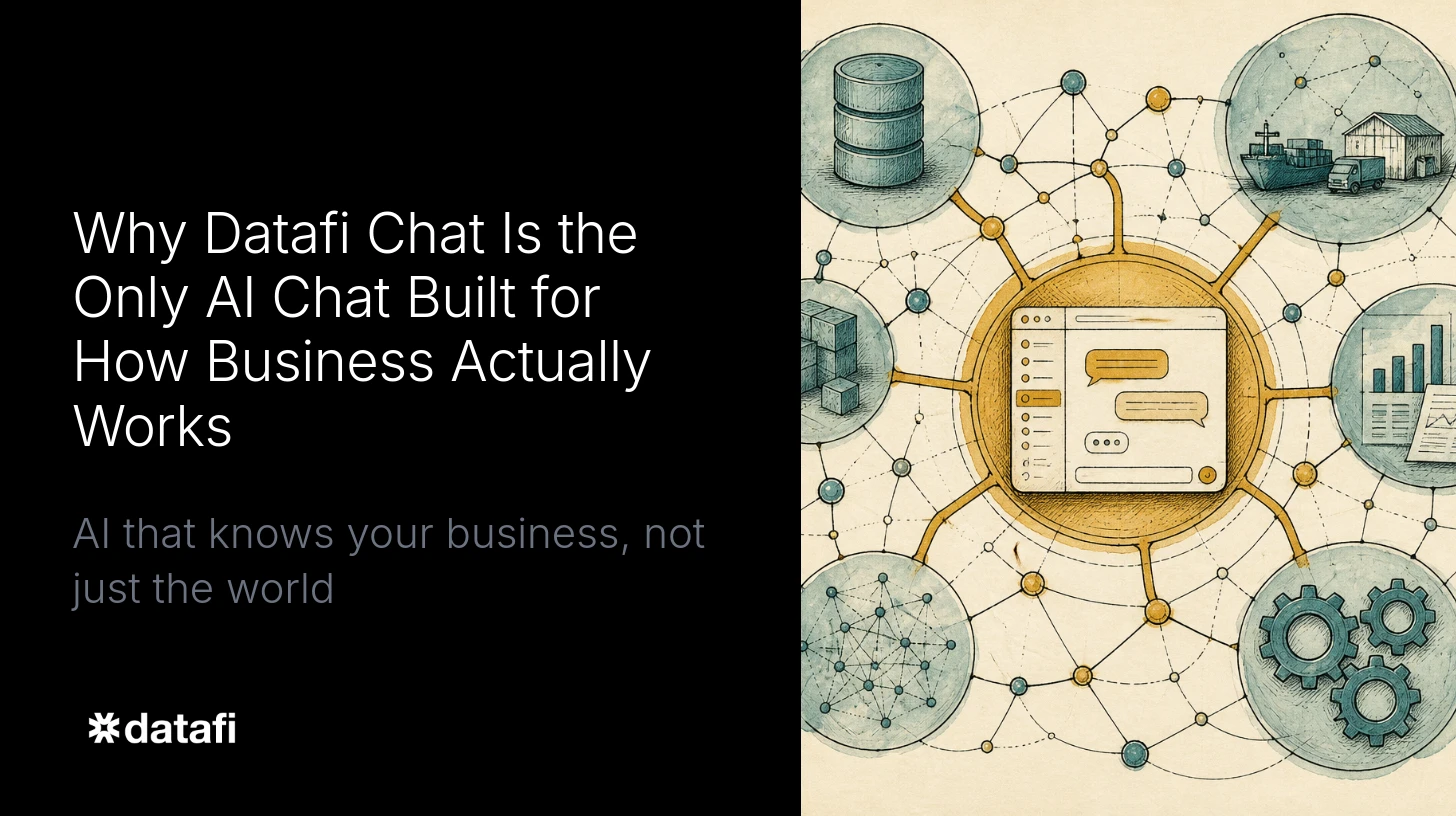
This is why Datafi’s Chat UI is designed explicitly for non-technical users, and why that design choice is inseparable from the clarity principle. A conversational interface built on top of a fully governed, contextually rich data ecosystem gives non-technical users something they have never had before: the ability to ask real business questions in natural language and receive answers that are grounded in the actual data of their organization, with enough transparency about the reasoning that they can engage with the output rather than simply accepting or rejecting it.
When the system asks a clarifying question before proceeding, it is not a limitation. It is a feature of clarity. It is the system making its assumptions visible, inviting the user to confirm or correct them before the AI commits to a direction. When the output surfaces the data sources it drew from, the time period it evaluated, the filters it applied, the user can assess the answer in context. They become a genuine participant in the reasoning rather than a passive recipient of conclusions.
McKinsey’s research found that when AI tools were allowed to ask clarifying follow-up questions before responding, nearly 75 percent of pilot users expressed enthusiasm for the tool, and the organization realized an incremental market sales uplift of more than 2 percent. That uplift did not come from a better model. It came from a better experience.
Clarity Is the Entry Point for Transformative AI
There is a deeper reason why clarity matters that goes beyond user trust and adoption, important as those are. Clarity is the condition under which AI can be used in critical thinking roles rather than just retrieval roles. It is the difference between AI that answers questions and AI that helps solve problems.
At Datafi, the perspective that informs the platform comes from years of working with data and AI at the point where they intersect with real operational decisions. What that experience makes clear is that the most valuable AI deployments are not the ones that return the fastest answers. They are the ones where the AI understands enough about the business to engage with the actual problem, where the user understands enough about the AI’s reasoning to push back, redirect, and refine, and where the interaction produces not just an answer but a decision that can be acted on with confidence.
This kind of engagement is only possible when the AI has access to the full context of the business and when the user can see into the logic well enough to evaluate it. LLMs operating with partial context, disconnected from the data ecosystem, without access to organizational policies and operational history, can approximate answers to narrow questions. They cannot develop the contextual layer required for complex agents and autonomous workflows. They cannot learn from the business in a way that improves their reasoning over time. They cannot be trusted with the kind of critical decisions that determine whether AI delivers transformation or delivers noise.
The vertically integrated architecture that Datafi has built is designed specifically to close this gap. By connecting the data ecosystem, the governance layer, the AI agents, and the user interface into a coherent system, Datafi creates the conditions under which AI can know the full context of the business, operate within appropriate boundaries, and surface its reasoning in a way that users can engage with. That is the architecture of clarity, it is the architecture of trust, and it is the architecture of Datafi.
The First Principle Is a Foundation, Not a Feature
McKinsey’s four design principles build on each other. Continuity, depth, and cocreation, the subjects of the next three articles in this series, all depend on a foundation of clarity. A system that carries context forward across interactions cannot do so usefully if the context it is carrying is opaque to users. A system that automates entire workflows cannot be trusted to do so if the reasoning behind each step is hidden. A system that invites genuine collaboration between human judgment and machine intelligence cannot sustain that collaboration without the transparency that makes it possible.
This is why clarity is not a feature to be added after the core architecture is built. It is a design principle that shapes the architecture from the start. It determines what data the AI has access to, how that data is governed, what the interaction layer looks like, and how outputs are structured and presented. Organizations that treat clarity as a UX refinement on top of a fundamentally opaque system will find that user adoption remains fragile and organizational impact remains elusive.
Organizations that build clarity into the foundation, starting with a complete, governed data ecosystem and a conversational interface designed for the people who actually need to use it, will find something different. They will find that trust develops, that adoption accelerates, and that AI begins to do the work it was always capable of: not just answering questions, but helping organizations solve the problems that actually matter.
In Part 2 of this series, we explore McKinsey’s second AI-era design principle, Design for Continuity, and how Datafi’s platform sustains context and memory across interactions to transform disconnected AI outputs into genuine organizational momentum.
About Datafi
Datafi is an applied AI software company building the integrated data and AI technology stack that organizations need to make AI work for every employee. By unifying the data ecosystem, governance, AI agents, and a conversational interface designed for non-technical users, Datafi gives organizations the platform to move from AI experimentation to AI transformation.