


AI-Era Design Principles, Part 3 of 4
Most enterprise AI deployments today share a quiet limitation that rarely gets named out loud. A user types a question. The AI responds. The user moves on. It feels productive, but the needle on actual business outcomes barely moves. The question was answered. The problem was not solved.
This is the gap at the center of what McKinsey calls the “gen AI paradox” in their recent article, Building Next-Horizon AI Experiences. Organizations are investing heavily in AI, employees are actively using it, and yet only a small minority report meaningful, measurable gains. The culprit, McKinsey argues, is not the models. It is the experience. And at the heart of that experience problem sits a design failure: we keep building AI tools that respond to single interactions when the work of running a business is inherently multistep, contextual, and domain-specific.
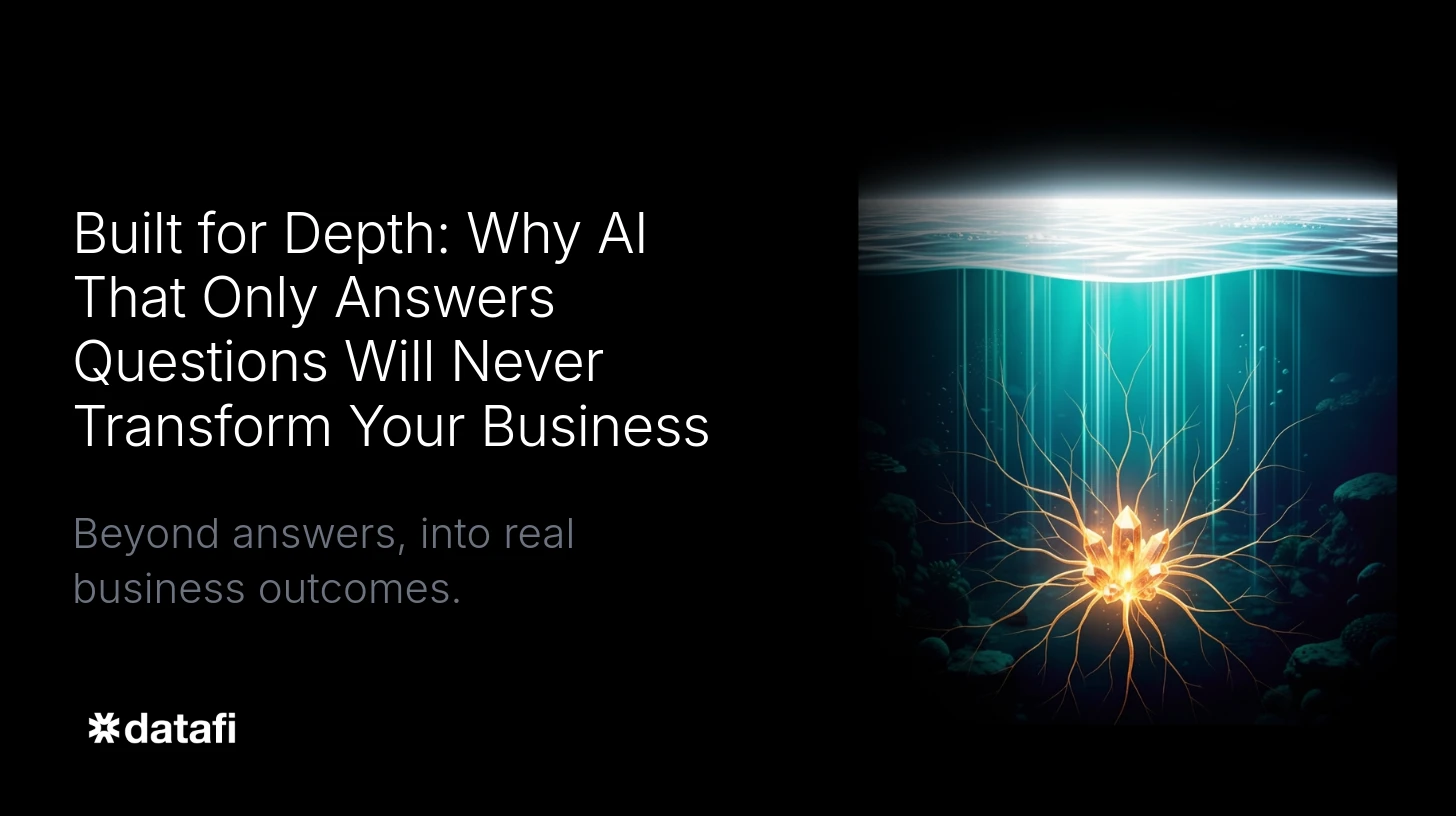
McKinsey’s third design principle addresses this directly. They call it Build for Depth: enabling rich, multistep, domain-specific workflows that go beyond single interactions to support meaningful end-to-end outcomes. At Datafi, this is not a principle we adopted after reading a framework. It is the architectural conviction we have been building toward since the beginning. This article explores what “built for depth” actually means in practice, why it requires more than a smarter chatbot, and how the Datafi platform is designed to take AI from interesting to indispensable.
The organizations that break through with AI will not be the ones that chase better models. They will be the ones that fundamentally rethink the way work happens, by building AI into the full depth of end-to-end workflows rather than stopping at single-interaction responses.
The Shallow Water Problem

Imagine asking a brilliant analyst a question and getting a precise, well-reasoned answer. Now imagine that analyst forgets the conversation the moment you walk away, has no access to your systems, does not know your industry, cannot act on anything they just told you, and needs you to re-explain your entire business context every time you return.
That is a remarkably accurate description of how most enterprise AI tools function today.
McKinsey describes four key breakdowns preventing AI from becoming a trusted partner: intent ambiguity, context gaps, generic outputs, and noncollaborative iteration. The depth problem runs through all four. When AI operates only at the level of the single interaction, it cannot accumulate context, apply organizational standards, or participate in the multi-stage decision-making processes that actually drive business value.
The workflows that matter most in an enterprise do not begin and end in one exchange. A procurement decision involves supplier data, contract history, compliance checks, budget alignment, and approval routing. A customer escalation involves transaction history, sentiment trends, SLA status, and the right stakeholder notification. An operational forecast involves integrating data from multiple systems, applying business-specific logic, scenario modeling, and triggering downstream actions. These are not questions. They are workflows. And answering a question in the middle of one of them does not constitute transformation.
Depth is the difference between an AI that tells you what is happening and one that helps you do something about it.
What “Built for Depth” Actually Requires
McKinsey frames the Build for Depth principle around a specific ambition: automating entire workflows rather than just providing answers. They describe the real opportunity as AI’s potential to connect the multistep processes that human workers follow instinctively, gathering data, applying logic, testing alternatives, and refining outputs. Depth transforms AI from a rapid respondent to a capable partner.
Delivering on that ambition requires three things that most AI deployments simply do not have: full data access, domain context, and the architectural capacity to act.
Full data access means AI is not working from a curated sample or a document library. It means AI can see and reason across the complete operational data ecosystem, structured and unstructured, transactional and analytical, historical and real-time. Depth is impossible if the AI is working with partial information. Every gap in data access is a gap in reasoning quality, and a gap in reasoning quality means a gap in trust. Enterprise decisions are only as good as the data behind them.
Domain context means the AI understands not just language, but your business. It knows your terminology, your data definitions, your organizational hierarchies, your policies, and the logic that governs how decisions get made in your specific environment. Generic outputs are the direct result of AI systems that lack this layer. When an AI does not know what a “high-value account” means in your context, or what constitutes a compliance exception in your industry, it cannot apply the specificity that transforms output from plausible to actionable.
The architectural capacity to act means AI can do more than generate text. It can trigger workflows, call functions, update systems, route tasks, and coordinate with other agents to complete a process from start to finish. This is the agentic layer. Without it, even the most insightful AI response lands in a human inbox where it either gets acted on slowly or forgotten entirely.
The Datafi Architecture: Depth as a Design Commitment
Datafi is built on a vertically integrated data and AI technology stack that brings these three requirements together. This is not accidental. It reflects a specific view of what enterprise AI needs to be before it can play meaningful roles in critical thinking, workflow automation, and operational decision-making at scale.
The Datafi platform connects to the complete data ecosystem, including the operational data stores, analytical platforms, and external sources that constitute the actual information environment of a business. This is the foundation that makes depth possible. AI agents operating within Datafi are not reasoning from a subset of your data. They are reasoning from the full context of your business.
Layered on top of that data access is a governed, compliance-ready AI environment. Policies, access controls, and audit capabilities are embedded into the architecture, not added afterward. This matters enormously when AI moves beyond answering questions into executing workflows. Every action an agent takes needs to be within sanctioned boundaries. Every decision needs to be traceable. Depth without governance is not enterprise-ready. It is a liability.
The Chat UI that non-technical users interact with is designed specifically to meet employees where they are, regardless of their data literacy or technical background. Most enterprise AI tools still require a degree of technical fluency to get real value from. Datafi’s interface is designed to remove that barrier, making depth accessible across the enterprise, from operations to finance to HR to customer success.
Agents and Workflows That Close the Loop

The most consequential shift Datafi enables is moving AI from advisor to actor. This is where the depth principle fully materializes.
In a Datafi workflow, an AI agent does not simply surface an insight and wait. It initiates a sequence. It gathers the relevant data, applies the appropriate business logic, checks it against governing policies, identifies exceptions or anomalies, escalates when human judgment is required, and routes downstream actions when it is not. The workflow closes. The outcome is achieved. The human’s role shifts from doing the work to stewarding it.
Consider the difference in a customer-facing operation. In a shallow AI deployment, a support manager asks the system for a summary of escalated tickets. The AI responds with a summary. The manager then manually reviews the cases, checks SLA status in a separate system, drafts responses, and routes tickets to the right teams. The AI saved some reading time. The operational burden remained.
In a depth-oriented deployment on Datafi, the same workflow runs differently. AI agents monitor escalations continuously, flagging high-risk cases based on SLA proximity, customer segment, and sentiment signals. When a threshold is crossed, the agent assembles the relevant context from across the data ecosystem, identifies the appropriate resolution path based on documented policies, drafts the communication, and routes it for human review before sending. The manager’s job is to approve and refine, not to orchestrate. The outcome is faster, more consistent, and more auditable.
This is the shift McKinsey is pointing at when they describe depth transforming AI from a rapid respondent to a capable partner. The difference is not speed. It is whether AI is in the workflow or outside it.
Every Employee, Not Just Analysts
One of the most important dimensions of Datafi’s approach to depth is the commitment to making these capabilities available to every employee in an organization, not just technical users or data teams.
Historically, the ability to extract meaningful insight from data and act on it required specialized skills. SQL proficiency, familiarity with BI tools, understanding of data structures. This created a two-tier enterprise: those who could access the intelligence and those who could not. AI has the potential to collapse that gap entirely. But only if the AI layer is designed for the full range of users, not just the ones who already know how to work with data.
Datafi’s unified data experience is designed with this principle as a core commitment. A frontline operations manager with no technical background and a data analyst with deep SQL expertise should both be able to engage with the same AI layer and get depth-appropriate responses calibrated to their role, context, and decision-making needs. The interface adapts. The intelligence remains consistent. The organizational barrier dissolves.
This is what unified operational data really means. Not just connecting systems, but making the intelligence those systems contain available and actionable for every person in the organization who needs it.
The Contextual Layer: Solving Problems, Not Answering Questions
There is a meaningful distinction between an AI that answers questions and one that solves problems. The distinction is not semantic. It is architectural.
To solve problems, AI must understand the problem fully. It must know the business context, the constraints, the goals, and the history of how similar problems have been approached before. It must be able to draw on information across systems, apply the right logic for the specific situation, and execute toward a resolution rather than stopping at a description.
LLMs at their base are extraordinarily good at answering questions. Making them good at solving problems requires giving them everything they need to do it: the complete data ecosystem, the organizational context that defines what a good outcome looks like, the governance layer that determines what actions are permissible, and the agentic architecture that allows them to act rather than just advise.
This contextual layer is what Datafi enables. It is the thing that differentiates an AI deployment that transforms how work gets done from one that adds a sophisticated chat interface to a system that was already there.
McKinsey puts it plainly: the organizations that break through will not be the ones that chase better models. They will be the ones that fundamentally rethink the way work happens. Datafi exists to enable exactly that rethinking, through an architecture designed not for the convenience of a single interaction, but for the full depth of the work that actually matters.
What Comes Next
The fourth and final principle in McKinsey’s framework is Orchestrate Cocreation: designing environments where human expertise and AI agents collaborate fluidly to amplify impact. As we will explore in the next installment of this series, cocreation is only possible when depth has already been established. You cannot meaningfully collaborate with an AI that does not understand your work, cannot carry context forward, and has no capacity to act. Depth is the prerequisite for everything that follows.
If your organization is still asking AI questions and waiting for answers, it is time to ask a different question. Not “what can AI tell us?” but “what can AI do for us, end to end, in the actual flow of work?”
That is the question Datafi is designed to answer.
This is the third article in Datafi’s four-part series exploring McKinsey’s AI-era design principles and what they mean for organizations building serious enterprise AI. Read Part 1 on leading with clarity and Part 2 on designing for continuity.