


AI-Era Design Principles, Part 4 of 4
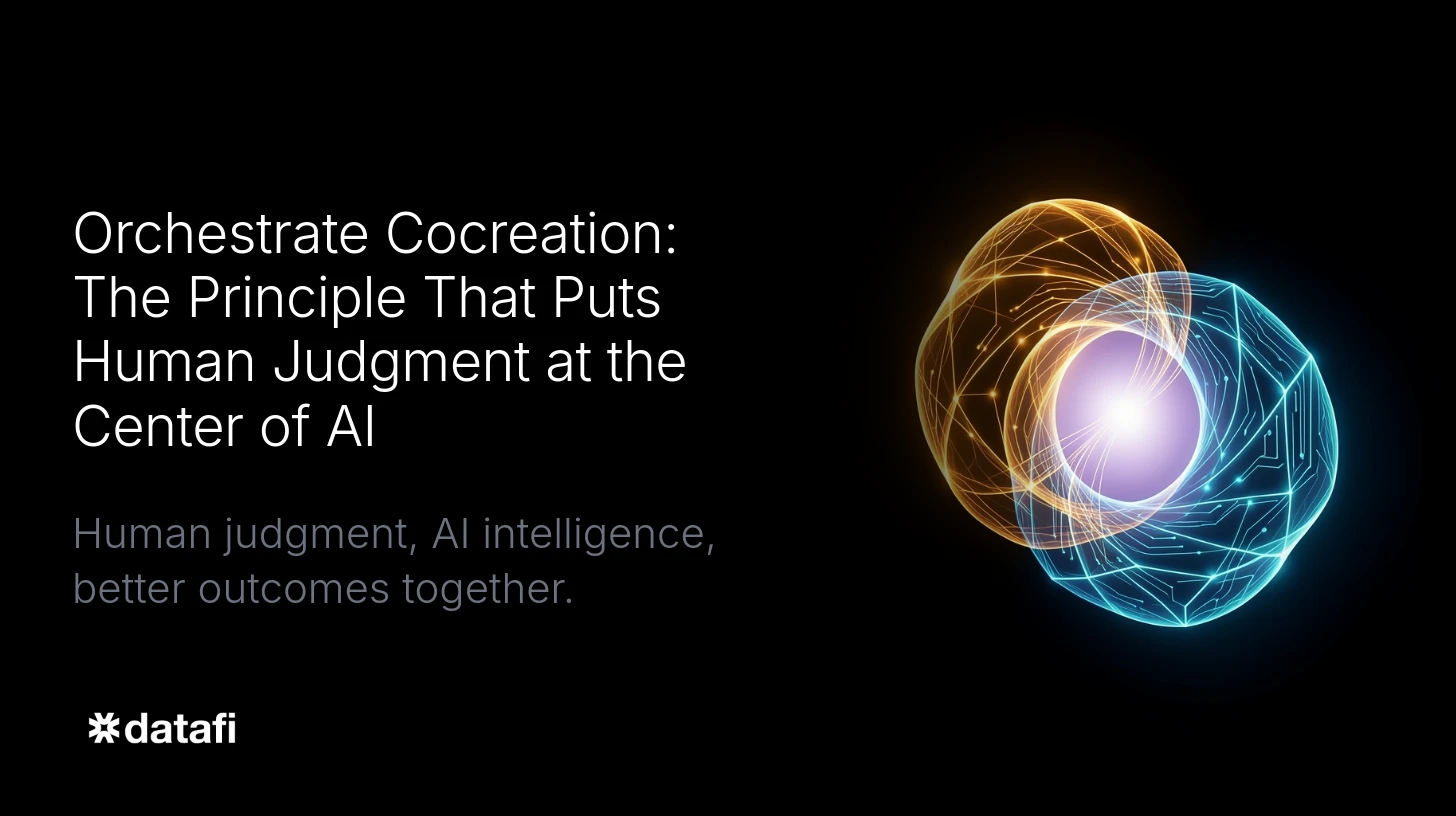
This is the final article in our four-part series exploring McKinsey’s AI-era design principles and what they mean for how organizations build AI experiences that truly work. In Part 1 we explored leading with clarity. In Part 2 we examined designing for continuity. In Part 3 we unpacked what it means to build for depth. Now we arrive at the principle that ties all three together and represents the most ambitious shift in how organizations think about work itself: orchestrating cocreation.
There is a version of AI adoption that looks impressive on a slide and disappoints in practice. It is the version where AI is treated as a high-speed assistant that handles individual tasks in isolation, a smarter search bar, a faster first draft, a shortcut through routine work. These gains are real, but they are not transformational. They leave the fundamental architecture of work unchanged.
McKinsey’s fourth AI-era design principle points toward something more consequential. The goal of orchestrating cocreation is to create environments where human expertise and AI agents collaborate fluidly, both in real time and across disciplines, to amplify impact. This is not a marginal improvement to existing workflows. It is a reimagination of how decisions get made, how knowledge gets applied, and how organizations of any size can move from generating answers to solving problems.
At Datafi, this principle sits at the heart of everything we build.
Orchestrating cocreation is not about adding AI to existing workflows. It is a fundamental reimagination of how human expertise and machine intelligence share responsibility to solve hard problems, not just accelerate routine tasks.
Why Cocreation Is the Hardest Principle to Get Right
The first three principles in this series, clarity, continuity, and depth, are primarily about the quality of the AI experience. Cocreation is about the nature of the relationship between human intelligence and machine intelligence. That makes it the most philosophically demanding and the most practically important of the four.
The future of work will depend on how effectively people and AI systems share responsibility. This goes beyond the notion of including a human in the loop. The goal is not for people to correct the system after the fact, but to design human-AI interactions that simplify, reimagine, and refine the work itself, in a way that improves with every interaction to drive real outcomes.
That distinction matters enormously. A human in the loop is a checkpoint. A cocreation model is a collaboration. In the first model, the AI generates and the human reviews. In the second, the AI and the human think together, each contributing what they do best, and the work itself is better for it.
Most enterprise AI tools today are still operating in the first model. They produce outputs. Humans accept, reject, or modify them. The interaction is transactional, not generative. And because the AI has no genuine access to the full context of the business, the outputs reflect only a shallow understanding of the problem at hand.
This is the gap that Datafi exists to close.
The Context Problem Is the Bottleneck

Before any cocreation can happen, there is a foundational requirement that most organizations have not yet addressed: the AI must actually know the business. Not a curated slice of it. Not a set of documents it has been trained to reference. The full operational context, the data, the policies, the workflows, the domain knowledge, the decision logic that makes your organization distinct.
Context gaps represent one of the key breakdowns in AI adoption today. Systems are not designed to identify, request, or retrieve the information required to perform a task thoroughly and accurately. While users trust the system to “know what it needs,” the AI often proceeds with only a partial understanding of the context.
This is why we believe that a vertically integrated data and AI technology stack is not a luxury; it is the prerequisite for genuine cocreation. When AI operates from a fragmented data environment, it can only produce fragmented intelligence. Agents that cannot access the complete data ecosystem cannot participate meaningfully in complex reasoning. They can answer the questions they can see. They cannot solve the problems that require understanding the full landscape.
At Datafi, we have built an environment where AI has access to the complete data ecosystem, including governed, policy-aware access that respects compliance requirements without sacrificing completeness. This is what makes it possible for AI agents to function in genuinely analytical and critical thinking roles rather than being limited to information retrieval.
From Answering Questions to Solving Problems
There is a meaningful difference between an AI that answers questions and an AI that solves problems. Question-answering is reactive. The user brings a query; the system returns a response. Problem-solving is proactive, iterative, and contextual. The system understands the objective, tracks progress toward it, surfaces relevant signals from across the data environment, and helps navigate the decisions that stand between the current state and the desired outcome.
This shift requires more than better models. It requires the contextual layer that allows models to understand not just what is being asked but why it matters, what constraints apply, what has already been tried, and what the acceptable range of solutions looks like. That contextual layer cannot be built on a chat interface alone. It requires deep integration with the operational data environment, the policy framework that governs how data can be used, and the workflow structures that define how decisions move through the organization.
This is precisely what we see our customers reaching for. They are not looking for AI that accelerates existing workflows by small increments. They are looking for AI that can take on meaningful roles in critical thinking and complex decision-making. They want agents that can reason across domains, surface non-obvious connections, and participate in the kind of work that currently requires the most expensive, experienced people in the organization.
That ambition is achievable. But it requires the infrastructure to support it.
What Fluid Collaboration Actually Looks Like
Consider how operational decisions typically move through an organization today. Data from multiple systems needs to be aggregated. Analysts interpret it. Insights are translated into recommendations. Those recommendations move through review cycles before reaching the people who act on them. At every stage, context is compressed, time is consumed, and the original signal from the data grows more distant from the moment of decision.
In a genuine cocreation environment, this changes fundamentally. AI agents work continuously across the operational data ecosystem, maintaining awareness of what is happening in real time. When conditions shift or anomalies emerge, the system does not wait to be asked. It surfaces the relevant context, frames the decision that needs to be made, and brings the appropriate human expertise into the loop at the moment it is actually needed.
The human contribution is not diminished in this model. It is elevated. Because routine synthesis and pattern recognition are handled by agents that never sleep and never lose context, the people in the organization are freed to apply the judgment, creativity, and relational intelligence that AI cannot replicate. They are not spending their cognitive bandwidth on data retrieval or report compilation. They are deciding, directing, and innovating.
AI systems must invite users to steer, revise, and debate, allowing solutions to emerge from collaboration rather than one-way generation.
This is a design imperative, and it is also a cultural one. Organizations that master cocreation do not do so through technology alone. They develop new habits of interaction between people and AI systems, new norms for how much autonomy agents are given, and new frameworks for how human judgment gets applied when the AI brings a problem to the surface.
Governed Cocreation at Enterprise Scale

One of the most important features of a cocreation environment is that it must be trustworthy. Fluid collaboration between humans and AI agents, operating across disciplines and in real time, cannot happen without a governance architecture that ensures every agent action is traceable, every data access is compliant, and every output can be audited.
This is not a constraint on cocreation. It is what makes cocreation possible at scale. Organizations that skip the governance layer are not moving faster toward fluid human-AI collaboration. They are accumulating risk that will eventually force them to pull back.
Datafi’s architecture treats governance as a first-class design principle, not an afterthought. Policies and controls are built into the data access layer, not bolted on after the fact. This means that AI agents can be given broader roles and deeper access precisely because the guardrails are reliable. Compliance-readiness is not in tension with operational agility. It is the foundation that makes agility safe.
For organizations that have been hesitant to move AI into more critical roles because of compliance concerns, this is the unlock. When you can demonstrate that your AI environment is governed, auditable, and aligned with your data policies, you can extend AI’s role with confidence rather than caution.
The Unified Data Experience as Competitive Advantage
McKinsey observes that organizations that break through will not be the ones that chase better models. They will be those that fundamentally rethink the way work happens. This insight points directly at the unified data experience as a source of competitive advantage.
When every employee, regardless of technical background, has access to the same governed, AI-augmented data environment, the organization develops a collective intelligence that is greater than the sum of its parts. Non-technical users bring domain expertise and judgment. AI agents bring the ability to synthesize vast operational data in real time. The interface between them, designed for clarity, continuity, and depth as we have explored in earlier articles in this series, becomes the platform on which better decisions are made faster.
This is the vision behind Datafi’s Chat UI, designed specifically for the non-technical majority of the workforce. Not a developer console or a data analyst’s workbench. A conversational interface that allows any employee to engage with the full intelligence of the organization’s data ecosystem, guided by AI agents that understand the context of the business and the permissions that govern each user’s access.
When this environment works as designed, the size of the organization stops being the primary determinant of data and analytical capability. A mid-sized company with a unified, AI-augmented data experience can operate with the analytical sophistication of a much larger enterprise. A large enterprise can achieve the speed and responsiveness of a much smaller one.
Building Toward Full Autonomy
The ultimate expression of cocreation is agents that can operate in fully autonomous roles, learning from the data environment, developing contextual understanding over time, and tackling hard business problems without requiring a human prompt for every step.
This is not a distant aspiration. It is the logical destination of a technology stack that is built correctly from the ground up. LLMs operating in narrow, disconnected environments will never develop the contextual depth required for autonomous problem-solving. LLMs operating within a vertically integrated stack, with full access to the data ecosystem, with policies embedded in the access layer, and with a history of interaction that accumulates into genuine organizational knowledge, these systems can develop the contextual layer that supports complex agents and autonomous workflows.
At Datafi, this is the direction we are building toward, deliberately and with the architecture to support it. Every customer engagement, every workflow automation, every governed agent deployment brings us closer to an environment where AI is not just a tool that employees use but a genuine participant in the work itself.
The Series in Sum
Across these four articles, we have traced a progression from making AI legible (clarity), to making it coherent across time (continuity), to making it capable of end-to-end work (depth), to making it a genuine collaborator in solving hard problems (cocreation). These are not four independent features to be checked off a product roadmap. They are four dimensions of a single design philosophy, one that treats the interface between human judgment and machine intelligence as the most important surface in the modern enterprise.
The interface is the collaboration layer between human judgment and machine intelligence, the zone in which intent is expressed, intelligence responds, and trust is built.
Getting this right is not a design challenge alone. It requires the data infrastructure to give AI genuine context, the governance architecture to make that context safe, and the product vision to bring it all together in an experience that non-technical users will actually choose to use every day.
That is what Datafi is building. Not a better chat window. A new way for organizations to think, decide, and act together, where human expertise and AI capability amplify each other in pursuit of outcomes that neither could reach alone.
The AI era is not coming. It is here. The organizations that will define it are the ones building the collaboration architecture today.
Datafi is an applied AI software company building the vertically integrated data and AI technology stack that enables every employee to work with the full intelligence of the organization. Explore how Datafi can transform your data and AI environment at datafi.com.