


The most important question in any enterprise software evaluation is not whether the platform is powerful. It is whether the platform was built for the kind of organization you are, and the kind of problem you are actually trying to solve.
There is a pattern that repeats itself throughout the history of enterprise software procurement. A platform is built to solve an extraordinarily difficult problem in a resource-rich, high-stakes environment. It solves that problem well. The vendor, recognizing the scale of the broader commercial opportunity, pivots to offer the same platform to a wider market. The commercial market adopts it, often enthusiastically, drawn by the prestige of the brand and the credibility of the original use cases. And then, over time, the organizations that adopted it discover that the assumptions baked into the platform at its founding do not always map cleanly to the reality of how commercial enterprises actually operate.
This is not a story about failure. It is a story about fit. And fit is the variable that most enterprise software procurement decisions underweight.
The most consequential question in enterprise AI procurement is not which platform is more powerful. It is which platform was built for an organization like yours. Fit determines whether your investment creates competitive advantage or disappears into implementation overhead.
Palantir is one of the most successful and genuinely impressive enterprise software companies of the past two decades. Its technology is powerful. Its track record in government, defense, and large-scale industrial deployments is real. But the honest question that every commercial enterprise should ask before committing to a Palantir engagement is not whether Palantir can do what it claims. It is whether Palantir was designed for an organization like yours, and whether the trade-offs built into its architecture are the right trade-offs given the outcomes you are trying to achieve.
Built for the Intelligence Community: What That Origin Actually Means
Palantir was founded in 2003 to solve a specific and extraordinarily difficult data problem: helping the United States intelligence community make sense of fragmented, multi-source, often adversarial data environments to support national security decision-making. The founding customers were organizations like the CIA, the NSA, and the Department of Defense. The founding use cases involved counterterrorism, fraud detection at federal scale, and intelligence analysis in environments where the cost of a wrong answer was measured in lives.
That origin shaped the company at every level. The architecture was designed for data environments of extraordinary complexity. The deployment model assumed the availability of significant specialized engineering resources. The security posture was built for classified environments where the consequences of a breach were catastrophic. The user interface was designed for trained analysts who would spend significant time learning to use the platform rather than casual business users who expected an intuitive experience on day one.
These are not weaknesses. In the context for which Palantir was built, they are precisely the right design decisions. When you are building a platform to support the intelligence community, you optimize for depth, security, and analytical sophistication, not for ease of deployment or accessibility to non-technical users.
The challenge comes when those design decisions travel with the platform into commercial enterprise environments where the operating assumptions are fundamentally different. Commercial enterprises are not intelligence agencies. Their data environments are complex, but they are a different kind of complex. Their security requirements are serious, but they operate in a different regulatory and threat context. Their users are not trained analysts. They are operations managers, supply chain planners, financial controllers, and customer service leaders who need AI that works within their existing workflows without requiring weeks of training to use effectively.
The Commercial Pivot: Real Progress, Inherited Assumptions
Palantir’s commercial pivot over the past several years has been genuine and commercially successful. The AIP platform, the Bootcamp sales model, and the company’s aggressive expansion into industrial and commercial enterprise sectors represent a sincere and in many ways impressive effort to bring Palantir’s capabilities to a broader market.
The commercial results are not in dispute. Palantir’s U.S. commercial customer base has grown significantly. Major industrial enterprises across manufacturing, energy, financial services, and healthcare have adopted the platform. The case studies demonstrate real operational value in organizations that are not defense contractors.
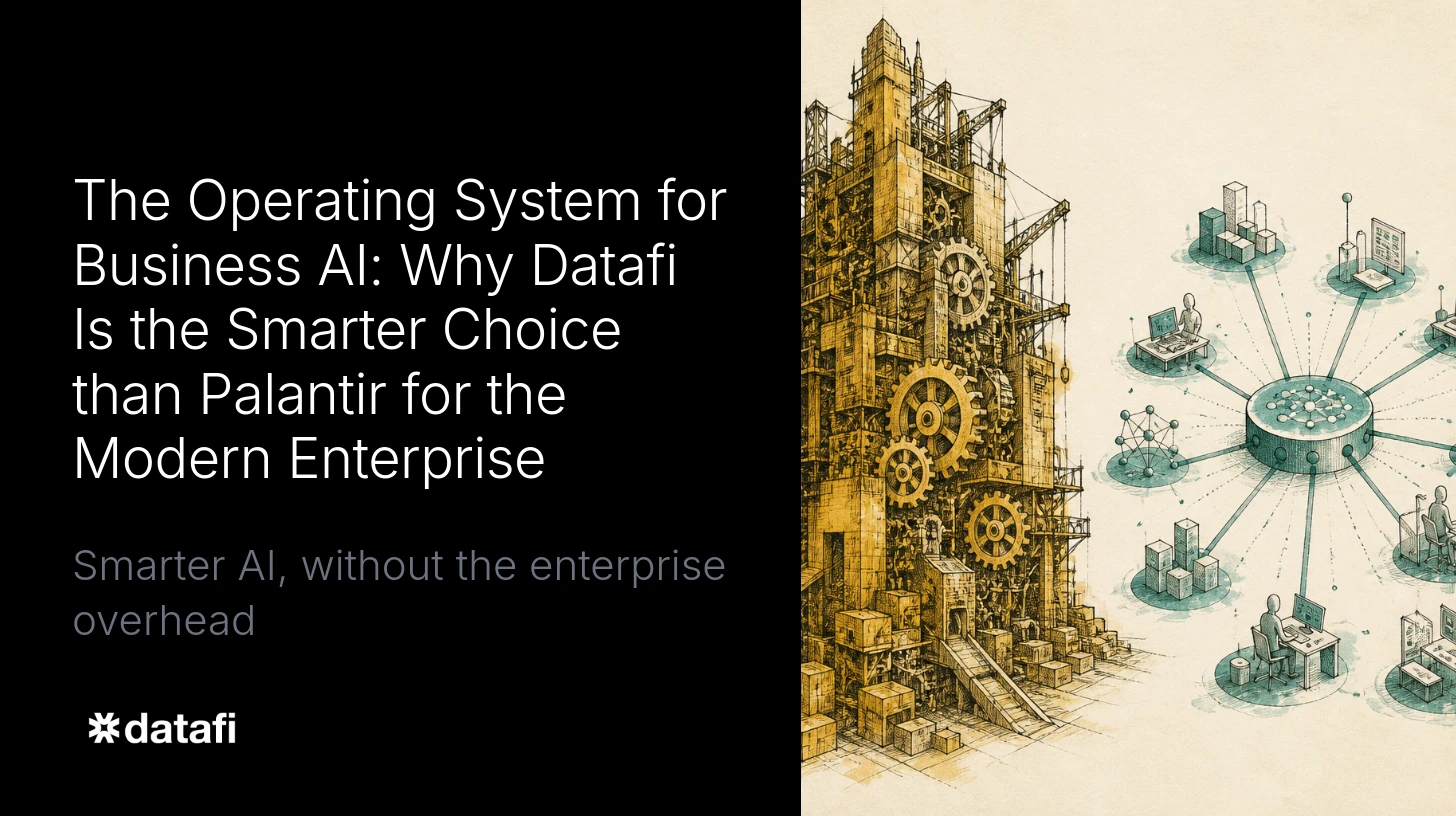
But the commercial pivot has not changed the foundational architecture. The Ontology is still the foundational data model, and building it still requires significant engineering investment. The deployment model still assumes specialized technical resources either from Palantir’s own forward-deployed engineering teams or from internal teams trained specifically on the platform. The user experience, while improved, is still fundamentally oriented toward technically sophisticated users rather than the broad enterprise workforce.
For large enterprises with substantial internal data engineering capabilities, long implementation timelines, and the organizational patience to invest in a multi-year platform build, the commercial Palantir offering can deliver genuine value. The assumptions built into the platform are not incompatible with every commercial enterprise environment. But they are incompatible with many of them, and particularly with the mid-market and growth-stage organizations that represent the majority of commercial enterprise activity and the majority of the AI deployment opportunity.
What the Commercial Enterprise Actually Needs
The commercial enterprise, at any size, shares a common set of operating realities that are structurally different from the environment Palantir was built to serve.
Time is constrained. Commercial organizations operate in competitive environments where the pace of change is set by the market, not by implementation timelines. A platform that requires twelve to eighteen months to reach operational deployment is not competing with a faster alternative on speed. It is competing with the business outcomes that the organization fails to achieve during those twelve to eighteen months because its AI capability is not yet live.
Technical resources are finite. Most commercial enterprises, including many large ones, do not have the internal data engineering depth to build and maintain a sophisticated AI architecture independently. They need a platform that their existing teams can deploy, govern, and extend without requiring a specialized sub-team dedicated specifically to platform maintenance.
Users are not analysts. The business value of AI in a commercial enterprise is not realized in the data science team or the analytics function. It is realized when the operations manager, the procurement director, the clinical coordinator, and the customer success leader can use AI as a natural part of their existing workflows. A platform that delivers sophisticated AI capability to a specialist team while remaining inaccessible to the broader workforce has solved only a fraction of the problem.
Data environments are messy and dynamic. Commercial enterprise data ecosystems are a product of years of technology implementation planning, acquisitions, and organic growth. They are heterogeneous, partially documented, and continuously changing. A platform architecture that requires a clean, formally modeled data environment as a prerequisite for AI deployment is asking commercial enterprises to solve a data infrastructure problem before they can solve their AI problem.
Datafi is built around each of these operating realities. The vertically integrated stack deploys in weeks, not months, because it does not require the organization to rebuild its data architecture before AI can function. The contextual layer integrates with data ecosystems as they exist, not as a formal model requires them to be. The Chat UI is designed from the ground up for user adoption by non-technical users, so AI capability reaches every employee who makes decisions based on information, not just the team with data science training. And native governance and policy controls mean that commercial enterprises with real regulatory obligations can deploy AI confidently without building a separate compliance architecture alongside the platform.
The Right Fit Question Is Not About Capability
It is worth being explicit about what this comparison is not arguing. It is not arguing that Palantir lacks capability. The platform is genuinely powerful, and for the right customer in the right context, it produces outcomes that are worth the investment required to achieve them.
The argument is about fit, and fit is a more nuanced concept than capability. A Formula One racing car is extraordinarily capable. It is not the right vehicle for driving to work.
The enterprise software procurement decisions that create the most value are those where the platform’s built-in assumptions align with the organization’s operating reality, not those that chase the most impressive capability demo.
The enterprise software procurement decisions that create the most value are those where the platform’s built-in assumptions align with the organization’s operating reality, where the deployment model matches the organization’s capacity and timeline requirements, and where the architecture is designed to deliver value at the scale and through the users that actually drive business outcomes.
For organizations operating at the intersection of defense, intelligence, and large-scale industrial complexity, with multi-year implementation budgets and substantial internal technical resources, Palantir’s assumptions may be the right ones. That is a real and significant market, and Palantir serves it well.
For the vast majority of commercial enterprises, including many large ones, those assumptions are a source of friction, cost, and delayed value realization rather than a source of competitive advantage. Those organizations need a platform built around their operating reality: fast deployment, contextual AI that reaches the entire workforce, governance that is native rather than constructed, and an architecture that grows with the business rather than requiring the business to grow into the architecture.
That is what Datafi is designed to be. Not a simplified version of a more powerful platform. A complete rethinking of what enterprise AI should look like when it is built for the commercial enterprise from the ground up.
Honest Assessment for Honest Decisions
The enterprise technology market would benefit from more honest fit assessments and fewer capability comparisons. The question is not whether Palantir or Datafi has more impressive demos. The question is which platform was built for an organization like yours, and which will still be the right strategic platform investment three years after the contract is signed.
That assessment requires honesty about your organization’s technical resources, your implementation timeline tolerance, your data environment’s current state, and the user population through which you expect AI to create value. If the honest answers to those questions describe an organization with deep technical resources, long planning horizons, and a small population of sophisticated analytical users, Palantir’s model may be the right fit.
If the honest answers describe an organization that needs AI operational quickly, serving a broad workforce across multiple functions, in a dynamic data environment that cannot be formally re-modeled before AI deployment begins, the platform built for that operating reality is Datafi. This is deployment flexibility by design.
The decision is not about prestige or capability. It is about fit. And fit is what determines whether your technology investment strategy creates competitive advantage or disappears into implementation overhead.
Datafi is the Business AI Operating System built specifically for the commercial enterprise: fast deployment, full workforce reach, and AI that solves problems in the data environment you already have. Learn more at datafi.co.
Part 4 of 10, next in the series: AI That Answers vs. AI That Acts: Autonomous Agents in Palantir AIP and Datafi