

Every enterprise AI platform claims to support autonomous agents. What separates genuine agentic capability from a marketing narrative is the architecture underneath it, and the depth of business context the agent can actually reason over when the workflow gets complex.
The difference between AI that genuinely operates autonomously in operational roles and AI that simulates autonomy while requiring human intervention at every consequential decision point is not a semantic distinction. It is the difference between a technology investment that transforms how an organization operates and one that produces impressive demonstrations that never quite scale into the workflows where real business value lives.
The language of agentic AI has become ubiquitous in enterprise software marketing, and with that ubiquity has come a significant dilution of meaning. Every platform that can chain a few automated steps together now describes itself as supporting autonomous agents. Every tool that can call an API in response to a user query is positioned as enabling agentic workflows. The word “autonomous” is doing an enormous amount of work that the underlying architecture often cannot support.
This matters because the difference between AI that genuinely operates autonomously in operational roles and AI that simulates autonomy while requiring human intervention at every consequential decision point is not a semantic distinction. It is the difference between a technology investment that transforms how an organization operates and one that produces impressive demonstrations that never quite scale into the workflows where real business value lives.
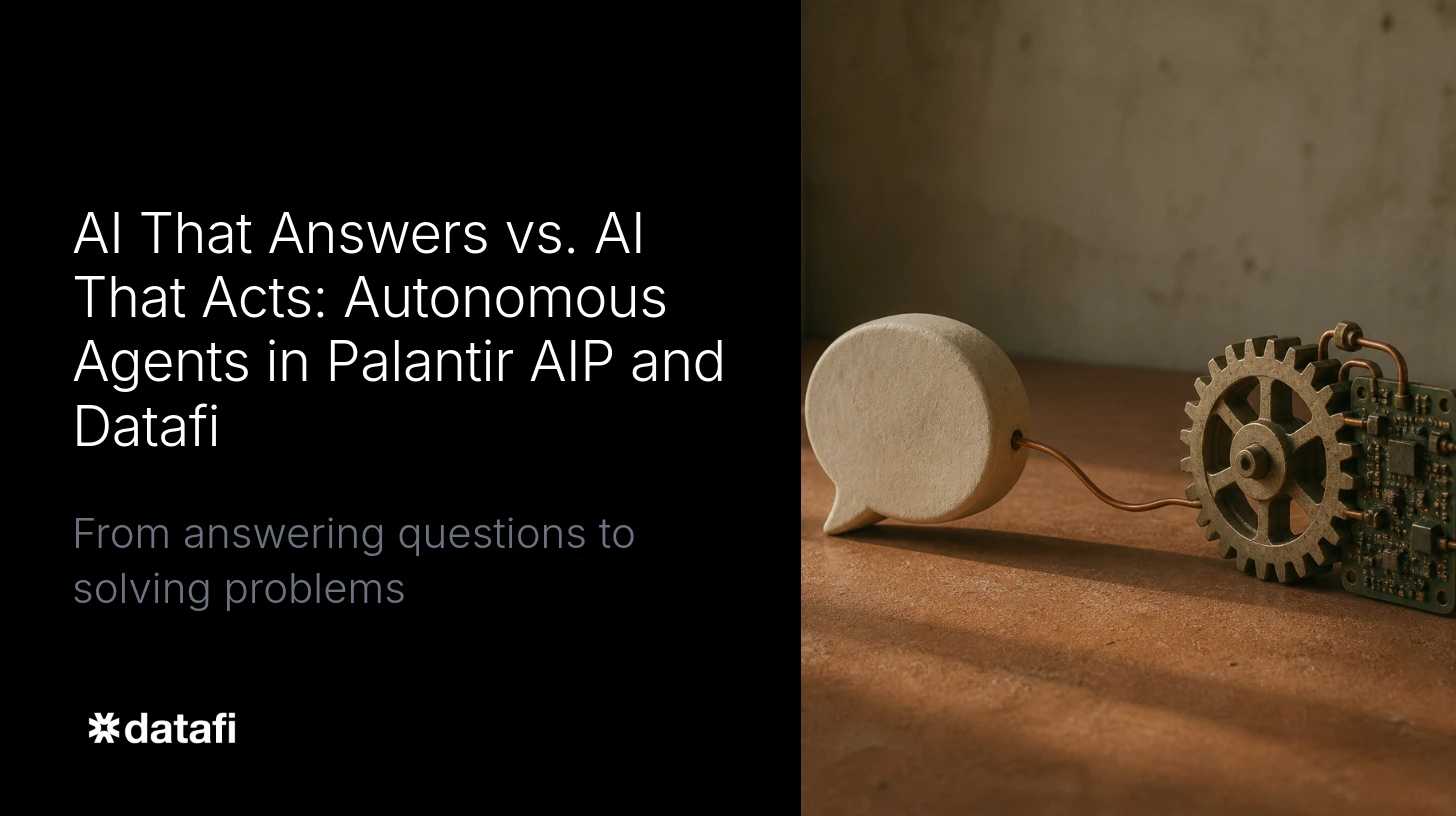
The distinction between AI that answers questions and AI that solves problems is the lens through which every enterprise AI platform should be evaluated. Answering questions is useful. Solving problems, autonomously, at scale, across the data ecosystem of the enterprise, is transformative. And achieving that outcome requires a fundamentally different architectural foundation than most platforms, including Palantir’s AIP, currently provide for the commercial enterprise.
What Agentic AI Actually Requires
Before comparing how Palantir and Datafi approach agentic capability, it is worth being precise about what genuine agentic AI requires to function in an enterprise operational context.
An AI agent operating autonomously in a real business workflow needs five foundational capabilities, and they are not independently optional. They are architecturally interdependent.
The first is full data access. The agent must be able to access the complete data ecosystem relevant to the task it is executing. Not a curated subset. Not a static snapshot. The live, current state of the operational data that is actually driving the business decision the agent is supporting.
The second is business context. Raw data access is not sufficient. The agent must understand what that data means in the context of the specific business: how entities relate to each other, what the relevant operational constraints are, how historical patterns map to current conditions, and what the downstream consequences of different decision options look like given the full state of the organization.
The third is governed autonomy. An agent operating without governance controls is not autonomous. It is uncontrolled. Genuine agentic capability requires that the agent’s actions are bounded by the same policy and compliance framework that governs human decision-making in the same domain. Governance is not a constraint on agentic AI. It is what makes it trustworthy enough to deploy at scale.
The fourth is workflow integration. An agent that produces a recommendation but cannot execute on it is a sophisticated report generator. Genuine agentic capability requires that the agent can trigger actions within the operational systems of the enterprise: creating work orders, updating records, initiating communications, adjusting parameters in operational systems, and escalating to human decision-makers when the situation falls outside the agent’s authorized action space.
The fifth is multi-step reasoning. The workflows where AI creates the most operational value are not single-step processes. They are chains of reasoning, data access, decision, and action that play out across time and across multiple systems. An agent that can execute step one reliably but requires human hand-off for steps two through five has not solved the workflow problem. It has automated the easiest part of it.
Palantir’s Agentic Foundry: The Promise and the Architecture
Palantir’s Agentic Foundry, launched in mid-2025, represents the company’s most direct response to the demand for genuine autonomous agent capability in the enterprise. The platform is designed to allow organizations to deploy agents that do not merely provide insights but actively manage tasks and execute within predefined operational guardrails.
The technical foundation of the Agentic Foundry is Palantir’s Ontology, the structured data model that gives the platform its operational awareness. Agents operating within the Agentic Foundry reason over the Ontology, which means they have access to the formal representation of the organization’s entities, relationships, and processes that the Ontology captures.
When the Ontology is current, comprehensive, and accurately represents the state of the business, this is a genuinely powerful foundation for agentic capability. Agents that reason over a well-built Ontology can operate with a level of operational context that enables sophisticated multi-step workflows. The Palantir case studies that demonstrate genuine agentic outcomes, accelerated fraud detection, supply chain optimization, clinical trial coordination, are real, and they reflect the capability that the platform can deliver when the foundational investment in the Ontology has been made.
The challenge, which follows directly from the analysis in earlier articles in this series, is that the Ontology dependency constrains when, for whom, and at what cost the Agentic Foundry can be deployed effectively.
An agent that reasons over the Ontology can only reason over what is in the Ontology. If a data source has not been integrated, the agent cannot access it. If the Ontology is out of date relative to the current state of the business, the agent’s reasoning reflects a world that no longer exists. And extending the agent’s capability into a new domain or a new data area requires first extending the Ontology, which requires the engineering investment that Ontology development always requires.
For organizations with mature Palantir deployments and well-maintained Ontologies, these constraints are manageable. For organizations in the early stages of deployment, or organizations whose data ecosystems are changing faster than the Ontology can track, they represent a fundamental limitation on what the Agentic Foundry can actually deliver in production.
Datafi’s Agentic Architecture: Context-First, Governance-Native
Datafi’s approach to autonomous agents is built on the premise that the contextual layer is the prerequisite for genuine agentic capability, and that the contextual layer must be available in full from the moment of deployment rather than as a product of a multi-year Ontology build.
An autonomous agent operating on Datafi’s platform has access to the complete data ecosystem through the contextual layer, which integrates with the organization’s existing data sources as they exist, not as a formal model requires them to be represented. Governance and policy controls are enforced at the data access layer, which means the agent’s actions are bounded by the same compliance framework that governs human access to the same information, without requiring that framework to be separately configured for each new agent or each new workflow.
The architectural consequence of this design is that Datafi’s agents can be deployed into production workflows faster, across a broader range of data environments, and with governance controls active from day one rather than as a separate implementation phase.
But the deeper architectural advantage is in how Datafi agents handle the full requirement set for genuine agentic capability. Because the contextual layer integrates directly with live operational data, agents always reason over the current state of the business rather than a formal model that may lag the operational reality. Because governance is native to the data access layer, agents can be authorized to take actions within clearly defined policy boundaries without requiring a separate governance configuration for each workflow. And because the Datafi platform’s vertically integrated stack includes workflow execution capability alongside data access and AI reasoning, agents can move from insight to action within the same operational environment rather than requiring integration with separate execution systems.
The Workflow That Reveals the Difference
The most effective way to understand the architectural difference between Palantir’s and Datafi’s agentic approaches is to trace a real enterprise workflow through both platforms.
Consider a predictive maintenance scenario in a manufacturing environment. The business outcome is to identify equipment that is approaching failure, determine the appropriate maintenance response, check parts availability and technician scheduling, update the maintenance management system, and notify the relevant operations manager, all before the equipment fails and causes unplanned downtime.
In a Palantir environment, executing this workflow depends on the Ontology having captured the relevant relationships: the equipment, its sensor data, its maintenance history, the parts inventory system, the technician scheduling system, and the escalation rules that determine when human notification is required. When those relationships are in the Ontology and current, the Agentic Foundry can execute a sophisticated version of this workflow with genuine operational awareness. When any of those relationships are missing, stale, or not yet encoded because the Ontology build is still in progress, the workflow breaks at the point where the missing context is required.
In a Datafi environment, the contextual layer integrates directly with the sensor data platform, the maintenance management system, the parts inventory system, and the scheduling system through native connectors. The agent reasons over live data from each of these systems, applies the governance rules that determine what actions it is authorized to take, and executes the full workflow, including the update to the maintenance management system and the notification to the operations manager, within the same operational environment. There is no separate Ontology build required before the workflow can run. The data environment the agent needs is the data environment the organization already has.
The outcome of the workflow, a maintenance issue identified and resolved before it becomes an unplanned failure, is the same in both scenarios. The difference is in what must be true before that outcome is achievable, and what the ongoing cost of maintaining it is.
Autonomy at Enterprise Scale: The User Dimension
There is a dimension of agentic AI deployment that technical architecture comparisons frequently underweight: the user dimension. Autonomous agents do not operate in a vacuum. They operate in organizational environments where the humans who benefit from and are affected by the agent’s actions need to understand what the agent is doing, trust that it is doing it correctly, and be able to intervene when intervention is appropriate.
This means that the Chat UI through which employees interact with AI agents is not a secondary concern. It is a primary one. An agent that can execute a sophisticated operational workflow but communicates its status, its reasoning, and its recommendations through an interface that only a trained analyst can interpret has not solved the organizational adoption problem. It has solved the technical problem while leaving the human problem intact.
Palantir’s interfaces are powerful, but they are fundamentally oriented toward technically sophisticated users. The natural language chat capabilities added to AIP represent genuine progress in accessibility, but the underlying mental model of the platform, the Ontology, the formalized data model, the complex configuration interfaces, remains one that rewards technical expertise.
Datafi’s Chat UI is designed from the ground up for the non-technical business user. The operations manager who needs to understand why the predictive maintenance agent flagged a specific piece of equipment, the procurement director who needs to review the supply chain optimization agent’s recommendation before it executes, and the clinical coordinator who needs to intervene in an automated patient pathway, all of these users need an interface that communicates AI reasoning in the language of their domain, not the language of data engineering.
This is not a design preference. It is an architectural commitment. AI that solves problems rather than answers questions must be accessible to the people for whom those problems have consequences. That accessibility is only possible when the user interface is designed for that population from the beginning.
The Agentic Standard the Enterprise Needs
The standard for agentic AI in the enterprise should be high, because the stakes of deploying autonomous agents in operational roles are high. Agents that operate with incomplete context make recommendations that reflect blind spots. Agents that operate without governance controls create compliance exposure. Agents that cannot communicate their reasoning to non-technical users create organizational mistrust that limits adoption regardless of how technically capable the underlying system is.
The architecture that meets this standard is one built on a foundation of full business context, native governance, workflow execution capability, and a user interface designed for the workforce that benefits from and is accountable for the agent’s actions.
Palantir has the technical ambition to meet that standard, and in specific deployment contexts it does. For the broader commercial enterprise, Datafi’s contextual-first, governance-native, workforce-accessible architecture is the foundation that makes genuine autonomous AI capability deployable at organizational scale, in the time that commercial enterprises have available, at the cost they can actually sustain.
That is the difference between AI that answers questions and AI that solves problems. And in an environment where AI capability is becoming the primary source of competitive differentiation, that difference is the whole enterprise AI decision.
Datafi’s autonomous agents operate over your complete data ecosystem, governed natively, accessible to every employee, and deployable without a multi-year Ontology build. That is what genuine agentic AI looks like in the commercial enterprise. Learn more at datafi.co.
Next in the Series: The Governance Question: Lock-In as Architecture vs. Governance as Architecture