


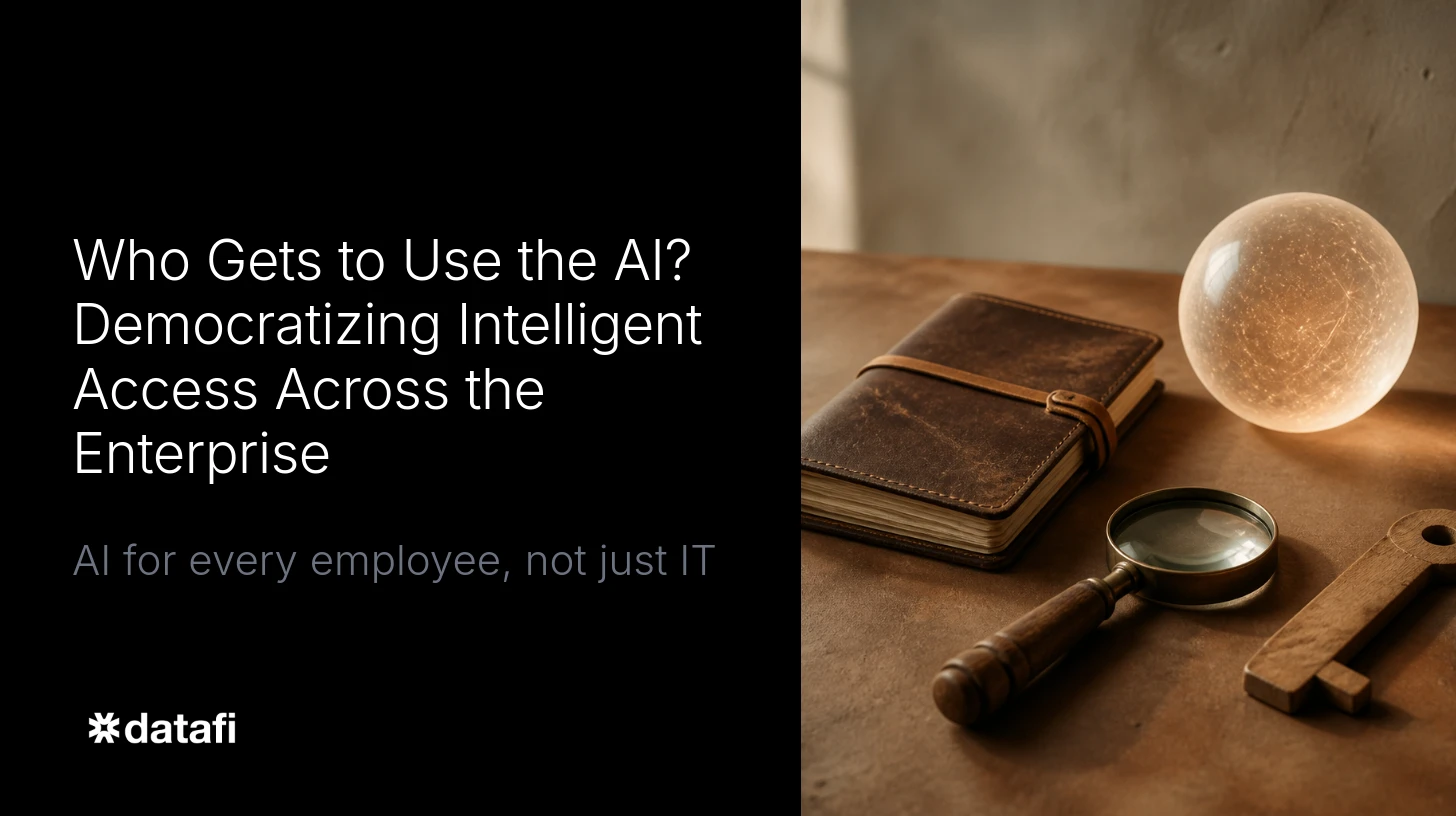
There is a persistent assumption embedded in how enterprise AI platforms are built, sold, and deployed. The assumption is that AI is a capability for technically sophisticated users: data teams, IT administrators, workflow architects, and the analysts who sit between the AI system and the business functions it is supposed to serve.
This assumption is so widely shared that most organizations do not notice it until they look at who is actually using their AI investments and compare that population to the employees who generate the most operational value and carry the deepest operational knowledge.
The field service technician who has serviced the same equipment for twelve years. The procurement manager who has built relationships with forty suppliers and knows which ones deliver when the contract says they will and which ones do not. The customer success manager who knows which accounts are genuinely satisfied and which are managing toward an exit. These are the people whose judgment drives business outcomes. They are also, in most enterprise AI deployments, the people who cannot access the AI.
The employees closest to operational decisions, field technicians, procurement managers, customer success teams, are precisely the ones most enterprise AI deployments leave behind. Closing that access gap is the most consequential lever organizations can pull to multiply the return on their AI investments.
ServiceNow’s AI Is Optimized for Platform Users
ServiceNow’s AI capabilities are genuinely useful for the people who live inside the ServiceNow ecosystem. IT service desk staff get AI-assisted ticket resolution. HR teams get automated intake and routing. Operations teams get workflow optimization recommendations. For users whose work is structured around ServiceNow processes, Now Assist delivers real productivity improvements.
The boundary of that value is the boundary of the platform. ServiceNow’s AI understands the world as ServiceNow represents it: through workflows, tickets, requests, and the data that flows through those processes. An employee whose work does not primarily run through ServiceNow workflows receives limited benefit from ServiceNow’s AI investments, regardless of how much the organization has spent on the platform.
This creates a structural inequity in AI access that most organizations have not fully accounted for. The organization invests in AI. A defined population of platform users benefits. The broader workforce, which includes many of the employees most critical to operational performance, continues working the way they always have, with no access to the intelligence that the AI investment is generating.
Datafi’s Chat Interface Changes the Access Model
Datafi’s Chat UI was designed from the premise that AI value should not be confined to the users of any particular enterprise platform. It provides a conversational interface that any employee can use, in a web browser or within the productivity applications they already use every day, to ask questions about the business and get answers grounded in real data.
The interface does not require the user to understand SQL, navigate a business intelligence dashboard, or know which system holds the data they need. It requires them to describe what they want to know, the way they would describe it to a knowledgeable colleague. The AI handles the rest: identifying the relevant data sources, synthesizing information across them, enforcing the access policies that govern what that user is authorized to see, and returning an answer that is actionable rather than merely informative.
This is not a simplified reporting tool. It is the full reasoning capability of the Datafi platform, made accessible through a natural language interface that does not require technical training to use.
What Enterprise-Wide AI Access Changes
The business case for democratizing AI access is straightforward in principle and consistently underestimated in practice.
When the field service technician can ask the AI whether the component they are looking at has a failure pattern in other equipment in the fleet, and get an answer in thirty seconds rather than submitting a request to the data team and waiting three days, the quality of the maintenance decision improves. More importantly, the technician’s expertise, which the AI does not have, combines with the AI’s data access, which the technician does not have. The outcome is better than either could produce independently.
When the procurement manager can ask the AI to surface the last eighteen months of delivery performance for their top twenty suppliers, segmented by product category and weighted by contract value, and have that analysis in front of them before a supplier negotiation, the negotiation outcome changes. The manager’s relationship knowledge and the AI’s analytical reach are complementary, not competitive.
When the customer success manager can ask the AI to identify accounts that show early behavioral signals of disengagement, and prioritize them by revenue at risk, the intervention happens before the customer has drafted the cancellation email rather than after.
AI that only the technical team can use multiplies the capacity of the technical team. AI that every employee can use multiplies the capacity of the organization. The second multiplier is larger by an order of magnitude, and it compounds as employees develop new ways to use the capability.
Governance Does Not Require Restriction
A common objection to broad AI access is the governance concern: if everyone can query the AI, how does the organization prevent sensitive data from reaching users who should not see it?
This concern is legitimate and important. It is also not an argument against broad access. It is an argument for governance architecture that scales with access breadth.
Datafi’s approach resolves this by making governance a property of the data access layer rather than a property of who is allowed to use the interface. When an employee queries the AI, the system enforces their specific access permissions against every data source the query touches. They receive answers that are complete and accurate within the scope of what they are authorized to see. They do not receive data they are not authorized to access, regardless of how the question was framed.
This means that a frontline employee and a C-suite executive can both use the same Chat UI, ask questions that may touch overlapping data domains, and receive answers that are simultaneously accurate, useful, and compliant with the access policies the organization has defined. The interface is democratized. The governance is not compromised.
The Competitive Implication
Organizations that deploy AI broadly, to the employees closest to operational problems and customer relationships, develop a compounding advantage over organizations that deploy AI narrowly, to the technical teams that manage platforms.
The advantage compounds because AI-augmented decisions are better than unaugmented ones, and better decisions accumulate. An organization where procurement managers, field technicians, customer success teams, and financial analysts all have AI access is making better decisions across more dimensions simultaneously than an organization where only the IT service desk and HR team have meaningful AI support.
ServiceNow is a powerful platform for the users who live inside it. Datafi is a platform for everyone in the organization. That difference in scope is not a product feature comparison. It is a strategic question about where AI value gets created and who gets to participate in creating it.
The enterprises that will lead in the AI era are not the ones with the most sophisticated AI tools available to the fewest people. They are the ones that put genuine intelligence in the hands of every employee who makes a decision that matters.
Datafi is the Business AI Operating System for the modern enterprise. To understand how the transformation ROI model applies to your industry and your operations, visit datafi.co
Next in the Series: From Answering Tickets to Solving Problems: The Ceiling on ServiceNow AI