


The threat surface has never been larger. Modern enterprises operate across distributed cloud environments, hybrid workforces, and increasingly automated supply chains, each layer generating security signals that multiply faster than any human team can process. At the same time, the tools organizations have deployed to manage this complexity have largely been additive rather than transformative: more dashboards, more alerts, more data that requires skilled analysts to interpret manually and act on incrementally. The volume of signals has outpaced the capacity of even the best-staffed security operations centers to absorb them.
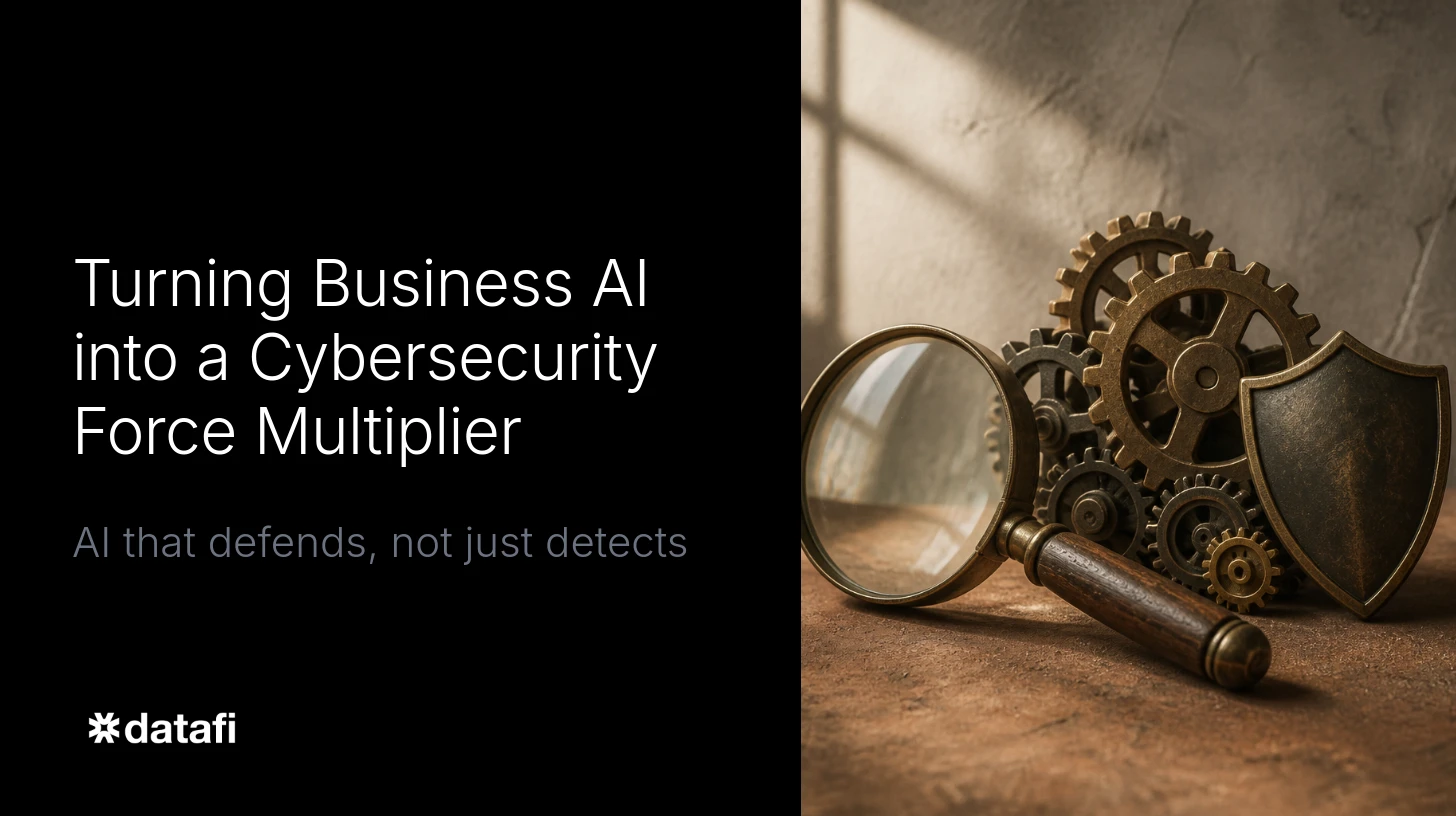
This is precisely the condition where AI stops being a competitive advantage and starts being an operational necessity. But not all AI is built for this role. Question-answering AI, the kind that retrieves information and surfaces insights when prompted, reaches its limit quickly in a security context. Security is not a retrieval problem. It is a reasoning, correlation, and response problem at machine speed. And solving it requires AI that is not simply answering questions about the environment, but actively understanding the business, autonomously monitoring what matters, and taking deliberate action when threats emerge.
Datafi was built for exactly this inflection point.
Security AI must go beyond answering questions. The organizations that will be most resilient are those that give their AI full enterprise context, governed access, and autonomous capacity to act decisively when threats emerge.
What Makes Security AI Different
Organizations exploring AI for cybersecurity quickly encounter a fundamental constraint that generic AI tools cannot resolve: security decisions are deeply contextual. A login at 2:00 AM from an unusual IP address means something completely different for a developer traveling internationally than it does for a service account that has never authenticated outside the corporate network. A spike in database queries is either routine reporting activity or a data exfiltration attempt, depending on what the business is doing that day, who holds the relevant data access credentials, and what workflows are scheduled to run. Pattern recognition in isolation is not enough.
Effective security AI requires access to the complete operational context of the enterprise: identity systems, endpoint telemetry, network logs, cloud configuration, business process workflows, HR records, ERP and CRM data, and the governance policies that define what is normal versus anomalous in each part of the organization. Without that full context, even a sophisticated model is operating with structural blind spots. It can surface anomalies but cannot accurately adjudicate them. It can flag events but cannot assign meaningful risk weight to them. It answers questions about what it can see, without knowing what it cannot see and why that matters.
This is the architectural reality that shapes Datafi’s design. A vertically integrated AI operating system, built to give LLMs full access to the enterprise data ecosystem, enforce policy and governance controls at every layer, and operate through a natural language interface that puts that capability in the hands of every employee, not just technical specialists.
The Datafi Operating System as a Security Architecture
Datafi’s core platform properties, the same properties that drive value in use cases from executive decision intelligence to supply chain optimization, translate with particular power into the cybersecurity domain.
The data ecosystem integration layer means Datafi’s AI agents are not restricted to a subset of security-relevant data. They can correlate events across identity providers, SIEM platforms, cloud infrastructure, endpoint detection systems, and business applications simultaneously. This cross-domain correlation is where the most sophisticated threats live and where point security tools consistently fall short. Advanced persistent threats, insider risk, and complex fraud patterns rarely confine themselves to a single system. They exploit the seams between systems, exactly where siloed tools go blind and where a unified AI operating layer can see clearly.
The policy and governance control plane means that security-sensitive operations happen within defined boundaries. Datafi’s architecture enforces data access policies at the agent level, which means the AI operates with the same permissioning structures that govern human analyst access. This is not a secondary consideration. It is foundational. An AI that can query any data indiscriminately in order to answer security questions creates its own risk surface. Datafi’s approach ensures that the AI is itself a governed actor within the enterprise security model, not an exception to it.
The natural language interface layer removes the access barriers that have historically confined advanced security analytics to a small number of specialist roles. When every employee can interact with Datafi’s AI in plain language, security awareness, policy compliance monitoring, and anomaly reporting become capabilities distributed across the workforce rather than concentrated in a single team.
Turning AI Into a Force Multiplier Across the Security Function
Threat Detection and Correlation at Scale
The traditional SIEM model depends on rules: predefined signatures that generate alerts when specific conditions are met. Rules are inherently backward-looking. They detect threats that were anticipated when the rules were written. Sophisticated adversaries adapt to evade rule-based detection, and the volume of alerts generated by even well-tuned rule sets routinely exceeds analyst capacity, forcing triage decisions that create coverage gaps.
Datafi’s AI agents operate differently. Rather than pattern-matching against static signatures, they reason over the full data ecosystem with access to business context, identifying deviations that are statistically unusual within the specific operational context of the organization. A credential use pattern that looks normal in isolation looks very different when the AI understands that the user associated with that credential submitted a resignation two weeks ago, that their data access has been expanding rather than contracting, and that the files being accessed fall outside their historical work scope. That is not a rule. That is contextual reasoning at scale, applied autonomously and continuously.
Security Operations Center Productivity and Triage
Security operations centers face a well-documented capacity crisis. Alert fatigue reduces analyst effectiveness, and the most skilled analysts spend a disproportionate share of their time on manual investigation tasks that are repetitive, structured, and increasingly amenable to automation. Datafi transforms this dynamic by deploying AI agents as autonomous first-responders to security events.
When an alert fires, a Datafi agent can immediately begin pulling enrichment data from across the ecosystem: threat intelligence feeds, historical behavior baselines, asset inventory, network topology, active business processes, and identity context. Within seconds, the agent constructs the kind of investigation summary that would take a human analyst fifteen to twenty minutes of tool-switching to assemble. For the majority of alerts that are confirmed false positives or low-priority events, the agent resolves them without human intervention. For genuine threats, the analyst receives a fully contextualized case file rather than a raw alert, dramatically compressing time to response and allowing skilled analysts to focus their judgment where it matters most.
This is not AI replacing the security analyst. It is AI multiplying the effective capacity of the security team by an order of magnitude, enabling a team of ten to do the investigative work that would otherwise require fifty.
Compliance and Governance Monitoring
Regulatory compliance is a continuous operational challenge that touches every part of the organization. GDPR, HIPAA, SOX, PCI-DSS, and sector-specific frameworks each impose requirements on data handling, access control, audit logging, and incident response that must be maintained at all times rather than demonstrated periodically. Manual compliance monitoring is inherently incomplete. Spot checks and periodic audits leave windows of non-compliance between review cycles.
Datafi’s always-on AI agents turn compliance monitoring from an event-based process into a continuous one. Agents monitor data access patterns, configuration states, policy enforcement logs, and user behavior against the organization’s compliance posture in real time. Deviations are surfaced immediately rather than discovered weeks later during a scheduled audit. When a configuration change or access grant falls outside policy bounds, the AI flags it, documents the event, and in many cases can initiate a remediation workflow autonomously.
The compliance reporting burden is similarly transformed. Generating evidence packages for regulatory audits is one of the most labor-intensive activities in enterprise security. With Datafi, that evidence is continuously assembled and organized by AI agents that understand what each framework requires and where the relevant data lives across the ecosystem. Audit preparation that previously took weeks of analyst time becomes a structured query rather than a manual investigation.
Vulnerability Management and Prioritization
Most organizations operate with a persistent backlog of open vulnerabilities. The gap between the rate at which new vulnerabilities are discovered and patched and the rate at which patching can realistically occur in complex production environments means that risk-based prioritization is not optional but necessary. The challenge is that most vulnerability prioritization tools operate on static risk scoring, CVSS scores that reflect the theoretical severity of a vulnerability in isolation rather than the actual risk it presents given the specific configuration of the organization’s environment and the current threat landscape.
Datafi enables a fundamentally different prioritization model. AI agents correlate vulnerability data with asset inventory, network exposure, active exploit intelligence, business criticality of affected systems, and current threat actor activity patterns. The result is a dynamic risk picture that reflects what actually matters in the organization’s specific context: not the vulnerabilities with the highest CVSS scores in the abstract, but the vulnerabilities most likely to be exploited given who the adversary is, what they want, and what pathways exist in the specific environment.
Incident Response and Autonomous Remediation
When a confirmed incident occurs, every minute of response time has a measurable cost. Datafi’s agentic workflows compress response timelines by automating the structured components of incident response, the steps that are well-defined enough to execute without human judgment, while ensuring the AI operates within the boundaries set by the organization’s response playbooks and authorization frameworks.
A Datafi agent responding to a confirmed ransomware indicator can immediately isolate the affected endpoints according to policy, revoke the compromised credentials, snapshot affected systems for forensic preservation, notify the relevant stakeholders through configured channels, and begin documenting the incident timeline, all within the time it would take a human analyst to finish reading the initial alert. The response is faster, more consistent, and fully auditable, because every action taken by the AI agent is logged with the contextual reasoning that drove it.
The Vertical Integration Advantage in Security
Security is not a use case that tolerates architectural compromise. A system that can reason over security data but cannot act is useful for analysis and helpless in a crisis. A system that can act but cannot access the full data ecosystem will make decisions with incomplete information, which is often worse than no decision at all. A system without governance controls creates new attack surface in the process of defending the existing one.
Datafi’s vertical integration addresses all three constraints simultaneously. The data ecosystem layer ensures complete context. The governance and policy layer ensures controlled, auditable operation. The agentic capacity layer ensures that insight translates into action at the speed the threat environment demands. And the natural language interface ensures that these capabilities are not locked behind a specialist credential requirement, but available to every authorized user across the enterprise.
This is what it means to use AI not as a tool that answers security questions, but as an operational layer that actively defends the enterprise. The organizations that will be most resilient in the threat environment of the next decade will not be the ones with the most security tools. They will be the ones that have given their AI the full context, the governed access, and the autonomous capacity to act decisively when it matters most.
Datafi is the operating system that makes that organization possible.