


Modernizing Without Replacing - Post 1 of 6
Ask ten enterprise technology leaders why they are modernizing their legacy systems, and most will give you some version of the same answer: the old system is holding us back. It cannot support modern AI. It cannot move at the speed the business needs. It has to go.
Then ask them what the modernization program has actually delivered so far.
The answers get quieter. They describe parallel-run environments that have outlasted their schedules. Data that no longer reconciles cleanly across the old system and the new one. Integrations that were stable for a decade and now have to be rebuilt from scratch. A go-live date that has moved twice. And underneath all of it, a business that was promised transformation and is mostly absorbing disruption.
The gap between what modernization promises and what it delivers is not usually a gap in execution. Well-run organizations with competent partners fall into it just as often as anyone else. It is a gap in the premise, and the premise is the part almost no one stops to question.
The modernization trap is not a failure of execution. It is a failure of premise. Legacy systems are rarely the actual problem; the real problem is that organizations cannot get modern intelligence to act on the data inside them. That is a different problem, and it has a different solution.
The assumption that drives the cost
The conventional modernization playbook rests on an assumption so embedded it rarely gets stated out loud: that the legacy system is the problem, and that the path to a modern, AI-capable enterprise runs through removing it.
It is worth pausing on that, because it is doing an enormous amount of work. If the legacy system is the problem, then replacement is the solution, and every cost that follows, the migration, the re-platforming, the multi-year program, the change management, the risk, is simply the price of solving it. The premise makes the cost feel non-negotiable.
But the legacy system is rarely the actual problem. The enterprise resource planning platform that has run the business for fifteen years is not failing to record transactions. The mainframe that processes claims is not failing to process claims. The operational databases tracking assets, inventory, and orders are doing precisely what they were built to do, often with a data fidelity that newer systems struggle to match for years after cutover.
These are not broken systems. They are systems that have accumulated something more valuable than a modern interface: decades of trusted, structured, business-critical data, and the institutional confidence that the numbers inside them are correct.
The real problem is almost never that these systems exist. The real problem is that the organization cannot get modern intelligence to act on the data inside them. That is a meaningfully different problem, and it has a meaningfully different solution.
What replacement actually buys, and what it actually costs
When an organization commits to ripping out and replacing a core system, the case is built around capability. The new platform will be cloud-native. It will have a modern data model. It will be ready for AI. These are real benefits, and for the right situation a full replacement is genuinely the correct decision. We will treat that case fairly later in this series, because it exists and it matters.
What the business case tends to understate is the shape of the cost. The cost of replacement is not primarily the license or the implementation fee. The cost is the period in between, the long, expensive, risk-saturated interval during which the organization runs two systems at once, migrates data of uncertain fidelity, retrains the people who do the work, and absorbs the operational drag of a business rebuilding its own foundation while still standing on it.
During that interval, several things are true at the same time. The data is in motion, which by definition makes it less trustworthy than it was sitting undisturbed in the system of record. Integrations that were stable for years must be rebuilt, and integration debt is notoriously underestimated. The institutional knowledge encoded in customizations and edge cases, the accumulated reality of how the business actually runs, is at constant risk of being lost in translation. And the modernization itself becomes the organization’s largest project, consuming the attention and budget that might otherwise have gone toward the outcomes the modernization was supposed to enable.
The capability gap is real. The conclusion is wrong.
None of this is an argument for standing still. The pressure driving modernization is legitimate. Enterprises genuinely cannot deploy modern AI on top of fragmented, inaccessible, ungoverned data, and legacy systems were never designed to expose their data to autonomous agents safely or in real time. The gap between what the business runs on and what the business now needs to do is real, and it is widening.
The error is not in feeling the pressure. The error is in the inference.
The conventional logic runs: our systems cannot support modern AI, therefore we must replace our systems. That inference only holds if intelligence and infrastructure are inseparable, if the only way to get modern capability is to modernize the underlying system that holds the data.
That used to be closer to true. It is no longer true. And the entire premise of the modernization trap depends on no one noticing that it has stopped being true.
A different question
What changes everything is asking a more precise question. Not “how do we replace this system,” but “what do we actually need this system to do that it cannot do today.”
Asked that way, the answer is almost never “exist differently.” The answer is that the business needs AI that can read the data in the system of record, reason over it with full business context, act on it inside real workflows, and do all of that under governance the enterprise can trust.
Notice that none of those requirements demand replacing the system of record. They demand a layer of capability the legacy system was never built to provide on its own. The system of record stays exactly where it is, doing exactly what it does well, holding the authoritative data, serving as the durable foundation. What gets added is the intelligence and the execution layer on top.
This is the distinction that runs through everything Datafi builds, and through the rest of this series. The objective of enterprise AI is not better answers about your data. It is AI that solves problems by acting on your data. A modernization program that replaces a system in order to eventually enable better reporting has, at considerable cost, bought itself a better view of its own history. That is not transformation. Transformation is when AI participates in the operation itself, reading from and writing back to the systems where the business actually runs, closing the loop between insight and action.
You do not need to replace the system of record to get there. In many cases, replacing it actively delays getting there.
Modernize the capability, not the infrastructure
Datafi was designed from the start around this premise. The Business AI Operating System is not a productivity layer applied to a freshly rebuilt stack. It is vertically integrated infrastructure that connects directly to the systems an organization already runs on, activates the data inside them, and puts governed, agentic AI to work on top, without asking the enterprise to tear out its foundation first.
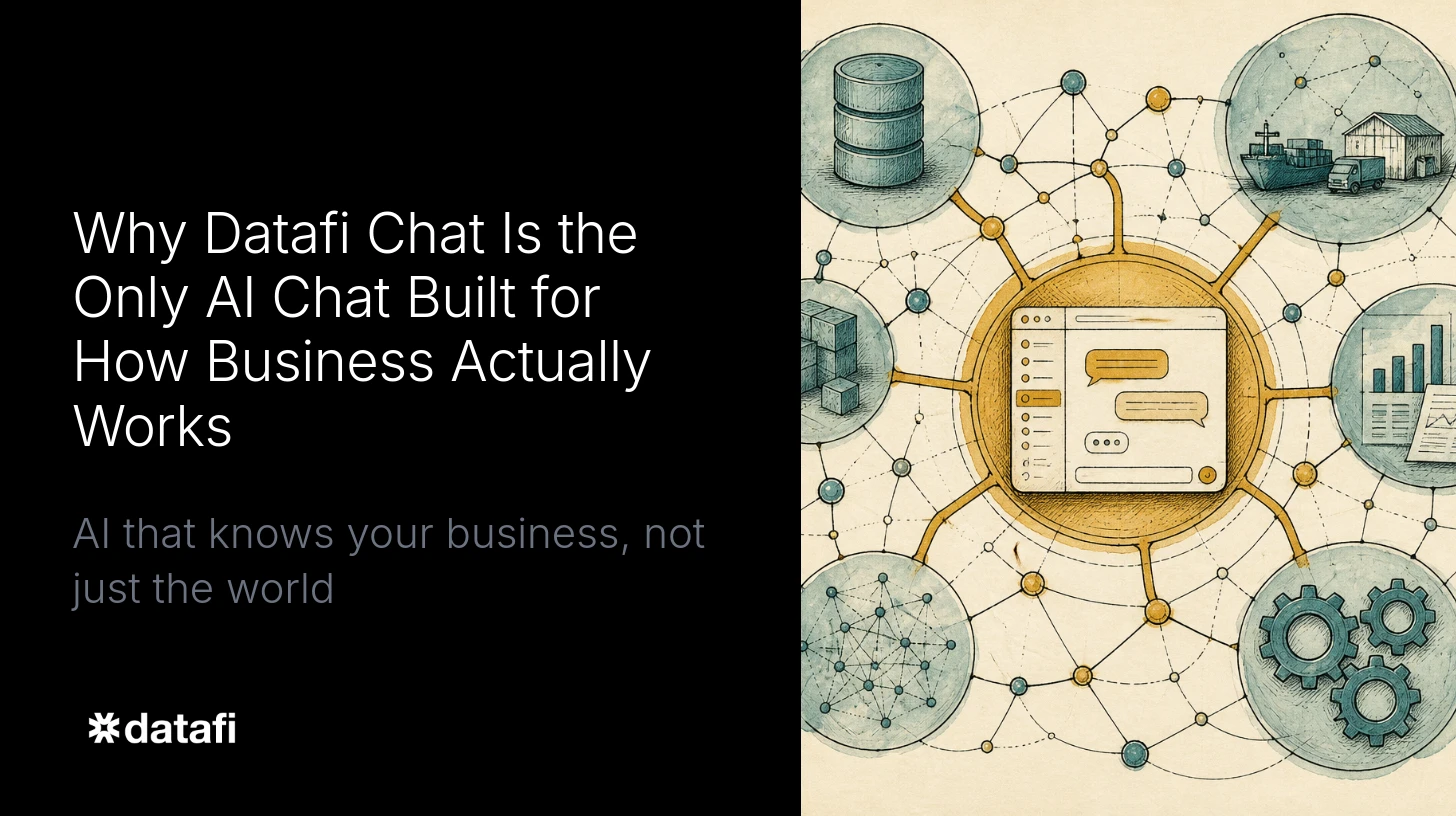
The connection to existing systems is bidirectional and real-time. Datafi reads directly from the ERP, the CRM, the operational databases, and the maintenance and inventory systems where the business actually runs, rather than from stale copies in a warehouse, and it can write back, updating records, triggering workflows, escalating exceptions, so that AI becomes a participant in the operation rather than an observer of its historical shadow.
The global business contextual layer is what gives that AI genuine understanding of the data it is acting on: the entity relationships, the operational definitions, the domain vocabulary, the rules and constraints that determine what a correct action looks like in this specific business. It is not an optional module. It is load-bearing architecture, and it is the multi-year moat that makes everything above it possible.
Sentinel, the governance framework, is not a compliance add-on bolted on after the fact. It is the mechanism that makes autonomous action permissible, enforcing access control, policy, and lineage across the existing systems of record so the enterprise gains modern capability while its authoritative data stays authoritative and audited.
The result is a different theory of modernization. The legacy systems remain the systems of record. The data inside them becomes the data layer. And the modern capability the organization actually needed, AI that understands the business and acts inside it, arrives in weeks, on top of what already exists, rather than years after a rebuild.
What this series will argue
Over the next five posts, we will build out the alternative in full.
We will reframe systems of record as the data layer rather than the obstacle, and show why activating them in place sidesteps the migration risk that sinks so many programs. We will look honestly at the hidden costs of replacement, and just as honestly at the situations where replacement remains the right call. We will return repeatedly to the distinction between AI that answers and AI that acts, because it is the entire point. We will examine why governance has to be load-bearing rather than bolted on for any of this to be safe at enterprise scale. And we will close with a pragmatic roadmap: activate now, replace selectively, retire deliberately, rather than commit to an all-or-nothing modernization mandate.
The thesis underneath all of it is simple. Legacy systems are not the enemy of transformation. Treating them as the enemy is. The enterprises that modernize fastest in the next few years will not be the ones that tore everything down and rebuilt. They will be the ones that recognized what they already had, activated it, and put modern intelligence to work on top of it.
The modernization trap is avoidable. The first step out of it is refusing the premise that got you in.
Post 2 in this series reframes the foundation itself: why your systems of record are not the obstacle to modernization but the data layer that makes it possible, and what changes when you stop treating legacy as cargo to be moved and start treating it as infrastructure to be activated.
Datafi is a Business AI Operating System designed for mid-enterprise organizations that need the full power of an integrated AI platform without the cost, risk, and timeline of replacing the systems they already run on. Learn more at datafi.co.
Series: Modernizing Without Replacing
Part 1: The Trap: Rethinking the Premise
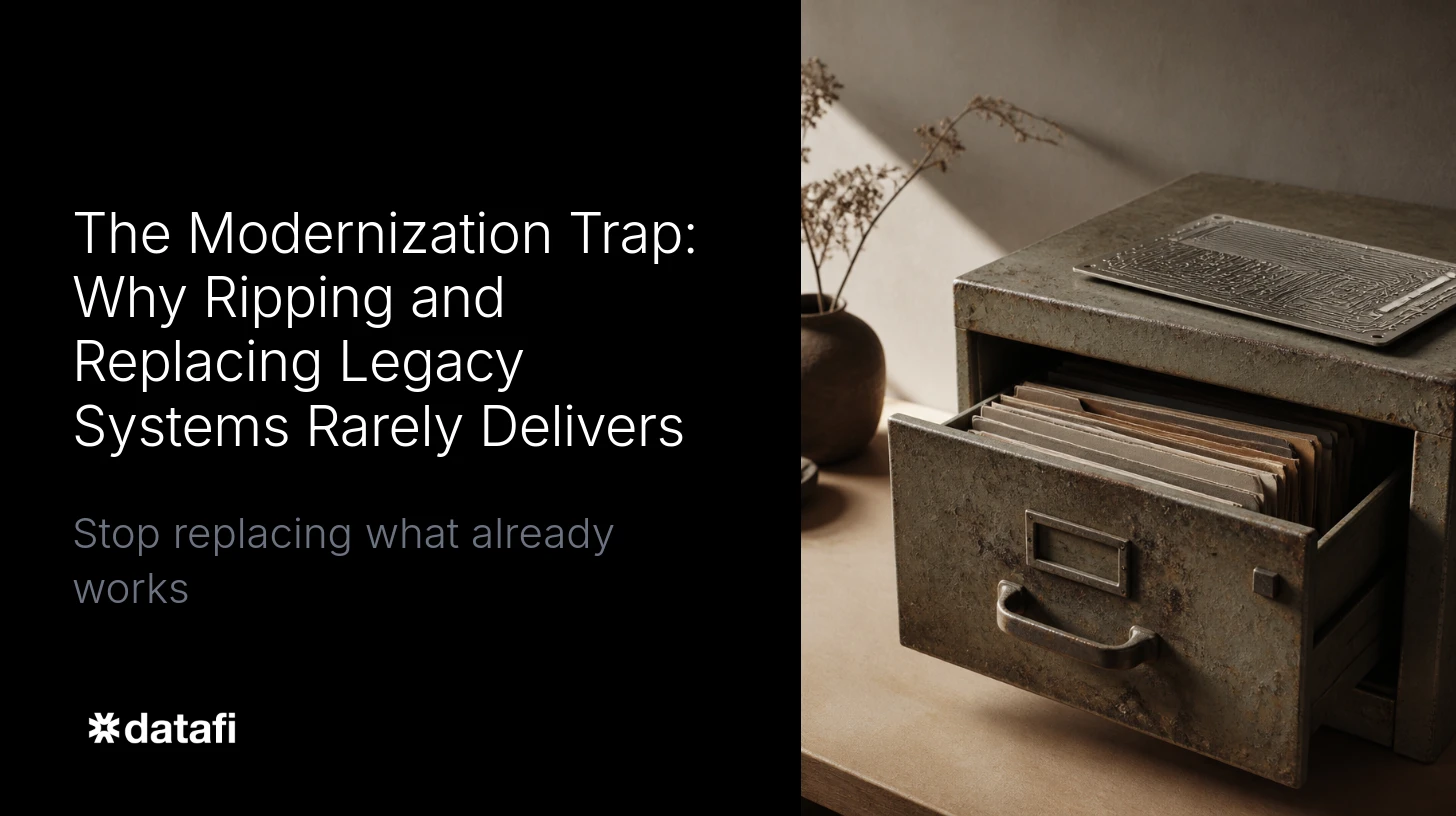
Post 1: The Modernization Trap - Why Ripping and Replacing Legacy Systems Rarely Delivers
Post 2: Systems of Record Aren’t the Enemy - Reframing Legacy as the Data Layer
Part 2: The Tradeoffs: An Honest Accounting
Post 3: The Hidden Costs of Modernization - Migration Risk, Data Loss, and Operational Disruption
Post 4: From Answering Questions to Solving Problems - What Modernization Is Actually For
Post 5: Governance Without a Rebuild - How Sentinel Lets You Modernize Capability, Not Infrastructure
Part 3: The Path: A Pragmatic Roadmap
Post 6: A Pragmatic Modernization Roadmap - Activate Now, Replace Selectively, Retire Deliberately