


Modernizing Without Replacing — Post 2 of 6
There is a phrase that shows up in nearly every modernization business case, usually somewhere near the top, stated as if it needs no defense: we need to get off our legacy systems.
It is worth sitting with how strange that sentence actually is.
The legacy system in question is, in most organizations, the most reliable piece of infrastructure they own. It is the system that has not lost a transaction in fifteen years. It is the system the finance team trusts when two other reports disagree. It is the system that, when something goes wrong anywhere else in the stack, everyone quietly checks first, because it is the one place the numbers are known to be right. And it is the system the modernization program has decided is the thing standing in the way.
The first post in this series argued that the premise driving most modernization programs — legacy system as problem to be removed — is the trap itself. This post goes further. It argues that the system of record is not a liability the organization is unfortunately stuck with. It is an asset the organization has not finished using. And the difference between those two framings determines whether modernization is a demolition project or an activation one.
The system of record is not an obstacle to modernization; it is the most valuable foundation an organization owns. Activating it in place, rather than replacing it, is the difference between building on fifteen years of earned trust and resetting that trust clock to zero.
What a system of record actually is
It is easy to talk about legacy systems as old technology. Aging interfaces, dated architectures, databases designed before the cloud existed. All of that is often true, and all of it is beside the point.
A system of record is not defined by its age or its interface. It is defined by its authority. It is the system the business has agreed to treat as the truth — the place where a transaction becomes official, where a record becomes the record, where the organization’s representation of reality is considered binding. When the ERP says an order shipped, the order shipped. When the claims system says a claim is adjudicated, it is adjudicated. That authority was not granted by the technology. It was earned over years of the system being correct, reconciled, and trusted by the people who depend on it.
This is the thing modernization programs consistently undervalue. The hard part of an enterprise system was never the software. It was the accumulation of authority — the years of cleaned data, the encoded business rules, the customizations that capture how this specific organization actually operates, the institutional confidence that what the system says can be acted on without checking. You can buy modern software in an afternoon. You cannot buy fifteen years of earned trust in your own data. And a replacement program, on day one of go-live, has exactly zero of it.
The legacy system holds something the new system will spend years trying to reacquire: the right to be believed.
The reframe: from cargo to foundation
Here is where conventional modernization and the approach this series describes diverge, and the divergence is almost entirely about how each one treats the data in the system of record.
Conventional modernization treats that data as cargo. It is something to be extracted, transformed, validated, and moved from the old vessel to the new one. The entire program is organized around the migration — the careful, expensive, risk-laden process of lifting decades of accumulated truth out of one system and setting it down, intact, in another. Every migration is a bet that nothing essential is lost in transit, and that bet is placed against the most valuable asset the organization has.
The alternative treats that same data as foundation. The system of record is not a vessel to be emptied. It is the floor the rest of the architecture stands on. The data does not move. The system of record stays exactly where it is, retains its authority, continues doing the job it has always done well — and the organization builds modern capability on top of it rather than in place of it.
This is not a small distinction in emphasis. It is the difference between two fundamentally different theories of what modernization is. In one, progress requires moving the foundation. In the other, progress requires activating it. And once you stop assuming the data has to move, an enormous category of cost and risk — the migration, the parallel run, the reconciliation, the fidelity bet — simply ceases to apply, because you are no longer doing the thing that creates it.
What “activate in place” actually means
It is fair to ask what activation means concretely, because “build on top of it” can sound like a slogan if it is not specified.
Activating a system of record means three things, technically.
The first is direct, bidirectional connection. Rather than copying data out of the system of record into a separate warehouse where it goes stale the moment it lands, the AI layer connects to the source system directly and reads from it in real time. The data the AI acts on is the live, authoritative data, not a snapshot of what was true at the last sync. And the connection runs both ways: the AI can write back to the system of record — updating a record, posting a transaction, advancing a workflow — so that action taken by AI lands in the same authoritative system the rest of the business already trusts.
The second is contextual understanding. A connection alone gives an AI access to fields and tables. It does not give the AI any understanding of what those fields mean in the life of the business — which customer is strategic, which SKU is substitutable, which exception is routine and which is a five-alarm event. Activation requires a layer that supplies that meaning: the entity relationships, the operational definitions, the domain vocabulary, the rules that determine what a correct action looks like in this specific organization. Without it, the AI is reading a database. With it, the AI understands a business.
The third is governance at the point of action. The moment AI can write back to a system of record, governance stops being a reporting concern and becomes a control requirement. Activation means every read and every write is bounded by policy — who and what is allowed to act, on which records, within which limits, with what authorization, leaving what audit trail. The authority of the system of record is preserved precisely because the actions taken against it are governed at least as tightly as the actions taken by the people who use it directly.
Why this is the harder thing to build, and the more durable one
There is a reason most AI efforts do not do this, and it is worth being honest about it.
Connecting an AI to a single document repository and letting it answer questions is comparatively easy. Activating a system of record — reading and writing live, with full business context, under enforceable governance — is comparatively hard. It requires infrastructure that most organizations do not have and most AI tools were never built to provide. It is genuinely easier to stand up a chatbot over a knowledge base than to make AI a trusted actor inside the system where the business officially runs.
But the easy version produces answers, and the hard version produces outcomes, and that gap is the entire subject of this series. An AI that can summarize what the inventory system says is useful. An AI that can act on what the inventory system says — expedite the order, raise the transfer, update the record, all inside the authoritative system, all within policy — is transformative. The difference between them is precisely the contextual and governance infrastructure that activation requires and that question-answering does not.
This is the moat, and it is a durable one. The systems of record are not going anywhere; they are the most stable layer in the enterprise. The contextual understanding of what the data in them means compounds over time rather than depreciating. An organization that activates its systems of record is building on the most permanent foundation it has, with a layer of business understanding that gets more valuable the longer it operates. An organization that replaces its systems of record is, at enormous cost, resetting that foundation to zero and starting the trust clock over.
How Datafi treats the system of record
Datafi was built on the premise this post describes: that the system of record is the foundation, not the obstacle.
The platform connects directly to the systems an organization already runs on — ERP, CRM, supply chain platforms, maintenance and inventory databases, operational records — and reads from them in real time rather than from copies in a warehouse. Because the connection is bidirectional, Datafi can write back into those same systems, so that AI-driven action is recorded in the authoritative system the business already trusts, not in a parallel layer the business has to reconcile.
The global business contextual layer supplies the understanding that turns access into capability — the entity relationships, operational definitions, and business rules that let AI act correctly on the data rather than merely retrieve it. It is the part that compounds, the multi-year moat that makes everything above it possible, and it is built precisely so that the systems of record never have to move for the organization to gain modern capability.
Sentinel governs every interaction with those systems of record — enforcing access control, policy, and lineage on every read and every write — so that activating a system of record never means loosening control over it. The authority of the system of record is preserved because the actions taken against it are governed as tightly as the system itself demands.
The result is the reframe made operational. The legacy systems remain the systems of record. The data inside them becomes the live data layer for governed, agentic AI. Nothing has to be migrated, because nothing has to move. The foundation the organization spent years earning the right to trust is not torn out. It is finally put fully to work.
The question this post leaves open
If the system of record does not have to move, and activation delivers modern capability without migration, a fair objection surfaces immediately: what about the cost and risk of the replacement programs organizations are already running, or already committed to? Is the argument that no one should ever modernize a core system?
It is not. There are situations where replacement is genuinely the right call, and treating them dishonestly would undermine everything else this series argues. The next post takes the replacement case seriously — the hidden costs that business cases consistently understate, and the specific, real conditions under which paying those costs is nonetheless the correct decision.
The reframe is not that modernization is always wrong. It is that modernization should be a deliberate choice made against a clear-eyed accounting of what it costs — not a reflex triggered by the unexamined assumption that the system of record had to go.
Post 3 in this series gives the replacement case an honest hearing: the migration risk, data loss, and operational disruption that modernization business cases tend to understate, and the specific conditions under which full replacement is still the right decision.
Datafi is a Business AI Operating System designed for mid-enterprise organizations that need the full power of an integrated AI platform without the cost, risk, and timeline of replacing the systems they already run on. Learn more at datafi.co.
Series: Modernizing Without Replacing
Part 1 — The Trap: Rethinking the Premise
Post 1: The Modernization Trap - Why Ripping and Replacing Legacy Systems Rarely Delivers
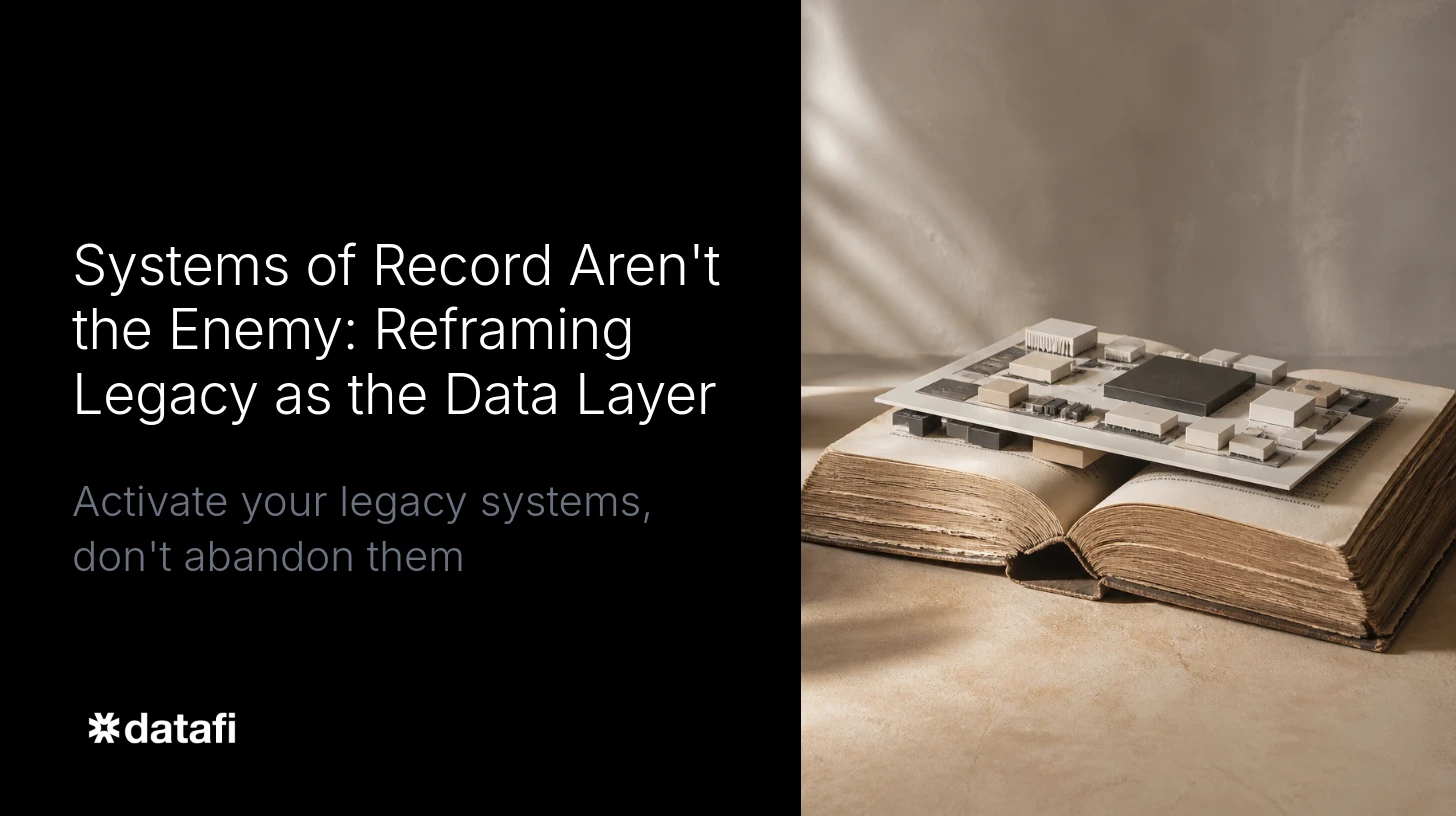
Post 2: Systems of Record Aren’t the Enemy - Reframing Legacy as the Data Layer
Part 2 — The Tradeoffs: An Honest Accounting
Post 3: The Hidden Costs of Modernization - Migration Risk, Data Loss, and Operational Disruption
Post 4: From Answering Questions to Solving Problems - What Modernization Is Actually For
Post 5: Governance Without a Rebuild - How Sentinel Lets You Modernize Capability, Not Infrastructure
Part 3 — The Path: A Pragmatic Roadmap
Post 6: A Pragmatic Modernization Roadmap - Activate Now, Replace Selectively, Retire Deliberately