


Business AI is crossing a critical threshold. As organizations move from conversational assistants to autonomous agents that reason, decide, and act, the stakes change fundamentally. An assistant that provides a wrong answer is inconvenient. An agent that takes a wrong action is dangerous.
Autonomy without observability is recklessness at scale.
The New Threat Model
Traditional software observability monitors known failure modes like errors, latency, and throughput. Autonomous AI agents introduce a fundamentally different threat model:
Existing monitoring tools were not designed for this. Organizations need a purpose-built observability layer for AI agents.
What Full AI Observability Really Means
Full AI observability extends far beyond logging API calls and tracking token usage. It requires five distinct layers:
1. Reasoning Observability
Understanding not just what an agent did but why. This includes capturing the full reasoning chain: what data was considered, what context was applied, what alternatives were evaluated, and how the final decision was reached. Without reasoning observability, every agent output is a black box.
2. Data Observability
Tracking what data an agent accessed, how it was filtered and interpreted, whether it met quality thresholds, and how it influenced the output. Data observability ensures that agents are reasoning on accurate, authorized, and appropriate information.
3. Action Observability
Monitoring every action an agent takes or attempts (API calls, system updates, notifications, file modifications, workflow triggers) with full context about why the action was initiated and what policy authorized it.
4. Policy Observability
Verifying that agents operate within defined boundaries at every step. This includes access controls, authority limits, compliance requirements, and organizational policies. Policy observability ensures governance is enforced, not just defined.
5. Impact Observability
Measuring the downstream effects of agent actions on business processes, systems, data, and outcomes. Impact observability closes the feedback loop, connecting agent behavior to real-world consequences.
Non-Negotiable Capabilities
Any enterprise-grade AI observability system must deliver:
- Real-time monitoring of agent reasoning, data access, and actions, not batch processing after the fact
- Audit trails that are complete, immutable, and queryable, meeting the requirements of regulators, auditors, and internal governance
- Anomaly detection tuned for AI-specific patterns: reasoning drift, unexpected tool usage, authority boundary testing, data access anomalies
- Intervention mechanisms that allow human operators to pause, redirect, or terminate agent operations when policies are violated or anomalies are detected
- Cross-agent correlation that identifies emergent risks from multiple agents interacting with shared systems and data
- Explainability that enables non-technical stakeholders to understand agent behavior and build justified trust
Practical Architecture
A full AI observability architecture operates across three planes:
Signal Plane: Collects telemetry from every layer of the agent stack, including model interactions, tool calls, data queries, reasoning traces, action logs, and outcome measurements. Signals are structured, timestamped, and correlated to enable real-time analysis.
Policy Plane: Defines and enforces the rules governing agent behavior: what data can be accessed, what actions are authorized, what escalation paths are required, and what boundaries cannot be crossed. Policies are versioned, testable, and dynamically updateable.
Control Plane: Provides the operational interface for human oversight: dashboards, alerts, intervention controls, investigation tools, and reporting capabilities. The control plane enables security, compliance, and operations teams to maintain authority over autonomous systems.
Where Datafi Fits
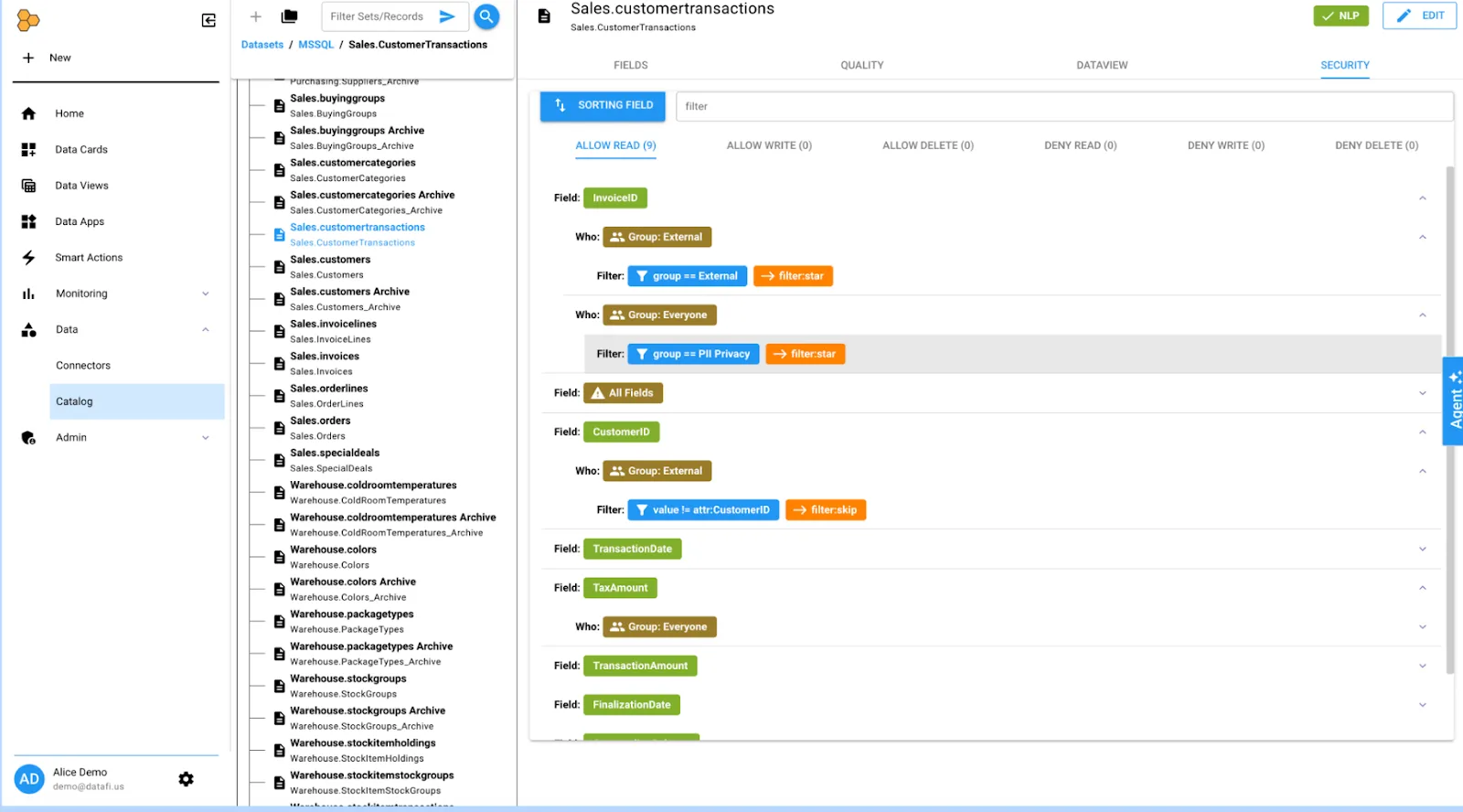
Datafi’s operating system provides the foundational infrastructure for full AI observability. Because Datafi connects data, context, governance, and workflow orchestration in a single integrated layer, it captures the signals needed for comprehensive observability as a natural byproduct of operation.
Every data access, reasoning step, policy check, and action is observable because it flows through the same governed platform. There is no separate instrumentation to deploy, no additional logging infrastructure to maintain, and no gaps between what agents do and what operators can see.
Adoption Path
Organizations should approach AI observability as a progressive capability:
Visibility
Implement comprehensive logging and monitoring for all agent interactions. Establish baselines for normal behavior. Build the dashboards and alerts that give operators situational awareness.
Governance
Layer policy enforcement onto the observability infrastructure. Define boundaries, authority limits, and escalation rules. Verify that agents operate within constraints and that violations are detected and addressed.
Intelligence
Apply analytics and AI to the observability data itself. Detect subtle drift, predict emerging risks, identify optimization opportunities, and continuously improve agent behavior based on observed outcomes.
Autonomy
With mature observability and governance in place, expand the scope of autonomous agent operations with confidence. Trust is built on evidence, and observability provides the evidence.
Metrics That Matter
Effective AI observability is measurable. Key metrics include:
- Reasoning fidelity: How consistently do agent reasoning chains align with expected patterns and policies?
- Boundary compliance: What percentage of agent actions fall within defined authority limits?
- Detection latency: How quickly are anomalies, policy violations, and drift identified?
- Intervention rate: How often do human operators need to intervene, and is the rate trending down?
- Outcome accuracy: Do agent actions produce the intended business outcomes?
- Explainability coverage: What percentage of agent decisions can be fully explained to stakeholders?
The Bottom Line
Autonomous AI agents will transform enterprise operations. But autonomy without observability is a liability, not an advantage. Organizations that invest in full AI observability across reasoning, data, action, policy, and impact will deploy agents with confidence, scale them with control, and build the trust that sustainable AI adoption requires.
The bottom line
The question is not whether to deploy autonomous agents. It is whether you can see, understand, and govern what they do. Full AI observability gives you the power to deploy agents with confidence, scale them with control, and build the trust that sustainable AI adoption demands.