


The life sciences industry runs on data. From the earliest preclinical studies to post-market surveillance, every decision, every milestone, and every regulatory submission depends on the ability to find, trust, and act on the right information at the right time. Yet for most pharmaceutical, biotech, and medical device organizations, the regulatory function remains one of the most data-intensive and chronically underserved areas of the enterprise. Regulatory affairs teams are still largely reliant on manual processes, disconnected systems, and fragmented data estates to produce some of the most consequential documents in the business: the dossiers and lifecycle submissions that determine whether a product reaches patients.
The regulatory data problem in life sciences is not that the right data is missing; it is that the data exists but remains inaccessible, ungoverned, and disconnected across dozens of systems, and closing that gap is the difference between submission bottlenecks and genuine competitive advantage.
The cost of this dysfunction is not abstract. Delayed submissions mean delayed approvals. Incomplete or inconsistent data packages draw regulatory queries that add months to review timelines. Lifecycle management activities, from label updates to post-approval changes to annual product reviews, consume enormous regulatory bandwidth that could be directed toward higher-value work. And as the volume and complexity of global submissions continues to grow, the gap between what organizations need to achieve and what their current data and technology infrastructure can support is widening.
Datafi was built to close that gap, not by adding another point solution to an already fragmented stack, but by delivering a vertically integrated data and AI technology platform that gives every employee in the organization, from a regulatory associate assembling a Module 3 package to a VP of Regulatory Affairs making a strategic filing decision, a unified, governed, and intelligent experience across the entire data ecosystem.
The Regulatory Data Problem Is a Structural Problem
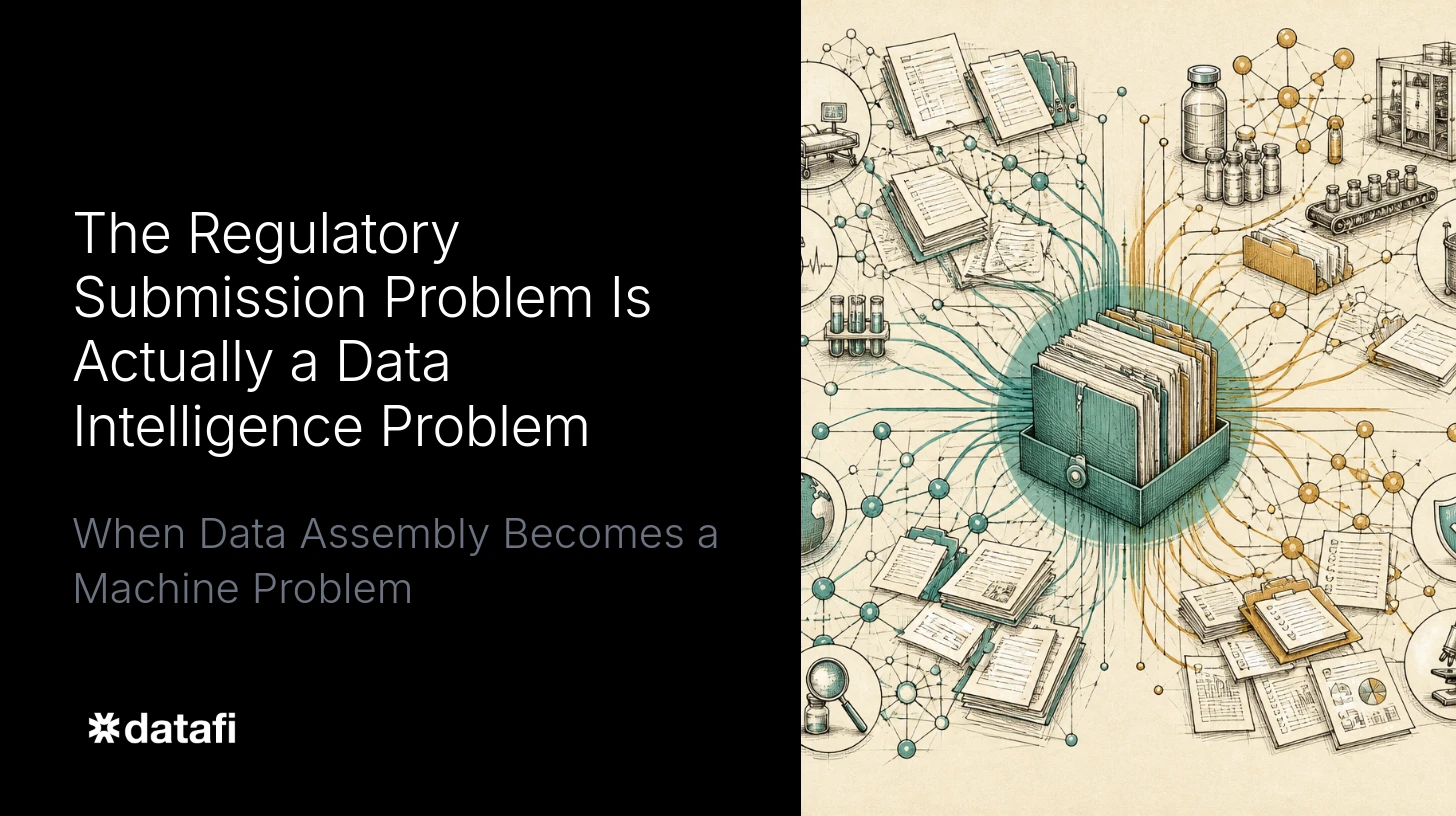
To understand the opportunity, it helps to understand the underlying challenge precisely. Life sciences regulatory functions operate across a data landscape that is almost uniquely complex. Clinical trial data lives in clinical data management systems and EDC platforms. Chemistry, manufacturing, and controls data spans laboratory information management systems, manufacturing execution systems, and quality management platforms. Preclinical and nonclinical data may be housed in separate repositories, often across different sites and vendors. Labeling content is managed in its own dedicated systems. Regulatory tracking and submission management tools hold filing histories, agency correspondence, and commitment logs. And above all of this sits a layer of documents, spreadsheets, emails, and shared drives that hold the institutional knowledge and operational context that formal systems rarely capture.
These systems do not talk to each other in any meaningful way. Assembling a Common Technical Document (CTD) dossier, whether for an original marketing application or a post-approval supplement, requires regulatory teams to manually pull, reconcile, and verify data from dozens of sources. Errors introduced in that process are not just operational problems. They are compliance risks. An inconsistency between a clinical study report and a summary document, a manufacturing specification that reflects an outdated version, or a mismatch between a proposed label and the approved indication language can trigger a Refuse to File determination or a Complete Response Letter that sets a program back by a year or more.
The deeper problem is that the data needed to prevent these errors exists in the organization. It is not missing; it is inaccessible, ungoverned, and disconnected. The regulatory team does not have a data problem in the traditional sense. They have a data experience problem, and that is exactly what Datafi solves.
A Unified Data Experience Built for Regulatory Complexity
At the core of Datafi’s platform is the concept of a unified data experience: the ability for any user, regardless of technical background, to access, query, and act on data from across the enterprise through a single, intelligent interface. For regulatory affairs, this means that the full context of a product’s development history, its preclinical package, clinical program, manufacturing controls, post-market data, and submission history, is accessible and coherent within a single environment.
This is not a data warehouse or a reporting layer. Datafi’s architecture connects to the live data ecosystem, meaning that when a regulatory writer queries the status of a manufacturing change, they are seeing current, governed data from the source system, not a stale export or a manually maintained tracker. When a regulatory operations team is assessing the impact of a protocol amendment on an existing submission commitment, they can surface the relevant data, precedents, and policy constraints in a single workflow rather than navigating four systems and two email threads.
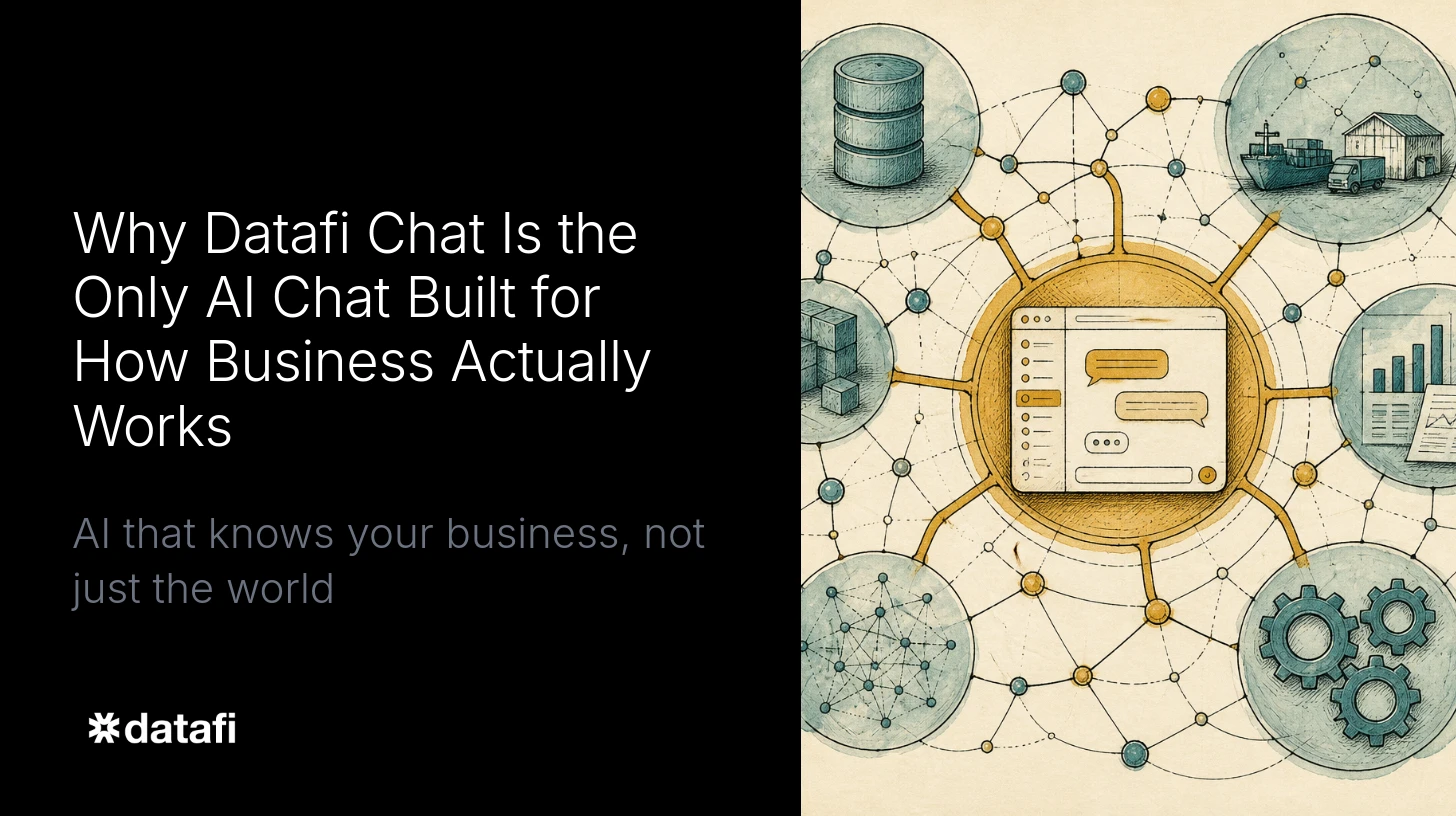
The Chat UI at the center of the Datafi experience is specifically designed for non-technical users. Regulatory professionals are subject matter experts in their field. They should not need to know how to write a SQL query or navigate a data catalog to get answers to questions that are critical to their work. Datafi’s conversational interface lets users ask questions in plain language, get answers grounded in real, governed data, and move directly from insight to action, all within a single experience.
AI Agents and Workflows That Actually Understand Your Business
The most significant shift that Datafi enables for life sciences regulatory functions is the deployment of AI agents and automated workflows in roles that go well beyond simple document retrieval or form completion. Datafi’s position is that the full transformative potential of AI in the enterprise is only realized when AI systems have access to the complete data ecosystem, understand the business context in which they are operating, and are empowered to function in genuinely autonomous problem-solving roles rather than as sophisticated search engines.
In the regulatory dossier context, this means AI agents that can do work of real consequence. A Datafi-powered regulatory workflow can monitor incoming data from clinical and manufacturing systems, identify gaps or inconsistencies relative to submission-ready standards, and surface actionable findings to the relevant team members before those issues become submission delays. An AI agent can draft and maintain the regulatory strategy documentation for a product lifecycle plan, drawing on the submission history, agency feedback, competitive intelligence, and internal policy frameworks that define the organization’s approach to a particular market or product class.
For lifecycle submissions specifically, where the volume of activity is high and the individual tasks are often repetitive but consequential, the efficiency gains from well-designed AI workflows are substantial. Annual product reviews, periodic safety update reports, post-approval change management protocols, and labeling harmonization activities all involve intensive data aggregation, cross-referencing, and documentation tasks that Datafi’s platform can automate, accelerate, and govern simultaneously. The regulatory team’s attention can shift from managing the process of finding and assembling information to making the higher-order decisions that require human expertise and judgment.
Governed, Compliance-Ready AI for a Regulated Industry
No conversation about AI in life sciences can proceed without a serious treatment of governance and compliance. The regulatory function operates in one of the most tightly controlled information environments in any industry. Data integrity requirements under 21 CFR Part 11 and Annex 11, the traceability expectations of GxP environments, and the audit readiness requirements that apply to submission-related activities mean that any AI system introduced into the regulatory workflow must meet a much higher bar than its counterparts in less regulated sectors.
Datafi was designed with this reality as a foundational constraint, not an afterthought. The platform’s policy and control layer allows organizations to define, enforce, and audit data access and usage rules at a granular level. When an AI agent queries data to support a regulatory workflow, that query is governed by the same data access policies that apply to human users. The output is traceable to its source. The reasoning is auditable. And the boundaries of what the AI is permitted to do are defined and enforced at the platform level, not left to the judgment of an individual language model.
This architecture matters enormously for life sciences organizations that want to move quickly with AI while maintaining the compliance posture that their regulatory obligations demand. Organizations can put AI to work in critical submission workflows knowing that the data it touches, the decisions it informs, and the documents it generates or contributes to are all operating within a controlled, auditable framework.
Contextual AI: The Difference Between Answering Questions and Solving Problems
Datafi’s perspective on the evolution of AI in the enterprise is grounded in a practical observation about where the real value lies. Question-answering AI, the kind that retrieves a document or surfaces a data point in response to a user query, is useful. It reduces friction and saves time. But it is not transformative. Transformative AI is AI that understands the full context of the business problem, has access to the complete data ecosystem relevant to that problem, and can take autonomous action to move the organization toward a solution.
In life sciences regulatory affairs, the distinction between these two modes plays out in concrete terms. Question-answering AI can tell a regulatory lead what the current status of a Type II variation submission is. Contextual, problem-solving AI can assess the full portfolio of pending submissions across all markets, identify the regulatory commitments that are at risk based on current resource allocation and timelines, model the impact of different prioritization decisions on the overall regulatory calendar, and recommend a course of action with a full rationale tied to real data from the business.
Building this kind of contextual AI layer requires more than a capable language model. It requires the complete, governed, connected data ecosystem that Datafi’s platform provides. LLMs operating in enterprise regulatory environments need to know the submission history, the agency relationship context, the product lifecycle stage, the internal capacity constraints, and the competitive landscape all at once, drawing on live data from the systems that hold that information, structured through a policy layer that ensures the right people and processes govern how that information is used.
Datafi builds the infrastructure that makes this level of AI capability possible and operational.
Accessible for Organizations of Any Size
One of the persistent challenges in life sciences is that the organizations doing the most innovative work, the emerging biotechs and mid-size specialty pharma companies, are often the ones with the least resources to invest in enterprise data infrastructure. The transformative data and AI capabilities that have historically been available only to large pharmaceutical organizations with significant technology investment capacity are not accessible at the scale and cost structure that earlier-stage companies can support.
Datafi changes this dynamic. Because the platform is built as an integrated stack rather than a collection of point solutions requiring significant implementation and integration overhead, life sciences organizations of any size can deploy a unified data and AI experience that connects their regulatory, clinical, manufacturing, and quality data into a coherent, governed, and intelligent environment. A 50-person biotech preparing its first NDA submission gets access to the same quality of AI-powered regulatory workflow capabilities as a global pharmaceutical organization managing a portfolio of hundreds of products across dozens of markets.
This democratization of data and AI capability is not a secondary benefit. It is central to Datafi’s mission and to the competitive logic of the life sciences regulatory environment. Speed to submission, quality of submissions, and the ability to manage a complex lifecycle efficiently are competitive differentiators regardless of organizational size. The companies that build a strong data and AI foundation early in their development are the ones that will have the regulatory operational leverage to move faster and more reliably as their portfolios grow.
A Foundation for the Future of Regulatory Operations
The regulatory landscape in life sciences is evolving rapidly. Agencies are investing in their own AI and data capabilities, changing the nature of what constitutes a high-quality submission and raising expectations for data standards and interoperability. The ICH M11 initiative, FDA’s Data Standardization efforts, and the EMA’s broader digital transformation agenda all point toward a future in which the ability to provide clean, structured, machine-readable data is not just a submission best practice but a baseline requirement.
Organizations that build their regulatory data infrastructure on a fragmented, manually intensive foundation are not just inefficient today. They are accumulating technical and operational debt that will make it harder to meet the standards of the regulatory environment they will be operating in five years from now. Datafi provides the foundation that positions life sciences organizations to meet those evolving expectations while capturing operational efficiencies and competitive advantages in the near term.
Unified data experience. Governed, compliance-ready AI. Workflow automation that actually solves problems. These are not aspirational capabilities. For life sciences organizations ready to move beyond submission bottlenecks and into a genuinely intelligent regulatory operating model, they are available today, through Datafi.