


There is a meaningful difference between AI that answers questions and AI that solves problems. It is the difference between a capable assistant and a transformative operating layer. It is also, at its core, the difference between what C3.ai offers enterprises today and what Datafi was purpose-built to deliver.
As organizations move beyond AI experimentation and into deployment at scale, the architecture decisions they make now will determine whether they realize genuine business transformation or simply add another layer of sophisticated complexity to the same underlying limitations. Choosing the right foundation matters enormously.
The gap between AI that answers questions and AI that solves problems is not a model capability gap. It is an architecture gap, and closing it requires a vertically integrated stack that gives every employee governed access to the full intelligence of the business.
The Promise and the Ceiling of C3.ai
C3.ai built its reputation on verticalized AI applications: pre-built solutions for predictive maintenance, demand forecasting, fraud detection, and supply chain optimization targeted at large enterprise customers. For organizations with the resources to support long implementation cycles, dedicated data science teams, and significant integration budgets, C3.ai’s application catalog offered a credible path to AI-driven outcomes in specific functional domains.
But that model carries structural limitations that are becoming increasingly apparent as enterprise AI expectations evolve.
C3.ai applications are purpose-built for specific use cases, which means each deployment is essentially a discrete project requiring its own integration work, its own data pipeline, and its own maintenance lifecycle. The platform is designed primarily for technical operators, data scientists, and enterprise architects. Non-technical users interact with outputs, not with the intelligence itself. And the total cost of ownership across licensing, implementation, professional services, and ongoing tuning is substantial enough that meaningful AI deployment has historically been reserved for organizations with the scale and budget to absorb it.
Perhaps most critically, C3.ai’s architecture reflects an older assumption about how AI creates value: that you identify a problem, build an application to address it, and measure the outcome in isolation. What it does not naturally support is the kind of continuous, context-aware, cross-functional intelligence that the current generation of large language models makes possible.
The market has evolved. The architecture needs to catch up.
Datafi: An Operating System, Not an Application Catalog
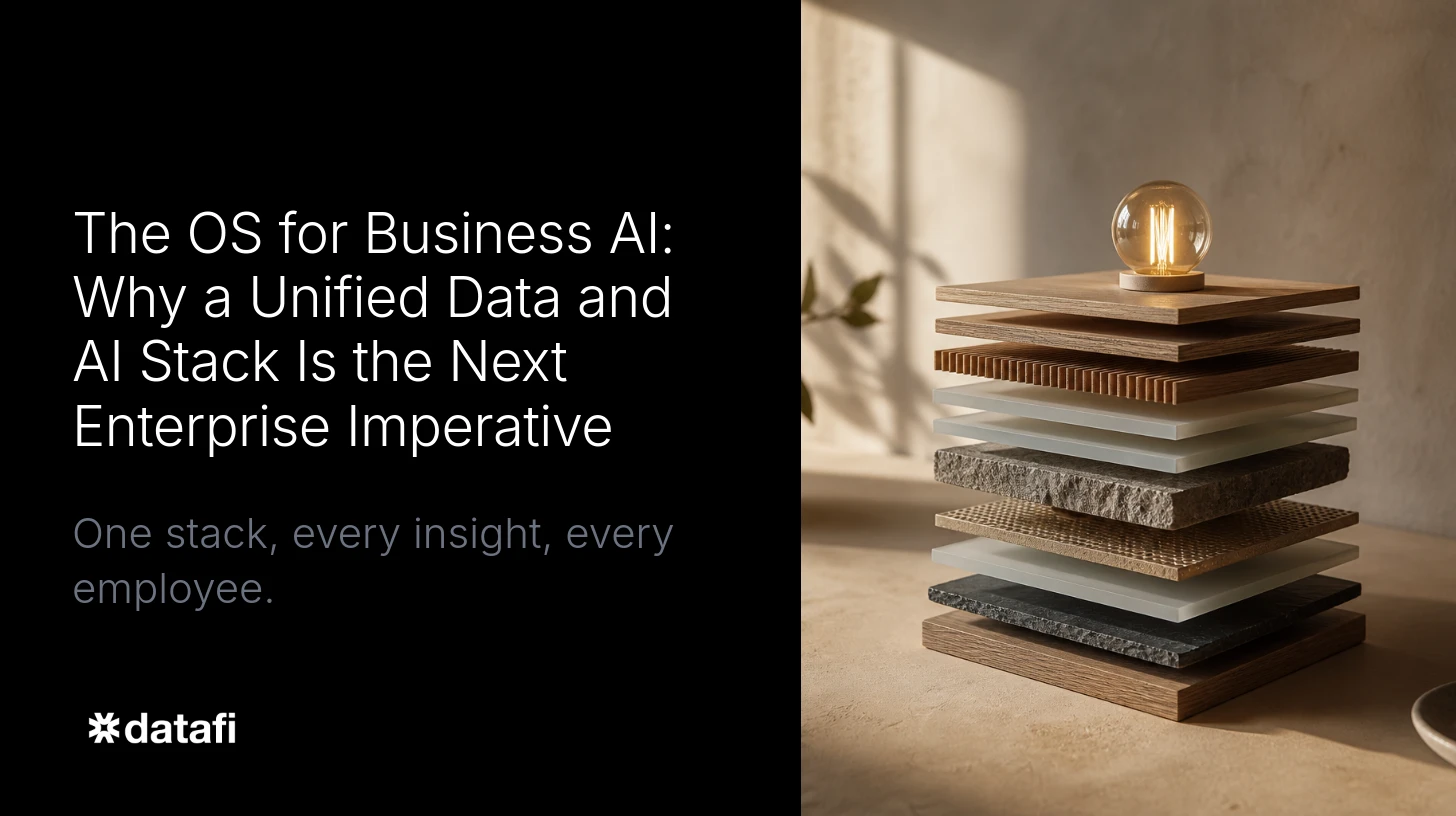
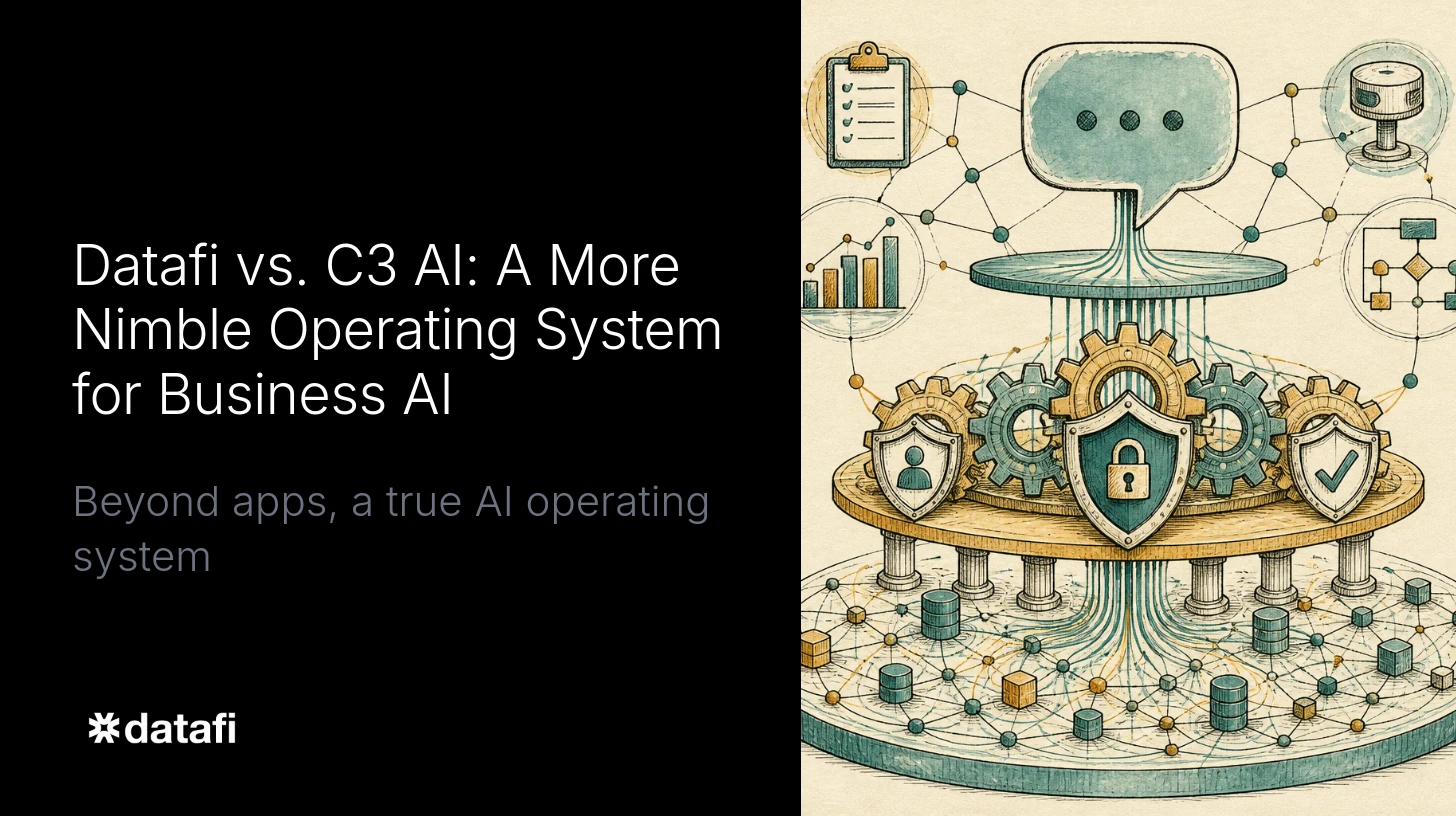
Datafi approaches enterprise AI from a fundamentally different starting point. Rather than building applications that sit on top of enterprise data, Datafi builds the operating layer underneath it, a vertically integrated data and AI technology stack that gives every employee, in every role, governed access to the full intelligence of the business.
This distinction matters more than it might initially appear.
An application catalog approach assumes that the set of problems worth solving can be defined in advance, that those problems are discrete and separable, and that the value of AI is realized use case by use case. A true operating system approach assumes something different: that the most valuable AI outcomes emerge when intelligence has full context, broad access, and the capacity to act across the enterprise, not just report within a silo.
Datafi is built on the second assumption. And that changes everything about what becomes possible.
Full Data Ecosystem Access
The intelligence of any AI system is bounded by the information it can see. LLMs are extraordinarily capable reasoning engines, but their ability to deliver genuinely transformative outcomes depends entirely on the richness and completeness of the context they operate within. A model that can only see a subset of enterprise data will, by definition, produce a subset of enterprise insight.
Datafi is architected to connect to the complete data ecosystem of an organization, structured and unstructured data, operational systems, external sources, historical records, real-time feeds. Not as a one-time integration project, but as a living, governed connection layer that evolves with the business. This is not a feature; it is a foundational design principle.
When an LLM has access to the full context of the business, its customers, its operations, its history, its performance, its people, it stops functioning as a question-answering tool and starts functioning as a reasoning partner capable of genuinely novel synthesis. That is the shift from AI that is interesting to AI that is indispensable.
Governance, Policy, and Control by Design
Broad data access without governance is not an enterprise solution; it is an enterprise liability. Datafi integrates policy, access control, and compliance frameworks directly into the stack, not as an afterthought or an add-on layer. Every interaction with enterprise data happens within a defined governance framework that organizations control.
This is what makes broad AI deployment viable in regulated industries, in organizations with complex data residency requirements, and in enterprises where different roles require different levels of access. Governance is not a constraint on Datafi’s architecture; it is a design principle baked into its foundations.
Accessible Intelligence for Every Employee
One of the most consequential limitations of enterprise AI in the C3.ai model is who can actually use it. When AI interfaces require technical fluency, when generating an insight requires constructing a query or interpreting a model output, the realistic user population collapses to a small subset of the organization. Data scientists and analysts get leverage. Everyone else gets a dashboard they may or may not know how to interpret.
Datafi’s Chat UI is designed explicitly to close this gap. Non-technical employees interact with enterprise intelligence in natural language, asking questions, exploring scenarios, and initiating workflows through a conversational interface that requires no technical training to use effectively. The complexity of the underlying stack, the data connections, the governance layer, the model orchestration, is entirely invisible to the end user.
This is not a cosmetic consideration. It is the mechanism by which AI value becomes organizational rather than departmental. When a logistics coordinator, a customer service representative, a plant supervisor, and a strategic planning executive can all interact with the same underlying intelligence through an interface designed for them, the leverage multiplies across the entire enterprise rather than concentrating in the technical core.
Organizations of any size can achieve this. Datafi is not a solution reserved for global enterprises with eight-figure technology budgets. The vertically integrated architecture means that even mid-market organizations can deploy a unified data experience and realize workflow efficiencies across every function without assembling the implementation teams that a C3.ai engagement typically requires.
Agents, Workflows, and the Autonomous Frontier
The most significant divergence between Datafi and C3.ai becomes visible at the leading edge of what AI can now do.
C3.ai’s application model is fundamentally reactive: it produces outputs in response to defined inputs, within a scope established at implementation. It can alert, predict, and recommend. It can surface patterns and flag anomalies. But it operates within the boundaries of its application design.
Datafi is built for a different model: AI that acts. Agentic capacity, the ability for AI to execute multi-step workflows, coordinate across data sources and systems, learn from outcomes, and operate with meaningful autonomy in service of defined business objectives, is not a future roadmap item for Datafi. It is a design requirement.
This matters enormously for the use cases that represent the highest-value frontier of enterprise AI today.
Predictive Maintenance and Asset Management: An agent with full access to sensor data, maintenance history, parts inventory, supplier lead times, and operational schedules does not just predict failure; it can initiate the response, coordinate the logistics, and close the loop, without waiting for a human to translate its recommendation into action.
Operations Optimization: Continuous, context-aware optimization across production, staffing, routing, and resource allocation requires an intelligence layer that can simultaneously hold all relevant variables and act on them in near real time. That requires both breadth of data access and autonomous workflow capacity.
Passenger and Customer Experience: In industries where experience is a competitive differentiator, AI that can personalize at scale, resolve issues autonomously, and anticipate needs before they are expressed requires exactly the kind of full-context, agentic architecture that Datafi provides.
Strategic Planning: The most demanding analytical tasks, scenario modeling, competitive analysis, market sensing, financial forecasting, require an AI that can synthesize signals from across the business and beyond it, reason about uncertainty, and surface insights that no individual analyst could assemble at the required speed and scale.
In each of these domains, the limiting factor is not the capability of the underlying LLM. It is the architecture that surrounds it. An LLM with narrow data access and no agentic capacity cannot solve these problems, regardless of how sophisticated its reasoning is. An LLM embedded in a full-context, fully governed, agentic operating system can.
The Contextual Layer: Where Transformative AI Lives
There is a concept worth naming directly, because it represents the core of what Datafi is building and what distinguishes its approach from the application catalog model.
Transformative AI outcomes require what might be called a contextual layer: a rich, continuously updated representation of the business that gives AI systems the information they need to reason about real problems in real conditions. This contextual layer is not a database and it is not a knowledge base. It is a living synthesis of organizational knowledge, historical, operational, relational, and environmental, that makes it possible for an AI agent to understand not just what the data says, but what it means in the specific context of this business, at this moment, facing these conditions.
Building this layer requires sustained access to the full data ecosystem. It requires governance structures that make that access trustworthy. It requires a Chat interface that captures the tacit knowledge employees bring to their interactions with AI. And it requires agentic capacity that allows the system to learn from its own actions over time.
C3.ai builds applications. Datafi builds the contextual layer. These are not competing approaches to the same goal; they are different theories of where AI value comes from.
Why Architecture Is Strategy
For enterprise leaders evaluating AI investments, the choice of architecture is not a technical decision delegated to the IT organization. It is a strategic decision about what kind of AI-enabled organization you are building.
An application catalog approach to enterprise AI produces incremental value in defined domains. It is a defensible choice for organizations that have identified specific, bounded problems they want to address with AI and are willing to accept the implementation burden and the user limitations that come with that model.
An operating system approach to enterprise AI produces compounding value across the enterprise as the contextual layer deepens, as agentic capacity expands, and as the intelligence of the system grows with every interaction. It is the right choice for organizations that see AI not as a set of tools to deploy but as a capability to develop, one that will eventually touch every role, every workflow, and every decision in the business.
Datafi exists because of a conviction developed through direct experience with what it actually takes to transform data into action: that the gap between AI that answers questions and AI that solves problems is not a model capability gap. It is an architecture gap. And closing that gap requires a vertically integrated stack that gives LLMs full business context, governed access to the complete data ecosystem, a natural language interface for every employee, and the agentic capacity to act on what they know.
That is the operating system for business AI. That is Datafi.
Datafi is an applied AI software company building the vertically integrated data and AI technology stack that enables organizations of any size to deploy AI across every function, for every employee. Learn more at datafi.us.