


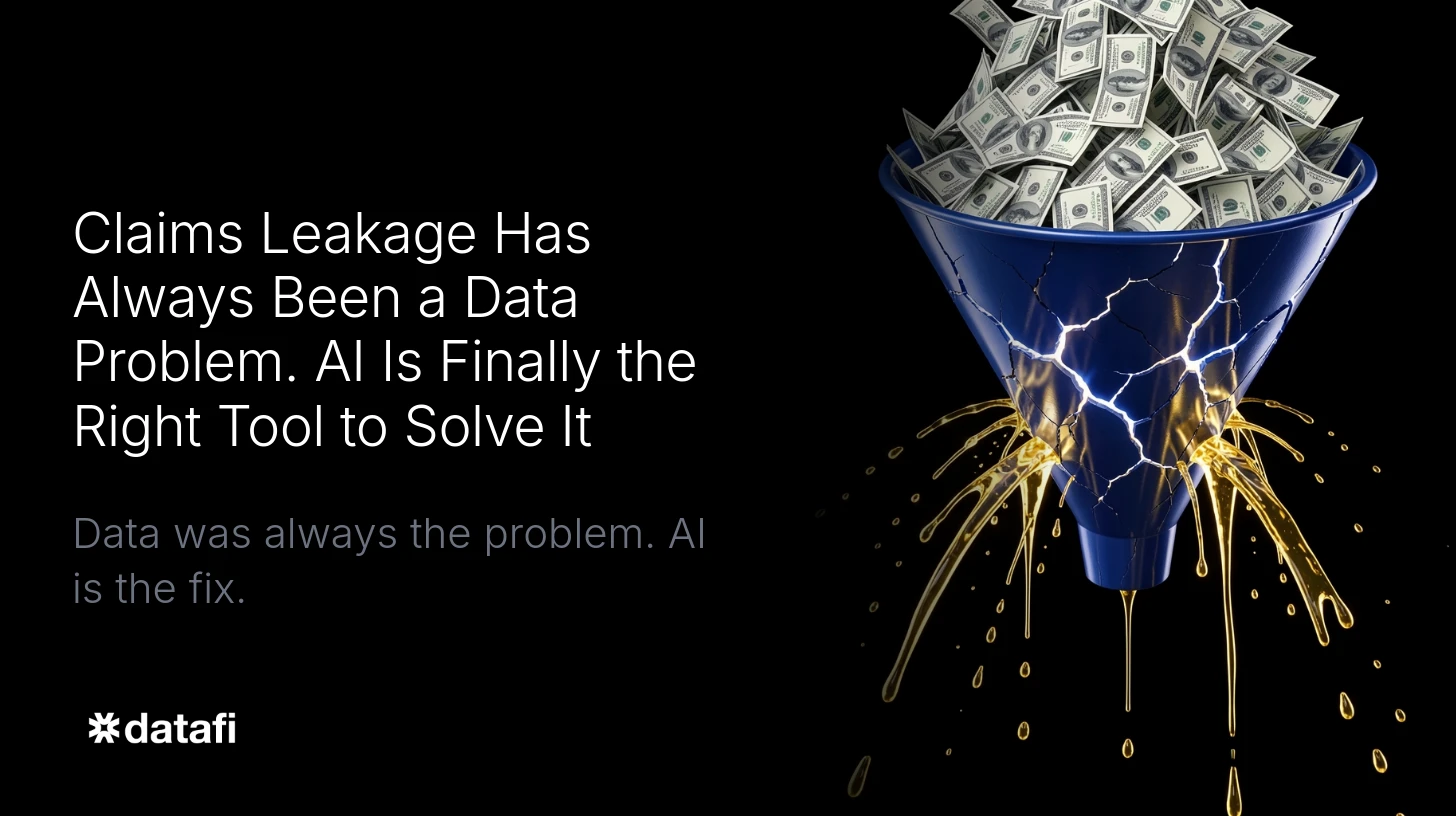
Every CFO in insurance knows the number. Claims leakage, the gap between what a claim actually costs and what it should have cost under ideal conditions, drains between 20 and 30 percent of total claims spend across the industry. For a mid-sized carrier processing $2 billion in claims annually, that is not a rounding error. It is $400 to $600 million leaving the business through a door that has never been properly closed.
The question that rarely gets asked directly is why. Why, after decades of investment in claims management systems, adjuster training programs, special investigations units, analytics platforms, and vendor auditing, does leakage persist at this scale? The answer is not process failure. It is not adjuster incompetence. It is not even fraud, though fraud is a real and contributing factor. The answer is data, specifically, the chronic inability of insurance organizations to bring the right information to the right decision at the right moment across the full lifecycle of a claim.
Claims leakage has always been a data problem. What has changed is that AI, built correctly and integrated deeply into the enterprise data ecosystem, is finally the right tool to solve it.
Claims leakage persists not because of process failure or adjuster error, but because fragmented data prevents the right information from reaching the right decision at the right moment. A true AI operating system with full data ecosystem access is the first tool capable of solving this at scale.
The Anatomy of Leakage
To understand why data is the root cause, it helps to trace where leakage actually originates. Claims professionals typically identify three broad categories: payment errors, process failures, and fraud and abuse. But each of these, when examined closely, resolves into a data problem at its core.
Payment errors occur when adjusters make settlement decisions without complete visibility into policy terms, prior claim history, medical billing benchmarks, jurisdictional fee schedules, or comparable settlements. The adjuster is not failing, the data is failing the adjuster. Critical information lives in disconnected systems: the policy administration platform, the claims management system, external medical databases, litigation history, and vendor invoices. Pulling this together manually is slow, inconsistent, and frequently incomplete. Decisions get made on partial pictures.
Process failures happen when claims move through the workflow without triggering the interventions that would have changed the outcome. A complex liability claim that should have been flagged for early legal involvement gets handled as routine. A catastrophic injury claim that warrants nurse case management never receives it. A subrogation opportunity expires because no one identified the recoverable amount in time. Each of these represents a moment where data existed that could have changed the trajectory of the claim, but that data was not surfaced to the right person at the right time.
Fraud and abuse, often treated as a category unto themselves, are equally data problems. Fraudulent billing patterns, provider anomalies, claimant behavioral signals, and network relationships are detectable, but only when claims data can be analyzed against a sufficiently broad and interconnected context. Isolated claims systems cannot do this. Detection requires connecting internal claims history with external provider data, industry benchmarks, geospatial information, and behavioral patterns across time.
In each case, the failure point is the same: fragmented data, inaccessible context, and workflows that force human judgment into situations where human judgment is operating with incomplete information.
Why Existing Tools Have Not Solved It

The industry has not ignored this problem. The past decade has seen significant investment in analytics platforms, rules-based fraud detection engines, predictive scoring models, and business intelligence dashboards. These tools have delivered incremental improvement. They have not solved leakage.
The reason is architectural. Most analytics investments have been additive rather than integrative. Organizations built reporting layers on top of existing systems rather than creating genuine data connectivity across the enterprise. Adjusters received dashboards they had to navigate separately from their claims workflow. Fraud scores appeared as a number with no accompanying reasoning. Recommendations from predictive models required manual interpretation and manual action.
The tools answered questions. They did not solve problems.
There is a meaningful distinction here that defines why the previous generation of AI and analytics investments underdelivered. Answering a question means returning information in response to a query. Solving a problem means taking action, surfacing the right insight at the right moment, initiating the right workflow, coordinating across systems, and closing the loop on outcome. Insurance claims are not a question-answering environment. They are a complex, time-sensitive operational environment where decisions compound, where delay creates cost, and where the difference between a good outcome and a poor one is measured in months of claim duration and hundreds of thousands of dollars in settlement variance.
The technology that solves claims leakage must be capable of operating at the level of the problem. That requires full data ecosystem access, the ability to reason across complex business context, and the capacity to act autonomously within governed boundaries. It requires a vertically integrated AI operating system, not a point solution bolted onto existing infrastructure.
What Full Data Context Actually Means in Claims
The phrase “data ecosystem access” is abstract. It is worth making it concrete in the context of claims operations.
A single bodily injury claim generates data across at least a dozen touchpoints before it closes. The first notice of loss captures incident facts. The policy record defines coverage, limits, endorsements, and exclusions. Medical records from treating providers describe injury and treatment course. Independent medical examinations introduce a clinical opinion. Attorneys enter the picture with representation letters and demand packages. Vendor invoices document services rendered. Reserve histories track financial exposure over time. Litigation records reflect court activity. Prior claim histories reveal patterns that change the risk profile of the current claim. External data sources, from weather records to public court filings to provider credentialing databases, add further context.
No human adjuster processes all of this simultaneously. No claims management system surfaces it in an integrated, reasoning-capable way. The result is that each decision in the claims lifecycle is made on a fraction of the available context, which means it is made with an elevated probability of error.
A true AI operating system changes this by giving the intelligence layer continuous, governed access to the complete data ecosystem. This is not retrieval. It is not search. It is the capacity for an AI that understands the full business context to reason across every relevant data source simultaneously and surface the right insight, recommendation, or autonomous action at the precise moment it matters.
When an adjuster opens a new claim, the AI operating system already knows the policy history, the claimant’s prior interactions with the carrier, the treating provider’s billing patterns relative to industry norms, the jurisdiction’s typical settlement range for similar injuries, and the carrier’s own comparable claims outcomes. It has not been asked to retrieve this. It holds it as context and applies it continuously as the claim develops.
This is the difference between a tool that answers questions and a system that solves problems.
Agentic Claims Workflows: Where the Economics Change

Understanding the data context problem clarifies why AI agents represent a fundamentally different opportunity in claims than previous analytics investments. Agents do not wait to be queried. They monitor, reason, and act within defined boundaries, continuously throughout the claims lifecycle.
In practice, this means autonomous workflows that previously required human initiation and coordination can now operate at scale and with consistency that human workflows cannot match. A claims AI agent can monitor every open claim simultaneously, identify the moment a medical billing pattern deviates from expected norms, initiate a review process, generate a summary of the anomaly for the assigned adjuster, and flag the claim for SIU referral if thresholds are met. This entire sequence, which in a manual environment requires an adjuster to notice something, escalate it, wait for a response, and coordinate next steps, happens in seconds.
The compounding effect across a claims portfolio is significant. Claims that get the right intervention earlier cost less and close faster. Duration is a primary driver of total claim cost. Shortening the period between loss event and appropriate clinical intervention, between anomaly detection and investigation initiation, between settlement authority request and resolution, directly reduces leakage at its source.
Reserve accuracy, another major leakage driver, improves when AI agents can continuously reassess reserve adequacy based on real-time developments in the claim rather than periodic human review. When a diagnosis changes, when litigation is filed, when a provider’s treatment plan extends beyond expected duration, the reserve should update. Manual reserve review happens on a cycle. AI agents happen continuously.
Subrogation recovery, historically one of the most underperforming areas in claims operations, benefits from the same pattern. Subrogation opportunities exist in a meaningful percentage of claims but require early identification, documentation, and follow-through across a long timeline. AI agents monitoring claims for subrogation signals, documenting the recoverable elements, and initiating the recovery workflow before the statute of limitations creates urgency recover value that would otherwise be left on the table.
The Governance Layer Is Not Optional
Any serious conversation about deploying AI in claims operations must address governance. Claims decisions have legal, regulatory, and financial consequences. An AI system operating without appropriate controls is not a solution; it is a liability.
This is where architectural integrity matters. Datafi’s approach to AI in the enterprise is built on the premise that full data ecosystem access and policy and governance controls are not competing requirements but complementary ones. The same system that gives the AI complete business context also enforces the rules that govern what the AI can access, what actions it can take, what decisions require human review, and what audit trail must be maintained.
In a claims environment, this means the AI operating system understands which data sources are permissible for which use cases, which decisions can be executed autonomously and which require adjuster confirmation, which recommendations must be logged for compliance purposes, and how human override interacts with the AI’s learning cycle. Governance is not a constraint on AI effectiveness. It is the condition under which AI can be trusted to operate in high-stakes environments.
Carriers that attempt to deploy AI without this governance architecture will encounter the same pattern: promising pilots that cannot scale because the organization cannot answer the audit question, the regulatory question, or the risk management question. Datafi is designed from the ground up for the environment where those questions must be answered before deployment, not after.
What This Means for Operational Leadership
For CFOs evaluating the claims leakage problem, the strategic opportunity is clearer than it has ever been. The technology required to make a material reduction in leakage now exists. The question is whether the technology is deployed in a way that matches the actual complexity of the problem.
Point solutions targeting individual leakage categories will continue to deliver incremental improvement. An AI operating system that integrates fully with the enterprise data ecosystem, deploys autonomous agents across the claims lifecycle, and operates within governed policy controls will deliver a categorically different outcome.
For VP Claims and operational leaders, the practical implication is a shift in what claims management looks like at scale. Adjusters working alongside AI agents have access to complete claim context from first notice of loss through closure. Complex claims surface earlier. Anomalies are caught before they become exposure. Subrogation is identified and pursued systematically rather than opportunistically. Reserve accuracy improves continuously rather than periodically. The adjuster’s judgment is amplified rather than replaced because it is applied to the decisions that genuinely require human expertise rather than information retrieval and pattern matching that AI executes better.
Claims leakage has persisted because the tools available to address it could not match the complexity of the data environment in which claims actually operate. That constraint has been removed. The carriers that move first to deploy a true AI operating system in claims will not merely reduce leakage. They will establish a structural cost advantage that compounds over time as the AI accumulates deeper business context, refines its models against real outcomes, and expands its role from advisory to autonomous across an increasing share of claims decisions.
The problem was always data. The solution is finally here.
Datafi is an applied AI software company delivering a vertically integrated data and AI operating system for enterprise operations. Datafi gives AI full access to the enterprise data ecosystem, enforces policy and governance controls, and provides a Chat UI designed for non-technical users, enabling autonomous agents and workflows across every function of the business.