


For two decades, the dashboard was the crown jewel of enterprise intelligence. It promised clarity. It delivered color-coded charts, trend lines, and KPI tiles that gave executives the feeling of being informed. And for a long time, that was enough.
It is no longer enough.
Across banking, asset management, and insurance, a quiet but consequential shift is underway. The C-suite is not abandoning data. It is abandoning the model that places a human being between data and action, requiring that person to read a report, form a judgment, escalate a decision, and hope the opportunity or the threat has not moved on by the time any of that happens. In risk-sensitive environments where a portfolio can reprice in minutes, a credit event can cascade across counterparties in hours, and a regulatory examination can materialize with little warning, the latency built into dashboard-driven workflows is not a minor inconvenience. It is a structural vulnerability.
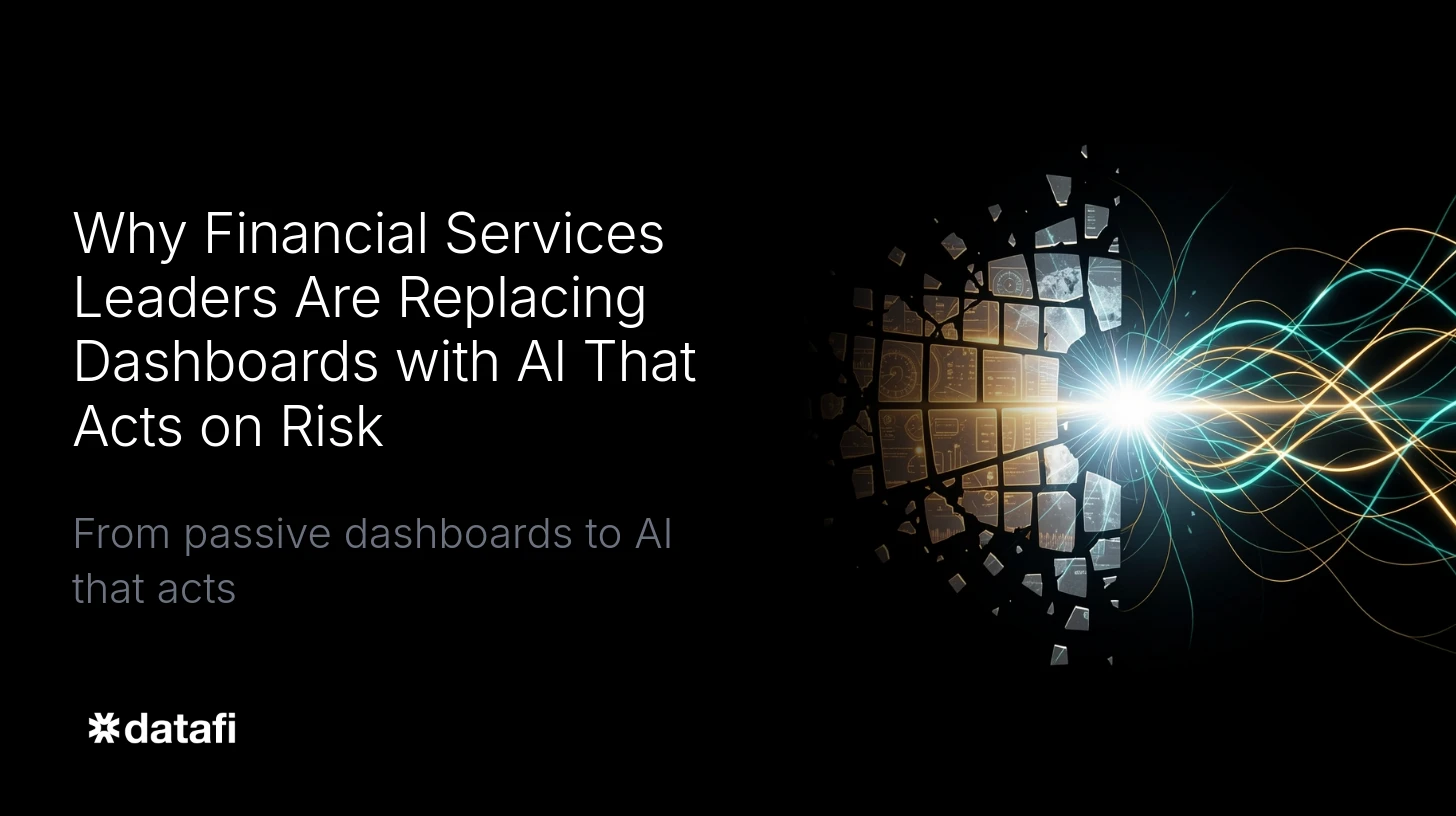
What is replacing dashboards is not simply better visualization. It is a fundamentally different model of how artificial intelligence operates inside a financial institution, one where the AI does not wait to be asked a question. It understands the business, monitors the data ecosystem continuously, identifies conditions that require action, and then takes that action, or surfaces a precisely framed decision to the person who needs to make it.
The distinction between AI that answers questions and AI that solves problems is not semantic. It is the difference between a reporting system and an operating system, and that gap is now a structural competitive vulnerability for financial institutions still relying on dashboards.
The Limits of the Dashboard Model

To understand why financial services is moving away from dashboards, it helps to be precise about what dashboards actually do. A dashboard reflects a state of the world at a point in time. It is, by construction, backward-looking. Even when refreshed in near real time, a dashboard presents information. It does not interpret it. It does not connect it to adjacent data that would change its meaning. It does not act on it.
The human reading the dashboard is expected to do all of that work, drawing on their knowledge of the business, their sense of what matters, and their ability to route a concern to the right person or system. In a well-staffed, low-velocity environment, that model holds. In the environment that actually characterizes financial services today, it does not.
Consider a credit portfolio manager at a regional bank. Her dashboard shows delinquency rates by segment, updated daily. What it does not show is the combination of macroeconomic signals, borrower behavioral shifts, and sector-specific stress indicators that, taken together, would allow her to anticipate where delinquency is heading rather than where it has been. That synthesis requires pulling data from multiple systems, most of which do not talk to each other, running analysis that her team may or may not have bandwidth for, and making a judgment call with incomplete information under time pressure. The dashboard told her something happened. It gave her no capacity to get ahead of it.
This is the gap that AI, properly deployed, is built to close.
What AI That Acts on Risk Actually Means
The phrase “AI that acts on risk” can sound abstract. In practice, it means deploying AI agents that operate with full access to an institution’s data ecosystem, that understand policy and governance constraints, and that are capable of executing workflows, not just surfacing information, when conditions warrant it.
In an asset management context, this looks like an AI system that monitors portfolio exposures across asset classes, watches for correlated movements that fall outside pre-defined parameters, evaluates liquidity conditions relative to redemption obligations, and either triggers a rebalancing workflow or escalates a structured alert to the portfolio manager with a recommended action already formulated. The manager does not start from a chart. She starts from a decision point, with context assembled and options evaluated.
In commercial banking, it looks like a system that monitors covenant compliance across a loan portfolio continuously, identifies borrowers showing early behavioral indicators of stress, cross-references that signal against macroeconomic conditions and sector exposure, and initiates a relationship manager outreach workflow before a formal covenant event occurs. The relationship manager does not learn about the risk when the borrower misses a payment. She learns about it when there is still something to do.
In insurance, it looks like a claims environment where an AI agent evaluates incoming claims against policy terms, historical patterns, fraud indicators, and regulatory requirements simultaneously, routes straightforward claims to automated settlement, flags complex cases with structured context for human review, and maintains an audit trail that satisfies compliance requirements without manual documentation effort. The claims examiner does not review every claim from scratch. She reviews the ones that genuinely require her expertise.
None of this is possible with a dashboard and a large language model bolted onto a search interface. All of it requires something more architecturally serious.
The Operating System Requirement

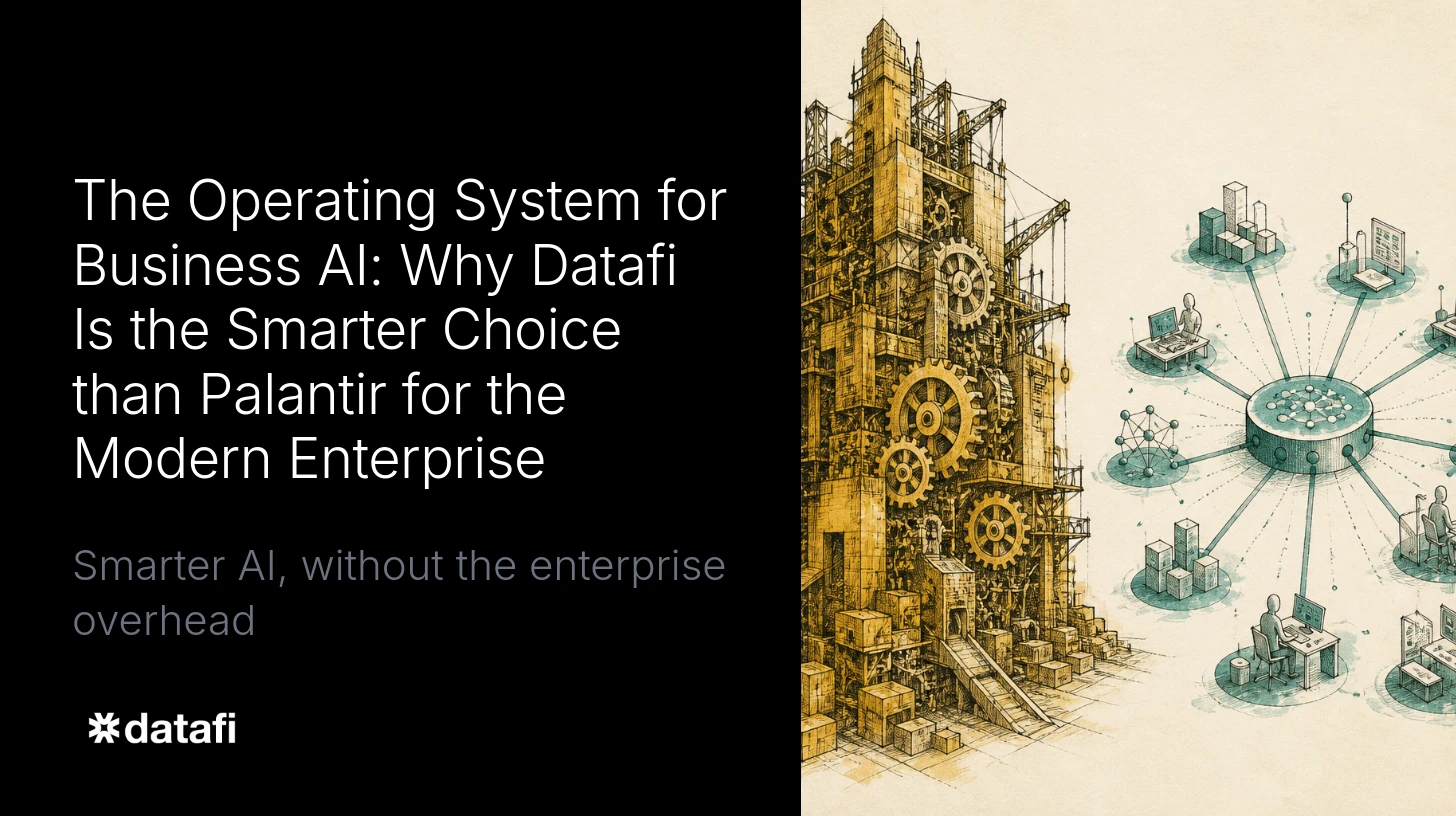
The reason most financial institutions have not fully realized the shift from reporting to action is not that they lack ambition. It is that they have approached AI as a feature rather than as an operating system. They have deployed a chat interface on top of a data warehouse, or added a generative AI layer to an existing analytics platform, or purchased a point solution that solves one problem in one department. The result is a collection of disconnected AI capabilities that cannot see the full picture of the business, cannot act across systems, and cannot be governed in the consistent way that financial regulation requires.
What is actually required is a vertically integrated AI stack, one that provides large language models with access to the complete data ecosystem, not a curated subset of it; that enforces policy and governance controls at the layer where data meets AI, not as an afterthought; that gives non-technical users a conversational interface that does not require them to know SQL or prompt engineering to get value; and that supports fully autonomous AI agents capable of executing multi-step workflows without a human being in the loop for every decision.
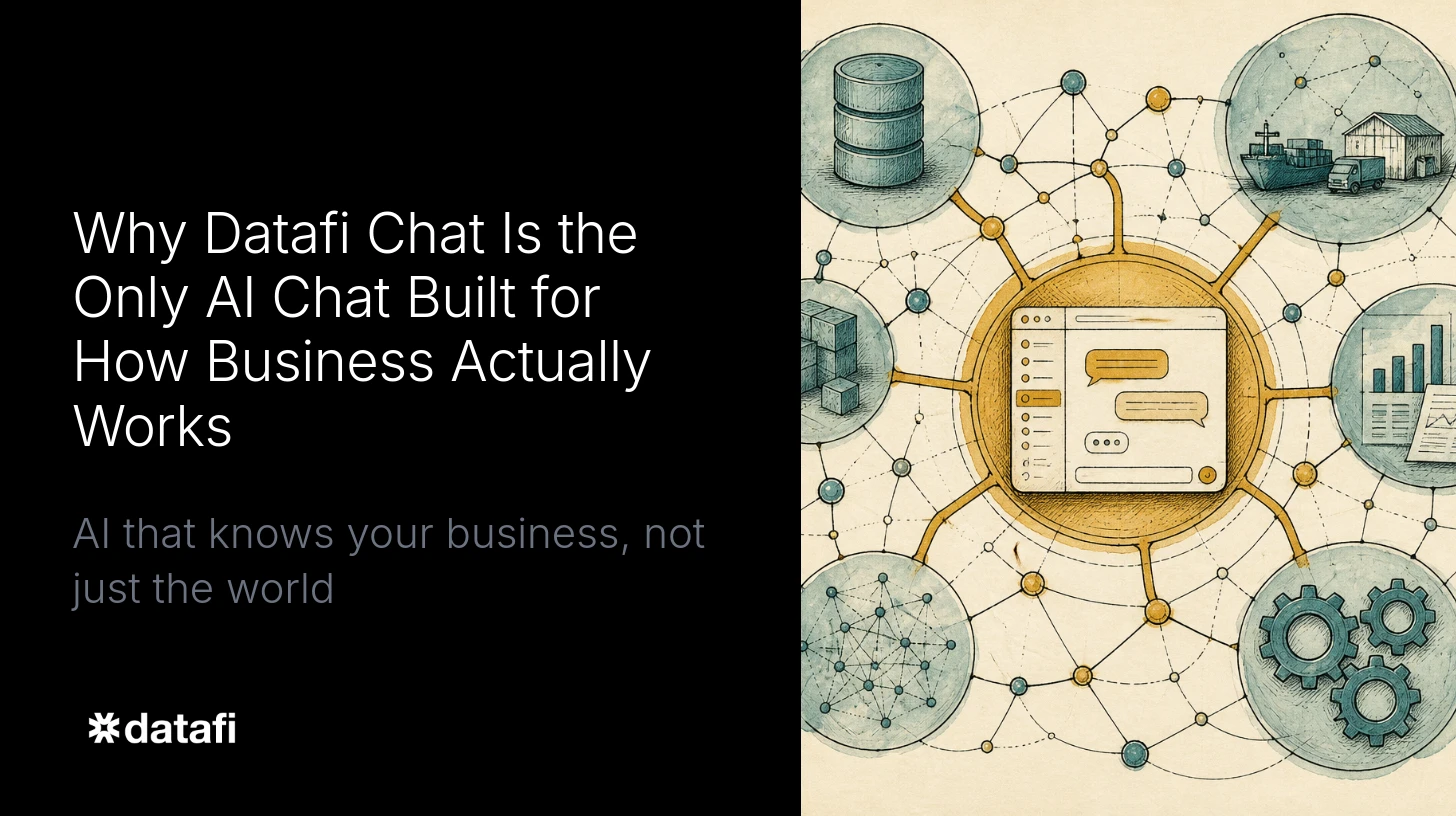
This is the architecture that Datafi has built. The Datafi operating system connects LLMs to the full enterprise data environment, whether that data lives in cloud warehouses, operational databases, streaming systems, or third-party feeds. It applies governance and access controls that financial institutions require, ensuring that the AI operates within policy boundaries and that every action is logged, explainable, and auditable. It provides a Chat UI designed for the business user, not the data scientist, so that a risk officer, a portfolio manager, or a compliance professional can interact with the AI in natural language and receive not just an answer but an action or a decision-ready recommendation.
The critical design principle underlying this architecture is that LLMs cannot operate effectively in complex financial environments without full business context. A model that can see only the data in a single system, or that has been trained on a generic corpus without knowledge of the institution’s specific portfolio, policy framework, counterparty relationships, and regulatory posture, will produce outputs that sound plausible but cannot be trusted for consequential decisions. The contextual layer, the layer that gives AI genuine understanding of the business rather than generic fluency, is what separates AI that acts on risk from AI that talks about risk.
From Passive Reporting to Active Intelligence Across the Institution
The shift from dashboards to active AI is not confined to the risk function. It represents a different relationship between data and work across every part of a financial institution.
In operations, it means AI agents that monitor transaction flows, identify anomalies, route exceptions, and reconcile positions, reducing the manual effort that currently consumes operations teams while improving accuracy and speed. In compliance, it means continuous monitoring of communications, transactions, and client activity against regulatory requirements, with AI-generated alerts that are already contextualized rather than raw signals requiring human triage. In client-facing functions, it means AI that understands a client’s portfolio, objectives, and behavioral history well enough to surface proactive recommendations before the client asks, or to identify clients at risk of attrition based on engagement patterns and life events.
What makes this possible at enterprise scale is not a single AI application. It is the operating system underneath, the layer that ensures every AI agent, across every function, is working from the same data ecosystem, subject to the same governance controls, and capable of coordinating action across systems rather than operating in isolation.
Financial institutions that have deployed AI in this way consistently report the same pattern of outcomes. The time from signal to action compresses dramatically. The quality of decisions improves because they are made with more complete context. The cost of operations declines as AI handles workflows that previously required human effort. And the institution’s capacity to take on complexity, whether in the form of regulatory change, market volatility, or portfolio expansion, increases because the AI infrastructure scales in ways that human teams cannot.
The Leadership Imperative
For C-suite leaders in financial services, the strategic question is no longer whether to invest in AI. Every institution is investing. The question is whether that investment is producing AI that observes or AI that acts, AI that answers questions or AI that solves problems.
The answer matters because the competitive dynamics of financial services are moving faster than traditional technology adoption cycles allow. An institution that deploys AI as an operating system, with full data ecosystem access, governed autonomy, and the capacity to act on risk in real time, is not simply running a more efficient version of the same business. It is running a categorically different business, one that can monitor and respond to conditions that its competitors are still trying to understand.
Visibility was never the hard problem. The hard problem was always what to do with what you see, fast enough to matter, with enough confidence to act, across a business too complex for any individual to hold entirely in mind.
The dashboard served financial services well for a long time. It made data visible. But visibility was never the hard problem. The hard problem was always what to do with what you see, fast enough to matter, with enough confidence to act, across a business too complex for any individual to hold entirely in mind.
That is the problem that AI, built on the right operating system, is now equipped to solve.
Datafi exists to make that capability real for financial services organizations of every size, from regional banks to global asset managers, from specialty insurers to diversified financial groups. The shift from passive reporting to active intelligence is not a future state. For the institutions that have made the architectural investment, it is already the present.
To learn more about how Datafi’s AI operating system is being deployed in financial services, contact the Datafi team.