



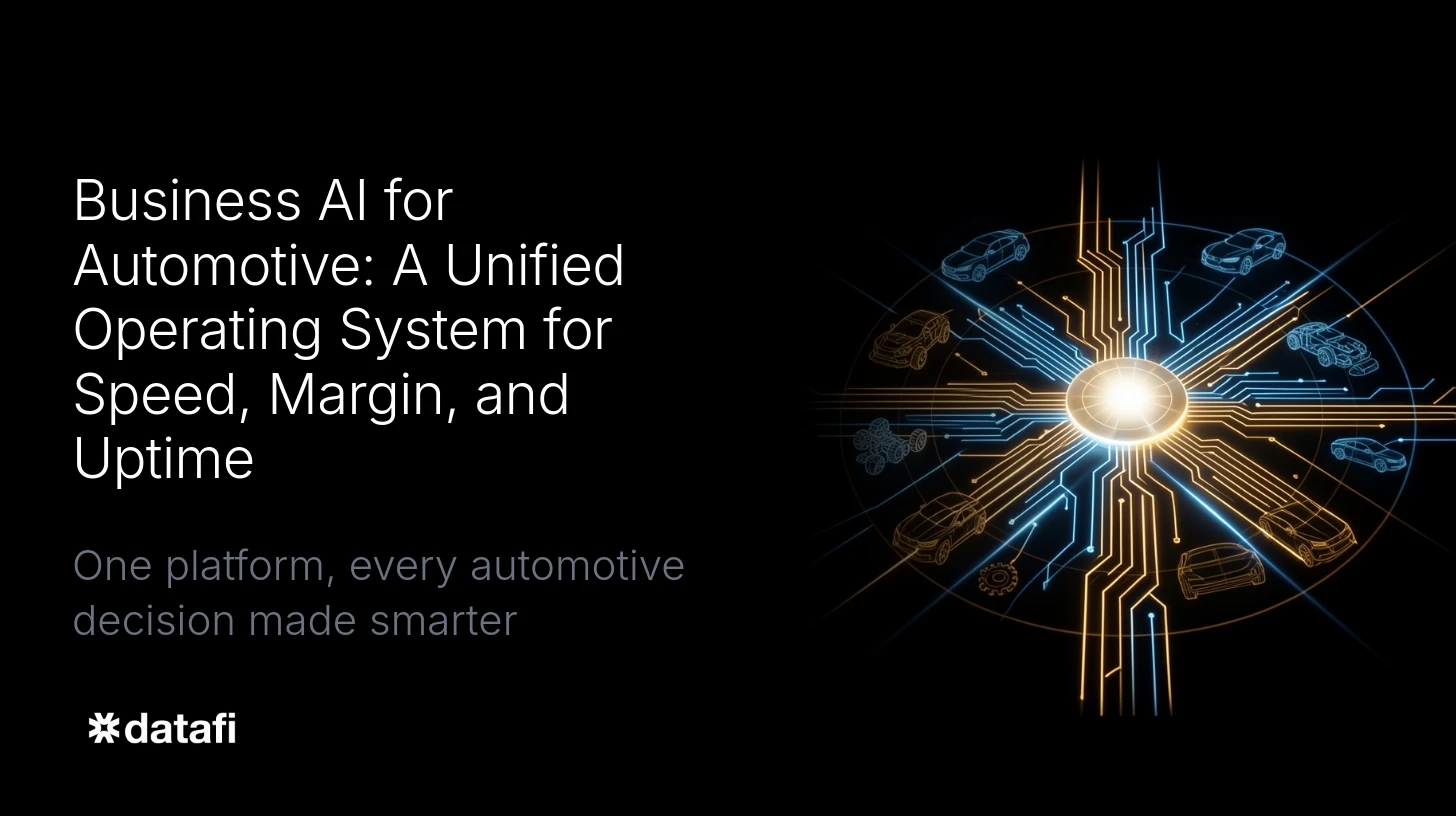
The automotive and mobility industry runs on complexity. OEMs, suppliers, dealer groups, aftermarket businesses, fleets, and mobility providers manage networks of plants, service operations, field teams, partners, and customers. Data lives across ERP, DMS, CRM, telematics, warranty systems, supplier portals, spreadsheets, and email, while decisions must be made in real time. AI only becomes truly valuable when it can understand the full business context and act inside the workflows that drive revenue, service, uptime, and margin. That is where datafi’s operating system for business AI creates advantage.
AI only becomes truly valuable in automotive when it can understand the full business context and act inside the workflows that drive revenue, service, uptime, and margin — not just respond to isolated prompts.
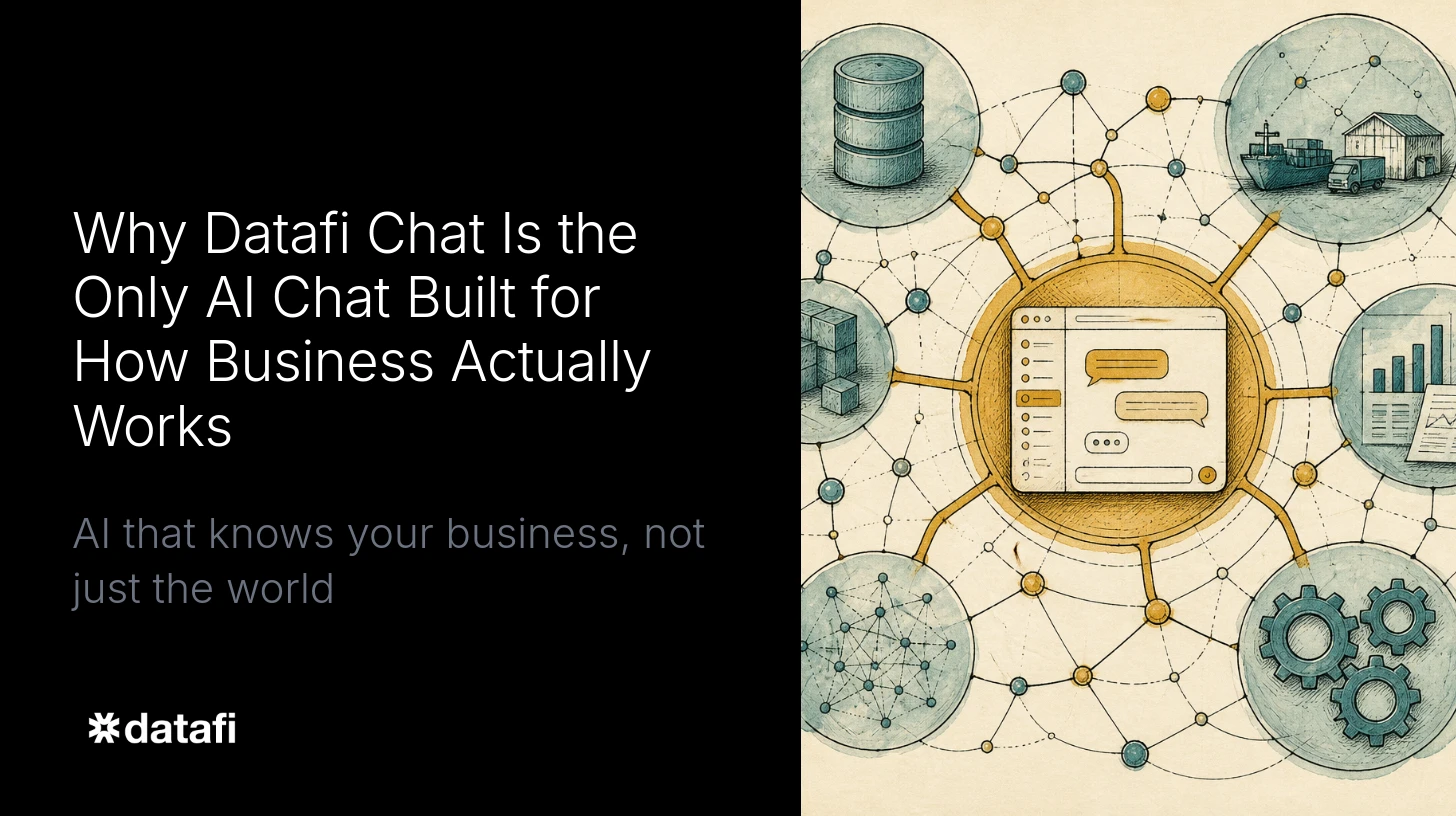
datafi gives automotive organizations of any size a unified data experience and workflow layer for every employee. Instead of forcing business users to navigate disconnected dashboards, reports, and applications, datafi connects the enterprise data ecosystem and makes it usable through an intuitive chat experience designed for nontechnical users. Employees, managers, and AI agents can reason across the same trusted context, take action inside real workflows, and improve how work gets done.
Dealer and Field Self-Service Intelligence

One of the most immediate benefits is dealer and field self-service intelligence. Automotive businesses depend on thousands of daily decisions made by dealer principals, service managers, field operations leaders, district managers, and regional teams. Those users need timely answers on sales performance, service throughput, incentive effectiveness, inventory position, technician productivity, repair trends, campaign execution, and customer satisfaction. With datafi, they can ask natural language questions against live business data and receive grounded answers without waiting on analysts or central reporting teams. That reduces friction, improves consistency, and empowers the field to solve problems faster.
Parts Availability and Working Capital Optimization
Parts availability and working capital optimization is another high-value use case. In automotive, too much inventory ties up capital and hides inefficiency, while too little inventory delays repairs, disrupts production, and frustrates customers. datafi allows AI agents and workflows to monitor demand signals across plants, warehouses, dealers, suppliers, service history, and logistics constraints in one environment. Teams can identify imbalances early, improve stocking decisions, recommend transfers, prioritize replenishment, and align inventory to real demand. That improves fill rates and service levels while freeing working capital that would otherwise remain trapped in slow-moving stock.
Predictive Maintenance and Uptime Assurance
Predictive maintenance and uptime assurance also become stronger when AI has access to a complete operating picture. Whether the challenge is production equipment on the factory floor, connected fleet assets in the field, or service capacity across distributed operations, reliability depends on combining signals that are rarely visible together. datafi can unify sensor data, maintenance records, work orders, asset history, technician schedules, and parts availability so AI can detect patterns that point to risk before failure occurs. More importantly, the platform can trigger the next best action, from scheduling preventive work to reserving parts and routing the right technician. The value is coordinated execution that protects uptime.
Warranty and Service Recovery Orchestration
Warranty and service recovery orchestration is a further area where fragmented systems often create cost leakage and customer dissatisfaction. Warranty issues sit at the intersection of quality, engineering, suppliers, service operations, and finance. datafi helps organizations connect claims, root cause analysis, service bulletins, supplier responsibility, vehicle populations, repair histories, and customer case data into a single context layer. AI workflows can identify anomalies, flag emerging failure patterns, prioritize claims for review, and guide recovery actions with greater precision. That helps reduce unnecessary payout, accelerate supplier chargeback processes, improve service response, and protect customer trust when issues arise.
Tariff, Sourcing, and Margin Monitoring

The same contextual intelligence is increasingly critical for tariff, sourcing, and margin monitoring. Automotive supply chains are exposed to constant change in input costs, regional trade conditions, supplier performance, freight volatility, and pricing pressure. Margin can erode quickly when sourcing, policy, and commercial signals are disconnected. datafi enables teams to monitor exposure across bills of material, supplier locations, landed cost, tariffs, rebates, incentives, and product profitability in one governed environment. AI agents can surface where changes are creating risk, simulate the impact of alternative sourcing decisions, and help leaders act before margin loss becomes embedded.
Governed AI Deployment Across Distributed Operations
Governed AI deployment across distributed operations is not optional. Plants, distribution centers, dealer networks, service organizations, field teams, and regional business units all need access to intelligence, but not all users should see the same data or trigger the same actions. datafi addresses this by embedding policy, permissions, control, and governance directly into the business AI operating model. Organizations can deploy AI broadly while maintaining access boundaries, auditability, process discipline, and confidence in how outputs are generated.
At datafi, we see customers wanting to use AI in more critical thinking, workflow automation, and analytical roles. That shift requires more than a model endpoint and a generic interface. It requires a vertically integrated data and AI technology stack with direct access to the data ecosystem, strong policy and control frameworks, and a chat user experience that business users can adopt without technical training. In automotive, where operations are interconnected and consequences are measurable in cost, downtime, and customer experience, those requirements become even more important. AI must be able to reason over the business, not just respond to isolated prompts.
That is why the long-term value of datafi is the contextual layer it builds for complex agents and workflows. Large language models will need to know the full context of the business, access the complete data ecosystem, and function in increasingly autonomous roles to learn and solve hard business problems. Without that foundation, AI remains narrow, brittle, and difficult to trust. With it, automotive organizations can move beyond experimentation and start deploying AI as an operational capability across the enterprise.
Without a unified contextual foundation, AI remains narrow, brittle, and difficult to trust. With it, automotive organizations can move beyond experimentation and deploy AI as a durable operational capability across the enterprise.
For automotive and mobility companies, the opportunity is clear. A unified operating system for business AI can give every employee a better data experience, reduce workflow friction, and enable intelligent automation where it matters most: dealer and field intelligence, parts and inventory optimization, predictive maintenance, warranty recovery, tariff and sourcing decisions, and governed AI execution at scale. In an industry defined by complexity and constant pressure on cost, uptime, and margin, datafi helps turn AI from a scattered set of tools into a durable system for better decisions and better business outcomes.