


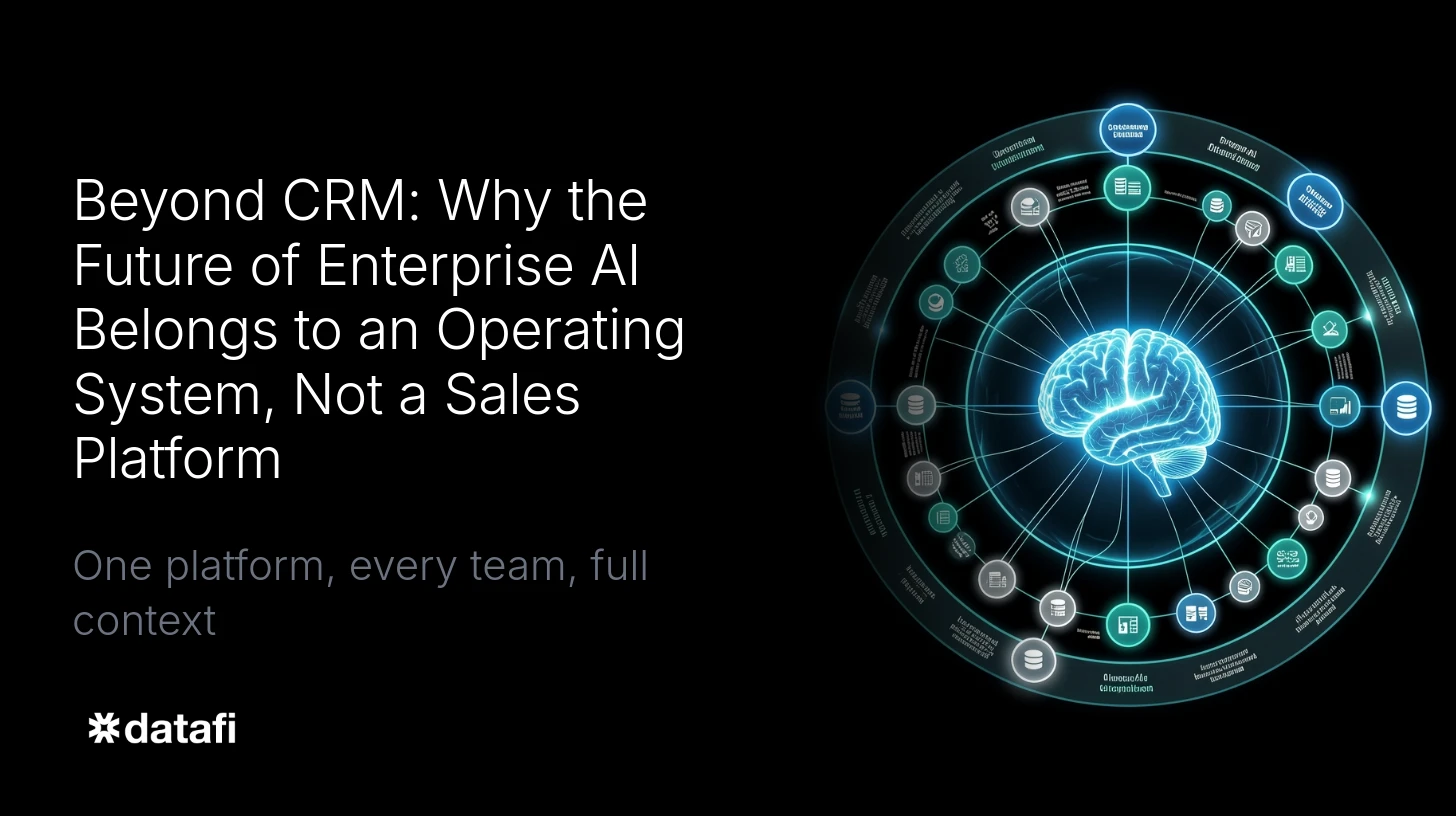
Beyond CRM: Why the Future of Enterprise AI Belongs to an Operating System, Not a Sales Platform
When Salesforce introduced AgentForce, the market listened. But for organizations serious about putting AI to work across every function, every workflow, and every employee, the real question isn’t whether AgentForce is impressive. It is whether a CRM-native AI agent platform can ever become the nervous system of a modern enterprise. At Datafi, we believe the answer is no, and the distinction matters more than most organizations realize.
Deploying AI agents without access to the full enterprise data ecosystem produces impressive output within a narrow frame, but it cannot solve complex, cross-functional business problems. True enterprise AI transformation requires an operating system, not a CRM add-on.
The Problem Is Not Agents. It Is Context.
There is a common misconception driving a lot of enterprise AI investment right now. Organizations believe that if they deploy enough AI agents, they will achieve transformation. They will not, unless those agents have access to the full context of the business.
An AI agent without complete context is like a brilliant analyst who has only ever read the sales team’s notes. They can give you impressive output within that narrow frame. But they cannot tell you why a deal closed late, whether the customer has an open support escalation, what the supply chain looks like for the product they just bought, or whether the margin profile makes that deal worth celebrating. They are answering questions. They are not solving problems.
This is the foundational gap in the AgentForce model, and it is not a criticism of the engineering behind it. It is a structural consequence of what Salesforce is. AgentForce is a powerful capability built on top of a CRM. Its intelligence is, by design, bounded by the data, workflows, and objects that live within the Salesforce ecosystem. For sales automation, customer service routing, and CRM-adjacent tasks, that boundary is acceptable. For enterprise-wide AI transformation, it is a ceiling.
Datafi was built to remove that ceiling entirely.
What an AI Operating System Actually Means

The term “operating system” gets used loosely in enterprise software. At Datafi, we mean something specific: a vertically integrated data and AI technology stack that gives LLMs access to the complete data ecosystem of an organization, enforces governance and policy controls at every layer, and delivers all of this through a Chat UI that any employee can use without technical training.
This is not an integration layer. It is not middleware. It is not a prompt wrapper placed on top of existing tools. Datafi is the environment in which AI thinks, acts, and learns, using the full body of knowledge that defines how a business actually operates.
Where AgentForce agents are informed by Salesforce records and connected cloud data, Datafi agents operate with access to structured and unstructured data across the enterprise, including operational databases, ERP systems, financial records, maintenance logs, sensor feeds, external market data, and proprietary knowledge repositories. The LLM does not see a curated slice of business context. It sees the whole picture; it’s able to see the forest through the trees.
That completeness is what makes the difference between AI that answers questions and AI that solves problems.
The Vertically Integrated Advantage
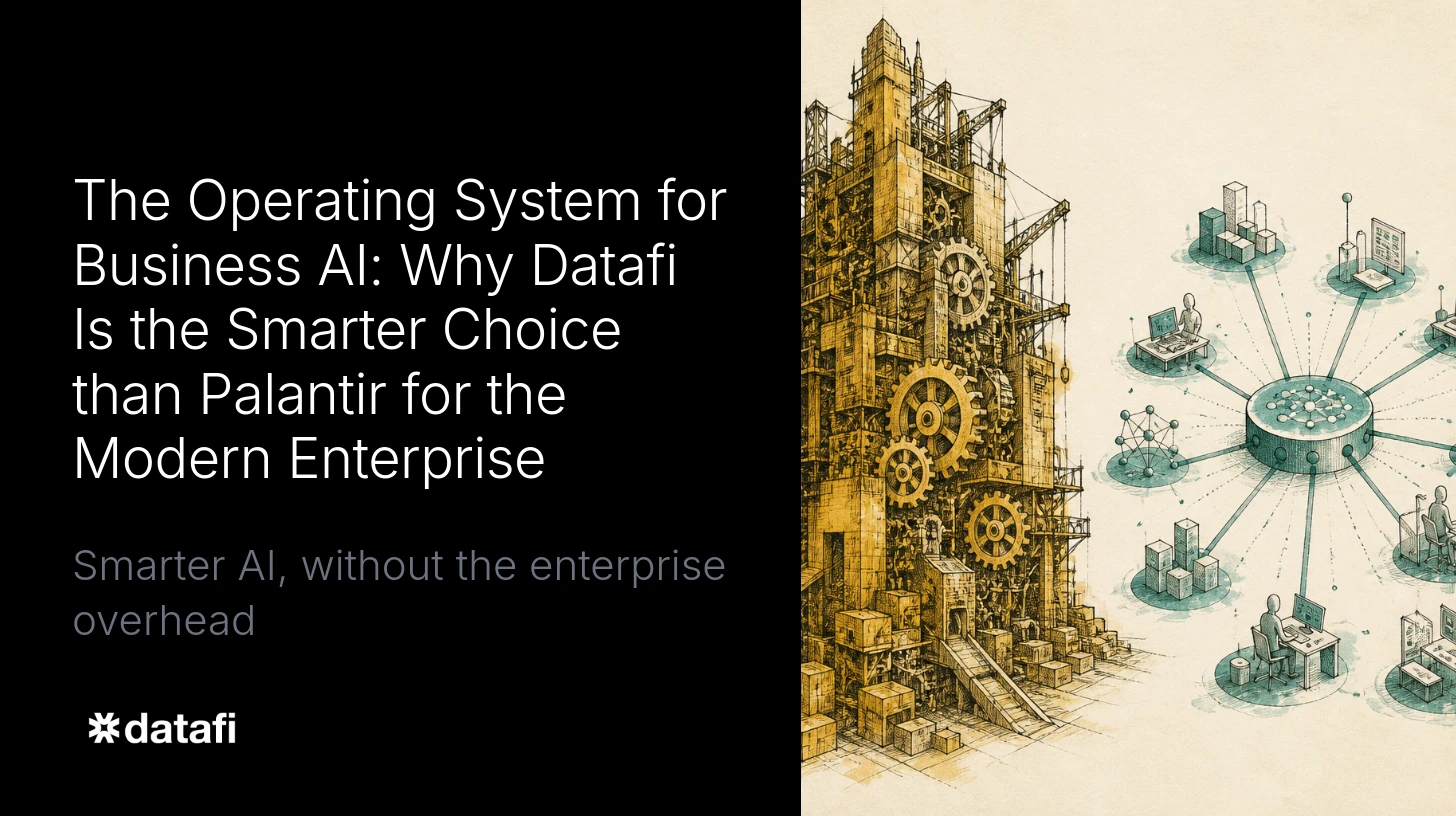
Salesforce has built an ecosystem of integrations, and AgentForce benefits from that ecosystem. But ecosystem integration is not the same as vertical integration. When you integrate disparate systems, you create dependencies, latency, governance gaps, and context loss at every seam. When you build vertically, you eliminate those seams entirely.
Datafi’s vertically integrated stack means that data access, AI reasoning, policy enforcement, workflow execution, and user interaction all occur within a single coherent environment. There is no translation layer between the data layer and the AI layer. There is no separate governance tool trying to supervise what the AI is doing. There is no API handoff that loses metadata, lineage, or permission context.
This architecture matters enormously when AI moves from answering questions to taking autonomous action. In a vertically integrated environment, every action an agent takes is traceable, auditable, and bounded by the same governance policies that govern human data access. In a loosely integrated environment, those properties are aspirational. In regulated industries, healthcare, financial services, transportation, and energy, the difference between aspirational governance and structural governance is not a preference. It is a compliance requirement.
AI for Every Employee, Not Just Every Sales Rep
AgentForce’s natural home is the commercial organization. It excels at automating the repetitive cognitive work of customer-facing teams. That is genuinely valuable. But it does not address the much larger opportunity: deploying AI across every function of the enterprise, including the functions that have never had a relationship with Salesforce at all.
Consider what enterprise AI transformation looks like in practice.
In predictive maintenance and asset management, maintenance technicians need AI that can correlate sensor data, maintenance history, parts availability, and failure rate models to predict equipment failures before they occur and prescribe interventions before downtime happens. This is not a CRM problem. It requires access to operational data ecosystems that AgentForce was never designed to reach.
In operations optimization, operations leaders need AI that can identify bottlenecks in real time, model the downstream consequences of process changes, and autonomously recommend or even initiate workflow adjustments. This requires access to production systems, logistics platforms, workforce management tools, and financial forecasting models, all synthesized by an agent with enough business context to understand the tradeoffs involved.
In passenger experience and service delivery, transportation and logistics organizations need AI that can synthesize customer feedback, operational performance data, and external disruption signals to proactively manage experience at scale. The data sources are diverse, real-time, and mission-critical. They do not live in a CRM.
In strategic planning, executives and analysts need AI that can ingest financial performance data, market signals, competitive intelligence, and internal capacity metrics to model strategic scenarios with precision and speed. This is the highest-stakes use of enterprise AI, and it requires an LLM that truly knows the business, not one that has been briefed on sales activity.
Datafi is designed to serve all of these functions, simultaneously, within a single governed environment.
The Non-Technical User Is Not an Afterthought

One of the most consequential design decisions in enterprise AI is who gets to use it. If AI capability requires technical expertise to access, then AI becomes a resource that reinforces existing power structures rather than distributing intelligence across the organization.
Datafi’s Chat UI was built from the ground up for non-technical users. A frontline maintenance technician, a logistics coordinator, a finance analyst who has never written a query in their life; anyone in the organization can interact with AI-powered workflows and receive intelligent, contextually grounded responses through a conversational interface that requires no training to use.
This is not about simplification. It is about access. When you democratize access to AI-powered insight and action, you change the capacity of the organization as a whole. You do not just automate existing tasks. You enable entirely new categories of work that previously required specialized expertise or were simply left undone.
AgentForce serves the users already inside Salesforce. Datafi serves everyone.
Autonomous Agents That Actually Learn
The most advanced capability in enterprise AI is not an agent that completes a task. It is an agent that learns from the outcomes of tasks and improves its own reasoning over time. To do that, an agent needs three things: full access to the data ecosystem, the ability to act in autonomous roles, and a governance layer that lets the organization trust that autonomy.
Datafi’s agentic architecture supports truly autonomous agents operating within defined policy guardrails. These agents do not just retrieve information and surface it to a human for decision-making. They initiate actions, monitor outcomes, revise their models, and escalate exceptions, all within a framework that gives organizations visibility and control at every step.
This is what it means to develop the contextual layer for complex agents and workflows. The LLM needs to know the business deeply enough to form hypotheses, test them against data, and refine its understanding over time. That capability cannot be bolted onto a CRM. It must be native to the environment where the data lives, where decisions get made, and where outcomes get measured.
Governance Is Not a Feature. It Is the Foundation.
Salesforce has built significant trust as a steward of customer data. But when organizations extend that trust to autonomous AI agents operating across enterprise systems, the governance requirements are categorically different from what any CRM platform was designed to provide.
Datafi’s approach to governance is structural, not supplemental. Access policies, data lineage, audit trails, and compliance controls are built into the core of the platform, not added on top of it. Every agent action is bounded by the same permission model that governs human access to the same data. Every decision an agent makes can be traced back through its reasoning and the data it used to reach its conclusion.
For organizations in regulated industries, this is not a nice-to-have. It is the condition under which enterprise AI deployment becomes possible at all. And for organizations not yet subject to strict regulatory requirements, it is the foundation of the internal trust that AI adoption requires. People need to believe that the AI operating in their organization is acting in their interests, bounded by their values, and accountable to their standards. Datafi makes that belief defensible.
The Real Comparison
AgentForce is a compelling product for organizations that want to extend the power of Salesforce into agent-assisted workflows. If your primary AI use case lives inside your CRM, it deserves serious consideration.
But if you are building toward a future where AI is the operating layer for the entire business, where every employee has access to intelligent assistance, where autonomous agents manage critical operations with full business context, and where governance and compliance are structural rather than aspirational, then you are not looking for a CRM add-on. You are looking for an AI operating system.
That is what Datafi is built to be.
Organizations of any size can achieve a unified data and AI experience across every function, every team, and every role. The data ecosystem is accessible. The governance is sound. The AI is capable of the kind of critical thinking, autonomous action, and continuous learning that transforms operations rather than simply streamlining them.
The question is not whether your organization needs this. The question is whether you are ready to move from AI that answers questions to AI that solves problems.
At Datafi, we are ready to help you make that move.
Datafi is a vertically integrated data and AI platform purpose-built for enterprise transformation. To learn how Datafi’s AI operating system can serve your organization, contact us to schedule a demonstration.