


For most of the history of enterprise cybersecurity, the attack surface was defined by humans and the systems they operated. Firewalls protected networks. Identity systems governed access. Data loss prevention tools monitored what left the perimeter. The adversary, whether an external attacker or a malicious insider, was a person who had to operate through a system.
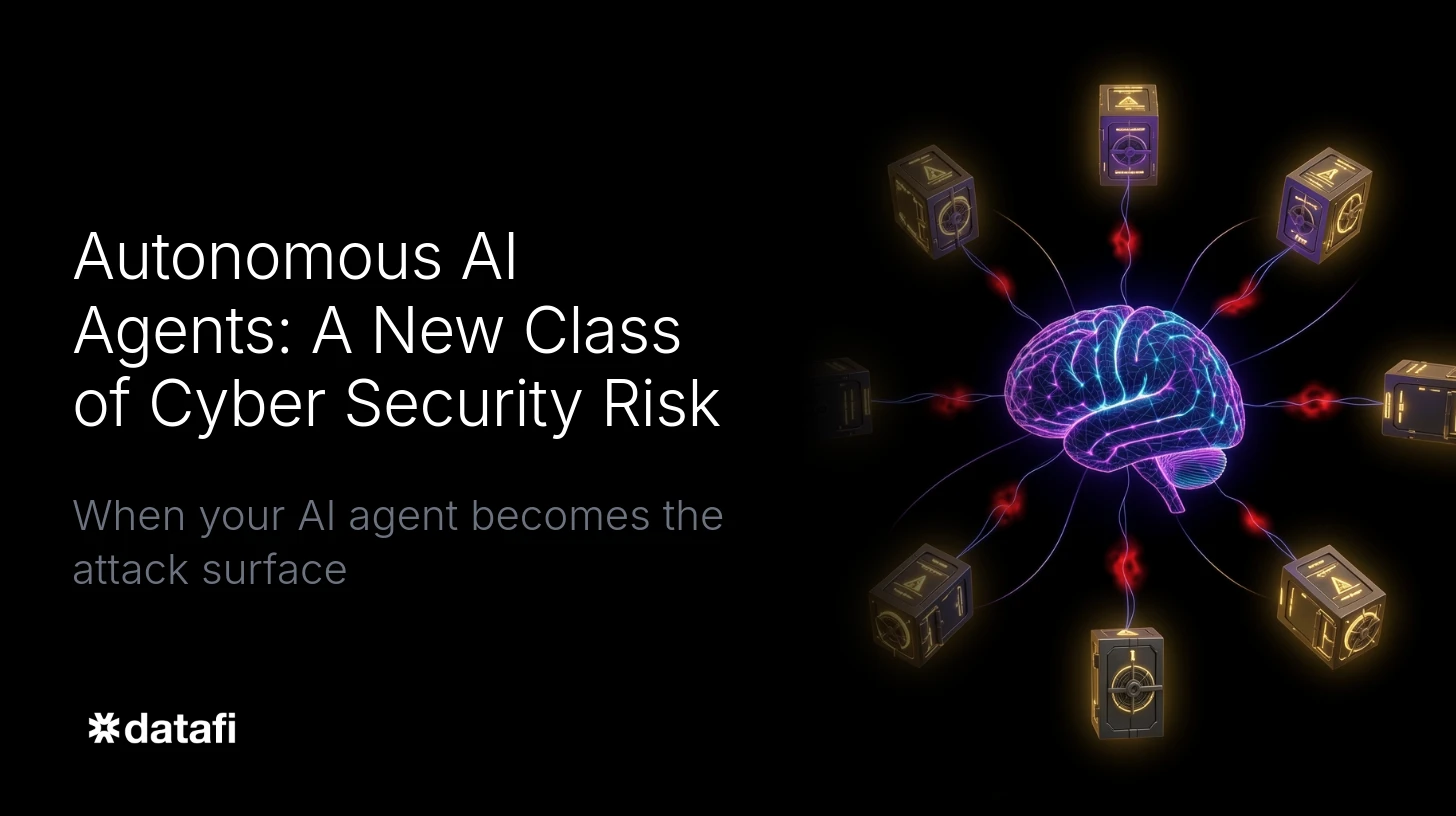
That assumption is breaking down. The emergence of autonomous AI agents, systems that can reason, plan, retrieve data, execute multi-step workflows, and make consequential decisions without human intervention, has introduced a fundamentally new class of cybersecurity risk. These agents are not merely automated scripts running predefined tasks. They are dynamic, context-sensitive reasoning engines that operate across the full span of enterprise data systems. And in many organizations today, they are being deployed without a security architecture built to contain them.
At Datafi, we build the operating system that enterprises use to deploy AI agents and workflows at scale. That position gives us a distinctive vantage point on where this risk landscape is heading, and what responsible, governed agent deployment actually requires.
Autonomous AI agents are not just another automation tool. They are dynamic reasoning engines that can accumulate access across dozens of enterprise systems simultaneously, and deploying them without purpose-built governance is one of the most significant security risks organizations face today.
Why Autonomous Agents Are Different

To understand why autonomous AI agents represent a new category of cybersecurity risk, it is useful to contrast them with prior generations of automation. A traditional robotic process automation system follows a fixed script. It executes the same steps in the same order every time. Its behavior is entirely predictable, auditable, and bounded by its programmed logic. When it fails, it fails in known ways.
A large language model-powered autonomous agent is categorically different. It receives a high-level objective, reasons across available context, selects tools and data sources dynamically, chains multiple actions across multiple systems, and adapts its behavior based on intermediate results. It does not follow a script. It constructs a plan.
This capacity for autonomous reasoning and dynamic action is precisely what makes agents so powerful for solving hard business problems. It is also what makes them so difficult to secure using conventional frameworks. You cannot write a firewall rule for an agent that generates its own action plans at runtime. You cannot audit its behavior through traditional logging alone. And you cannot assume that the boundary of what it can access is the same as the boundary of what it will access.
The cybersecurity implications unfold across several distinct dimensions.
The Privilege Escalation Problem
Every security practitioner understands the principle of least privilege: systems and users should have access only to the data and capabilities required to perform their specific function. This principle has been operationalized across decades of identity management, role-based access control, and network segmentation.
Autonomous AI agents create a fundamental challenge to this principle. To be genuinely useful, an agent needs broad, contextual access to enterprise data. A procurement optimization agent needs visibility into supplier contracts, inventory systems, financial data, and historical purchasing patterns. A customer experience agent needs access to interaction histories, account records, product data, and resolution workflows. An agent operating with artificial data restrictions is an agent that cannot reason effectively.
The risk is that this operational breadth creates an implicit privilege profile that far exceeds what any individual human employee would possess. A single agent, deployed to solve a cross-functional business problem, may accumulate access rights across ERP systems, CRM platforms, data warehouses, and external APIs simultaneously. If that agent is compromised, or behaves unexpectedly, the blast radius is enormous.
The answer is not to restrict agent access arbitrarily. It is to enforce fine-grained, policy-driven access controls that are native to the agent’s operating environment, not bolted on afterward. At Datafi, policy and governance are architectural primitives, not afterthoughts. Every agent operates within a defined data access policy enforced at the platform layer, with no path around it.
The Prompt Injection Attack Surface
One of the most consequential and underappreciated attack vectors in autonomous agent systems is prompt injection: the embedding of adversarial instructions within data that an agent is processing.
When a human analyst reads a document, they interpret its content and then decide what to do. When an AI agent reads a document, that content may directly influence its subsequent behavior. A malicious actor who can insert instructions into any document, email, database record, or external data source that an agent is likely to encounter, has the potential to redirect that agent’s actions entirely.
The implications are significant. Consider an agent tasked with summarizing inbound contract documents and routing them for legal review. If a vendor embeds adversarial instructions within a contract document directing the agent to approve specific terms without human review or exfiltrate data to an external endpoint, the agent may interpret those instructions as legitimate directives. Unlike a human, it has no instinctive skepticism about whether the content it is reading is trying to manipulate it.
This attack vector is particularly dangerous because it operates through legitimate data channels. It does not require network intrusion, credential theft, or malware deployment. It requires only that a malicious actor be able to place data in a location the agent will read.
Defending against prompt injection requires a layered approach: rigorous input validation, clear separation between instruction context and data context, agent architectures that constrain which outputs can trigger which actions, and continuous behavioral monitoring to detect anomalous execution patterns. These defenses must be built into the agent operating environment itself, not left to developers to implement case-by-case.
Data Exfiltration Through Reasoning

Traditional data loss prevention systems operate by monitoring what leaves a defined boundary. They look for patterns in outbound traffic, flag unusual data volumes, and intercept transfers of known sensitive data types. These mechanisms assume that data exfiltration looks like data moving.
Autonomous agents introduce a subtler variant: inference-based exfiltration. An agent with broad data access can synthesize information across sources in ways that reveal sensitive information without directly transmitting any individual sensitive record. An agent that has access to personnel data, financial data, and project assignment data can potentially be queried in ways that reconstruct individually sensitive information through legitimate-looking analytical workflows.
This is not a hypothetical concern. It is the natural consequence of deploying reasoning systems with broad data access in environments where the query interface is designed to be flexible. The more contextual intelligence an agent is designed to provide, the more effectively it can inadvertently serve as a mechanism for information aggregation by an adversary who has gained access to the query channel.
Addressing this requires policy controls that operate at the inference layer, not just the data access layer. Organizations need the ability to define not only what data an agent can read, but what kinds of conclusions it is permitted to synthesize and surface. Datafi’s policy framework is designed to enforce these controls at the platform level, providing governance over both raw data access and the analytical outputs agents are permitted to generate.
The Auditability Gap
In regulated industries, auditability is not optional. Healthcare, financial services, and life sciences organizations operate under frameworks that require the ability to reconstruct, review, and attest to the decision-making processes that led to consequential outcomes. Human decisions leave a record: who made the decision, what information they had access to, what process they followed, and when the decision was made.
Autonomous AI agents create an auditability challenge that many organizations are not yet equipped to address. An agent that has made a procurement decision, flagged a compliance issue, or generated a risk assessment has done so through a reasoning process that may be opaque by default. Without purpose-built logging of agent reasoning traces, tool calls, data retrievals, and decision outputs, the audit trail either does not exist or cannot be reconstructed with sufficient fidelity.
This is not merely a compliance concern. It is a security concern. An agent whose behavior cannot be audited cannot be investigated when something goes wrong. Organizations may discover that a breach occurred, or that an agent took an unauthorized action, without having the telemetry required to understand what happened, how it happened, or how to prevent recurrence.
Purpose-built agent infrastructure must treat auditability as a first-class design requirement. Every agent action, every data retrieval, every decision output must be logged in a structured, queryable format that supports both real-time monitoring and forensic investigation after the fact.
The Identity Problem for Non-Human Principals
Modern identity and access management systems were designed around human principals. A user has a persistent identity, authenticates with credentials, and operates within a role. Their access rights are tied to their identity, and their identity is tied to their employment status.
Autonomous agents are non-human principals, and they do not map cleanly onto this model. They may be ephemeral, spinning up and tearing down across workflow executions. They may operate with delegated identity, acting on behalf of a human user. They may call external services that have their own identity requirements. And they may need to chain actions across systems that have different authentication requirements.
The identity model for autonomous agents requires a fundamentally different approach: strong non-human identity management with fine-grained credential scoping, dynamic permission grants tied to specific workflow contexts, and revocation mechanisms that can respond in real time to anomalous behavior. Organizations that attempt to manage agent identity using the same frameworks they use for human users will find that the model breaks down quickly at scale.
What Secure Autonomous AI Deployment Requires
The risks described above are not arguments against deploying autonomous AI agents. They are arguments for deploying them on an infrastructure that has been purpose-built to govern them. The organizations that will capture the most value from AI in the coming decade are those that move beyond reactive security postures and build governance into the agent operating environment from the start.
At Datafi, we believe that secure autonomous agent deployment requires five architectural commitments.
First, policy-native governance. Access controls, data policies, and operational constraints must be enforced at the platform layer, applied consistently across every agent, and not reducible to per-application configuration choices made by individual developers.
Second, full data ecosystem integration with controlled access. Agents need broad contextual access to produce genuine business value. That access must be mediated through a governed data layer that enforces role-based, purpose-driven permissions at the point of retrieval, not at the point of query.
Third, input validation and architectural separation of instruction and data context. The prompt injection attack surface must be addressed through both technical controls and agent architecture design that limits the ability of ingested data to redirect agent behavior.
Fourth, comprehensive behavioral auditability. Every agent action must be logged in a structured, queryable format that supports real-time anomaly detection and forensic investigation. This is not optional in regulated environments, and it is best practice everywhere.
Fifth, non-human identity management. Organizations must extend their identity frameworks to accommodate ephemeral, delegated, and service-to-service agent identities with appropriate credential scoping and revocation capabilities.
The Stakes Are High Enough to Get This Right
We are at an inflection point in enterprise AI adoption. The organizations moving fastest to deploy autonomous agents in critical business workflows are gaining real competitive advantage. They are automating analytical work that was previously bottlenecked on scarce human expertise. They are compressing decision cycles that previously took days into workflows that complete in minutes. They are solving problems that were previously considered too complex for automation.
But the organizations cutting corners on governed, secure agent infrastructure are building on a foundation that will not hold as agent capabilities and deployment scale increase together. The cybersecurity risks of autonomous AI are not speculative future concerns. They are present-tense challenges that are already manifesting in organizations that deployed agents before their security frameworks were ready.
Agents that operate within a well-governed, policy-enforced data ecosystem are more trustworthy, more auditable, and ultimately more capable of taking on the complex, consequential roles that generate real business value.
The Datafi operating system for AI was built on the conviction that transformative AI outcomes and rigorous governance are not in tension. They are mutually reinforcing. Agents that operate within a well-governed, policy-enforced data ecosystem are more trustworthy, more auditable, and ultimately more capable of taking on the complex, consequential roles that generate real business value.
The future belongs to the organizations that understand this. And the future is already here.
Datafi is the vertically integrated AI operating system for enterprise. Built for the AI-native enterprise, Datafi combines governed data ecosystem access, policy-enforced security controls, agentic workflow capacity, and a Chat UI designed for every employee, technical or not.