
Datafi Explained · 07 · A Datafi Position
The Smart Alternative to Building
You could build a business AI operating system yourself. The real question is not whether you can. It is whether the next three years of your best engineers should go into plumbing no customer will ever see.
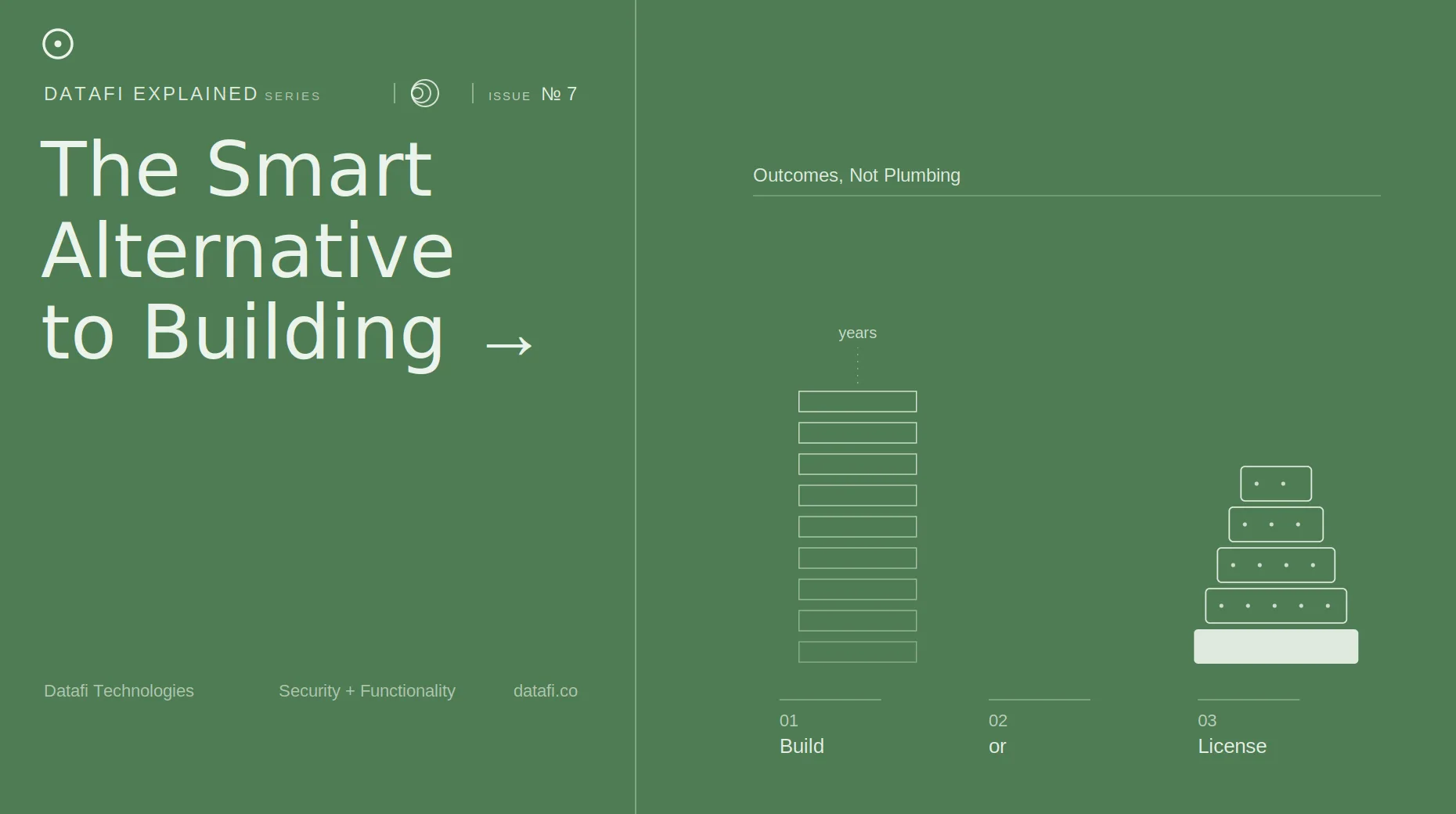
This is the seventh and final piece in Datafi Explained. The previous six made the case for what Datafi is and why it is built the way it is. This one answers the practical question that follows: why license this rather than build your own? The honest answer is not that you cannot build it. It is that building it is rarely the best use of what makes your company valuable.
Every capable enterprise eventually asks the build question, and it is the right question to ask. You have engineers. You have data. You understand your business better than any vendor ever will. So why not build the operating system yourself and own it end to end? It is a serious question, and it deserves a serious answer rather than a sales pitch.
Here is the honest version. You almost certainly could build it. The largest technology companies in the world have built their own internal platforms, and a handful of others will succeed at it too. The question was never really whether it is possible. It is what building it actually costs, not in the line-item sense, but in the years, the focus, and the opportunity you spend doing it.
“The build question is not can you. It is should you, and what it costs you to find out.”
What building actually costs
Everything in the previous six pieces is something a build team has to produce before they deliver a single outcome. A unified layer for data and AI. An operating system that coordinates agents, services, and workflows. Security enforced in the foundation rather than bolted on. Interfaces that let non-specialists build safely. An execution layer that can act on real systems. A contextual layer that unifies the whole business. None of that is the use case. All of it is the prerequisite to the use case.
So a build effort spends its first long stretch producing infrastructure that, done well, is invisible. It needs a standing platform team, not for a launch but permanently, because an operating system is not a project that ends. And it does all of this against a frontier that moves every few months, which means the target shifts under the team the entire time they are building toward it. The risk is not only that it takes years. It is that it is not finished when the years are up.
“The hardest part of building an AI operating system is that you are never done building it.”
What licensing changes
Licensing Datafi inverts where your effort goes. The foundation already exists, maintained and advanced by a team whose entire job is to keep it at the frontier. Your people do not spend three years building the operating system. They spend three years building outcomes on top of one that is already there, which is the work that actually differentiates your business.
This is the difference between owning a problem and owning an outcome. Build, and you own the operating system: every upgrade, every security gap, every shift in the frontier, forever. License, and you own the thing that was always the point, the use cases, the outcomes, the advantage that is specific to you. The plumbing is someone else's permanent responsibility. Your differentiation is yours.
The real measure: time to value
There is a number that settles most of this debate. A build effort measures its early progress in quarters and headcount before anything reaches production. Datafi measures it in weeks. The deployment framework is designed to move from understanding your objectives to a validated pilot to production scale on a timeline that build efforts spend just assembling the foundation.
That gap is not a detail. It is quarters of outcomes a licensed platform is delivering while a build effort is still laying pipe, and the difference compounds. Every quarter spent building the foundation is a quarter not spent on the advantage, and that time does not come back.
“Build, and you measure the first year in foundation. License, and you measure it in outcomes.”
When building is the right call
To be fair to the question, building sometimes is right. If the operating system itself is the product you intend to sell, you should build it. If you have a genuinely unique requirement that no platform can meet and the scale to justify a permanent team around it, build. Honesty about when to build is what makes the case for licensing credible. For nearly every enterprise whose product is not the platform, though, the math points the same way: license the foundation, and spend your scarce talent on what only your company can do.
The distinction
Building it yourself
- Years of work before the first outcome ships
- A permanent platform team to maintain it
- Chasing a frontier that moves every few months
- Your best engineers building invisible plumbing
Licensing Datafi
- Build outcomes on a foundation that already exists
- A dedicated team maintains the platform for you
- The frontier is someone else's job to keep pace with
- Your best engineers building your differentiation
The shorter version
Datafi is the smart alternative to building because the operating system was never the prize. The outcomes on top of it are. Building means years of invisible infrastructure, a permanent platform team, and a frontier that keeps moving, all before the first real result. Licensing means that foundation already exists, so your best people spend their time on the advantage that is yours alone, and you measure progress in weeks rather than quarters.
That closes this series. Six pieces on what Datafi is and why it is built as it is, and one on why letting us build it lets you get on with the work that matters. If any of it resonated, the best next step is not to read more. It is to see it act on a problem of your own.
###
About Datafi
Datafi is the operating system for business AI. It unifies enterprise data, documents, and operational context into one governed layer, so AI can act on how a business actually works, securely and at scale.