
Datafi Explained · 08 · A Datafi Position
Human Agency: People Stay in Control
AI that acts raises an obvious question: who is in control? At Datafi the answer never changes. People are, by design.
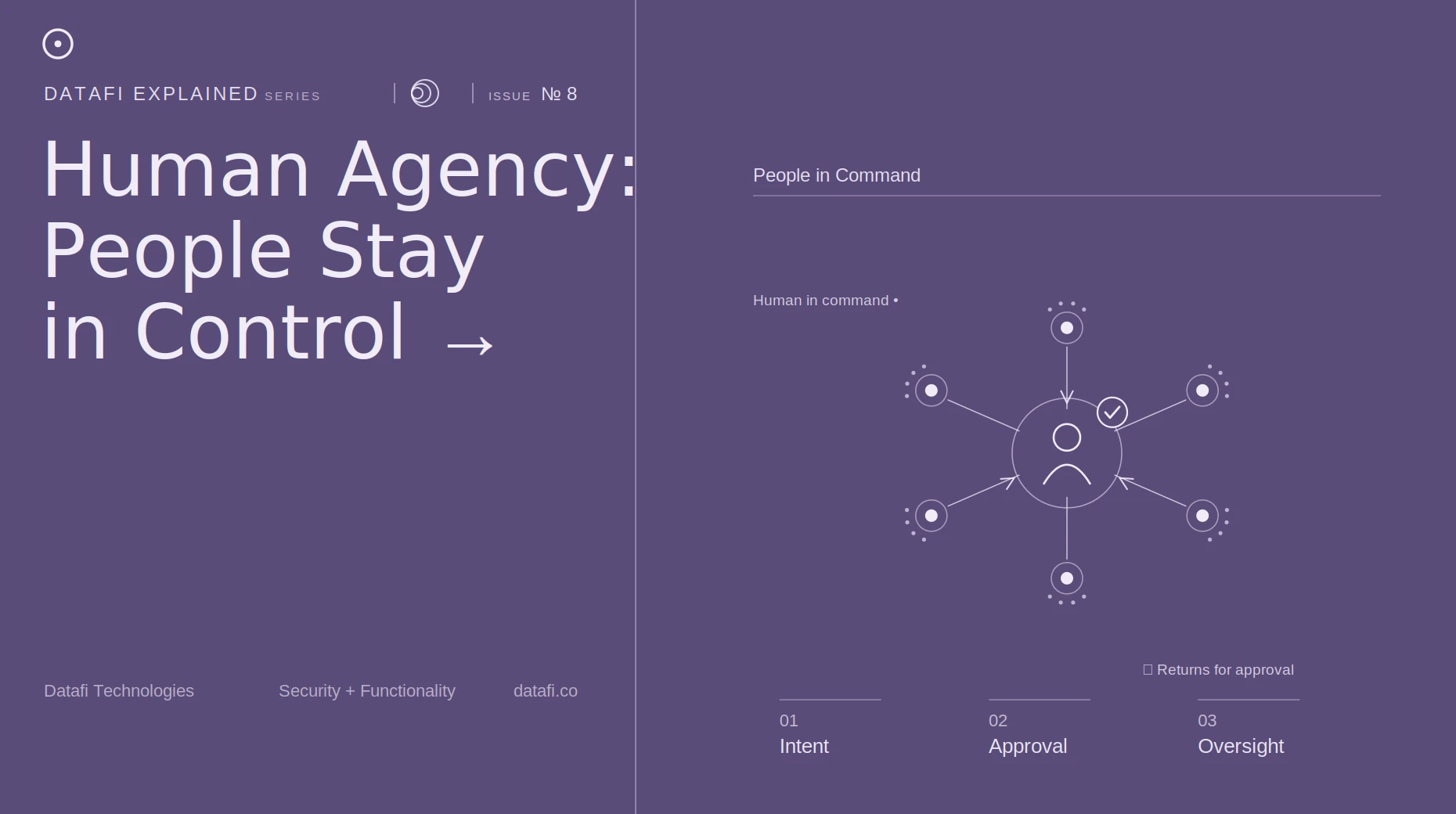
This is the eighth piece in Datafi Explained. The previous piece argued that AI should act, not just answer. This one is the commitment that makes acting safe to want. Action without human agency is a liability, so the moment AI can do things, keeping people in control stops being a nice principle and becomes the whole point.
The moment you say AI should act, a reasonable person tenses up. Act on what authority? With what judgment? And what happens the first time it acts on a bad assumption at machine speed, across systems, before anyone notices? These are not the worries of people who fear technology. They are the worries of people who understand consequences, and any honest account of acting AI has to answer them directly rather than wave them away.
Our answer is that agency and automation were never the opposites they are made out to be. The goal of putting AI to work is not to remove people from the decisions that matter. It is to remove them from the mechanical work that surrounds those decisions, so their judgment reaches further and lands faster. The human does not leave the loop. The busywork does.
“The point of AI that acts is not fewer people in control. It is more reach for the people in control”
Why automation gets this wrong
The fear is earned, because a lot of automation has treated human oversight as friction to be engineered out. The implicit goal was a system that needed no one, and the measure of success was how completely the person could be removed. That framing produces exactly what people are afraid of: systems that act confidently, opaquely, and without a clear place for a human to intervene before something happens rather than after.
It also produces brittle outcomes. A system designed to exclude human judgment cannot call on that judgment when it meets the situation its designers did not foresee, and every real business is a steady supply of those. Removing the person does not make the system more capable. It makes it more confident in precisely the moments it should defer.
“Automation that treats human judgment as friction discovers, too late, that judgment was the point.”
What human agency means at Datafi
Human agency means the person sets the intent and keeps command of the decision, while the system carries out the work within limits the person defined. People decide what the AI is for and where its authority ends. Consequential actions wait for human approval rather than assuming it. And nothing the system does is hidden: every step is visible, inspectable, and reversible or stoppable, so a person can always see what is happening and step in before it goes further.
That is the difference between agency as a feature and agency as an architecture. A person stays in control not because a particular tool was polite enough to ask, but because the operating system underneath every tool will not let a consequential action proceed without the human the business put in charge of it. Oversight is built in, not bolted on, which is the only form of oversight worth relying on.
Why the foundation makes this real
Human agency cannot be a promise on a slide; it has to be enforced by the system, or it is just a hope. This is where the earlier pieces pay off. Because Datafi is one operating system with governance in the foundation, control is not something each application is trusted to implement well. The platform itself defines what an agent may do, holds consequential actions for approval, and records every step in a complete audit trail, so a person can always answer what happened, who authorized it, and why.
That is the difference between agency as a feature and agency as an architecture. A person stays in control not because a particular tool was polite enough to ask, but because the operating system underneath every tool will not let a consequential action proceed without the human the business put in charge of it. Oversight is built in, not bolted on, which is the only form of oversight worth relying on.
“Human control that the system enforces is worth something. Human control the system merely permits is not.”
The distinction
Automation That Replaces
- Aims to remove the person from the loop
- Consequential actions assume approval
- Acts opaquely, reviewed only after the fact
- A fixed level of autonomy baked into the tool
Agency That Applifies
- Removes the busywork, keeps the person in command
- Consequential actions wait for it
- Every step visible, inspectable, and stoppable
- Autonomy set per action by the business
The shorter version
Datafi keeps people in control because acting AI is only worth having if the humans it works for stay in command of it. People set the intent, approve what matters, and can see and stop anything at any time, while the system takes on the mechanical work that used to slow their judgment down. Agency is not the price of automation here. It is the purpose of it.
The previous piece argued that AI should act. This one draws the line that makes acting safe to want: it acts for people, within limits people set, under oversight people keep. Next, we turn to the context that lets it act well in the first place, the full picture of the business behind every decision..
###
About Datafi
Datafi is the operating system for business AI. It unifies enterprise data, documents, and operational context into one governed layer, so AI can act on how a business actually works, securely and at scale.