
Datafi Explained · 06 · A Datafi Position
Your Full Business Context, Unified
AI that sees only a slice of the business makes confident decisions on incomplete information. Datafi gives it the whole picture, so it acts on how your business actually works.
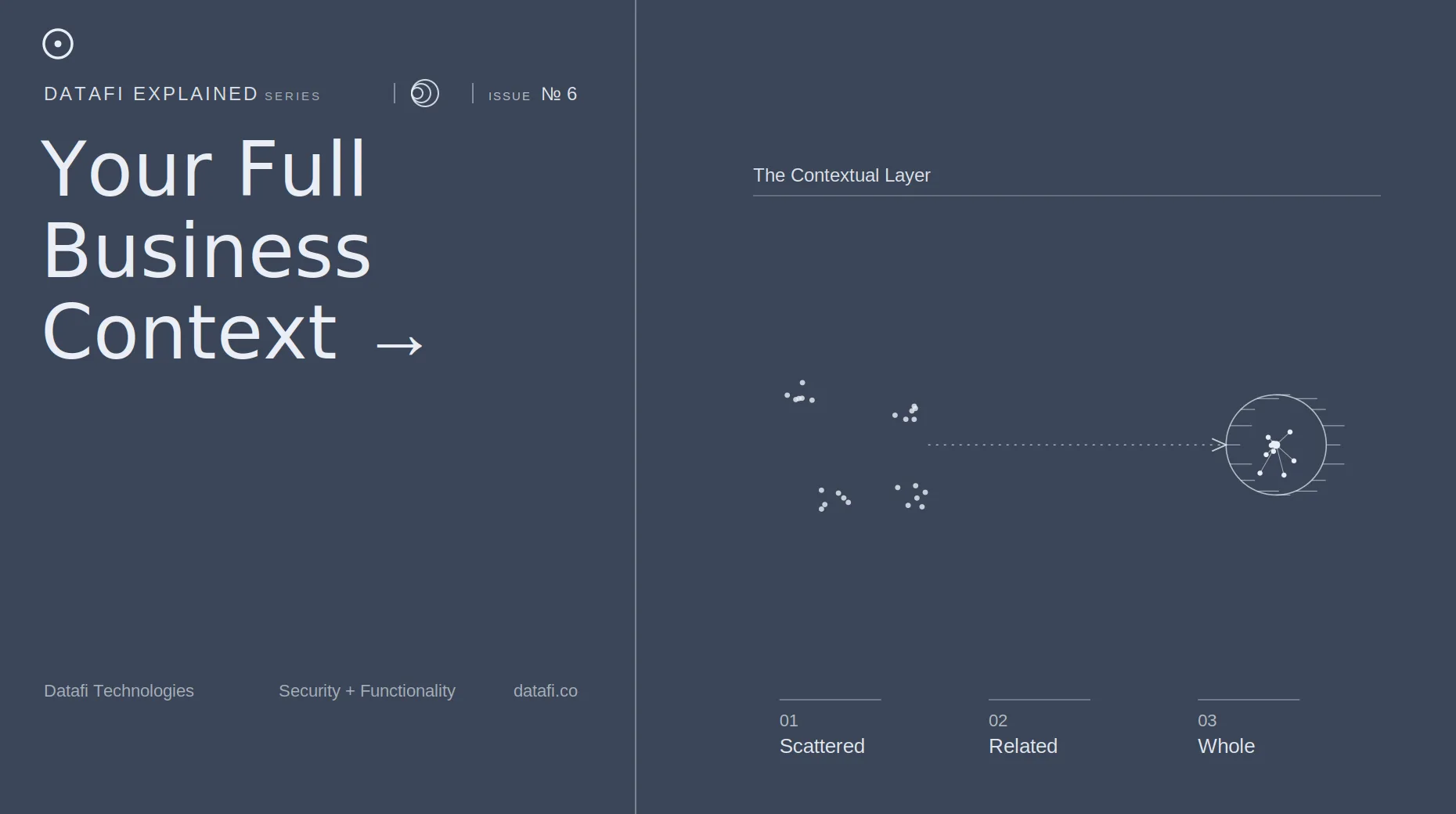
This is the sixth piece in Datafi Explained. The previous piece argued that AI should act, not just answer. This one is its other half. Action is only as good as the context behind it, and most AI is starved of that context. Here we explain what full business context means and why it is the prerequisite for everything else in this series.
Give a capable person a single spreadsheet and ask them to run your business, and they will make confident, well-reasoned, badly wrong decisions. Not because they lack intelligence, but because they lack context. They cannot see what is happening in the next department, what a policy forbids, what a contract requires, or what everyone who has done the job for ten years simply knows. Intelligence without context is not judgment. It is guessing with conviction.
This is the condition most enterprise AI operates in. A model is pointed at one system, or fine-tuned on one dataset, and asked to reason about a business it can only see a sliver of. The output sounds authoritative because language models always do. But underneath, it is working from a fraction of what it would need to be right, and the confidence of the answer hides the narrowness of the view.
“Intelligence without context is not judgment. It is guessing with conviction.”
Where the context actually lives
The reason this is hard is that a business's real context is scattered. It lives in transactional systems and data warehouses, but also in documents, email threads, operational tools, and policies that were written down somewhere and never connected to anything. And a great deal of it lives nowhere a computer can see it at all, in the tribal knowledge of the people who know why the official process and the actual process differ.
Each of those fragments is partial. The warehouse knows the numbers but not the policy. The document knows the rule but not the live data. The veteran operator knows the exception but cannot be in every workflow at once. No single source is the context. The context is all of them, related to each other, which is precisely what no individual system was built to provide.
What full business context means
Datafi brings these fragments into one contextual layer, so an agent reasons over a unified picture of the business rather than a single slice of it. Data, documents, policies, and operational knowledge stop being disconnected islands and become one connected whole that AI can draw on. When an agent acts, it acts with awareness of the rule and the live data and the downstream effect, because all of it is reachable from the same foundation.
This is also why context compounds. Every source connected and every process captured makes the next decision better informed than the last, because it joins a picture that is already richer. The contextual layer is not a one-time integration project. It is an asset that grows more valuable the more of the business it reflects.
Why this is the prerequisite
Full context is what makes the rest of the series real rather than aspirational. AI that acts is only trustworthy if it acts on a complete picture; an agent taking action on a partial view is not a feature, it is a liability. Designed for everyone only works if the context a business user draws on is the real one, not a fragment. Even governance leans on it, because policy can only be enforced against actions the system actually understands in context.
So this is not one capability among several. It is the ground the others stand on. Unify the context, and acting becomes safe, broad access becomes reliable, and intelligence finally has something complete to reason from. Leave it fragmented, and everything above it inherits the gaps.
“Every other promise in this series rests on one thing: AI that can see the whole business, not a slice of it.”
The distinction
AI on a slice
- Reasons from one system in isolation
- Confident answers from a fraction of the picture
- Tribal knowledge stays locked in people's heads
- Each integration is a one-off that goes stale
AI on full context
- Reasons over data, documents, and policy together
- Decisions grounded in the whole business
- Operational knowledge captured and reachable
- Context compounds with every source connected
The shorter version
Datafi unifies your full business context because AI is only as good as what it can see, and what it needs to see is scattered across systems, documents, policies, and people. We bring those fragments into one connected layer so every agent reasons over the whole business rather than a slice of it. That is the difference between AI that sounds confident and AI that is actually right.
Taken together, the convictions in this series describe one thing: a unified operating system that gives governed, context-aware AI to everyone in the enterprise, so it can act on how the business truly works. That is what Datafi is, and why we built it the way we did.
###
About Datafi
Datafi is the operating system for business AI. It unifies enterprise data, documents, and operational context into one governed layer, so AI can act on how a business actually works, securely and at scale.