
Datafi Explained · 05 · A Datafi Position
Built to Act, Not Just Answer
Most AI stops at the answer. The hard part, and the valuable part, is what happens next. Datafi closes the loop from insight to action, safely and inside the work itself.
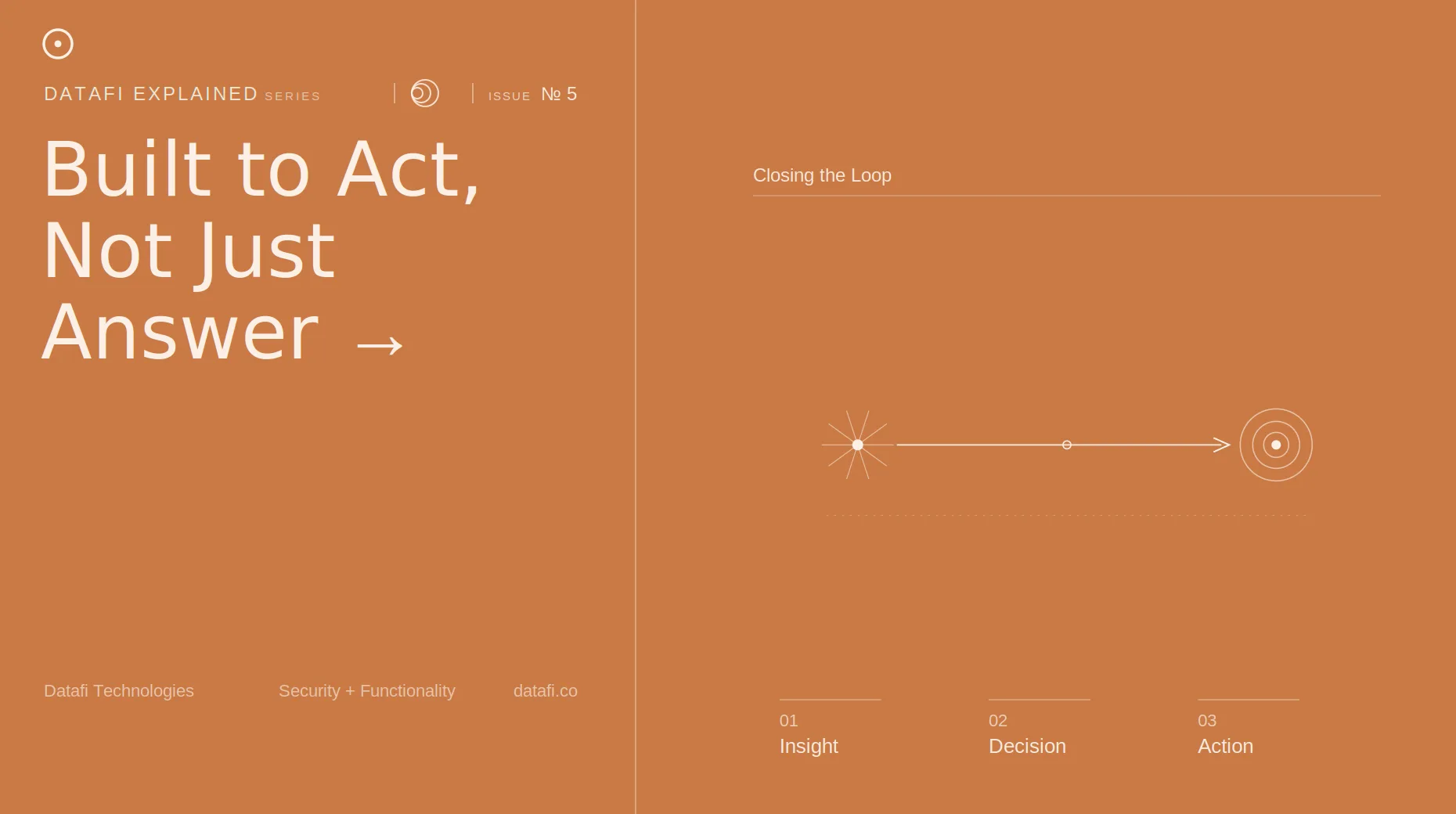
This is the fifth piece in Datafi Explained. Earlier pieces explained what Datafi is, why it is an operating system, why security comes first, and who it is for. This one names the difference that motivates all of them. Everything we have built exists so that AI can do more than describe a problem. It can resolve it.
The last few years of enterprise AI have been a parade of impressive answers. Ask a question, get a fluent response. Summarize this, draft that, tell me what the data says. It is genuinely useful, and it is also where almost every tool stops. The AI produces an answer and hands the work back to a person, who still has to go do the thing the answer implied.
That handback is the gap where value leaks out. Knowing that a shipment will miss its window is not the same as rebooking it. Knowing which claim looks wrong is not the same as routing it for review. Knowing a customer is about to churn is not the same as doing something before they do. The answer is the easy ten percent. The action is the ninety percent that actually changes the outcome, and most AI leaves it entirely to you.
“An answer tells you what should happen. It is action that makes it happen.”
Why most AI stops at the answer
Stopping at the answer is not a choice most tools made. It is a limit they could not cross. Producing language is contained and low-risk; if a summary is wrong, you notice and move on. Taking action is neither. To act on the business, AI has to reach real systems, hold the right permissions, respect policy at every step, and leave a record of what it did. Most AI tools have none of that, so the safest place for them to stop is the moment before anything actually happens.
So the handback is not laziness. It is an architecture problem. A tool that only ever generates text was never built to touch the systems where work happens, and bolting that on after the fact is exactly the brittle, ungoverned seam the earlier pieces in this series warned about. Acting safely is not a feature you add to an answering tool. It is something the foundation has to be designed for.
What built to act means
Datafi closes the loop. An agent does not just surface that a shipment will be late; within policy, it can take the next step, trigger the rebooking, open the case, update the system of record, notify the right person. The insight and the action live in the same workflow, so the gap where value used to leak simply is not there. This is why we describe Datafi as AI that acts rather than AI that answers. The answer is a step, not the destination.
None of this works without the rest of the operating system, which is the point. Acting on the business requires reaching data the platform already governs, running on an execution layer built to coordinate real work, and operating inside continuous policy with a complete audit trail. Action is not a bolt-on. It is what the whole foundation was built to make safe.
What this changes
When AI acts instead of only answering, the relationship to the work changes. Oak Harbor Freight Lines did not just gain better visibility into thousands of daily operational touchpoints. They changed what their teams could do with it, moving from reacting to problems to preventing them. That shift, from describing a situation to resolving it, is the entire difference between AI as a smarter report and AI as part of how the business runs.
It also changes the math on value. An answering tool makes people modestly faster at the step they were already doing. Acting AI removes the step. The return is not a better dashboard; it is work that no longer needs a human to carry it across the last mile, freeing those people for the judgment only they can provide.
“A smarter answer makes you faster. Action is what changes the outcome.”
The distinction
AI that answers
- Surfaces the insight, then hands work back
- A person re-enters the result into real systems
- Value stops at knowing
- Action improvised outside any policy
AI that acts
- Carries the insight through to the next step
- The workflow updates the system of record
- Value lands at doing
- Every action taken inside continuous governance
The shorter version
Datafi is built to act, not just answer, because the value an enterprise is looking for lives on the far side of the answer. Knowing is the easy part; doing is the part that changes the result. We close the loop from insight to action inside the workflow, on a foundation governed well enough to make acting safe, so AI stops handing the real work back and starts carrying it through.
This is the conviction the rest of the series serves. The unified data and AI foundation, the operating system, the security model, the reach to everyone: all of it exists so that AI can do the one thing that actually moves a business, which is to act on it.
###
About Datafi
Datafi is the operating system for business AI. It unifies enterprise data, documents, and operational context into one governed layer, so AI can act on how a business actually works, securely and at scale.