
Datafi Explained · 04 · A Datafi Position
Designed for Everyone
Powerful AI has lived behind a wall of specialists. We think that wall is the bottleneck. The people who understand the business should be the ones putting AI to work on it.
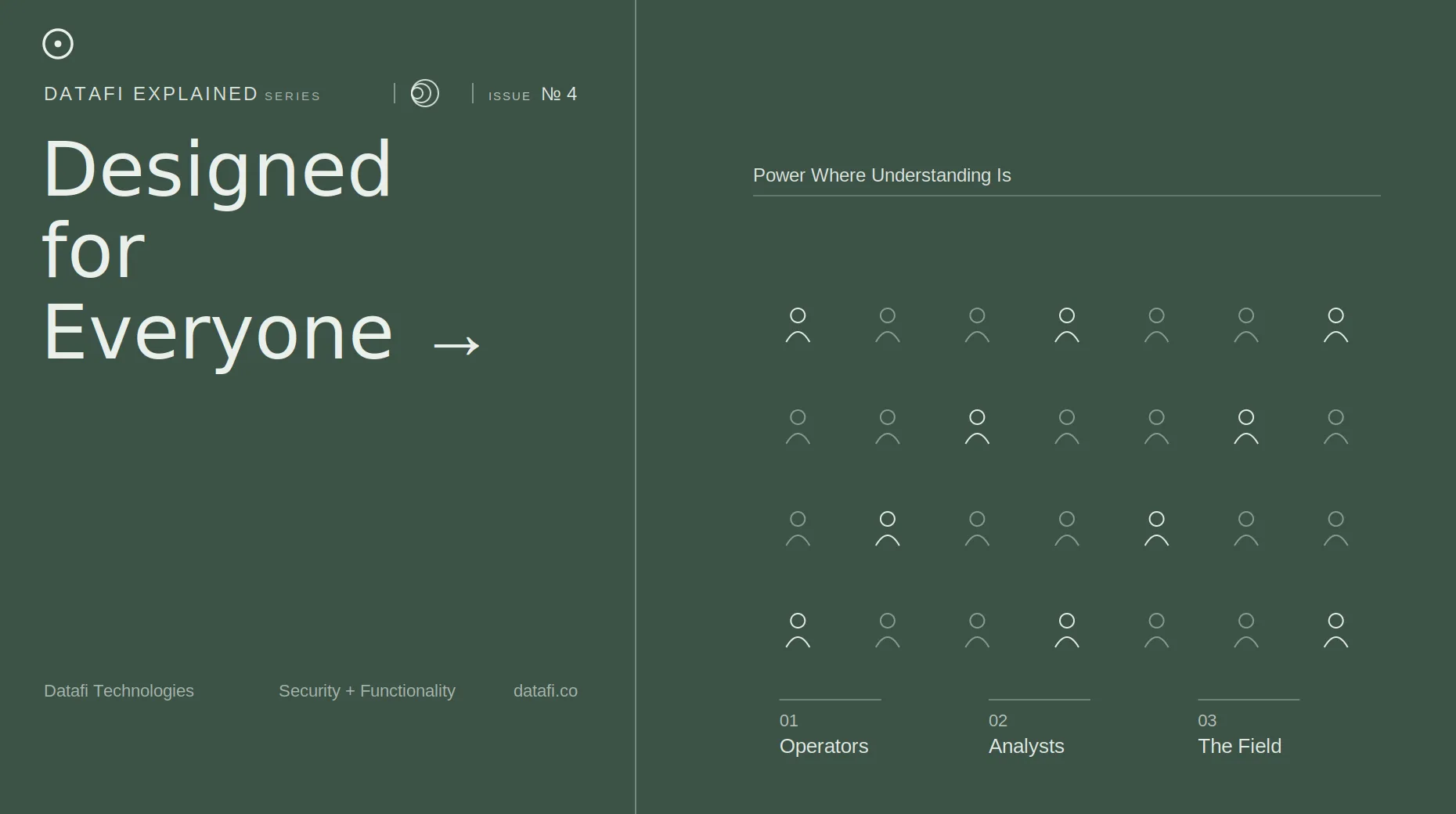
This is the fourth piece in Datafi Explained. The first three covered what Datafi is, why it takes the form of an operating system, and why security comes first. This one is about who the system is for. It is also where the previous piece pays off: broad access only works when the foundation underneath it is governed, which is exactly what we built.
For most of its history, serious AI has been the province of a small group: data scientists, machine learning engineers, the people fluent in the tools and the math. If you wanted AI applied to a problem, you joined a queue and waited for one of them to have time. The capability was real, but it was rationed, and it sat one or two steps removed from the people who actually understood the problem.
That arrangement has a cost that rarely shows up on a budget line. The person who knows why a shipment is late, why a claim looks wrong, or why a customer is about to churn is almost never the person who can build an AI workflow to do something about it. The knowledge sits in one place and the capability sits in another, and the distance between them is where most of the potential value quietly evaporates.
“The bottleneck in enterprise AI was never the technology. It was the queue in front of it.”
Why the specialist bottleneck exists
It is not anyone's fault. AI tools were built by technical people for technical people, because that was who could use them at all. Building an agent meant writing code, wiring up data connections, and understanding the model underneath. Naturally the tools assumed that expertise. The expertise became the gate, and the gate became the bottleneck.
The instinct to fix this by hiring more specialists does not scale, and it misses the point. Even with a larger team, the knowledge of the business still lives with the operators, the analysts, the people in the field. Every workflow they need has to be translated across that gap by someone else, and translation is slow, lossy, and expensive. The constraint is structural, not a matter of headcount.
What designed for everyone means
Datafi is built so that the people closest to the work can put AI to work directly, without writing code. Studio provides visual workflow builders and natural language, so building an AI application looks like describing what you want rather than programming it. The operator who understands the problem becomes the person who solves it, with no queue and no translation layer in between.
This is not about dumbing anything down. It is about moving the capability to where the understanding already is. Your technical teams are not displaced; they are freed from being a service desk for every request and able to focus on the hard, central problems that genuinely need them. Everyone else stops waiting in line.
“Put the power where the understanding already is, and the queue disappears.”
Access and governance are not in tension
There is an obvious objection: if everyone can build AI workflows, have you not just multiplied your risk? It is the right question, and it is exactly why the previous piece came first. Broad access is only safe on a governed foundation. Without one, opening the doors would indeed be reckless. With one, it is not.
On Datafi, when a business user builds a workflow, it runs inside the same continuous policy enforcement as everything else on the platform. They can only reach the data they are permitted to reach and take the actions they are permitted to take, and every step is recorded. The operating system does not ask each user to be a security expert. It enforces the rules underneath them, which is what lets you safely hand the capability to everyone in the first place.
“Open access and strong governance are not opposites. The second is what makes the first responsible.”
The distinction
AI for specialists only
- The operator waits in a queue for a specialist
- Business knowledge translated across a gap
- Building an agent means writing code
- Technical teams act as a request service desk
Designed for everyone
- The operator builds the workflow directly
- Knowledge and capability in the same hands
- Building an agent means describing the goal
- Technical teams freed for the hard problems
The shorter version
Datafi is designed for everyone because the understanding that makes AI valuable is spread across the whole business, not concentrated in a technical few. We put the capability where the knowledge already lives, so the people who see the problem can act on it without a queue or a translator. And because the foundation is governed, doing that adds reach without adding risk.
###
About Datafi
Datafi is the operating system for business AI. It unifies enterprise data, documents, and operational context into one governed layer, so AI can act on how a business actually works, securely and at scale.